How an Egg Substitute Works in Banana Bread Baking
An egg substitute works in banana bread baking by replicating the structural, hydrating, emulsifying, and leavening functions that whole chicken eggs naturally provide. Because banana bread is a dense quick bread, egg substitutes must...
An egg substitute works in banana bread baking by replicating the structural, hydrating, emulsifying, and leavening functions that whole chicken eggs naturally provide. Because banana bread is a dense quick bread, egg substitutes must bind wet ingredients, retain moisture, set the crumb matrix through starch gelatinization or protein coagulation, and trap air expanded by chemical leaveners.
Contents
The Culinary Role of Eggs in Banana Bread Batter
To understand how an egg substitute works in banana bread, it is necessary to first examine what a whole chicken egg contributes to quick bread chemistry. Banana bread is classified as a quick bread—a baked good leavened primarily through chemical reactions (baking powder or baking soda) rather than biological fermentation (yeast). Batter systems for quick breads rely heavily on a balance between structure builders, tenderizers, moisteners, and driers.
Whole eggs act as multi-functional workhorses in quick bread batters because they contain approximately 75% water, 12% protein, 10% lipids (fats), and minor trace compounds such as lecithin. Each component serves a distinct structural or chemical purpose:
- Structural Matrix Formation: Egg white proteins (primarily ovalbumin, ovotransferrin, and globulins) denature when exposed to mechanical shear during mixing and heat during baking. As heat disrupts their natural folded structure, these proteins cross-link to form a three-dimensional protein network. This network solidifies around expanding steam and carbon dioxide bubbles, fixing the structural height and crumb architecture of the banana bread.
- Emulsification: Egg yolk contains high concentrations of lecithin, a phospholipid featuring a hydrophilic (water-attracting) head and a lipophilic (fat-attracting) tail. Lecithin binds the water-based ingredients (banana puree, liquid sugars, milk) with fat-based ingredients (melted butter, oil, or shortening). Proper emulsification prevents phase separation, resulting in an even crumb texture and preventing a greasy sensation.
- Moisture Retention: The water content in eggs hydrates dry flour starches and proteins (gliadin and glutenin), while the coagulated proteins help retain bound water within the baked loaf, keeping the banana bread soft over several days.
- Crumb Browning and Flavor: Proteins provide amine groups that react with reducing sugars (from both added sugar and natural sugars in ripe bananas) in a thermal process called the Maillard reaction. This produces aromatic compounds and deep golden-brown crust color.
In banana bread, the challenge of replacing an egg is uniquely complex compared to lighter baked goods like sponge cakes. Ripe banana mash is naturally heavy, acidic, and high in soluble sugars and fruit pectin. While pectin provides natural viscous binding, it does not provide thermal coagulation or structural firmness. Without an effective egg substitute, banana bread risk turning out unpleasantly gummy, dense, or structural fragile, causing the loaf to collapse under its own weight.
Chemical Mechanisms: How Different Egg Substitutes Function
No single egg substitute perfectly mimics all biological functions of an egg simultaneously. Instead, different functional ingredients replicate specific physical and chemical properties of eggs—such as hydrocolloid gelation, starch gelatinization, or protein denaturation.
- Hydrocolloid Mucilage (Flax / Chia)
- Soluble fiber gelation
- Traps free water
- Mechanical binding
- Starch Gelatinization (Commercial Powders)
- Viscosity increase
- Thermal set at >140°F
- Moisture immobilization
- Protein Denaturation (Aquafaba / Soy)
- Hydrophobic alignment
- Foam network stability
- Maillard browning
Hydrocolloids and Mucilage (Flaxseed and Chia Seed "Eggs")
Ground flaxseed and chia seeds are among the most common whole-food egg substitutes in plant-based baking. Their functional mechanism relies on mucilage, a complex polysaccharide (hydrocolloid) located in the seed's outer cell layers.
When ground flaxseed or chia seed meal is combined with water (typically in a ratio of 1 tablespoon ground seed to 3 tablespoons water per replaced egg), the soluble arabinoxylans and galacturonans swell rapidly. These long-chain carbohydrates absorb up to ten times their weight in water, creating a thick, viscoelastic mucilaginous gel.
When mixed into banana bread batter:
- Viscosity Enhancement: The gel instantly increases cold batter viscosity, helping suspend dense banana solids and flour particles evenly throughout the pan.
- Moisture Binding: The hydrocolloids entrap water molecules via hydrogen bonding, retarding moisture migration during baking and cooling.
- Mechanical Cross-linking: As heat is applied, the hydrocolloid matrix thickens further, bridging flour starches and banana fibers.
However, flax and chia gels do not undergo true thermal setting (coagulation) like egg proteins. Because they remain flexible even after cooling, banana bread made with flax eggs features a moister, slightly more fragile crumb that benefits from cooling completely before slicing.
Starch Gelatinization and Plant Gums (Commercial Powder Substitutes)
Commercial powdered egg replacers generally consist of formulated blends of purified starches (such as potato starch or tapioca flour) combined with hydrocolloid gums (xanthan gum, guar gum, or cellulose gum) and chemical leaveners (baking powder).
The double-action functional mechanism operates as follows:
- Cold Viscosity: Hydrocolloid gums like xanthan gum dissolve in cold liquid, providing immediate shear-thinning viscosity. This keeps the batter stable while filling the baking vessel.
- Thermal Gelatinization: As the internal temperature of the banana bread reaches approximately 140°F to 160°F (60°C to 71°C), the raw starch granules absorb surrounding water and swell exponentially. At the gelatinization point, starch molecules (amylose and amylopectin) leach out and form an irreversible molecular network upon cooling. This replaces the structural setting role of denatured egg proteins.
Because starches absorb significant quantities of water, commercial replacers produce a clean-slicing crumb structure with minimal structural collapse, making them highly effective for dense quick bread formulations.
Protein Denaturation and Foaming (Aquafaba and Silken Tofu)
To mirror the structural protein network of real eggs, protein-rich plant substitutes utilize legume-derived proteins.
- Aquafaba (Chickpea Cooking Water): Aquafaba is a complex mixture of dissolved proteins, soluble carbohydrates, and saponins extracted from cooked chickpeas. The proteins and saponins act as amphiphilic surfactants, reducing surface tension between water and air bubbles. When whipped or stirred vigorously, aquafaba traps air bubbles within a flexible liquid-protein film. In banana bread, this trapped air expands under oven heat alongside chemical leaveners, contributing lightness to an otherwise heavy batter.
- Silken Tofu (Blended Soy Protein): Silken tofu contains high concentrations of intact soy proteins (glycinin and beta-conglycinin) along with natural soy lipids. When blended smooth and folded into banana bread batter, the globular soy proteins denature under oven heat. They cross-link into a firm, moist protein-lipid gel that closely mirrors the texture, structural cohesion, and mouthfeel provided by whole eggs.
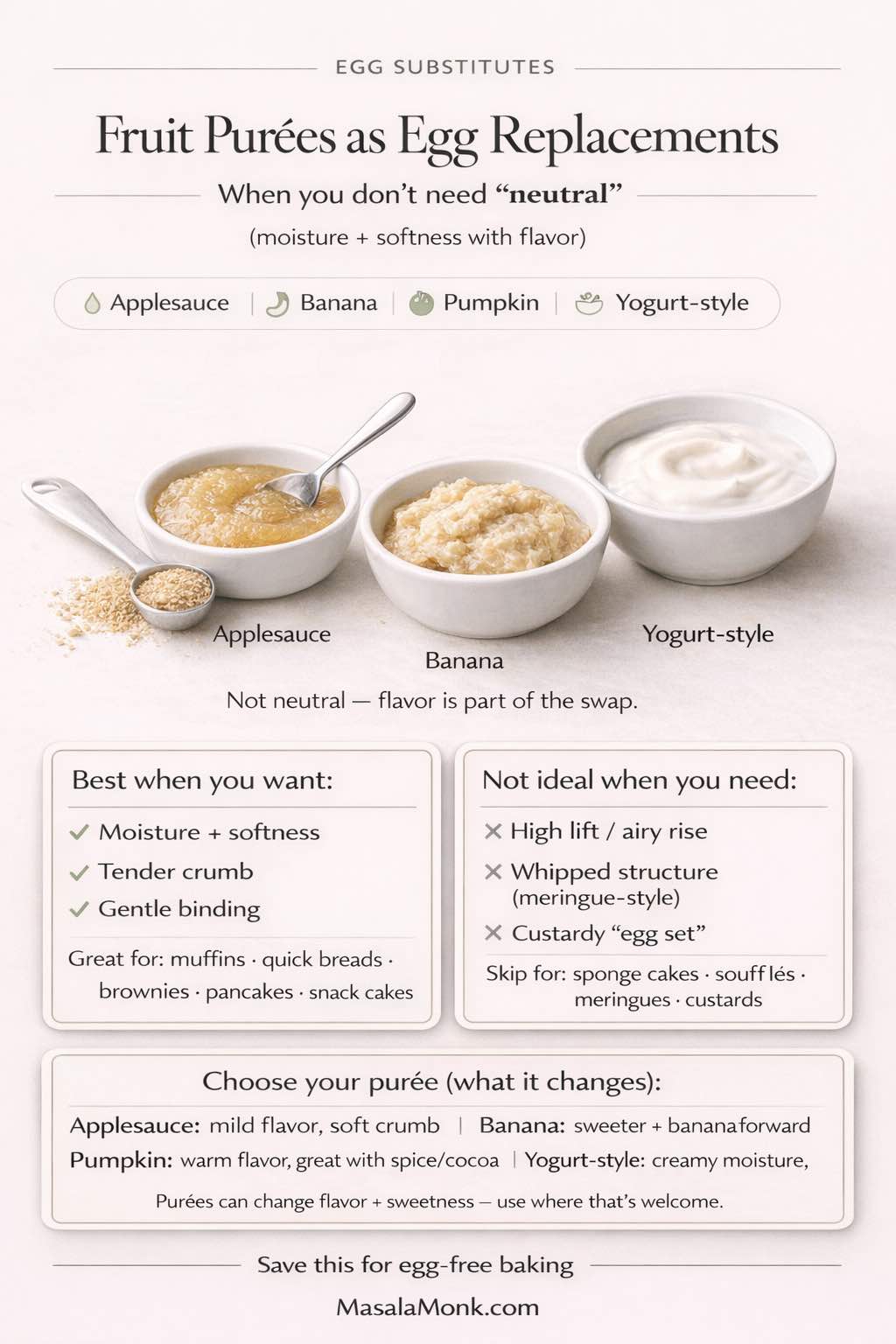
Pectin and Carbohydrate-Based Substitutes (Fruit Purées and Applesauce)
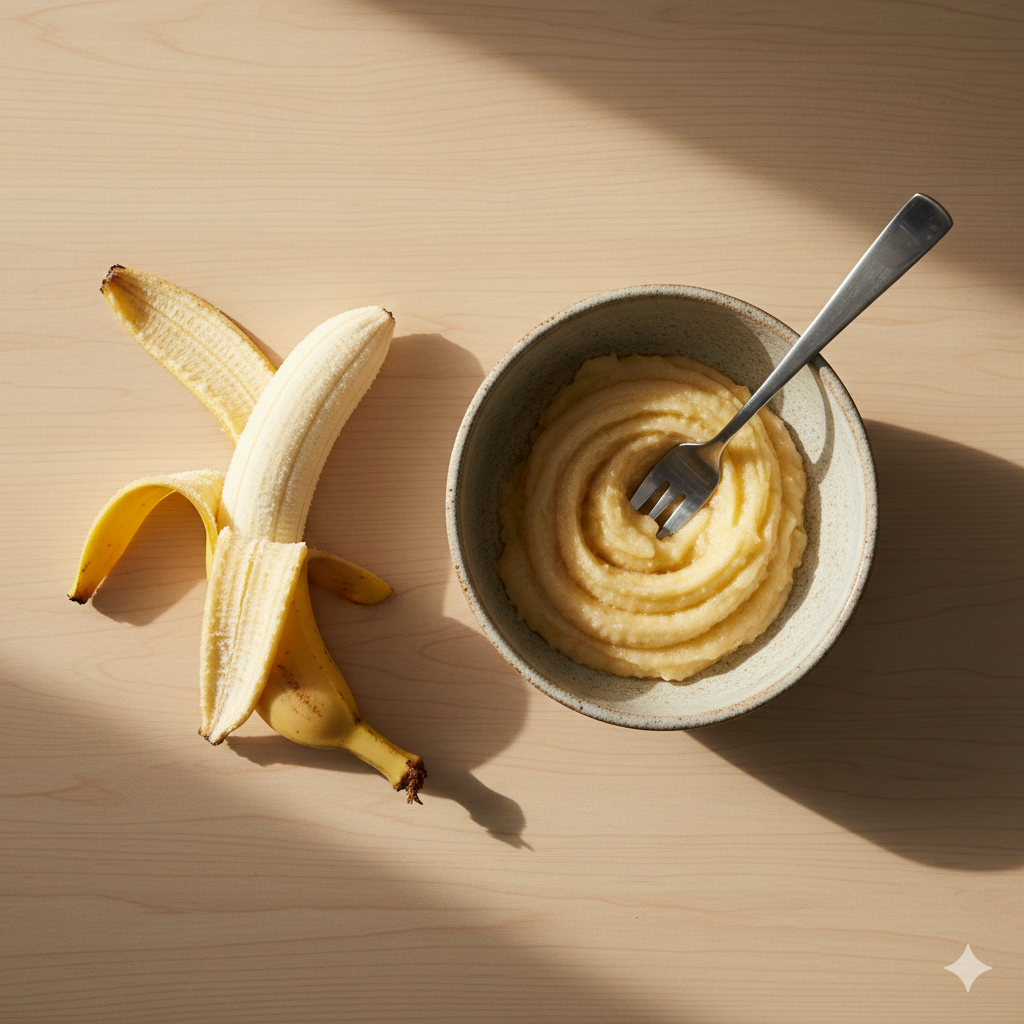
Fruit purées—such as unsweetened applesauce, mashed pumpkin, or additional banana purée—act primarily as moisteners and bulk extenders rather than true structural binders.
Fruit purées are rich in soluble fruit pectin and natural sugars. Pectin forms weak gel networks in the presence of sugar and acid, assisting in moisture retention and contributing to a tender, dense crumb. However, because fruit purées lack fat, emulsifiers, and coagulating proteins, using them as an egg substitute can easily lead to a wet, gummy center if the recipe lacks sufficient flour structure or chemical leavening.
Functional Comparison of Common Egg Replacements in Quick Breads
Evaluating egg substitutes based on their primary chemical functions helps bakers select the correct ingredient according to their desired end product:
| Replacement Type | Primary Functional Mechanism | Impact on Crumb & Texture | Structural Integrity | Required Recipe Adjustments |
|---|---|---|---|---|
| Flax Egg (1 tbsp ground flax + 3 tbsp water) | Hydrocolloid mucilage binding & moisture entrapment | Moist, dense crumb with slight nuttiness and dark specks | Moderate; handle carefully until fully cooled | Let rest 10–15 min before adding; may need +1/4 tsp baking powder |
| Commercial Powder (Starch & Xanthan Gum blend) | Starch gelatinization & gum matrix formation | Uniform, light crumb; neutral flavor profile | High; closely mimics whole egg binding | Follow package hydration ratios precisely; do not overmix |
| Aquafaba (3 tbsp liquid per egg) | Protein surfactant foam stability & gas suspension | Light, tender crumb; fine air-cell structure | Moderate to High | Whip to soft peaks before folding into batter for maximum loft |
| Silken Tofu (1/4 cup blended smooth) | Denatured soy protein gelation & fat dispersion | Very dense, highly tender, cake-like moist crumb | High structural setting | Ensure complete puréeing; add 1/8 tsp extra baking soda for lift |
| Applesauce / Pumpkin (1/4 cup purée per egg) | Pectin binding & carbohydrate water-holding | Extremely moist, soft crumb; risk of wet center | Low to Moderate | Increase chemical leavening by 10-15%; extend bake time by 5 min |
| Yogurt / Acidified Milk (1/4 cup dairy/plant yogurt) | Acid-base reaction & dairy protein gelation | Tender, delicate crumb with mild tang | Moderate | Reduce other liquids slightly; adjust baking soda to neutralize acid |
Adapting Banana Bread Recipes for Egg Substitutes
Substituting eggs in banana bread is rarely as simple as a 1:1 ingredient swap. Because eggs provide a delicate balance of moisture, fat, protein, and acidity, adjustments to the base recipe are often necessary to ensure proper crumb rise and structural stability.
- Step 1: Hydration Balance: Measure fluid volume precisely (approx. 45-50g per replaced egg equivalent).
- Step 2: Leavening Power Adjustment: Add 1/4 tsp baking powder per egg replacement to offset lost biological lift.
- Step 3: Fat and Emulsification Balance: Incorporate 1/2 tsp vegetable oil or liquid lecithin if using oil-free substitutes.
- Step 4: Thermal Processing Adjustments: Extend bake time by 5-10 mins at 350°F (175°C) to allow full starch set.
1. Hydration Ratios and Water Balance
A standard large chicken egg weighs roughly 50 grams, consisting of 37 grams of water, 6 grams of protein, 5 grams of fat, and 2 grams of trace nutrients. When using dry or concentrated substitutes (such as flaxseed, chia, or commercial powders), the hydration ratio must match this water contribution.
If an egg replacement delivers insufficient liquid, the dry flour starches will compete with the substitute for available water, resulting in dry, crumbly banana bread. Conversely, if excess liquid is introduced (e.g., watery applesauce), the liquid-to-flour ratio shifts, weakening the gluten/starch matrix and causing the loaf to collapse in the center.
2. Leavening Adjustment
Eggs contribute physical volume when mechanical agitation whips air into the whites or whole egg mixture. Most egg substitutes—with the exception of aquafaba—cannot trap air during initial mixing.
To compensate for lost physical aeration, increase the chemical leavening agent slightly:
- Add approximately 1/4 teaspoon of additional baking powder per replaced egg.
- If using acidic egg substitutes such as plant-based yogurt or buttermilk, add 1/8 teaspoon of baking soda to react with the added acid, generating extra carbon dioxide gas to lift the heavy banana batter.
3. Fat Content and Emulsification
When replacing eggs with fat-free alternatives (such as fruit purées, aquafaba, or commercial starch powders), the batter loses approximately 5 grams of lipids per egg, as well as the natural emulsifier lecithin.
To maintain a tender crumb and prevent the loaf from drying out rapidly:
- Incorporate 1/2 teaspoon of neutral vegetable oil or melted fat for every fat-free egg substitute used.
- Mix the fat thoroughly into the wet ingredients before combining with dry ingredients to ensure optimal lipid dispersion across the batter.
4. Bake Time and Oven Dynamics
Eggless banana bread batters often retain moisture longer than traditional egg-based batters because plant hydrocolloids and fruit pectins release bound water more slowly during baking than denaturing egg proteins do.
- Bake banana bread at 350°F (175°C) to ensure steady heat penetration through the dense loaf core.
- Expect to extend the total bake time by 5 to 10 minutes compared to standard recipes.
- Rely on internal temperature checks rather than surface color alone. Banana bread is fully set when a probe inserted into the center registers 200°F to 205°F (93°C to 96°C).
Troubleshooting Common Deficiencies in Eggless Banana Bread
Omitting eggs changes the physical behavior of baking batter under heat. The following table identifies common textural defects in eggless banana bread, explains their underlying chemical causes, and details precise corrective actions.
| SYMPTOM | CAUSE | SOLUTION |
|---|---|---|
| Dense/Gummy Center | Excess Unbound Water | Reduce liquid by 1-2 tbsp |
| Crumbly Structure | Weak Protein/Starch Set | Add Xanthan Gum or Flax |
| Loaf Collapse | Premature Gas Release | Reduce Leavener by 15% |
| Pale Crust Color | Reduced Maillard React. | Add Soy Milk / Molasses |
Uncooked or Gummy Center
- Chemical Cause: Excessive moisture retaining agents (such as over-hydrated starch or too much fruit purée) coupled with insufficient thermal energy reaching the core. Without denaturing egg proteins to lock the crumb structure, free water remains trapped in an un-gelatinized starch slurry.
- Correction: Reduce added liquid (such as milk or water) by 1 to 2 tablespoons. Ensure bananas are measured by weight or precise cup volume rather than count, as banana sizes vary significantly. Extend bake time while tenting the loaf pan loosely with aluminum foil to prevent crust burning.
Crumbly, Weak Structure That Falls Apart
- Chemical Cause: Lack of sufficient protein cross-linking or hydrocolloid binding to bridge the starch granules together after cooling.
- Correction: Incorporate 1/4 teaspoon of xanthan gum into the dry ingredients, or swap pure fruit purée substitutes for ground flaxseed or a starch-based commercial egg replacer that forms a firmer network upon cooling. Allow the loaf to cool completely in the pan for at least 20 to 30 minutes before transferring to a wire rack.
Sunken Core or Collapsed Top
- Chemical Cause: The chemical leaveners generated carbon dioxide gas faster than the alternative structural matrix (starch gel or mucilage) could set. The expanded gas bubbles expanded beyond their elastic limit, burst, and escaped, leaving the unsupported core to fall.
- Correction: Reduce baking powder or baking soda by 15-20%. Avoid opening the oven door during the first 35 minutes of baking, as sudden ambient temperature drops can cause fragile, un-set air cells to deflate prematurely.
Pale, Unbrowned Crust
- Chemical Cause: Reduced amino acid concentration in the batter. Eliminating eggs reduces the concentration of reactive proteins available for the Maillard browning reaction.
- Correction: Brush the top crust with soy milk or an almond milk and maple syrup wash prior to baking, or replace a portion of refined white sugar with unrefined brown sugar or molasses to supply reactive reducing sugars and natural acids.
Frequently Asked Questions
Why does banana bread need an egg or egg substitute if bananas are already binding?
While banana mash provides moisture, viscous thickness, and pectin, it lacks the thermal coagulation properties of proteins. As bananas heat, their starches melt and soften rather than harden. Without an egg or an egg substitute capable of forming a solid matrix (through protein denaturation or starch gelatinization), the loaf will remain wet, dense, or gummy in the center.
Can I just leave eggs out of banana bread without adding a replacement?
Leaving eggs out entirely without adding a replacement typically results in a dense, flat, and fragile quick bread that crumbles easily. If no substitute is added, you must adjust the recipe by increasing dry flour binding, tuning liquid ratios, and adding extra chemical leavening agents to prevent structural failure.
Which egg substitute produces the fluffiest banana bread texture?
Aquafaba (whipped chickpea liquid) and light commercial starch-based replacers produce the lightest, fluffiest crumb. Whipping aquafaba to soft peaks traps micro-bubbles of air that expand during baking, offsetting the weight of the heavy banana purée better than heavy fruit purées or flax gels.
How do I store banana bread made with an egg substitute?
Eggless banana breads—particularly those made with hydrocolloids like flax or chia—retain high levels of bound moisture. Store the cooled loaf in an airtight container lined with a paper towel at room temperature for up to 3 days, or refrigerate for up to 7 days. The paper towel absorbs excess ambient moisture, preventing the surface crust from becoming sticky.
Practical Recommendations for Optimal Results
To consistently produce balanced, structurally sound eggless banana bread, select your replacement method based on your target texture and dietary preferences:
- For traditional texture and clean slicing: Use a formulated commercial powdered egg replacer (starch and gum blend). Follow package hydration instructions exactly, mixing the powder with water until smooth before folding it into the wet batter.
- For maximum moisture and rich flavor: Use ground flaxseed meal (1 tablespoon flaxseed meal mixed with 3 tablespoons warm water per egg). Allow the mixture to sit at room temperature for 10 to 15 minutes until a viscous gel fully develops before adding it to the wet ingredients.
- For a light, airy crumb: Whip 3 tablespoons of aquafaba per replaced egg until foamy and soft peaks form. Fold the whipped aquafaba gently into the finished batter last to protect the suspended air bubbles.
- Always verify thermal set: Check internal loaf temperature using an instant-read thermometer inserted into the center of the loaf. Target an internal reading between 200°F and 205°F (93°C to 96°C) to confirm starches have fully gelatinized before removing the banana bread from the oven.
Image Gallery