Understanding Strike Options in Equity Markets: A Comprehensive Guide to Strike Price Selection
In equity markets, a strike price (or exercise price) is the fixed price per share at which an options contract can be exercised. For call options, it is the price at which you can buy the underlying stock; for put options, it is the p...
In equity markets, a strike price (or exercise price) is the fixed price per share at which an options contract can be exercised. For call options, it is the price at which you can buy the underlying stock; for put options, it is the price at which you can sell it.
Contents
The strike price is perhaps the most critical variable in an options contract, as it determines whether the option has intrinsic value and dictates the likelihood of the contract expiring profitably. In 2026, as equity markets continue to evolve with high-frequency trading and sophisticated retail platforms, understanding the relationship between the strike price and the current market price of the underlying asset remains the cornerstone of successful derivative trading.
The Role of the Strike Price in Equity Options
When an investor enters an options contract, they are essentially entering into a legal agreement where the strike price serves as the primary anchor. Unlike the market price of a stock, which fluctuates continuously during trading hours, the strike price is a static figure set at the time the contract is created. This price is standardized by exchanges, such as the Chicago Board Options Exchange (CBOE), and typically follows set intervals—such as $1, $2.50, or $5—depending on the liquidity and price of the underlying stock.
The choice of a strike price directly impacts the "premium," which is the cost of the option. The premium is composed of two main parts: intrinsic value and extrinsic (time) value. The strike price is the sole determinant of intrinsic value. For example, if a stock is trading at $150 and you hold a call option with a strike price of $140, the option has $10 of intrinsic value because it allows you to buy the stock for $10 less than its current market worth.
Deciphering Moneyness: ITM, ATM, and OTM
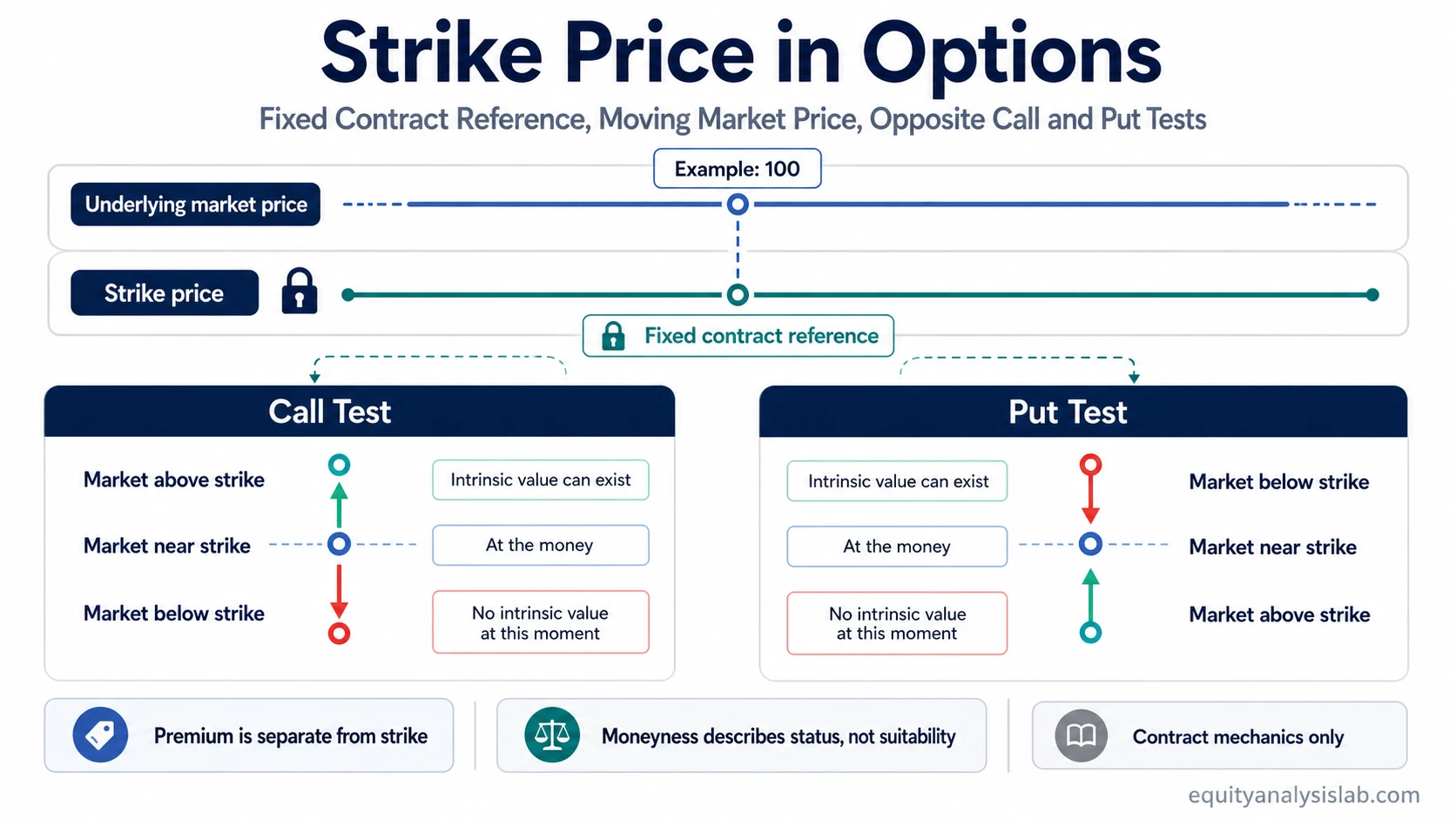
The term "moneyness" describes the relationship between the strike price and the current market price of the underlying equity. Understanding these three states is essential for determining the risk-reward profile of any option trade.
In-the-Money (ITM)
An option is In-the-Money if exercising it would result in a theoretical profit. For a call option, this occurs when the strike price is below the current market price. For a put option, it occurs when the strike price is above the market price. ITM options are more expensive because they already possess intrinsic value. Investors choose ITM strikes when they want a higher "Delta"—meaning the option price will move more closely in tandem with the underlying stock price.
At-the-Money (ATM)
An option is At-the-Money when the strike price is identical, or very close, to the current market price of the stock. ATM options are highly sensitive to price changes and volatility. They contain no intrinsic value but possess the highest amount of extrinsic value (time value), making them a favorite for traders speculating on a significant move in either direction.
Out-of-the-Money (OTM)
An option is Out-of-the-Money if it has no intrinsic value. For a call option, the strike price is higher than the market price; for a put, the strike price is lower. OTM options are the cheapest to purchase because their value is derived entirely from the hope that the stock price will move past the strike before the expiration date. While they offer high leverage, they also carry a higher risk of expiring worthless.
How Strike Prices Influence Option Premiums
The premium of an option is not arbitrary; it is calculated using complex mathematical models, most notably the Black-Scholes model. The strike price is a primary input in these formulas. As the 2026 market environment shows, even small shifts in the underlying stock can cause violent swings in premiums, particularly for strikes near the current market price.
- Distance from Market Price: The further OTM a strike price is, the lower the premium will be. This is because the probability of the stock reaching that price before expiration is lower.
- Intrinsic Value Calculation: Intrinsic value is simply the difference between the market price and the strike price (if that difference is positive for the holder).
- Extrinsic Value (Time Value): This represents the "extra" amount traders pay for the possibility that the stock will move favorably. Strikes that are ATM have the most time value because there is the greatest uncertainty about whether they will end up ITM or OTM.
Strategic Selection: Choosing the Right Strike
Selecting a strike price is an exercise in balancing probability against potential payout. Your choice should be dictated by your market outlook and your risk tolerance.
Aggressive Speculation (OTM Strikes)
Traders who expect a massive, rapid move in a stock often buy OTM options. Because these contracts are inexpensive, a trader can control a large number of shares for a small capital outlay. However, if the stock does not reach the strike price by expiration, the entire investment is lost. This is often referred to as a "low probability, high reward" strategy.
Conservative Growth (ITM Strikes)
Investors looking for a substitute for owning the stock itself often buy deep ITM call options. These options have a high Delta (often 0.80 or higher), meaning for every $1 the stock moves, the option moves $0.80. This requires less capital than buying the stock outright but offers similar gains with a defined risk (the premium paid).
Income Generation (Selling OTM Strikes)
Many sophisticated investors in 2026 use "covered calls" or "cash-secured puts." This involves selling OTM options to other traders. By choosing a strike price that is unlikely to be reached, the seller (writer) of the option aims to keep the premium as pure profit. This strategy is foundational for wealth management and portfolio hedging.
Strike Price Comparison and Outcomes
The following table illustrates how different strike prices perform for a hypothetical stock currently trading at $100.
| Option Type | Strike Price | Moneyness | Premium Level | Risk Profile | Primary Use Case |
|---|---|---|---|---|---|
| Call | $90 | In-the-Money | High | Lower | Stock replacement / High Delta |
| Call | $100 | At-the-Money | Moderate | Balanced | Speculating on direction |
| Call | $110 | Out-of-the-Money | Low | High | Aggressive growth / Leverage |
| Put | $110 | In-the-Money | High | Lower | Defensive hedging |
| Put | $100 | At-the-Money | Moderate | Balanced | Volatility plays |
| Put | $90 | Out-of-the-Money | Low | High | Low-cost disaster insurance |
The Impact of Volatility and Time Decay
When selecting a strike, one must consider the "Greeks," specifically Theta (time decay) and Vega (sensitivity to volatility).
- Theta: As an option approaches its expiration date, its extrinsic value erodes. This decay is most aggressive for ATM strike prices. If you are buying an option, you want to choose a strike that you believe will be reached quickly to avoid losing value to Theta.
- Vega: When market volatility increases, premiums for all strike prices generally rise. However, OTM strikes can see significant percentage increases in value even if the stock price doesn't move, simply because the probability of a big move has increased.
Technical Considerations: Standardized vs. Non-Standardized Strikes
In the equity markets, most strike prices are standardized. However, corporate actions such as stock splits, mergers, or special dividends can result in "adjusted" or non-standardized options. For instance, if a company undergoes a 2-for-1 stock split, a call option with a $100 strike price would be adjusted to two contracts with a $50 strike price. It is vital for traders to monitor FINRA alerts and exchange notices regarding these adjustments to avoid confusion over contract terms.
Common Mistakes in Strike Selection
One of the most frequent errors made by novice traders is buying "too far" out-of-the-money. While a $200 call on a $150 stock might look attractive due to its $0.10 price tag, the statistical probability of that stock rising 33% before a monthly expiration is often negligible. This is colloquially known as "buying lottery tickets."
Another mistake is failing to account for the "break-even" price. If you buy a $100 strike call for a $5 premium, the stock must be at $105 at expiration just for you to break even. Understanding that the strike price is not the break-even point is fundamental to managing expectations in the equity markets.
Summary of Key Regulatory Guidance
As of 2026, the Securities and Exchange Commission (SEC) continues to emphasize the importance of "Options Disclosure Documents" (ODD). These documents provide standardized information on the risks and characteristics of strike prices and exercise procedures. Before trading, individuals are legally required to be provided with these disclosures by their brokerage firm to ensure they understand the mechanics of the contracts they are entering.
Frequently Asked Questions
Can the strike price of an option change after I buy it?
Under normal market conditions, no. The strike price is a fixed term of the contract. However, it can be adjusted in the event of major corporate actions like stock splits, reverse splits, or extraordinary dividends. These adjustments are made to ensure that the total value of the contract remains fair for both the buyer and the seller.
What happens if the stock price is exactly the same as the strike price at expiration?
If the market price equals the strike price at expiration, the option is "At-the-Money." In this scenario, the option usually expires worthless because there is no financial incentive to exercise it (as you could buy or sell the stock for the same price on the open market). Furthermore, you would lose the entire premium paid to enter the trade.
Why are some strike prices spaced $1 apart and others $5 apart?
The interval between strike prices is determined by the exchange based on the stock's price, trading volume, and market demand. Highly liquid, high-priced stocks (like major tech giants) often have narrower strike intervals to allow for more precise hedging and speculation, while lower-volume stocks may only offer strikes at $5 or $10 increments.
How does the strike price affect the "Delta" of an option?
Delta measures how much an option's price changes for every $1 move in the underlying stock. Deep ITM options have a Delta near 1.00 (moving almost exactly with the stock), while deep OTM options have a Delta near 0.00. The strike price you choose determines your starting Delta and, consequently, your sensitivity to market movements.
Is it better to buy ITM or OTM options?
There is no "better" choice; it depends on your objective. ITM options have a higher probability of profit but require more capital. OTM options offer higher potential percentage returns (leverage) but have a much higher probability of expiring worthless. Most professional traders use a combination based on their specific risk-reward analysis.
Practical Recommendation
For most investors entering the equity options market in 2026, the most balanced approach is to focus on At-the-Money or slightly In-the-Money strikes for directional bets. These strikes offer a meaningful Delta without the extreme risk of total loss associated with deep Out-of-the-Money "lottery tickets." Always calculate your break-even price (Strike + Premium) before executing a trade, and ensure that your chosen strike price aligns with a realistic technical target for the underlying stock.
Image Gallery