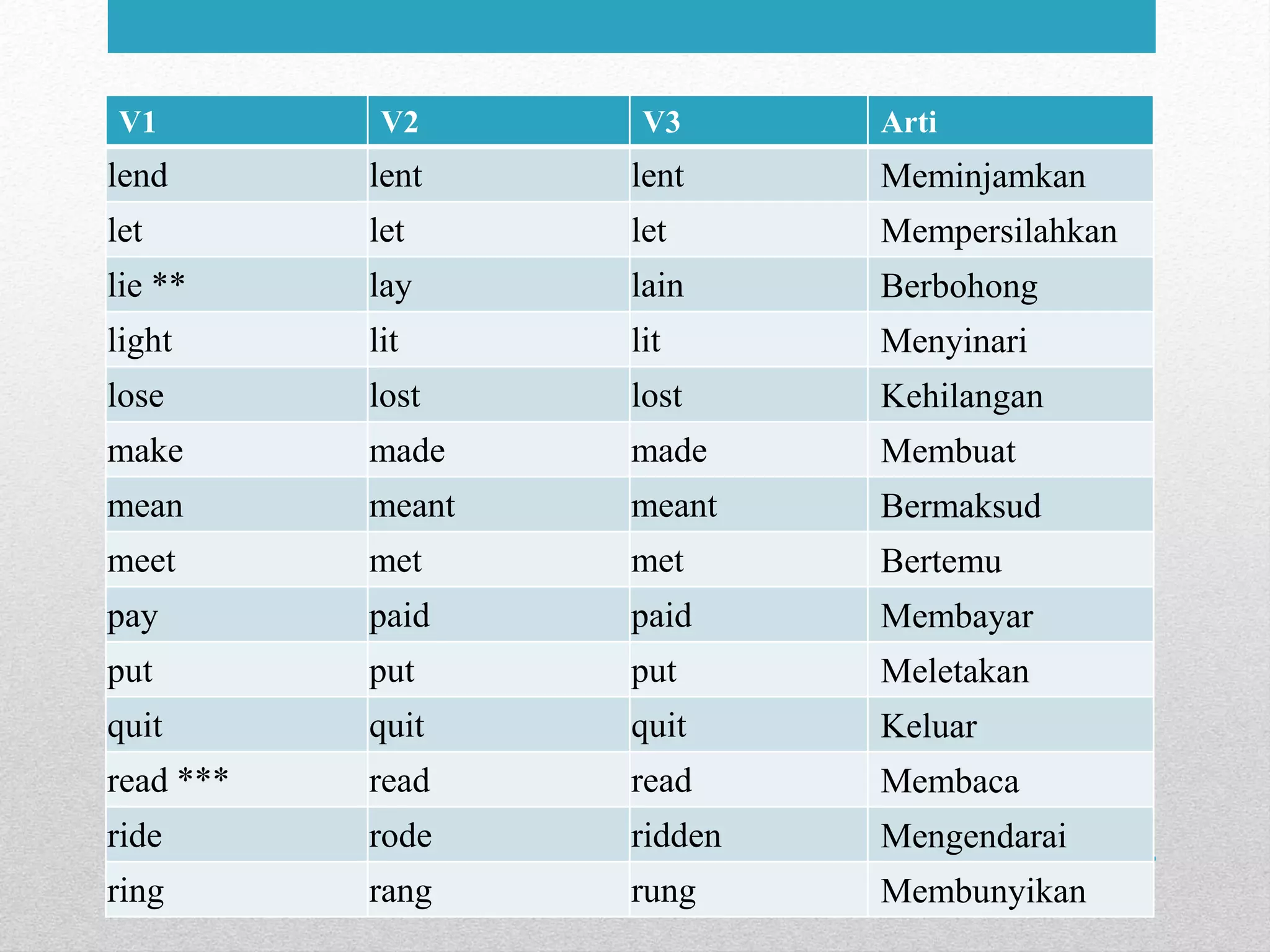
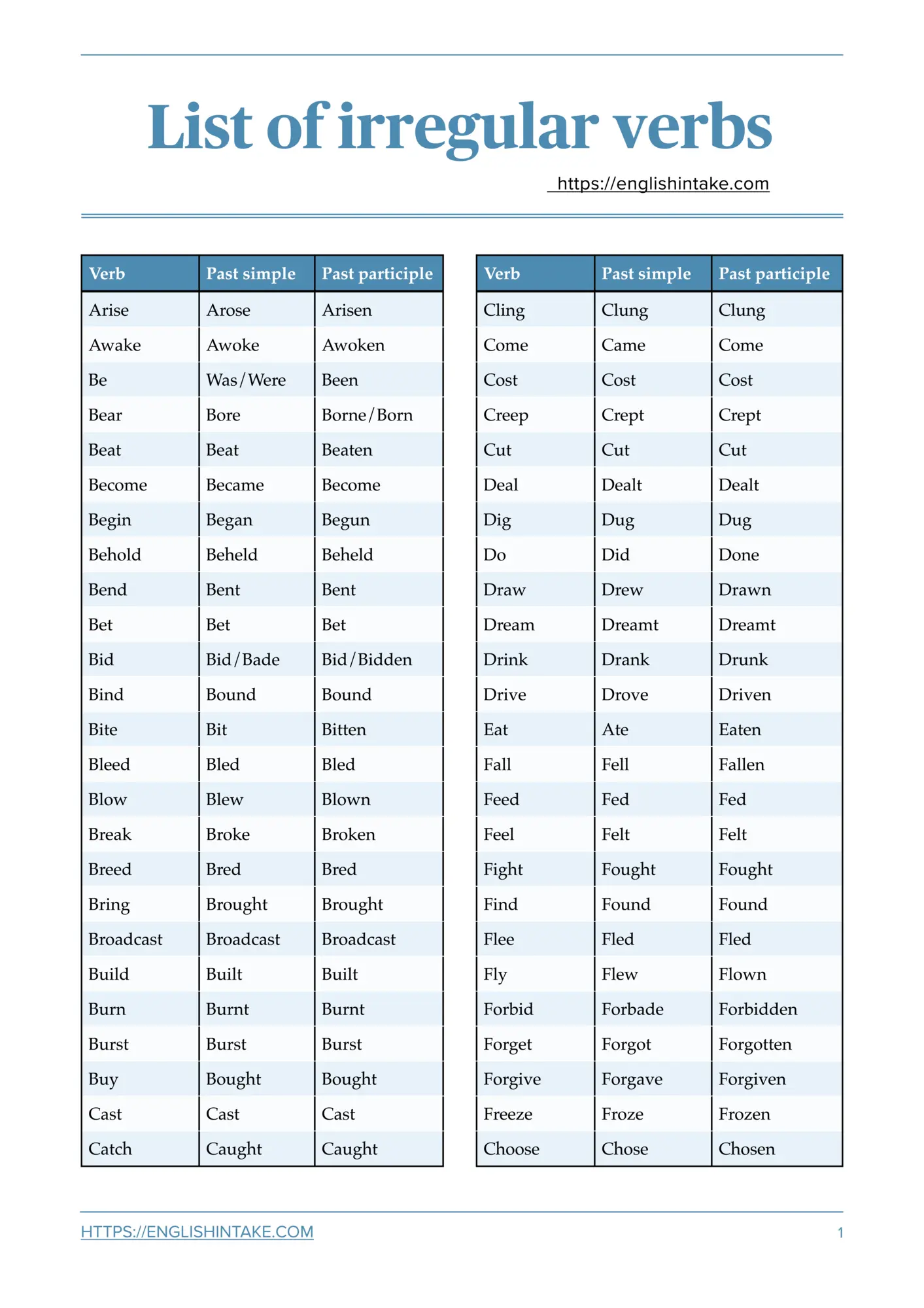
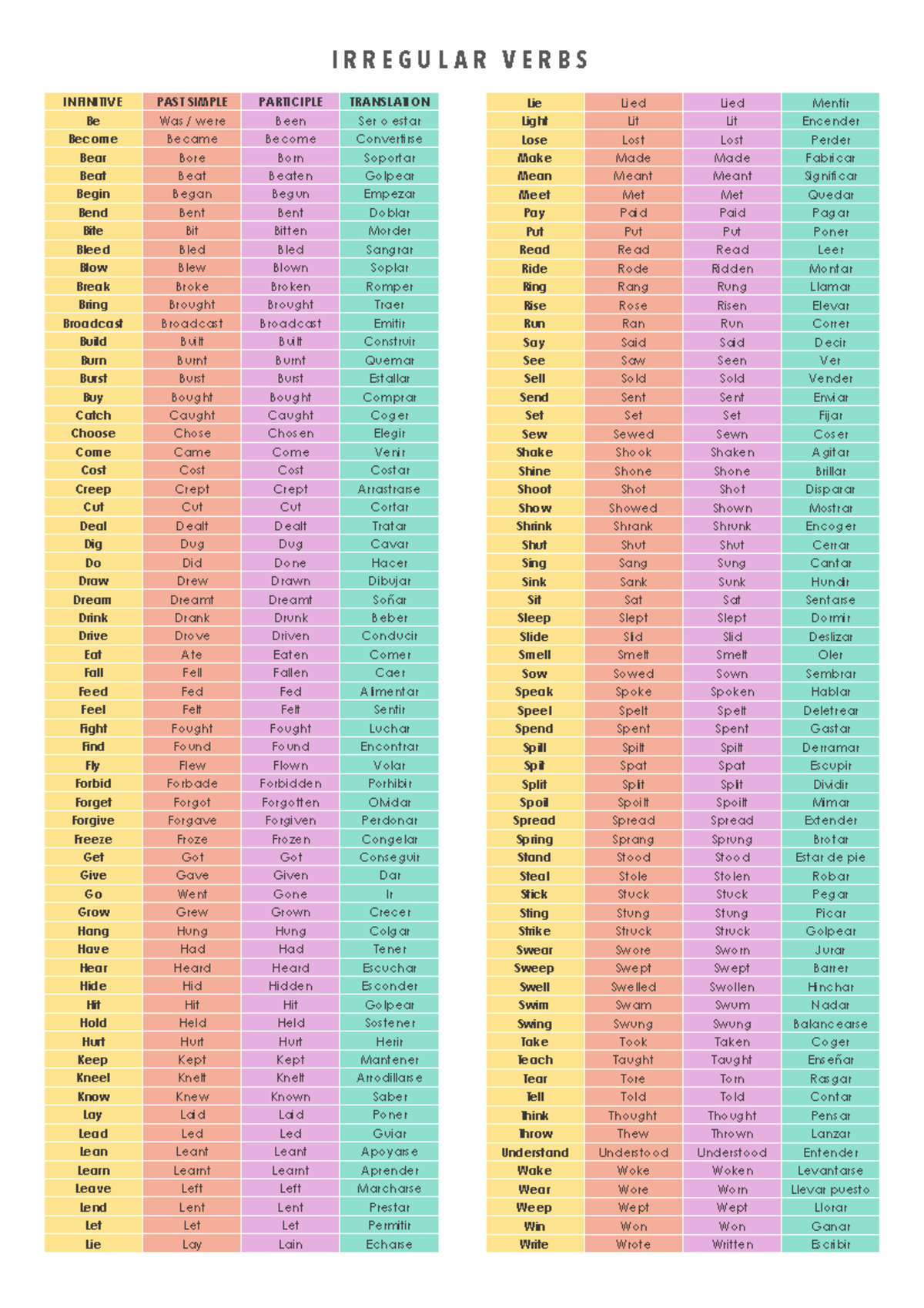
Comprehensive 1000 Irregular Verbs List PDF: Mastery and Usage Guide
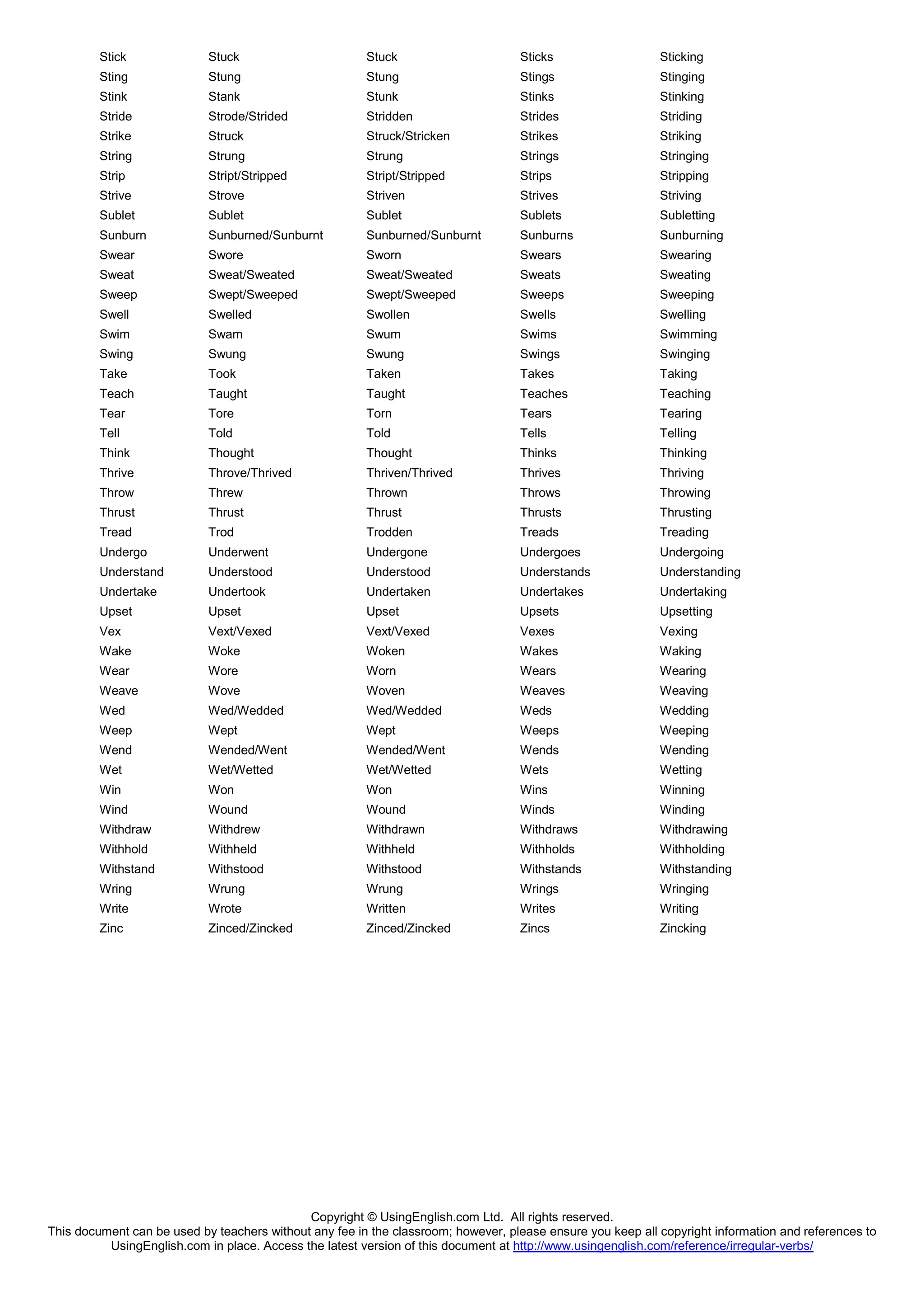
A 1000 irregular verbs list PDF serves as a definitive linguistic resource for students, educators, and writers aiming for complete English proficiency. Unlike regular verbs that follow the standard "-ed" suffix pattern, irregular verb...
A 1000 irregular verbs list PDF serves as a definitive linguistic resource for students, educators, and writers aiming for complete English proficiency. Unlike regular verbs that follow the standard "-ed" suffix pattern, irregular verbs undergo internal vowel shifts or remain unchanged across their infinitive, simple past, and past participle forms.
Contents
Mastering a list of this magnitude is not merely about rote memorization; it involves understanding the historical Germanic roots of the English language and the phonetic patterns that govern how words evolve. While most daily communication relies on a core set of 100 to 200 irregular verbs, a comprehensive 1000-verb document provides the necessary depth for academic writing, literature analysis, and professional communication in 2026.
The Linguistic Foundation of Irregular Verbs
To understand why a 1000-verb list exists, one must look at the history of "strong" and "weak" verbs. Regular verbs are a relatively modern development in the evolution of English, providing a streamlined rule for the majority of new actions (e.g., "to google" becomes "googled"). Irregular verbs, however, are often the oldest words in the language, surviving from Old English.
These verbs frequently employ a process called ablaut—a change in the root vowel to indicate a change in grammatical function. For example, the shift in "sing, sang, sung" is a remnant of ancient Indo-European patterns. When you access a 1000-verb PDF, you are looking at a collection that includes these common ancestral words as well as compound verbs and archaic forms that still appear in legal, religious, and classical texts.
Why Target 1,000 Verbs?
Most learners begin with a list of 50 to 100 verbs. However, as one moves toward C1 and C2 proficiency levels (Advanced/Mastery), the need for specific vocabulary grows. A 1000-verb list includes:
- Common irregulars: Be, have, do, go, see.
- Compound verbs: Understand (from stand), withdraw (from draw), overcome (from come).
- Archaic or literary forms: Behold, smite, tread, forsake.
- Prefix-derived forms: Mistake, overtake, outrun.
By including these variations, the list reaches a thousand entries, providing a comprehensive map of English verb morphology that ensures no text—whether a modern technical manual or a 19th-century novel—remains indecipherable.
Structural Organization of a High-Quality Verb PDF
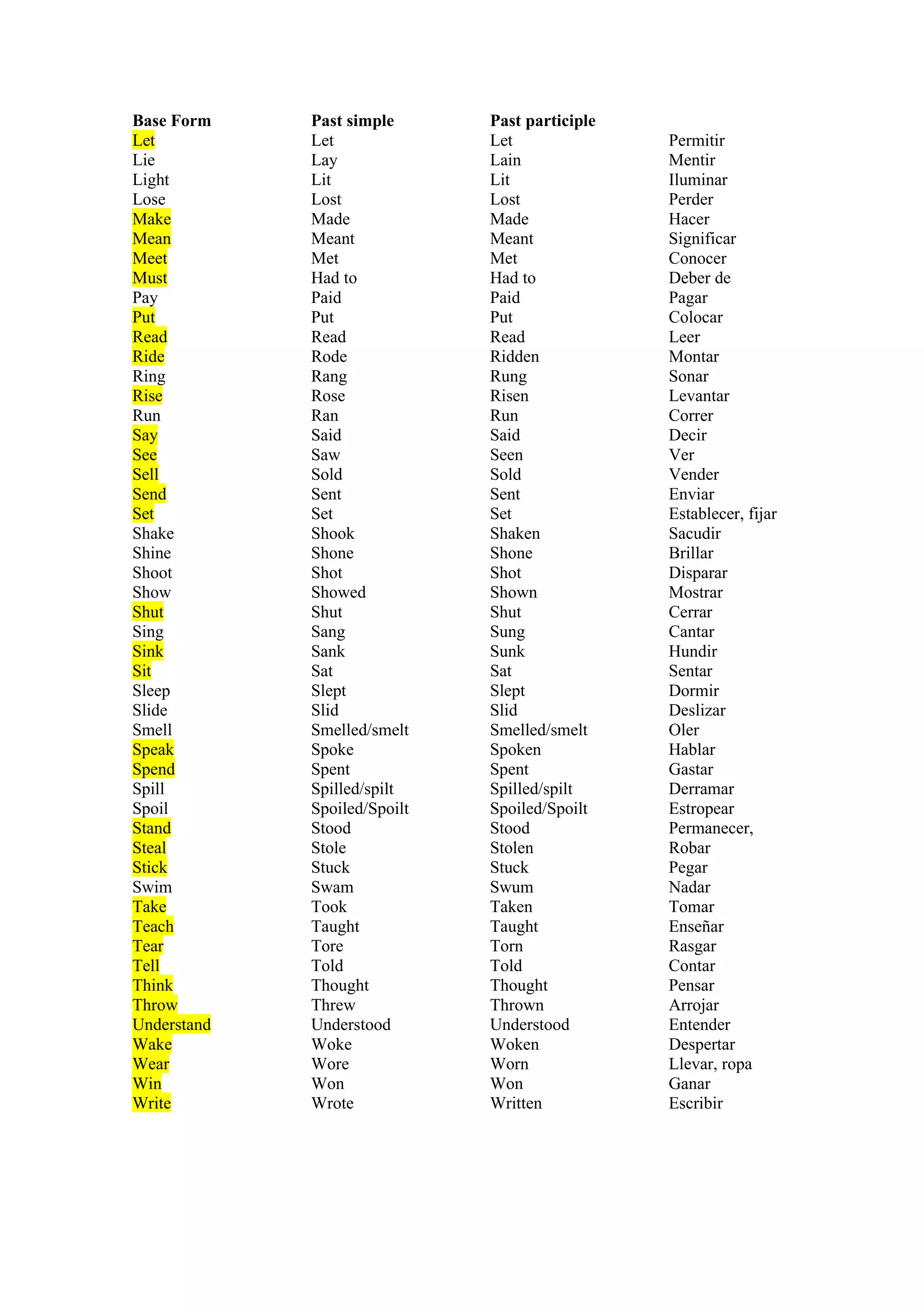
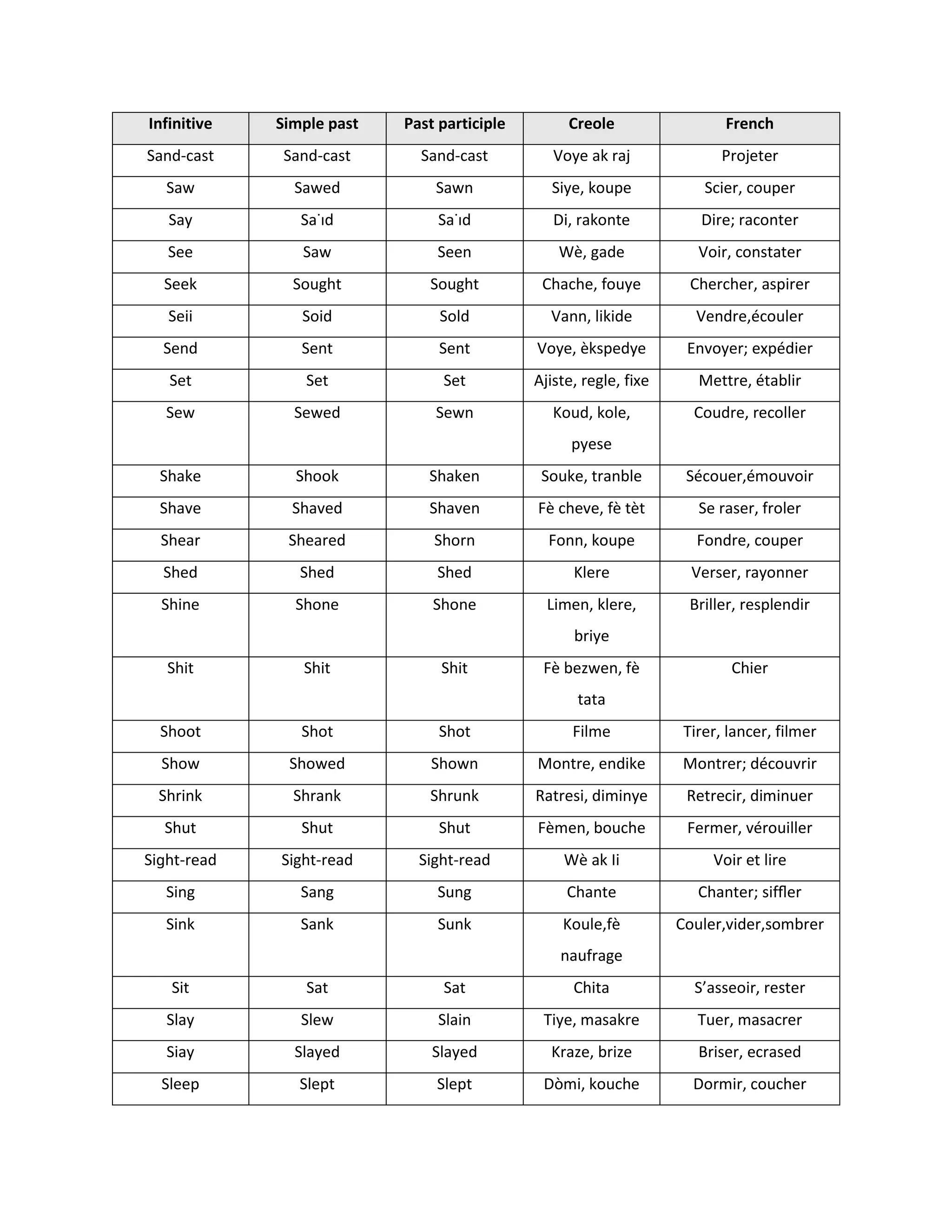
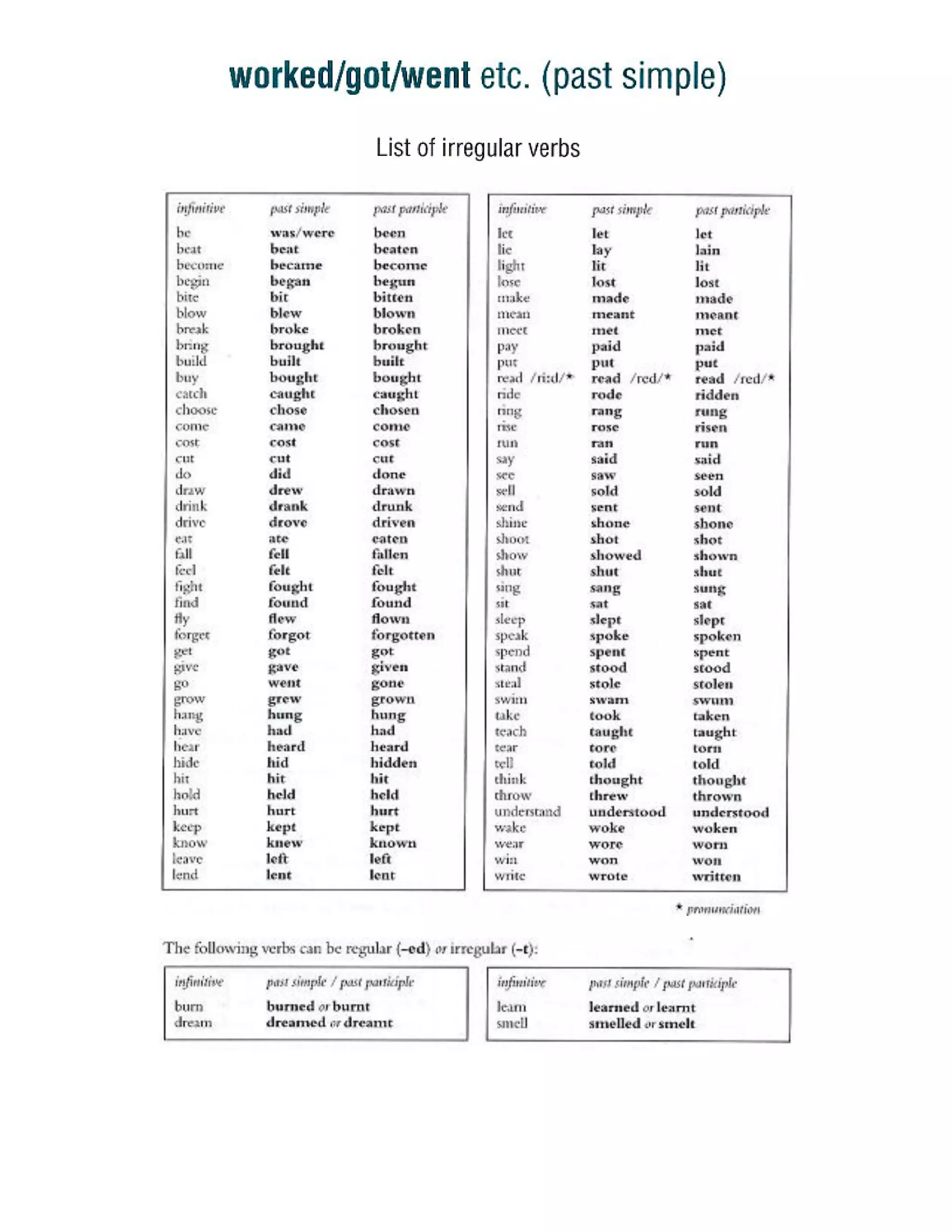
A functional 1000 irregular verbs list PDF should be organized logically to facilitate quick reference and effective study. Most professional lists are structured into four or five distinct columns to provide maximum utility for the user.
Essential Data Columns
- Infinitive (Base Form): The dictionary form of the verb (e.g., Speak).
- Simple Past (V2): Used for completed actions in the past (e.g., Spoke).
- Past Participle (V3): Used for perfect tenses and the passive voice (e.g., Spoken).
- Gerund/Present Participle (V4): Though often regular (adding "-ing"), including this helps with spelling nuances like doubling consonants (e.g., Running).
- Meaning/Definition: A brief explanation to ensure the user understands the context of rarer verbs.
Categorization by Morphological Patterns
The most effective way to digest a list of 1000 verbs is to group them by how they change. This reduces the cognitive load of memorization.
- The "AAA" Pattern: Verbs where all three forms are identical (e.g., cut-cut-cut, set-set-set).
- The "ABA" Pattern: Verbs where the infinitive and past participle are identical (e.g., run-ran-run, come-came-come).
- The "ABB" Pattern: Verbs where the simple past and past participle are identical (e.g., buy-bought-bought, think-thought-thought).
- The "ABC" Pattern: Verbs where all three forms are unique (e.g., write-wrote-written, fly-flew-flown).
Selected Reference Table: Diverse Irregular Verb Samples
The following table provides a snapshot of the variety found in a comprehensive 1000-verb list, ranging from common everyday actions to more specialized vocabulary.
| Infinitive (Base) | Simple Past (V2) | Past Participle (V3) | Pattern Type |
|---|---|---|---|
| Arise | Arose | Arisen | ABC |
| Beseech | Besought | Besought | ABB |
| Broadcast | Broadcast | Broadcast | AAA |
| Cling | Clung | Clung | ABB |
| Dwell | Dwelt | Dwelt | ABB |
| Forbear | Forbore | Forborne | ABC |
| Gird | Girt / Girded | Girt / Girded | Variable |
| Kneel | Knelt | Knelt | ABB |
| Mislay | Mislaid | Mislaid | ABB |
| Partake | Partook | Partaken | ABC |
| Shed | Shed | Shed | AAA |
| Strive | Strove | Striven | ABC |
| Undergo | Underwent | Undergone | ABC |
| Weave | Wove | Woven | ABC |
| Wind | Wound | Wound | ABB |
Advanced Usage: The Past Participle and Complex Tenses
One of the primary reasons for downloading a 1000 irregular verbs list PDF is to master the Past Participle (V3). This form is essential for several advanced grammatical structures that are common in professional and academic English in 2026.
The Perfect Aspect
The past participle is required for the Present Perfect (I have seen), Past Perfect (I had seen), and Future Perfect (I will have seen). Using the wrong form (e.g., saying "I have saw" instead of "I have seen") is a common marker of non-native speech or lack of formal education. A comprehensive list helps students distinguish between the simple past (used for specific times) and the participle (used for indefinite time or completed status).
The Passive Voice
In technical and scientific writing, the passive voice is frequently used to maintain objectivity. The formula "to be + past participle" relies heavily on irregular verb knowledge. For instance, "The data was taken" or "The law was upholden" (though "upheld" is more common now, a 1000-verb list covers these stylistic choices).
Adjectival Use
Many irregular past participles function as adjectives. Understanding the difference between a "broken" window (from break) and a "painted" window (regular) is vital for descriptive accuracy.
Study Strategies for Mastering 1,000 Verbs
Attempting to learn 1000 verbs at once is inefficient. In 2026, language learners use a combination of traditional PDF resources and digital tools to achieve retention.
Spaced Repetition Systems (SRS)
Converting the PDF list into digital flashcards (using apps like Anki or Quizlet) allows you to use Spaced Repetition. The software shows you difficult irregular verbs more frequently and easier ones less often, optimizing the neural pathways required for long-term memory.
Contextual Immersion
Instead of just reading the list, learners should write three sentences for every ten new verbs they study. Use the verb in the simple past, the present perfect, and as an adjective. For example, using the verb shrink:
- Simple Past: The shirt shrank in the wash yesterday.
- Present Perfect: My savings have shrunk due to inflation.
- Adjectival: The shrunken head was a museum artifact.
Auditory Reinforcement
Many irregular verbs have unique pronunciations that do not match their spelling (e.g., read [reed] vs. read [red]). When using a PDF list, it is helpful to cross-reference with an authoritative dictionary to hear the vowel shifts. Reliable sources for pronunciation include the Oxford Learner's Dictionary and Cambridge Dictionary.
Common Pitfalls and Troubleshooting
Even with a 1000-verb PDF, certain areas of English irregularity remain challenging.
Over-Regularization
This occurs when a speaker applies regular rules to irregular verbs (e.g., "goed" instead of "went" or "bringed" instead of "brought"). This is common in children and language learners. Regular review of the "ABB" and "ABC" categories in your PDF can help eliminate these errors.
British vs. American English Variations
Some verbs are irregular in British English but have become regular in American English. A high-quality 1000-verb list will note these differences:
- Burn: Burnt (UK) vs. Burned (US)
- Learn: Learnt (UK) vs. Learned (US)
- Dream: Dreamt (UK) vs. Dreamed (US)
Confusing Similar Verbs
Certain verb pairs are notoriously difficult because their forms overlap. The most famous example is Lie and Lay:
- Lie (to recline): Lie, Lay, Lain.
- Lay (to put something down): Lay, Laid, Laid. A comprehensive list provides the necessary clarity to distinguish these based on whether the verb takes a direct object (transitive vs. intransitive).
The Evolution of Verbs in 2026
As of 2026, the English language continues to evolve. Some irregular verbs are gradually becoming regularized through common usage. For example, the past tense of "speed" can be "sped" or "speeded" depending on context (e.g., "He sped away" vs. "He was speeded by the process").
Modern PDF resources now often include "Usage Notes" that reflect these shifts. Furthermore, digital versions of these lists are frequently integrated with AI-driven writing assistants. These tools use the 1000-verb database to provide real-time corrections, ensuring that even if you haven't memorized the entire list, your output remains grammatically flawless.
FAQs
Why do some irregular verbs have two different past forms?
Many verbs in the English language are in a state of transition. Verbs like dive can have a traditional past form (dived) and a newer irregular form (dove), or vice versa. Additionally, differences between British and American English often result in two acceptable forms. A 1000-verb list typically includes both, marking one as "archaic" or "regional" where appropriate.
Is it necessary to learn all 1000 irregular verbs?
For the average speaker, no. Knowing the top 200 verbs covers roughly 90% of daily conversation. However, for those reading legal documents, historical literature, or specialized technical papers, the remaining 800 verbs are crucial for understanding nuance and precision.
How can I tell if a verb is regular or irregular without a list?
There is no definitive rule in the spelling of the infinitive that indicates irregularity. While many irregular verbs end in consonants, so do many regular ones. This is why a reference PDF is essential; it provides a verified source for words that do not follow the standard "+ed" logic.
Does a 1000-verb list include phrasal verbs?
A comprehensive 1000-verb list primarily focuses on root verbs and their prefixed forms (e.g., take, mistake, overtake). While it may not list every single phrasal verb combination (like take off, take in, take out), knowing the irregular forms of the root verb (take, took, taken) allows you to correctly conjugate any phrasal verb derived from it.
What is the best way to use a 1000 irregular verbs PDF for exams?
Focus on the "ABC" pattern verbs first, as these are the most frequently tested in exams like the TOEFL, IELTS, or SAT. Create a "daily ten" habit where you memorize ten verbs every morning and use them in writing exercises throughout the day.
Final Recommendation
To achieve true mastery of the English language, download a verified 1000 irregular verbs list PDF and categorize the entries into the AAA, ABA, ABB, and ABC patterns. Focus your initial efforts on the 200 most common verbs, then gradually expand into compound and literary forms to enhance your reading comprehension and writing sophistication. For further verification of specific verb forms and their current usage, consult the Merriam-Webster Dictionary.
Image Gallery