Financial Help for Seniors with Auto Insurance: Programs and Savings Strategies for 2026
While there is no federal grant that directly pays for car insurance, seniors can access significant financial help through state-sponsored low-income programs, mandatory safety course discounts, and specialized usage-based insurance m...
While there is no federal grant that directly pays for car insurance, seniors can access significant financial help through state-sponsored low-income programs, mandatory safety course discounts, and specialized usage-based insurance models. In 2026, many states and private insurers offer targeted relief to ensure that older drivers on fixed incomes can remain mobile and legally insured.
Contents
State-Sponsored Low-Income Auto Insurance Programs
For many seniors, the primary obstacle to maintaining coverage is the cost of premiums relative to a fixed Social Security income. Currently, a few states lead the way in providing direct regulatory "help" through specialized, low-cost insurance tiers designed for low-to-moderate-income residents.
California Low Cost Automobile Insurance (CLCA)
The CLCA program remains a benchmark for state-funded assistance. It provides affordable liability insurance to good drivers who meet specific income requirements. For a senior in California to qualify in 2026, their household income must typically fall within 250% of the federal poverty level. The program is specifically designed to prevent people from being forced off the road due to high private-market rates. It provides the minimum liability coverage required by law, ensuring that seniors can drive to medical appointments and grocery stores without the fear of legal penalties for being uninsured.
New Jersey Special Automobile Insurance Policy (SAIP)
Often referred to as the "Dollar-a-Day" policy, New Jersey’s SAIP is available to individuals who are enrolled in Federal Medicaid with hospitalization. Many low-income seniors fall into this category. While this policy only covers emergency treatment after an accident and provides a $10,000 death benefit—rather than broad liability for property damage—it satisfies the state’s legal requirement for insurance. It is a vital safety net for seniors who would otherwise have no financial means to comply with state law.
Mandatory Defensive Driving Discounts
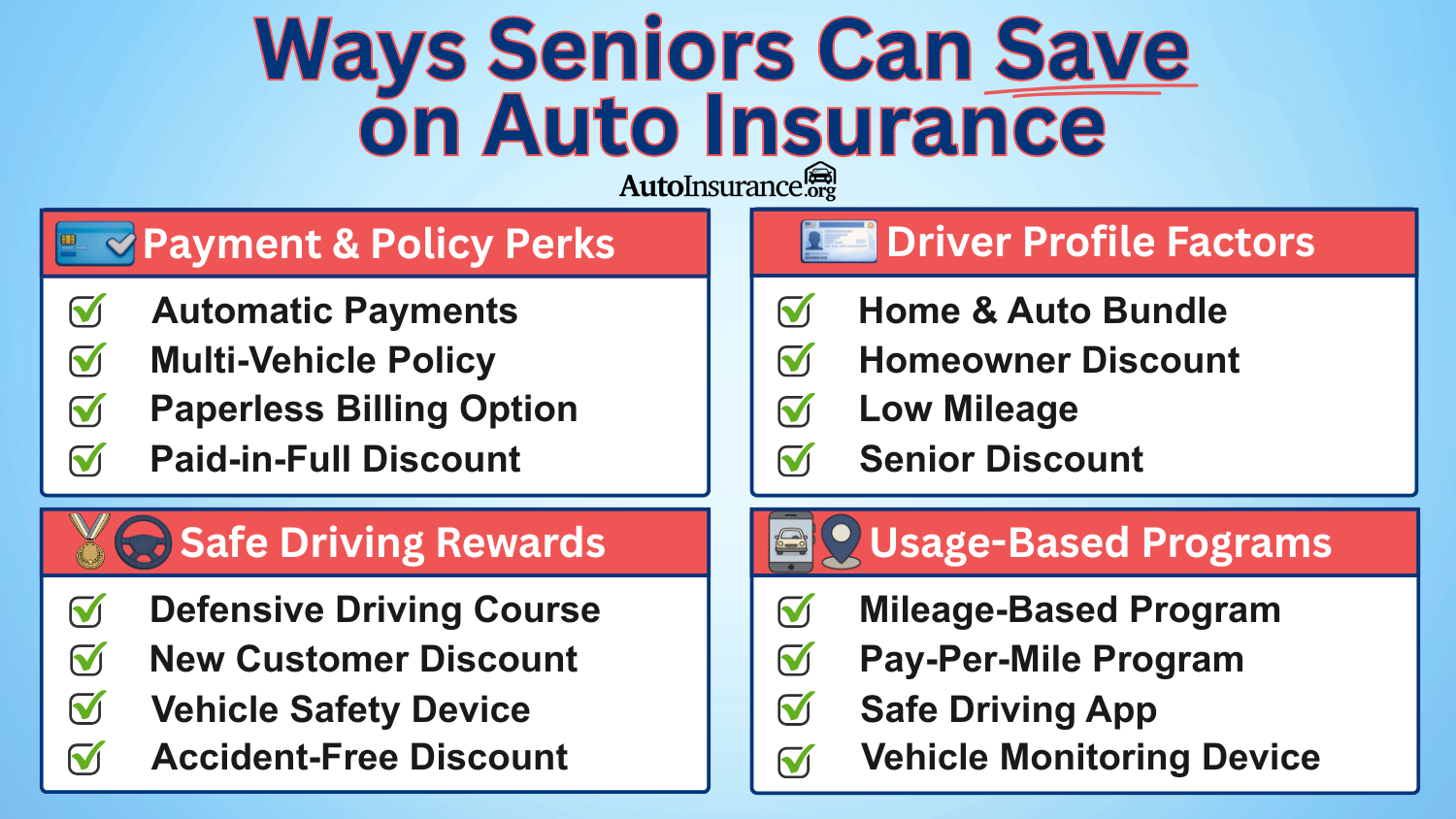
One of the most reliable forms of financial help is the "Senior Safety Discount," which is mandated by law in over 30 states. These laws require insurance companies to reduce premiums for drivers over a certain age (usually 55 or 60) who complete a state-approved defensive driving course.
In 2026, these courses are widely available online and in person through organizations like AARP and AAA. The logic behind this financial incentive is actuarial: seniors who refresh their knowledge of modern traffic laws, vehicle safety technology, and age-related physical adjustments are statistically less likely to file a claim.
- Potential Savings: Typically 5% to 15% off the liability, medical payments, and collision portions of a policy.
- Duration: Most discounts are valid for three years, after which the senior can retake the course to renew the savings.
- Accessibility: Online versions allow seniors to complete the training at their own pace, which is particularly helpful for those with mobility issues.
Usage-Based Insurance (UBI) and Low-Mileage Discounts
As of 2026, the insurance industry has fully embraced telematics—technology that tracks how, when, and how much you drive. For retirees, this is a major form of indirect financial help. Since many seniors no longer commute to a 9-to-5 job, their annual mileage is often significantly lower than the national average.
Pay-Per-Mile Programs
Programs like Allstate’s Milewise or Nationwide’s SmartMiles allow seniors to pay a low base rate plus a few cents for every mile driven. If a senior only drives 2,000 to 4,000 miles a year, they could save upwards of 40% compared to a traditional flat-rate policy. This "pay-as-you-go" model is effectively a financial subsidy for the lifestyle of a retiree.
Behavioral Telematics
By using a plug-in device or a smartphone app, seniors can prove to their insurer that they avoid high-risk behaviors such as hard braking, rapid acceleration, or late-night driving. Companies like Progressive and State Farm offer "good driver" discounts based on this data. For a cautious senior driver, this can result in a personalized rate that is much lower than the standard age-based demographic average.
Organizations Offering Negotiated Rates for Seniors
Membership-based organizations act as powerful advocates, using their collective bargaining power to secure lower rates for their members. While these aren't "government" help, they function as a structured financial support system.
- AARP (American Association of Retired Persons): AARP’s long-standing partnership with The Hartford offers specialized auto insurance features, such as "RecoverCare," which helps pay for home help (cleaning, cooking, transportation) if a senior is injured in an accident. They also offer lifetime renewability, protecting seniors from being dropped by their insurer simply because of their age.
- AMAC (Association of Mature American Citizens): AMAC offers similar negotiated discounts through various partner carriers. They often provide roadside assistance packages tailored to the needs of older vehicles and drivers.
Strategies for Reducing the Financial Burden
Beyond specific programs, seniors can find "help" by restructuring their policies to better fit their current financial reality. This involves auditing the policy to remove unnecessary costs that may have been relevant ten years ago but are no longer useful.
Adjusting Physical Damage Coverage
If a senior is driving an older vehicle that is fully paid off, the cost of collision and comprehensive insurance might exceed the actual value of the car. Financial experts often suggest the "10% rule": if the annual cost of the insurance premium is more than 10% of the car's book value, it may be time to drop full coverage and carry only liability. This can instantly halve an insurance bill.
Increasing Deductibles
For seniors with a modest "rainy day" fund, increasing a deductible from $500 to $1,000 can reduce the premium by 15% to 30%. This is a calculated risk, but for those who drive infrequently and safely, the long-term premium savings often outweigh the one-time cost of a higher deductible in the event of a claim.
Comparison of Financial Assistance Options for Seniors (2026)
| Program / Strategy | Primary Eligibility | Type of "Help" | Estimated Savings |
|---|---|---|---|
| CLCA (California Only) | Income < 250% Poverty Level | Subsidized Liability Policy | $500 - $1,000 annually |
| SAIP (New Jersey Only) | Medicaid Enrollment | Minimal Legal Coverage | Approx. $365 / year |
| Defensive Driving Course | Age 55+ (usually) | Mandated Rate Reduction | 5% - 15% of premium |
| Pay-Per-Mile Insurance | Low-Mileage Drivers | Usage-Based Pricing | Up to 40% vs. Standard |
| AARP / Hartford | AARP Membership | Negotiated Group Rates | Varies by state |
| Medicaid/Medicare | Low-income / Age 65+ | Indirect: Medical coverage | Reduces need for high MedPay |
Frequently Asked Questions
Does Medicare help pay for car insurance?
No, Medicare does not pay for car insurance premiums. However, because Medicare (and potentially a Medigap or Medicare Advantage plan) covers most medical costs resulting from an accident, seniors can sometimes afford to carry lower limits on the "Medical Payments" (MedPay) or "Personal Injury Protection" (PIP) portion of their auto insurance, depending on their state's laws. This can result in a lower monthly premium.
Is there a federal "Senior Car Insurance" subsidy?
There is no federal subsidy or "Social Security benefit" specifically for car insurance. Auto insurance is regulated at the state level. Financial help is therefore found through state-specific programs (like those in CA or NJ) or through private-sector discounts mandated by state legislatures.
Can my car insurance company raise my rates just because I turned 70?
In many states, it is illegal for an insurance company to raise your rates solely based on your age. However, insurers can raise rates for an entire demographic group if their data shows that drivers over a certain age are becoming more involved in accidents. To counter this, seniors should utilize the defensive driving discounts mentioned above to prove their individual safety.
Does Social Security offer help with car insurance?
Social Security does not provide direct payments for car insurance. However, for those receiving Supplemental Security Income (SSI) due to limited income and resources, the aforementioned state programs like the SAIP in New Jersey often use SSI or Medicaid enrollment as the primary qualifier for low-cost insurance.
How do I find out if my state has a low-income insurance program?
You should contact your State Department of Insurance (DOI). Each state has a governing body that regulates insurance companies. They can provide a list of "assigned risk" plans or low-income assistance programs available in your specific jurisdiction.
Recommendation for Next Actions
To secure the most financial help for your auto insurance in 2026, follow these three steps:
- Complete a Safety Course: Enroll in an AARP or AAA driver safety course. The small upfront cost (usually under $30) is almost always eclipsed by the three years of savings you will receive on your premiums.
- Request a "Usage Audit": Call your current agent and provide your actual annual mileage. If you are driving less than 7,500 miles a year, ask to be moved to a low-mileage tier or consider switching to a pay-per-mile carrier.
- Check State Eligibility: If you are on a limited income or enrolled in Medicaid, visit your State Department of Insurance website to see if a low-cost automobile insurance program exists in your area.
Image Gallery