Understanding the TD Bank Identification Code for International Transfers
The TD Bank identification code for international transfers is primarily the SWIFT code (also known as a BIC). For TD Canada Trust, the most common code is TDOMCATT, while TD Bank, N.A. in the United States typically uses TDOMUS33. The...
The TD Bank identification code for international transfers is primarily the SWIFT code (also known as a BIC). For TD Canada Trust, the most common code is TDOMCATT, while TD Bank, N.A. in the United States typically uses TDOMUS33. These codes ensure that cross-border funds reach the correct institution and branch securely and efficiently.
Contents
The Role of Bank Identification Codes in 2026
In the global financial landscape of 2026, the movement of capital across borders remains a cornerstone of both personal and commercial banking. When sending or receiving money internationally through TD Bank, the identification code serves as a digital address. Without these precise alphanumeric strings, the global financial network—governed largely by the Society for Worldwide Interbank Financial Telecommunication (SWIFT)—would be unable to route transactions through the maze of thousands of intermediary and recipient banks.
Understanding these codes is not merely a matter of administrative curiosity; it is a prerequisite for financial security. An incorrect identification code can lead to delayed transfers, rejected payments, or, in complex cases, funds being temporarily held in suspense accounts. Whether you are a business owner paying an overseas supplier or an individual sending a gift to family abroad, identifying whether you need a SWIFT code, a routing number, or an IBAN is the first step in a successful transaction.
TD Canada Trust vs. TD Bank, N.A.: A Critical Distinction
A common point of confusion for customers is the distinction between TD Canada Trust (operating in Canada) and TD Bank, N.A. (operating in the United States). Although they share the same parent organization, the TD Bank Group, they operate within different national regulatory frameworks and banking systems.
TD Canada Trust (Canada)
TD Canada Trust is headquartered in Toronto and follows the Canadian clearing system guidelines. For international incoming wires, the identification code required is the SWIFT/BIC. Additionally, Canadian banks use a unique "Routing Number" format for domestic transfers, consisting of a five-digit transit number and a three-digit institution number (which is 004 for TD).
TD Bank, N.A. (United States)
TD Bank, N.A., often marketed as "America's Most Convenient Bank," is headquartered in Cherry Hill, New Jersey. It operates within the U.S. Federal Reserve system. International transfers to or from a U.S. TD account require a different SWIFT code than their Canadian counterparts. Furthermore, domestic U.S. transfers rely on a nine-digit ABA Routing Number, which is distinct from Canadian formats.
The SWIFT Code: The Primary International ID
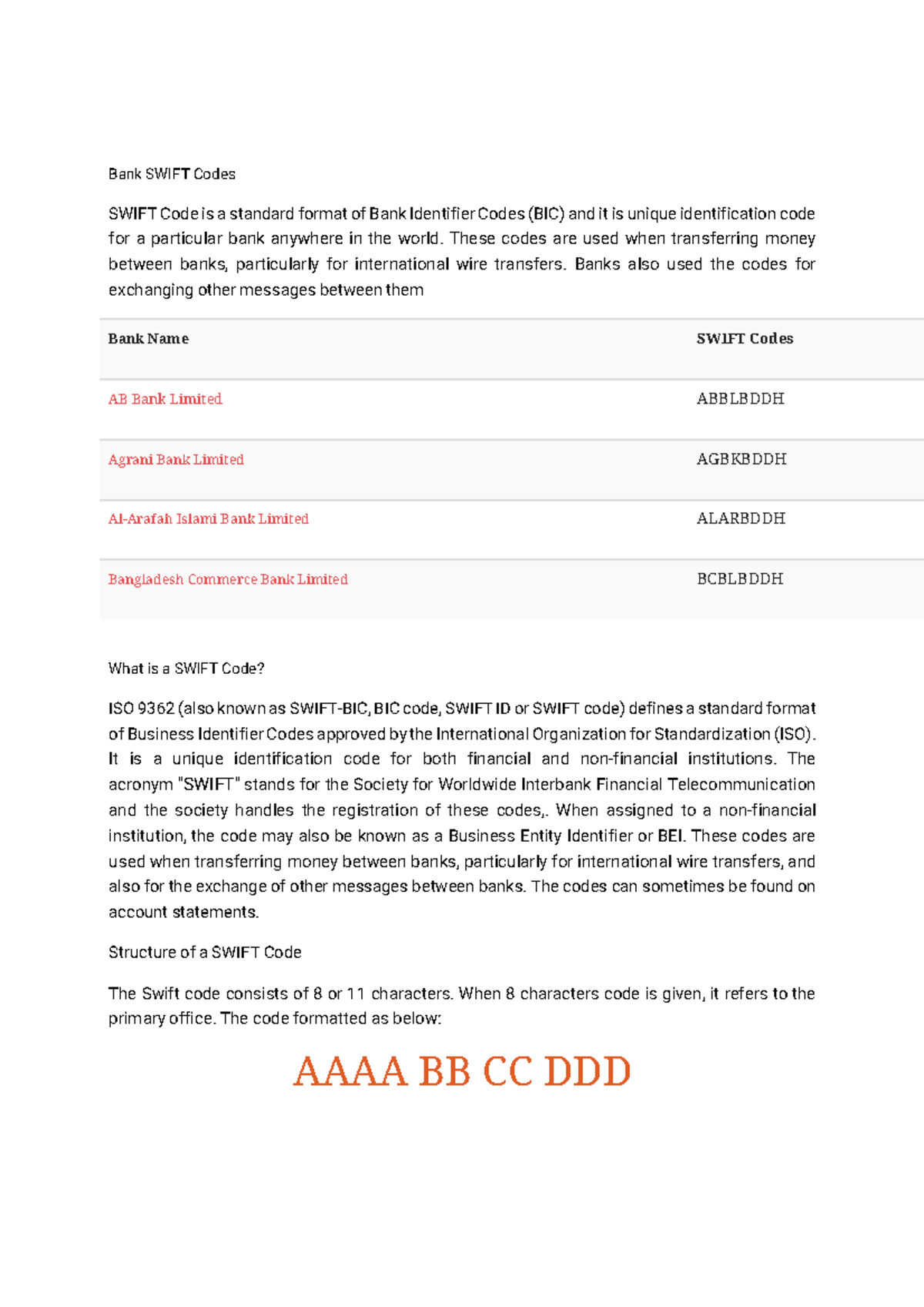
The SWIFT code, or Bank Identifier Code (BIC), is the standard format for Business Identifier Codes approved by the International Organization for Standardization (ISO). It is the most vital piece of information for any international wire transfer involving TD Bank.
The code typically consists of 8 or 11 characters:
- Bank Code (4 letters): "TDOM" represents TD Bank.
- Country Code (2 letters): "CA" for Canada or "US" for the United States.
- Location Code (2 characters): These letters or digits represent the head office city.
- Branch Code (3 characters): (Optional) "XXX" usually refers to the head office, while other characters refer to specific branches.
Verified TD SWIFT Codes for 2026
| Entity | SWIFT/BIC Code | Region | Use Case |
|---|---|---|---|
| TD Canada Trust | TDOMCATT | Canada | Receiving international wires into Canadian accounts. |
| TD Bank, N.A. | TDOMUS33 | United States | Receiving international wires into U.S. accounts. |
| TD Securities | TDOMCATT | Global | Institutional and high-value securities settlement. |
Note: For many personal accounts, the 8-character code (ending without the branch suffix) is sufficient as the funds are routed to the central clearing hub and then distributed to the specific account number.
Supplementary Codes: Transit and Routing Numbers
While the SWIFT code identifies the bank on a global scale, supplementary codes are often required to pinpoint the specific account or branch within the national system.
The Canadian Format
When receiving money into a TD Canada Trust account, the sender may ask for your "Routing Number." In Canada, this is not a single number but a combination:
- Institution Number: 004 (This identifies TD Canada Trust).
- Transit Number: A five-digit number that identifies your specific "home" branch where the account was opened.
- Full Format: Often expressed as 0004XXXXX (where XXXXX is the transit number).
The American Format
For TD Bank, N.A., the nine-digit ABA Routing Number is used. This number is essential for Fedwire or ACH (Automated Clearing House) transfers. If an international sender is using a system that bridges directly into the U.S. clearing house, they may request this routing number in addition to the SWIFT code.
The IBAN Confusion: Does TD Bank Have One?
One of the most frequent questions encountered by TD Bank customers in 2026 is: "What is my TD Bank IBAN?"
The answer is that TD Bank does not have an IBAN. The International Bank Account Number (IBAN) is a system used primarily in Europe, the Middle East, and parts of the Caribbean and North Africa. Canada and the United States do not participate in the IBAN system.
If an international sender (for example, from France or Germany) insists on an IBAN, you must explain that North American banks use the SWIFT code and Account Number combination instead. Providing your 8-digit or 11-digit SWIFT code along with your full account number and branch transit number serves the same purpose as an IBAN.
Requirements for Sending an International Transfer
If you are the one sending funds from a TD account to an overseas recipient in 2026, the identification codes you need will depend on the destination. To ensure the transfer is processed without a hitch, you should gather the following:
- Recipient’s Full Legal Name and Address: Banks now perform more stringent "Know Your Customer" (KYC) checks than ever before.
- Recipient’s Bank Name and Address: This helps verify the SWIFT code provided.
- Recipient's SWIFT/BIC: Mandatory for almost all international wires.
- Recipient's IBAN: Mandatory if sending to an IBAN-participating country (e.g., UK, EU, UAE).
- Purpose of Payment: Many jurisdictions now require a specific reason code (e.g., "Family Support," "Property Purchase") to prevent money laundering.
Cost Considerations and Transfer Methods in 2026
International transfers are rarely free. TD Bank offers several methods for moving money, each with different cost structures associated with their identification codes.
Wire Transfers
The traditional wire transfer is the most reliable for large sums. As of 2026, outgoing international wire fees at TD typically range from $40 to $80 CAD/USD, depending on the amount and the level of service (online vs. in-branch). Incoming international wires usually incur a flat fee, often around $17.50, which is deducted from the received amount.
TD Global Transfer
For smaller personal transfers, TD offers the "Global Transfer" service. This often allows users to send money to a recipient's bank account, for cash pickup via Western Union, or to a Visa Card (Visa Direct). The identification codes for these are often simplified within the TD app, sometimes requiring only a name and an account/card number rather than a full SWIFT profile.
Intermediary Bank Fees
A common "hidden" cost in international banking is the intermediary bank fee. Because TD may not have a direct relationship with a small bank in, for example, rural Thailand, the money must pass through a "correspondent bank." That middle bank may strip a small fee (usually $10–$25) from the principal amount before it reaches the destination.
Troubleshooting and Common Mistakes
Even with the correct TD identification code, errors can occur. Here are the most common pitfalls:
- Confusing "TDOMCATT" with "TDOMUS33": Sending money meant for a Canadian account to the U.S. SWIFT code will result in a "Bank Not Found" error or the funds being returned after several days, often minus the processing fees.
- Missing the Transit Number: In Canada, the account number alone is often not enough to route the money to the correct branch. Always provide the 5-digit transit number.
- Incorrect Currency Selection: If you send CAD to a USD account without a prior agreement, the receiving bank will perform the conversion at their own (often unfavorable) retail exchange rate.
- Transposing Characters: SWIFT codes are alphanumeric. Confusing an 'O' (letter) with a '0' (zero) is a frequent typographical error that can halt a transfer.
Security and Verification Protocols
In 2026, TD Bank employs enhanced multi-factor authentication (MFA) for all international transfer requests initiated online or through mobile apps. When you enter a SWIFT code, the system will typically "auto-populate" the bank name and city. If the auto-populated information does not match your recipient’s bank, do not proceed.
Additionally, be wary of "Business Email Compromise" (BEC) scams. If a supplier sends you an email claiming their "bank identification codes have changed," always verify this via a secondary communication channel (like a phone call) before sending funds. Bank codes for major institutions like TD rarely change.
FAQs
What is the SWIFT code for TD Canada Trust?
The primary SWIFT code for TD Canada Trust is TDOMCATT. This code is used for all international incoming wire transfers to TD accounts located in Canada. While specific branches may have their own 11-character codes, the 8-character "TDOMCATT" is the standard for the head office and is generally sufficient for all Canadian TD branches.
Does TD Bank use a different code for Euro transfers?
The SWIFT code (TDOMCATT or TDOMUS33) remains the same regardless of the currency being sent. However, if you are receiving Euros into a TD account, the bank will either convert them to the local currency (CAD or USD) upon arrival or deposit them into a specialized Foreign Currency Account if you have one set up.
How do I find my specific TD branch transit number?
You can find your 5-digit transit number on the bottom of your TD checks (the first five digits of the routing string) or by logging into TD EasyWeb or the TD mobile app. It is also listed on your monthly bank statements. This number is required alongside the 3-digit institution code (004) for domestic and some international identification.
Why was my international transfer to TD rejected if I used the correct SWIFT code?
Rejections can occur for several reasons beyond the SWIFT code. Common issues include a mismatch between the recipient's name and the account holder's name on file, missing or incorrect transit numbers for Canadian accounts, or the absence of a required "Purpose of Payment" description as mandated by 2026 regulatory standards.
Can I use a TD Routing Number instead of a SWIFT code for international wires?
Generally, no. For transfers originating outside of North America, the SWIFT code is the primary identification mechanism. A domestic routing number (ABA in the US or Transit/Institution in Canada) is usually insufficient for the international SWIFT network to locate the bank, though it is often required as supplementary information.
Practical Recommendation
Before initiating or requesting an international transfer, always verify the specific entity of TD Bank you are dealing with. If the account is in Canada, use TDOMCATT and include your 5-digit transit number. If the account is in the United States, use TDOMUS33 and have your 9-digit ABA routing number ready. For the most accurate results in 2026, initiate transfers through the TD mobile app or EasyWeb, as these platforms include built-in validation tools that check the integrity of the bank identification codes before the funds are dispatched.
Image Gallery