How Commercial Auto Insurance in Melbourne, Arkansas, Is Changing in 2026
The landscape for commercial auto insurance in Melbourne, Arkansas, is currently undergoing a significant transition driven by national actuarial shifts, the integration of telematics, and localized economic pressures. Business owners...
The landscape for commercial auto insurance in Melbourne, Arkansas, is currently undergoing a significant transition driven by national actuarial shifts, the integration of telematics, and localized economic pressures. Business owners in Izard County are seeing changes in premium structures, stricter underwriting requirements for fleet coverage, and a greater emphasis on risk mitigation technology compared to previous years.
Contents
For business owners operating in Melbourne, navigating these changes requires a proactive approach to risk management. As insurance providers recalibrate their models to account for rising repair costs, evolving legal liabilities, and the specific geographic challenges of rural Arkansas, the traditional "set it and forget it" method of policy management is becoming increasingly obsolete. Understanding these shifts is essential to maintaining both operational compliance and financial stability for your commercial enterprise.
The Factors Driving Insurance Shifts in Izard County
The primary drivers of change for commercial auto insurance in Melbourne are not necessarily local, but their impact is felt keenly within the regional market. National trends regarding the "social inflation" of liability claims—where court settlements and jury awards for accidents involving commercial vehicles have risen—are forcing insurance carriers to increase premiums across the board.
In Arkansas, this is compounded by the rising complexity of modern vehicle repair. Today’s commercial vehicles, whether light-duty pickups used by contractors or heavy-duty transit vans, are equipped with sophisticated Advanced Driver Assistance Systems (ADAS). When these vehicles are involved in collisions, the costs for specialized diagnostics, sensor recalibration, and genuine OEM parts have surged. Insurance underwriters are reflecting these higher loss severities directly into the rates offered to local business owners.
Furthermore, economic development in North Central Arkansas has led to increased traffic volume on local routes, including sections of State Highway 9 and State Highway 69. Increased vehicle density, coupled with the seasonal volatility of Ozark weather patterns, creates a unique risk profile that underwriters are beginning to weigh more heavily than in the past.
The Role of Telematics and Usage-Based Insurance
Perhaps the most tangible change for Melbourne businesses is the aggressive adoption of telematics. Carriers are increasingly offering, and in some cases requiring, the installation of "black box" devices or smartphone-based tracking apps to monitor driving habits.
In 2026, the shift is moving from passive monitoring to active risk intervention. Insurers now provide feedback loops that help business owners identify:
- Harsh Braking and Acceleration: Indicators of aggressive driving that increase wear and tear.
- Route Optimization: Patterns that keep drivers on safer, well-maintained roads.
- Idle Time Tracking: Data points that assist in fuel management and engine longevity.
For a small business in Melbourne, demonstrating a commitment to this technology often serves as a primary lever to negotiate better premiums. Businesses that can prove a lower risk profile through data—rather than relying solely on their "clean" history—are finding it much easier to secure favorable terms than those opting out of the technology.
Comparing Traditional Coverage vs. Modern Risk-Adjusted Policies
Choosing the right structure for your commercial auto policy in 2026 requires understanding the difference between standard coverage and dynamic, risk-adjusted options. The table below outlines how these two approaches compare for a typical Melbourne-based business.
| Feature | Traditional Fixed-Rate Policy | Modern Telematics-Adjusted Policy |
|---|---|---|
| Premium Basis | Annual flat fee based on vehicle type | Monthly adjustments based on data |
| Risk Assessment | Static (Credit score, past accidents) | Dynamic (Driver behavior, mileage) |
| Underwriting Focus | Macro-level industry trends | Micro-level individual fleet behavior |
| Loss Control | Reactive after a claim is filed | Proactive monitoring and prevention |
| Requirements | Standard driver MVR checks | Driver consent for data tracking |
Navigating Underwriting Requirements for Local Businesses
The underwriting process for commercial auto insurance in Melbourne has become more stringent. Insurers are looking closer at the "Human Factor" than ever before. If your business employs drivers, you should expect more rigorous scrutiny of Motor Vehicle Records (MVRs). In 2026, insurance companies are tightening the criteria for what constitutes an "insurable driver."
Minor infractions that might have been overlooked five years ago are now being flagged as high-risk indicators. Many carriers are now utilizing automated systems to pull MVRs at renewal rather than just at the inception of the policy. If a driver in your fleet has accumulated points on their license, it may trigger an automatic premium increase or, in some cases, a requirement to exclude that driver from the policy entirely.
To remain compliant and keep costs manageable, businesses should implement:
- Quarterly MVR Audits: Do not wait for your annual renewal to discover that one of your drivers has a suspended license or significant moving violations.
- Safety Training Documentation: Maintain records of driver safety training. Many carriers now offer discounts for businesses that hold documented quarterly safety meetings.
- Vehicle Maintenance Logs: Modern underwriters are asking for proof of preventative maintenance. A well-maintained vehicle is statistically less likely to experience a catastrophic mechanical failure on the road.
Managing Costs in a Hardening Market
As commercial insurance markets continue to harden, the cost of premiums is a significant concern for Melbourne entrepreneurs. While you cannot control the national economic forces driving the cost of claims, you can control how your business presents its risk to the underwriter.
Transparency is the most effective cost-reduction tool. When you apply for a policy or seek a renewal, provide your insurance agent with a detailed summary of your risk management efforts. Highlight your safety culture, the age and condition of your fleet, and any internal policies you have regarding vehicle usage.
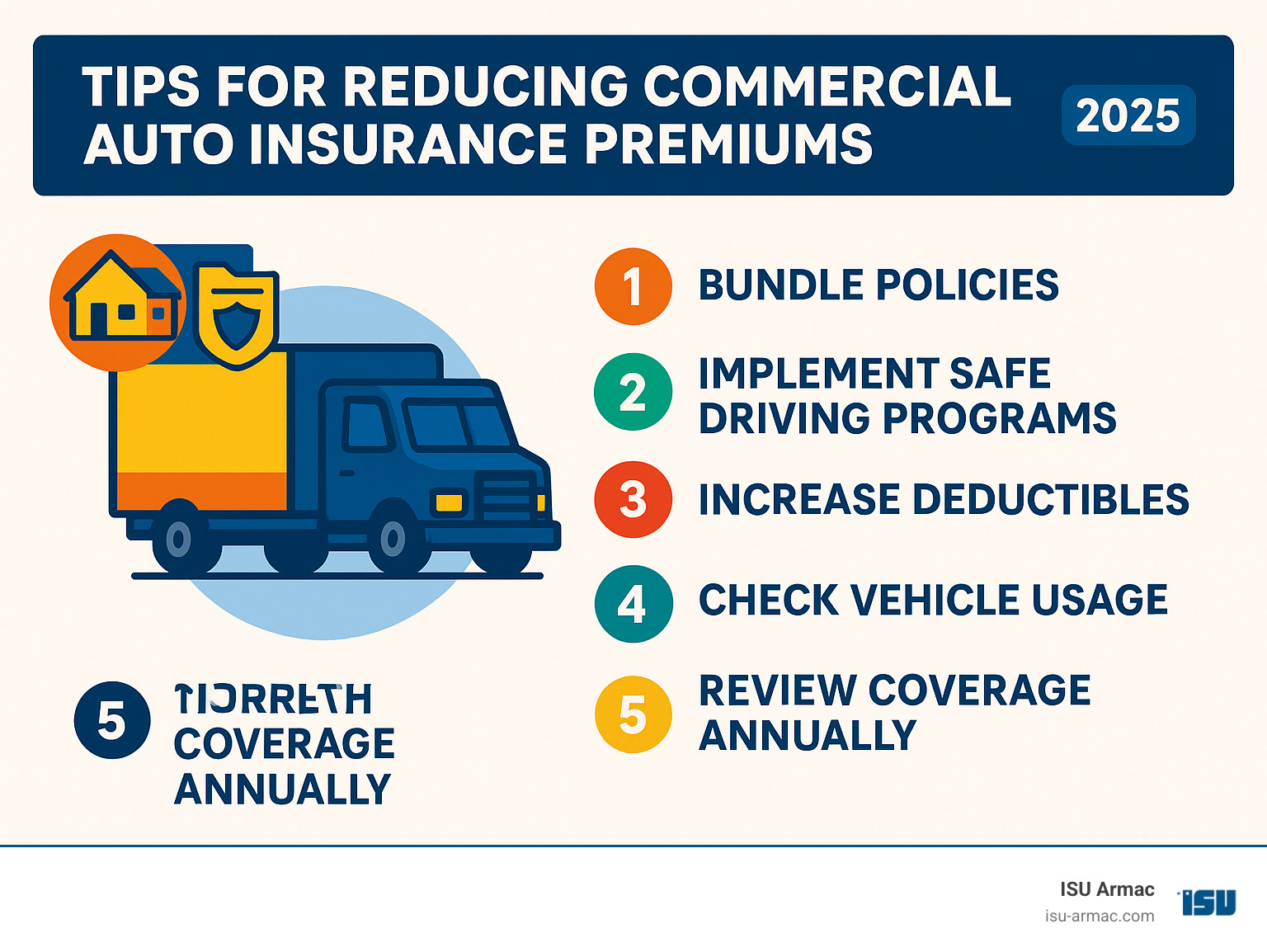
Consider adjusting your deductible structure. By raising your deductible, you lower your monthly premium. However, this is a financial strategy that must be balanced against your company's cash flow. Ensure you have the liquid capital set aside to cover a higher deductible should an accident occur. A higher deductible is a bet on your own safety protocols; it is only a sound financial strategy if you are confident that your risk mitigation is working effectively.
Frequently Asked Questions
Is commercial auto insurance in Melbourne, Arkansas, legally required to be higher than in other states?
No. Insurance rates are not mandated by state law to be a specific amount; however, Arkansas is subject to the same national inflationary pressures affecting all states. Your specific rates are determined by the insurance carrier's actuarial analysis of risk in the Melbourne area, which accounts for local traffic patterns and local repair costs.
Can I use my personal auto insurance for business-related driving in Melbourne?
Generally, no. Personal auto policies almost universally contain "business-use" exclusions. If you are involved in an accident while performing business tasks, your personal insurer may deny the claim, leaving your business exposed to significant personal liability.
How does the size of my fleet affect my insurance policy?
Insurers categorize policies based on size. A single vehicle or a small fleet (often 1–5 vehicles) is typically covered under a Business Auto Policy (BAP), while larger fleets may qualify for "Fleet Policies" that offer different pricing structures and more comprehensive group coverage. Larger fleets have more data points, which can be an advantage for high-safety companies.
Are there specific local discounts for Melbourne businesses?
While there are no "geographic" discounts specific to Melbourne, your business may qualify for multi-policy discounts if you bundle your commercial auto insurance with your general liability or property insurance through the same carrier. Ask your local broker about carrier-specific affinity programs or industry-group discounts.
What should I do if my insurance provider denies coverage for a driver?
First, request the specific reason for the denial. If it is based on an MVR, check the record for accuracy, as mistakes do happen. If the record is accurate, you may need to move that driver to a non-driving role, implement a stricter driver training program, or work with your agent to find a "surplus lines" carrier that specializes in high-risk coverage, though this is typically more expensive.
Next Steps for Your Business
To ensure your business remains protected in the evolving insurance market, conduct an audit of your current coverage this month. Contact your local independent insurance agent to verify that your current limits reflect your current business assets and liabilities, particularly if you have added new vehicles or increased your service radius over the past year. By being proactive rather than reactive, you can secure the necessary coverage to protect your livelihood in Melbourne while minimizing the impact of shifting market conditions.
Image Gallery