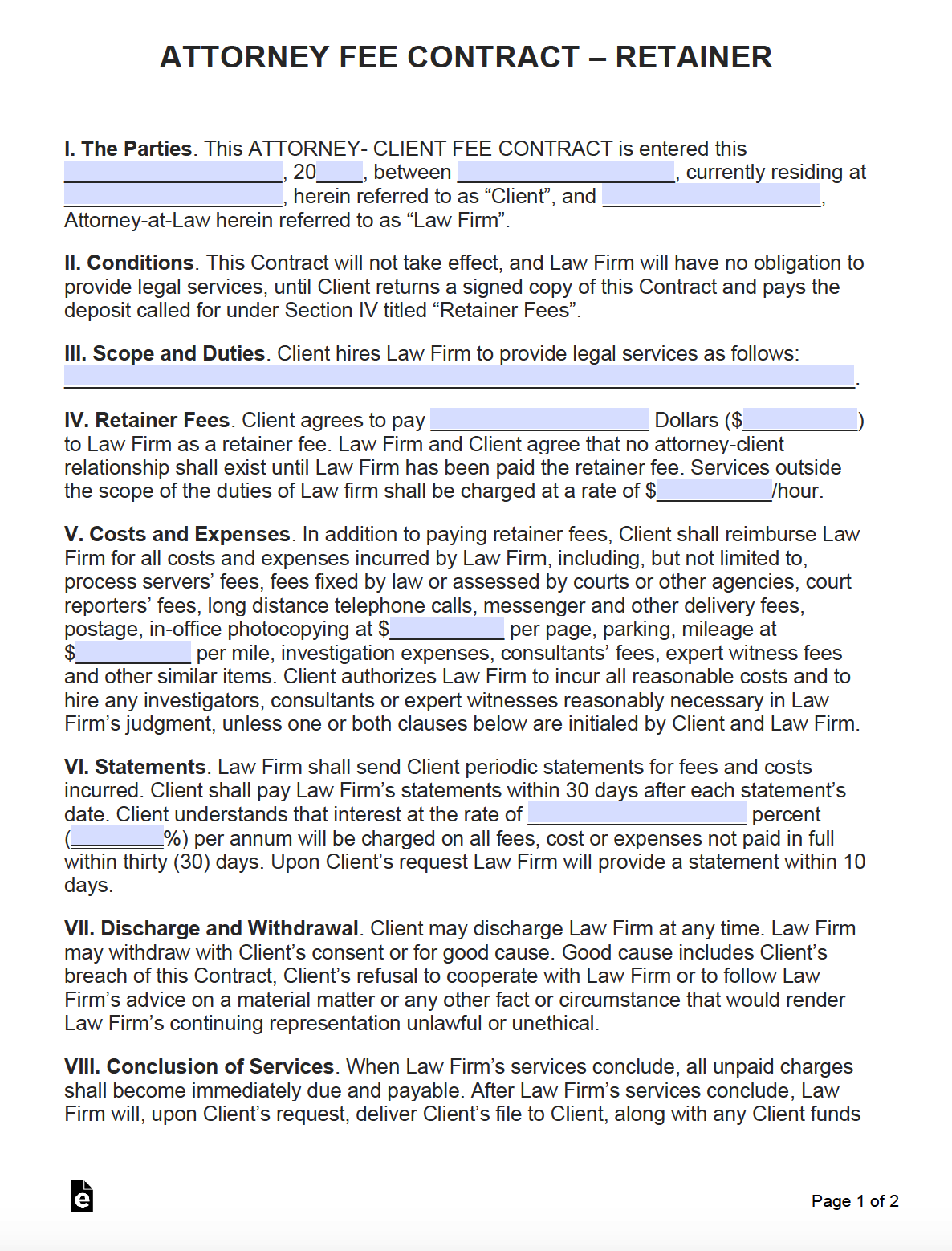
What Is a Lawyer Retainer Fee? How It Works, Costs, and Types
A lawyer retainer fee is an upfront deposit paid by a client to secure an attorney’s services and cover upcoming legal costs. The money is placed into a dedicated client trust account, and the attorney draws from this fund as they perf...
A lawyer retainer fee is an upfront deposit paid by a client to secure an attorney’s services and cover upcoming legal costs. The money is placed into a dedicated client trust account, and the attorney draws from this fund as they perform billable work and earn hourly fees.
Contents
Understanding the Legal Retainer Fee
When individuals or corporate entities hire legal counsel, law firms usually require an initial financial commitment before work begins. This payment is known as a retainer fee. Contrary to a common misconception, a standard retainer fee is not an extra charge, a tip, or necessarily the total cost of legal representation. Instead, it operates as an advance deposit against future legal services, expenses, and billable hours.
Legal retainers protect both parties in an attorney-client relationship. For the law firm, a retainer ensures that the client has dedicated financial resources to pay for services rendered. For the client, paying a retainer reserves the lawyer's availability, establishes formal legal representation, and creates an immediate attorney-client privilege regarding the matter.
In legal practice, retainer structures depend heavily on the area of law, the complexity of the case, and the firm’s standard operating procedures. Understanding how these fees function, where the money is stored, and what rights clients retain over unused funds is essential before signing any legal engagement agreement.
How Attorney Retainer Fees Work: Accounting and Trust Accounts
The administration of a lawyer’s retainer fee is strictly regulated by state bar associations and legal ethics standards. In the United States, rules of professional conduct (such as the American Bar Association’s Model Rule 1.15) dictate precisely how client funds must be handled.
- Client Pays Retainer Fund
- Deposited into IOLTA / Trust Account
- Attorney Performs Billable Work
- Detailed Invoice Issued
- Earned Funds Transferred to Operating Account
1. The Client Trust Account (IOLTA)
When a client pays an advance retainer, the law firm cannot deposit that money directly into its business operating account or use it for general expenses. Instead, the funds must be placed into a separate account known as an Interest on Lawyers' Trust Accounts (IOLTA) or a dedicated client trust account. The funds remain the legal property of the client until the attorney performs billable work.
2. Earning the Fee and Invoicing
As the attorney works on the case—drafting pleadings, conducting legal research, negotiating contracts, or appearing in court—they log their billable time. At regular billing intervals (typically monthly), the firm generates an itemized invoice detailing:
- The date and description of each task performed.
- The attorney or paralegal who performed the work and their hourly rate.
- The precise amount of time billed (often recorded in 6-minute or 15-minute increments).
- Third-party costs paid on the client's behalf (such as court filing fees, expert witness costs, or deposition court reporter fees).
3. Transferring Funds
Once the itemized statement is provided to the client (and provided there are no immediate billing disputes), the law firm transfers the earned portion of the fees from the client trust account into its operational bank account. If any money remains in the trust account at the conclusion of legal representation, state ethics rules require the attorney to refund the unearned balance to the client promptly.
The Four Primary Types of Legal Retainers
Not all retainer agreements operate in the exact same manner. Depending on the legal arrangement, attorneys use one of four primary types of retainers:
1. Security Retainer (Advance Fee Deposit)
This is the most widespread retainer model used in litigation, family law, and corporate representation. The client deposits a fixed sum into a trust account, and the lawyer bills their hourly rate against that fund. If the legal matter is resolved before the initial deposit is exhausted, the remaining funds are returned to the client.
2. Evergreen Retainer
An evergreen retainer builds upon the security retainer framework by setting a mandatory minimum account balance threshold. For instance, if an attorney requires a $10,000 initial retainer with a $3,000 evergreen threshold, the client must replenish the trust account whenever the balance drops below $3,000. This ensures the law firm never works without available client funds in trust.
3. Classic (General) Retainer
A classic retainer—sometimes called an availability retainer—is paid to secure an attorney's availability over a specified timeframe, regardless of whether legal work is actively performed. This model is common for mid-to-large corporations, high-net-worth individuals, or businesses that require standing legal advice. Classic retainers are often considered earned upon receipt by the attorney because the value provided is the attorney’s commitment to remain available and turn down competing clients due to potential conflicts of interest.
4. Special or Flat-Fee Retainer
A special retainer involves an advance payment for a specific, defined project or legal service (such as drafting a simple will, reviewing a lease, or handling an uncontested real estate closing). Depending on state rules, flat fees may be placed in trust and drawn down as project milestones are met or treated as earned upon completion.
Comparing Legal Retainer Types
The table below outlines how different retainer arrangements compare across key operational metrics:
| Retainer Type | Purpose / Mechanism | Account Location | Refundability | Typical Application |
|---|---|---|---|---|
| Security Retainer | Upfront deposit for ongoing hourly billable work | Client Trust Account (IOLTA) | Refundable (unearned portion must be returned) | Civil litigation, divorce, criminal defense |
| Evergreen Retainer | Security retainer requiring client replenishment when balance drops below threshold | Client Trust Account (IOLTA) | Refundable (unearned portion must be returned) | Complex litigation, long-term commercial disputes |
| Classic Retainer | Fee paid solely to guarantee attorney availability over a defined period | Firm Operating Account (in most jurisdictions) | Generally Non-refundable (earned upon receipt for availability) | Corporate counsel, high-profile retainer services |
| Flat-Fee Retainer | Pre-agreed total cost for a specific, single legal transaction | Client Trust Account or Operating Account (varies by state) | Varies (refundable if work is not completed) | Estate planning, routine real estate, basic contract drafting |
Average Retainer Fees Across Common Legal Practice Areas
Retainer amounts vary significantly based on geographic region, firm size, attorney experience, and case complexity. A sole practitioner handling a minor traffic offense will require a drastically lower retainer than a senior litigation partner handling federal antitrust litigation.
- Family Law & Divorce: Initial security retainers typically range from $2,500 to $10,000+. High-net-worth or heavily contested custody cases can require retainers of $15,000 to $25,000 or higher.
- Criminal Defense: For misdemeanor charges, retainers or flat fees generally range between $1,500 and $5,000. Felony representation or complex white-collar defense often commands upfront retainers from $10,000 to $50,000+.
- Civil Litigation & Commercial Disputes: Initial retainers commonly start between $5,000 and $20,000, with ongoing replenishment required via evergreen clauses as depositions and motion practice proceed.
- Estate Planning: Often structured as flat fees rather than open-ended retainers, ranging from $1,000 to $5,000 for comprehensive estate plans.
- Corporate & Business Law: Small businesses typically pay initial retainers between $3,000 and $10,000 for general counsel, contract drafting, or transaction support.
Retainer Fees vs. Other Legal Fee Structures
To understand where a retainer fits into legal costs, it helps to contrast it with alternative billing arrangements:
Retainer Fee vs. Hourly Rates
A retainer is not a alternative to hourly billing; rather, it is the payment mechanism for hourly billing. An hourly rate is the price charged per hour of work (e.g., $350/hour), whereas the retainer fee is the pool of funds used to pay those hourly charges.
Retainer Fee vs. Contingency Fee
In a contingency fee agreement—most common in personal injury, medical malpractice, and debt collection cases—the attorney receives a percentage (typically 33% to 40%) of the monetary recovery obtained through settlement or trial verdict. If the client wins no money, the attorney receives no fee. Consequently, contingency fee cases rarely require a standard retainer fee for attorney time, though clients may occasionally advance funds for hard costs like court filing fees and medical record requests.
Retainer Fee vs. Flat Fee
A flat fee sets a fixed, total cost for a specific legal service regardless of how many hours the attorney puts in. A retainer fee for hourly representation is open-ended: if the case takes more time than anticipated, the client must add more funds to the retainer account once the initial deposit is exhausted.
Key Terms to Inspect in a Legal Retainer Agreement
Before submitting payment or signing an engagement agreement, clients should carefully examine the contract terms governing the retainer:
- Billing Increments: Determine how the attorney logs time. Common billing increments are 1/10th of an hour (6-minute blocks) or 1/4th of an hour (15-minute blocks). Smaller billing increments generally result in lower charges for short phone calls or brief emails.
- Scope of Representation: Ensure the agreement explicitly defines what services the retainer covers. A retainer paid for a corporate contract review does not automatically cover representation in a lawsuit arising from that contract unless specified.
- Replenishment Terms: Look for evergreen clauses that require you to top off the trust account when it falls below a certain dollar limit.
- Expense Allocation: Verify whether non-attorney costs (such as travel, paralegal hours, filing fees, legal research databases, and copying) will be deducted directly from your retainer deposit.
- Refund Policy: Check the language describing what happens to unused funds when representation ends. Under ethical rules, unearned funds in a security retainer must be returned, but clear language prevents misunderstandings.
How to Handle Unused Retainers and Billing Disputes
When a legal matter concludes or if a client terminates the attorney-client relationship prior to resolution, the attorney must perform a final accounting. Any remaining balance held in the client trust account must be promptly refunded to the client.
If a client believes an attorney’s fee deductions from the retainer were excessive, inaccurate, or unauthorized, several steps can be taken:
- Request Detailed Billing Statements: Review the itemized logs to check for billing errors, duplicate entries, or vague descriptions (e.g., billing multiple hours simply listed as "research").
- Submit a Written Objection: Notify the attorney in writing about specific contested entries within the timeframe specified in your engagement agreement.
- State Bar Fee Arbitration: Most state bar associations operate fee dispute resolution or arbitration programs. These programs provide an informal, low-cost mechanism to resolve legal fee disputes without full-scale litigation.
Frequently Asked Questions
Is a lawyer retainer fee refundable?
Yes, in standard security retainer arrangements, unearned portions of a retainer fee are fully refundable. Under legal ethics rules, money held in a client trust account remains the client's property until the attorney actually earns it by performing billable work. However, classic retainers paid solely to reserve an attorney's availability may be non-refundable if permitted by state law.
What happens when a legal retainer runs out?
If a case requires more time or resources than covered by the initial retainer, the client must replenish the retainer account or pay subsequent monthly invoices directly, depending on the terms of the engagement agreement. If an evergreen retainer clause is present, the client is contractually required to maintain a set minimum balance throughout representation.
Can an attorney take money from a retainer immediately?
No. An attorney cannot transfer money from a client trust account to their operating account until the work has been performed and an itemized invoice has been issued to the client, following the required notice period established by state bar regulations.
Does paying a retainer guarantee a specific case outcome?
No. Paying a retainer fee secures legal representation and covers billable work; it does not guarantee a successful verdict, favorable settlement, or specific outcome. Ethics rules prohibit attorneys from guaranteeing results in legal matters.
Why do lawyers charge different retainer amounts for the same type of case?
Retainer requirements vary based on the attorney's hourly rate, years of experience, firm overhead, anticipated case complexity, expected court appearances, opposing party aggressiveness, and geographic jurisdiction.
Recommendations and Next Actions
If you are preparing to retain legal counsel, follow these practical steps to protect your financial and legal interests:
- Request a Written Agreement: Never pay a retainer fee without a signed engagement letter detailing how the money will be held, billed, and refunded.
- Clarify the Retainer Model: Explicitly ask the attorney whether the retainer is a security retainer (refundable advance) or a flat fee, and confirm that funds will be held in an IOLTA account.
- Review Invoices Monthly: Closely inspect every monthly statement. Reconcile charges against work performed while details are fresh in your mind.
- Clarify Additional Staff Rates: Ask how work by paralegals, junior associates, and legal assistants will be charged against your retainer balance, as their hourly rates are typically lower than senior partners.
Disclaimer: This article provides general educational information regarding legal billing structures and does not constitute formal legal or financial advice. Legal regulations and fee rules vary by state and jurisdiction. Consult a licensed attorney in your area to discuss specific legal representation requirements.
Image Gallery