Mile Hi Skydiving Center in Colorado: A Complete 2026 Guide to High-Altitude Jumps
Mile Hi Skydiving Center, located at the Vance Brand Airport in Longmont, Colorado, is the state's premier full-service dropzone. Operating the largest fleet of multi-engine turbine aircraft in the region, it specializes in high-altitu...
Mile Hi Skydiving Center, located at the Vance Brand Airport in Longmont, Colorado, is the state's premier full-service dropzone. Operating the largest fleet of multi-engine turbine aircraft in the region, it specializes in high-altitude tandem skydiving from 17,500 feet MSL, comprehensive Accelerated Freefall (AFF) training, and professional videography services for all experience levels.
Contents
The High-Altitude Advantage at Mile Hi Skydiving
In the world of skydiving, altitude is the primary currency of safety and enjoyment. Mile Hi Skydiving Center distinguishes itself by offering jumps from 17,500 feet Mean Sea Level (MSL). To understand why this is significant, one must consider the geography of the Colorado Front Range. The airport in Longmont sits at approximately 5,050 feet above sea level. When a plane climbs to 17,500 feet MSL, the jumpers are positioned roughly 12,500 feet above the ground (AGL).
This altitude provides approximately 60 seconds of freefall time. Many smaller operations use "Cessna-sized" aircraft that only reach 10,000 or 12,000 feet MSL, which significantly truncates the freefall experience. By utilizing high-capacity turbine aircraft like the DeHavilland Twin Otter and the Beechcraft King Air, Mile Hi ensures that participants receive the maximum possible time in the air. These aircraft are not only faster and more comfortable than smaller piston-engine planes but also allow for larger groups to jump together, which is a major draw for parties and corporate events.
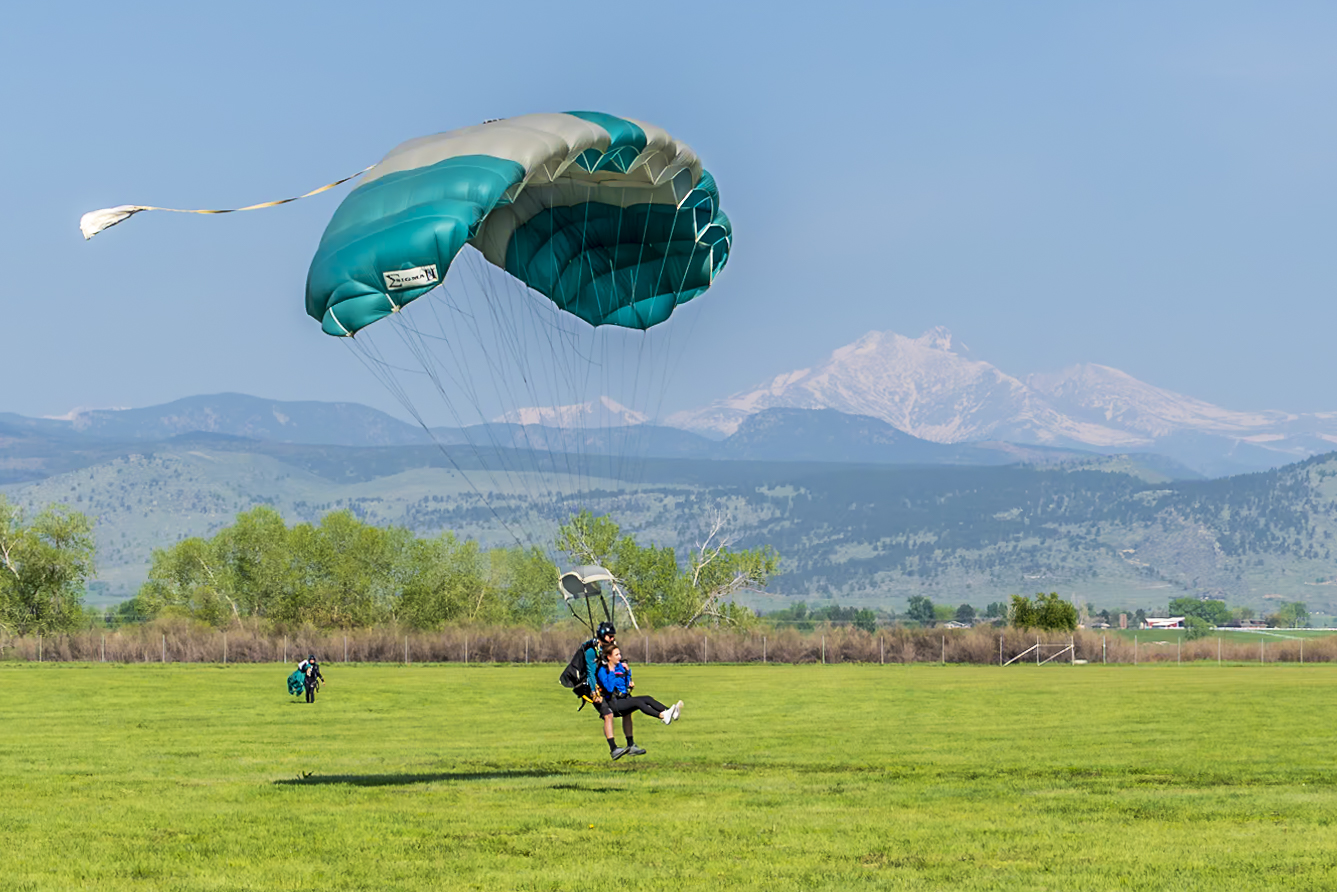
Furthermore, the 2026 season continues to highlight the importance of the "Front Range View." During the ascent, jumpers are treated to a panoramic vista that includes Longs Peak, the Continental Divide, and the Denver skyline to the south. This visual backdrop is often cited as one of the most scenic environments for skydiving in the United States.
The Tandem Skydiving Experience: Step-by-Step
Tandem skydiving is the most accessible way for an individual to experience human flight with minimal training. At Mile Hi Skydiving, the process is designed to be streamlined while prioritizing safety protocols mandated by the United States Parachute Association (USPA).
Arrival and Check-in
Upon arrival at the Longmont facility, participants must present a valid government-issued photo ID. As of 2026, the minimum age remains strictly 18, regardless of parental consent. The check-in process involves a comprehensive waiver system. It is essential to be transparent about physical health; while skydiving does not require peak athleticism, it does require a basic level of mobility and the ability to lift one's legs for landing.
The Training Brief
Unlike solo students, tandem passengers undergo a focused 20-minute briefing. This session covers the four critical phases of the jump:
- The Exit: How to position your body in the "banana" shape as you leave the aircraft.
- The Freefall: Maintaining a stable belly-to-earth orientation.
- The Canopy Ride: Understanding how the instructor steers the parachute and how the passenger can assist.
- The Landing: The crucial "legs up" maneuver to ensure a smooth slide-in or stand-up landing.
Gear and Boarding
The instructor fits the passenger with a specialized tandem harness that features four attachment points, each capable of supporting thousands of pounds of force. Once geared up, the group boards the turbine aircraft. The climb to 17,500 feet takes approximately 15 to 20 minutes, during which instructors perform final gear checks and oxygen levels are monitored if necessary (standard for jumps exceeding 15,000 feet MSL to prevent hypoxia).
Professional Training: The Accelerated Freefall (AFF) Program
For those who wish to move beyond being a passenger, Mile Hi Skydiving Center operates a world-class Accelerated Freefall (AFF) program. This is the fastest method to become a licensed solo skydiver. The program is structured into levels, each designed to build specific skills under the supervision of USPA-rated instructors.
- Ground School: Before the first jump, students attend a rigorous 6-to-8-hour ground course. This covers aerodynamics, equipment function, emergency procedures, and parachute canopy control.
- Initial Levels (1-3): The student jumps with two instructors holding onto their harness. The focus is on stability, altitude awareness, and pulling the ripcord independently.
- Intermediate Levels (4-7): The student transitions to having only one instructor. They learn advanced maneuvers such as 360-degree turns, forward movement, and tracking (horizontal movement to create separation).
- Graduation and Solo Flight: Once Level 7 is cleared, the student is cleared for solo supervised jumps. To earn an "A License," the jumper must complete a total of 25 jumps and satisfy a comprehensive proficiency card.
Mile Hi's status as a USPA Group Member ensures that the training received in Colorado is recognized at any dropzone worldwide. The facility uses modern student gear equipped with Automatic Activation Devices (AADs), which are back-up computers designed to deploy the reserve parachute automatically if the jumper is unable to do so at a safe altitude.
Safety Standards and Equipment Specifications
Safety at Mile Hi Skydiving is governed by both FAA (Federal Aviation Administration) regulations and USPA safety mandates. The center employs full-time FAA-certified airframe and powerplant (A&P) mechanics to maintain their fleet, a necessity given the high volume of flights performed during the peak Colorado summer season.
Parachute Systems
Every skydiving rig used at Mile Hi—whether for tandems, students, or experienced jumpers—contains two parachutes: a main and a reserve.
- The Main Canopy: A rectangular "ram-air" wing that allows for precise steering and soft landings.
- The Reserve Canopy: A secondary parachute that is inspected and repacked every 180 days by an FAA-certified rigger, regardless of whether it has been used.
- The AAD (Automatic Activation Device): All Mile Hi equipment utilizes devices such as the CYPRES 2 or Vigil Cuatro. These devices measure barometric pressure and rate of descent, firing a cutter to release the reserve parachute if the jumper is still in freefall at a critically low altitude (typically around 1,900 feet for tandems).
Weather and Atmospheric Considerations
Skydiving is a weather-dependent sport. In Colorado, "mountain waves" and high-altitude winds can lead to jump cancellations or delays. Mile Hi utilizes real-time aviation weather monitoring to ensure that wind speeds at the surface and at jump altitude are within safe operational limits. In 2026, the center continues to adhere to a conservative weather policy, prioritizing safety over schedule density.
Pricing and Package Comparison
Skydiving is a premium experience that reflects the costs of aviation fuel, specialized equipment maintenance, and professional labor. Below is a breakdown of the typical 2026 pricing structures at Mile Hi Skydiving Center.
| Service Category | Altitude (MSL) | Estimated Price | Key Features |
|---|---|---|---|
| Standard Tandem | 17,500 ft | $240 - $280 | Full freefall, gear, and instructor fees included. |
| Video & Photo Add-on | N/A | $100 - $150 | High-definition footage from an instructor's "hand-cam." |
| Outside Video Add-on | N/A | $160 - $200 | A dedicated camera flyer jumps with you for a 3rd-person view. |
| AFF Level 1 | 12,500 ft+ | $350 - $400 | Includes full-day ground school and two-instructor jump. |
| Licensed Jumper Lift | 17,500 ft | $35 - $45 | "Slot" price for experienced jumpers with their own gear. |
Note: Prices are subject to seasonal changes and fuel surcharges. Group discounts are often available for parties of 5 or more.
Logistics: Preparing for Your Visit
To maximize the experience at Mile Hi Skydiving, participants should follow specific preparation guidelines.
- Clothing: Wear athletic, weather-appropriate clothing. In Colorado, it can be 20-30 degrees colder at 17,500 feet than it is on the ground. Long sleeves and pants are recommended even in summer to protect against the wind and for sliding in on landings.
- Footwear: Lace-up sneakers or "tennis shoes" are mandatory. Boots with hooks, open-toed sandals, or heels are strictly prohibited as they pose a snag hazard or injury risk during landing.
- Nutrition: Eat a light, balanced meal before arriving. Jumping on an empty stomach often leads to nausea or lightheadedness due to the adrenaline surge. Stay hydrated, but avoid alcohol for at least 12 hours prior to the jump.
- Time Commitment: While the jump itself takes under an hour, participants should plan to spend at least 4 hours at the dropzone. Factors such as weather holds, air traffic control delays, and aircraft rotation can impact the schedule.
The Vance Brand Airport (LMO) is located about 45 minutes north of Denver and 20 minutes northeast of Boulder. There is ample parking and a dedicated spectator area where friends and family can watch the parachutes land in the designated landing transition area.
Frequently Asked Questions
What is the weight limit for skydiving at Mile Hi?
The standard weight limit for tandem skydiving is 230 lbs. This limit is dictated by the manufacturer's specifications for the parachute systems and the harness. Participants weighing between 200 and 230 lbs may be subject to an additional "weight surcharge" to account for the extra stress on the equipment and the physical effort required by the instructor. All participants are weighed discreetly during the check-in process.
Is skydiving at Mile Hi Skydiving Center safe?
Skydiving is an inherently high-risk activity, but modern technology and strict regulation have significantly mitigated those risks. According to the United States Parachute Association (USPA), the safety record for tandem skydiving is exceptionally high, with roughly one fatality per 500,000 jumps in recent years. Mile Hi maintains its aircraft to FAA standards and employs instructors with thousands of jumps of experience.
Can I bring my own GoPro or camera?
Per USPA safety regulations, jumpers are not permitted to carry cameras until they have reached a high level of experience (usually a "C License" or 200 jumps). This is because a camera is considered a "snag hazard" and a "distraction" that can interfere with emergency procedures. Mile Hi offers professional video services where instructors use specialized, snag-free mounts to capture the experience safely.
What happens if the parachute doesn't open?
While a "total malfunction" is extremely rare, every skydiving rig is equipped with a reserve parachute. If the main canopy fails to deploy or inflate correctly, the instructor (or solo student) performs a "cut-away" of the main and deploys the reserve. Additionally, the AAD (Automatic Activation Device) serves as a final safety layer to deploy the reserve if the jumper is unable to do so.
Can I jump if I have a fear of heights?
Surprisingly, many regular skydivers have a fear of heights (acrophobia). The sensation of skydiving is more akin to "flying" or "floating" rather than "falling." Because you are so high up, the ground does not provide the same depth perception cues that cause vertigo when standing on a ladder or a tall building. Most participants find the fear disappears once they leave the aircraft door.
Final Recommendation for 2026 Jumpers
If you are planning to skydive in Colorado in 2026, Mile Hi Skydiving Center remains the most robust option for those seeking high altitudes and professional turbine aircraft service. The combination of its proximity to the Denver metro area and its commitment to USPA safety standards makes it a reliable choice for both first-timers and seasoned athletes.
For the best experience, book a morning slot. The Colorado winds tend to be calmer in the early hours, and the air is generally clearer, providing the best views of the Rocky Mountains. Ensure you have your documentation ready, arrive hydrated, and prepare for one of the most significant adrenaline experiences available in the United States.
Image Gallery