Comprehensive Guide to Obtaining a Georgia Educational Leadership Certificate in 2026
To obtain a Georgia Educational Leadership Certificate in 2026, educators must complete a Georgia Professional Standards Commission (GaPSC) approved program, pass the relevant GACE leadership assessments, and adhere to a specific tiere...
To obtain a Georgia Educational Leadership Certificate in 2026, educators must complete a Georgia Professional Standards Commission (GaPSC) approved program, pass the relevant GACE leadership assessments, and adhere to a specific tiered structure. Requirements vary between Tier I for entry-level leadership and Tier II for advanced roles like principal or superintendent.
Contents
The landscape of school administration in Georgia is defined by a rigorous, tiered certification system designed to ensure that school leaders possess both the theoretical knowledge and the practical skills necessary to improve student outcomes. Managed by the Georgia Professional Standards Commission (GaPSC), the educational leadership certificate is not a one-size-fits-all credential. Instead, it is a developmental pathway that scales with an educator's career progression. Whether you are a classroom teacher looking to move into an assistant principal role or a seasoned administrator aiming for the superintendency, understanding the nuances of the 2026 certification requirements is essential for professional advancement.
The Tiered Certification Structure
Georgia transitioned to a tiered leadership model to better distinguish between those who support school operations and those who lead entire buildings or districts. As of 2026, this structure remains the backbone of administrative licensure in the state.
Tier I: Entry-Level Leadership
Tier I certification is designed for educators who seek leadership positions that do not involve the direct supervision of principals. These roles typically include assistant principals, instructional coaches, and department chairs with administrative authority.
The focus of Tier I is on foundational leadership skills, including school operations, basic organizational management, and instructional supervision. Educators at this level work under the guidance of a Tier II leader. To qualify for a Tier I certificate, a candidate must generally hold a Master’s degree and complete a GaPSC-approved Tier I preparation program.
Tier II: Advanced Leadership
Tier II is the "Professional" or "Advanced" level of certification. This is required for anyone serving as a principal or in a district-level position that oversees other leaders or entire school systems.
Tier II programs are significantly more intensive and are performance-based. Unlike Tier I, which is often coursework-heavy, Tier II requires a residency or extensive clinical practice where the candidate demonstrates leadership efficacy in a real-world setting. Candidates must typically hold a Specialist (Ed.S.) or Doctoral degree to move into this tier.
Eligibility and Prerequisites
Before an educator can apply for a leadership certificate, they must satisfy several baseline requirements. The GaPSC mandates that candidates are not only academically prepared but also ethically vetted.
- Valid Professional Certificate: Applicants must already hold a valid professional teaching, service, or leadership certificate in Georgia at Level 5 or higher. This means you must have already completed a Master's degree in a relevant field.
- Experience Requirements: Most preparation programs require a minimum of three years of successful classroom teaching experience before admission.
- LUA Support: For Tier II performance-based programs, candidates must have the support of their Local Unit of Administration (LUA), such as a school district. The district must agree to provide the candidate with leadership opportunities and a mentor.
- Ethics Requirements: All candidates must complete the Georgia Ethics for Educational Leadership assessment. This is often a prerequisite for program admission or a requirement for the initial "induction" phase of the certificate.
Required GACE Assessments
The Georgia Assessments for the Certification of Educators (GACE) are the standardized tests used to verify content knowledge. For educational leadership, there are two primary assessments that candidates must navigate.
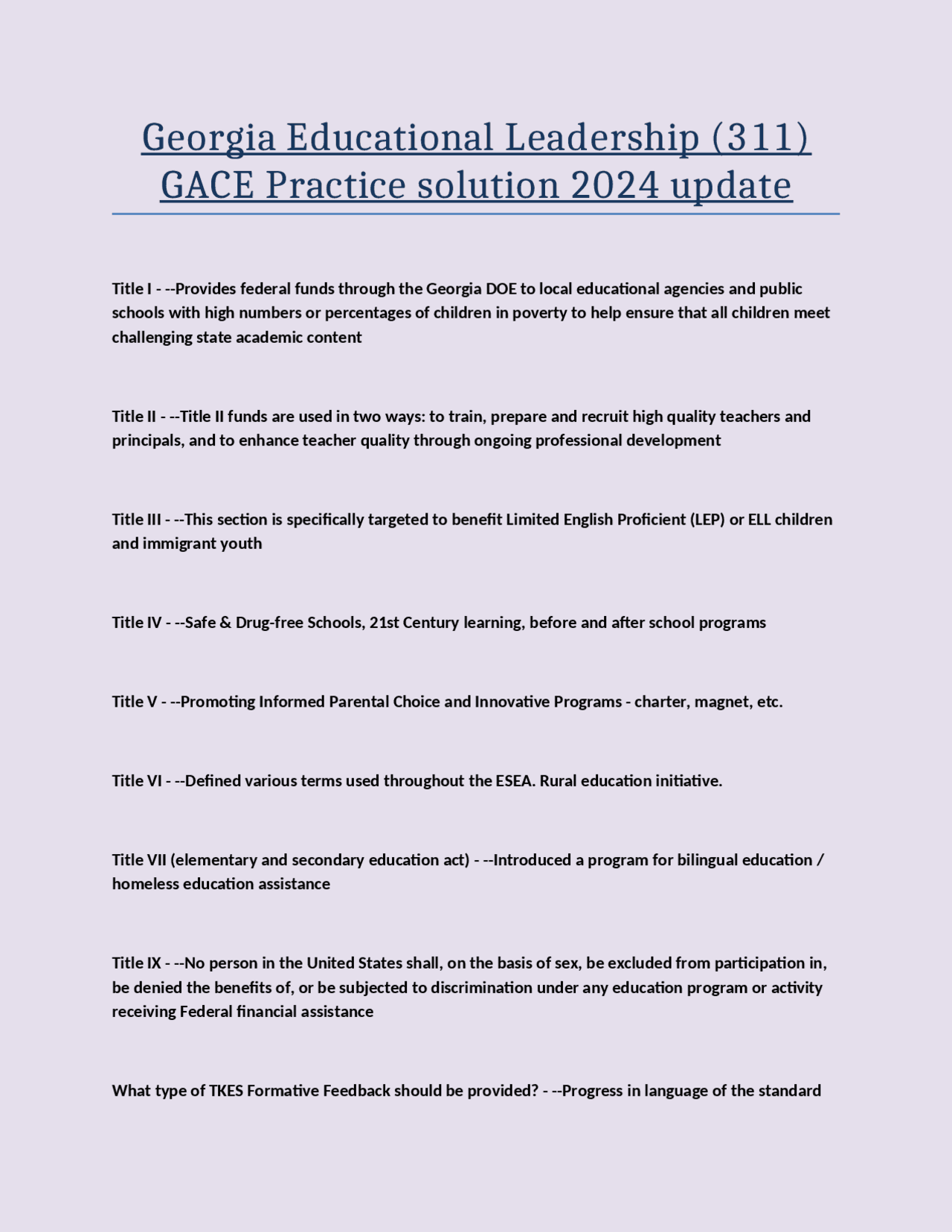
GACE Educational Leadership (Test Code 301)
This is the primary content assessment. In 2026, the test covers a wide array of domains, including:
- Visionary Leadership and School Culture
- Instructional Leadership and Program Improvement
- Management of the Organization, Operations, and Resources
- Collaboration with Families and the Community
- Ethics, Integrity, and Fairness
- The Education System and Professional Development
The assessment is designed to mirror the National Educational Leadership Preparation (NELP) standards, ensuring that Georgia leaders are measured against national benchmarks for excellence.
Georgia Ethics for Educational Leadership (Test Code 380)
This is a modular, computer-based assessment. It is not a traditional "pass/fail" test in the same sense as the content exam, but rather a series of learning modules followed by summative assessments. Candidates must complete this to demonstrate an understanding of the Georgia Code of Ethics for Educators, which governs professional conduct, financial reporting, and student-teacher boundaries.
Comparing Tier I and Tier II Certification
The following table outlines the primary differences between the two levels of certification as of 2026.
| Feature | Tier I (Entry-Level) | Tier II (Advanced) |
|---|---|---|
| Primary Roles | Assistant Principal, Program Manager | Principal, Superintendent, System Director |
| Minimum Degree | Master’s Degree (Level 5) | Specialist or Doctorate (Level 6 or 7) |
| Program Type | Traditional Preparation Program | Performance-Based Residency |
| Clinical Hours | Standard Practicum | Intensive Year-Long Residency |
| Supervisory Scope | Cannot supervise principals | Can supervise all school/district staff |
| GACE Requirement | Content Assessment (301) | Content Assessment (301) + Residency Portfolio |
The Application and Conversion Process
Applying for the certificate involves a coordinated effort between the educator, the university providing the preparation, and the GaPSC.
Step 1: Program Completion
You must complete a program specifically approved by the GaPSC for Leadership certification. If you attend an out-of-state institution, the program must be accredited and lead to leadership certification in that state for Georgia to consider it via reciprocity.
Step 2: Recommendation for Certification
Once your degree or certification-only program is finished, the university's certification officer must electronically "recommend" you to the GaPSC. This confirms that you have met all state-mandated standards and clinical practice hours.
Step 3: MyPSC Account Submission
Educators must log into their MyPSC account to officially apply. This involves:
- Updating personal and professional profile information.
- Selecting the "Add a Field" or "Upgrade" option.
- Confirming that the GACE scores have been sent electronically to the GaPSC.
- Completing the Personal Affirmation Questions (PAQs) regarding criminal history and professional conduct.
Step 4: Employer Verification
If you are currently employed by a Georgia public school district, your Human Resources department will often play a role in the final step of the process, verifying your employment status and supporting the transition from a teaching field to a leadership field on your certificate.
Reciprocity for Out-of-State Administrators
Georgia is a member of the NASDTEC Interstate Agreement, which facilitates the movement of educators between states. However, leadership certification has specific hurdles.
Administrators moving to Georgia in 2026 with an out-of-state license must generally show proof of:
- Completion of a State-Approved Program: The program must have been completed at a regionally accredited institution.
- Professional Experience: Usually, three years of successful leadership experience is required to waive certain Georgia-specific requirements.
- Special Education Requirement: Georgia law requires all educators to complete a course in "Identification and Education of Exceptional Children." This is a common "deficiency" for out-of-state applicants that must be rectified within the first year of Georgia certification.
If the applicant has not passed a leadership content exam in their previous state that is deemed equivalent to the GACE, they will be required to pass GACE 301.
Costs and Financial Considerations
Pursuing an educational leadership certificate is a significant financial investment. In 2026, candidates should budget for the following estimated expenses:
- Graduate Tuition: Prices vary significantly between public institutions (like Georgia State University or Valdosta State University) and private colleges. Costs for an Ed.S. typically range from $12,000 to $25,000.
- GACE Content Assessment: Approximately $190 per attempt.
- GACE Ethics Assessment: Approximately $30.
- GaPSC Application Fees: While many initial certifications are free for Georgia residents, certain upgrades or adding fields may incur a $20 to $40 processing fee if not handled through a district office.
- Background Checks: Fingerprinting and background checks through the Georgia Bureau of Investigation (GBI) typically cost between $45 and $60.
Frequently Asked Questions
Can I skip Tier I and go straight to Tier II?
Generally, no. The GaPSC structure is designed to be sequential. However, some "Certification-Only" programs allow educators who already hold a Specialist or Doctorate in another field to complete the Tier I and Tier II requirements in an accelerated, combined format if they are already in a leadership role.
Does a leadership certificate expire?
Yes. Like all professional certificates in Georgia, the Educational Leadership certificate is valid for five years. To renew, the educator must be employed by an LUA and have a satisfactory performance evaluation. There is no longer a "Professional Learning Unit" (PLU) requirement; instead, renewal is tied to the district's professional development plan.
What happens if I fail the GACE 301?
You may retake the GACE assessment after a mandatory 30-day waiting period. There is no limit on the number of attempts, but you must pay the registration fee for each retake. Most GaPSC-approved programs offer remediation or test-prep sessions for students who struggle with the content exam.
Is an Ed.S. degree required for all leadership roles?
An Ed.S. or higher is technically required for Tier II certification. For Tier I, a Master's degree (Level 5) is sufficient. However, because Tier II pay scales are higher and required for principal roles, most career-minded administrators eventually pursue the Specialist degree.
Can I hold leadership certification if I am not currently an administrator?
Yes. You can hold the certificate in a "Valid" status even if you are currently working as a classroom teacher. This is common for educators who have completed their leadership programs and are waiting for an administrative opening to become available.
Practical Recommendation for Aspiring Leaders
If you are beginning this journey in 2026, your first step should be to secure a mentor within your current school or district who holds a Tier II certificate. Georgia’s leadership model relies heavily on practical application; having a mentor will help you navigate the "Performance-Based" requirements of Tier II and provide the necessary LUA support for your application. Furthermore, prioritize the GACE Ethics Assessment early in the process, as it is a prerequisite for many program enrollments and can be completed relatively quickly.
Image Gallery