Why the Most Smartest Country in the World Matters for Global Development
The concept of the "smartest country" refers to nations that lead in global cognitive development, research output, educational infrastructure, and technological innovation. These countries serve as the primary engines of human progres...
The concept of the "smartest country" refers to nations that lead in global cognitive development, research output, educational infrastructure, and technological innovation. These countries serve as the primary engines of human progress, providing the scientific breakthroughs, economic stability, and intellectual frameworks that allow the rest of the world to mitigate crises, advance public health, and drive sustainable growth in 2026.
Contents
Defining National Intelligence and Cognitive Capital
When researchers and policy experts discuss the "smartest" countries, they rarely refer to a singular, static metric. Instead, they examine a composite of cognitive capital, which includes the average quality of a nation’s education system, the frequency of peer-reviewed scientific publications, the prevalence of patent filings, and the ability to foster high-tech industries.
The importance of these nations lies in their function as "innovation hubs." A country that invests heavily in basic research—such as quantum computing, mRNA vaccine development, or renewable energy materials—does not merely benefit its own citizens. It generates knowledge spillovers. Because scientific data is non-rivalrous, innovations developed in top-tier intellectual environments eventually filter through global markets, allowing emerging economies to adopt advanced technologies without repeating the expensive, time-consuming research and development phases.
The Role of Research and Development (R&D) Infrastructure
The most significant impact of a high-IQ, highly educated population is the creation of complex R&D ecosystems. In 2026, global challenges ranging from climate change to artificial intelligence ethics require intense, collaborative intellectual power. Countries that prioritize STEM (Science, Technology, Engineering, and Mathematics) education and provide robust funding for laboratories and startup incubators act as the world’s primary problem-solvers.
When a nation ranks at the top of international performance indices, it demonstrates a commitment to human capital. This commitment manifests in several critical ways:
- Academic Excellence: High-quality universities that attract global talent, creating a diverse pool of intellectual exchange.
- Technological Autonomy: The ability to develop indigenous solutions for domestic problems, reducing reliance on volatile international supply chains.
- Economic Resilience: A workforce capable of pivoting quickly to new industrial realities, such as the current global transition toward automated manufacturing and AI-integrated administrative services.
Global Impact of Knowledge Distribution
Why does it matter if a country is "smart"? It matters because, in a globalized world, intellectual leadership is the currency of influence. Nations that possess the highest concentration of specialized knowledge define the standards for global industries. For instance, in telecommunications, the countries that lead in semiconductor research set the standards for 6G network protocols.
This creates a "standard-setting" dynamic where other nations must align their regulatory frameworks and technical infrastructure with the pioneers. While this can create a form of digital dependency, it also ensures that global systems operate on high-efficiency, verified scientific foundations. Furthermore, these countries often provide the intellectual scaffolding for international organizations, influencing policies regarding environmental regulations, cybersecurity, and financial market stability.
Comparative Metrics of National Intelligence
Determining which countries lead in these categories requires looking at verified, objective data points. While no single metric is perfect, analysts typically look at the intersection of education scores and innovation indices.
| Metric | Source/Indicator | Impact on National Standing |
|---|---|---|
| PISA Scores | OECD | Measures the application of knowledge in 15-year-olds. |
| Global Innovation Index | WIPO | Ranks countries on R&D, creative output, and institutions. |
| Scientific Output | Nature Index | Measures the quality and quantity of research articles. |
| Patent Filings | USPTO/WIPO | Tracks the commercial application of new ideas. |
By analyzing these metrics, stakeholders can identify the countries that are not just "smart" in terms of test scores, but "effective" in terms of translating that knowledge into economic and social value.
Prerequisites for Sustaining Intellectual Leadership
Becoming—and remaining—the "smartest" is not a permanent state; it is a result of sustained policy choices. For a nation to maintain its intellectual edge, it must satisfy specific conditions:
- Investment in Early Childhood Education: The cognitive foundation of a population is built before the age of 10. Countries with high social mobility and strong primary education consistently outperform those that neglect foundational learning.
- Openness to Talent Migration: No country can rely solely on its indigenous population to solve every complex problem. High-performing nations act as "talent magnets," offering residency and research grants to experts worldwide.
- Institutional Stability: Intellectual work requires long-term planning. Countries with predictable legal systems, property rights, and protection for intellectual property (IP) attract the capital necessary to sustain research projects that may take decades to mature.
- Cultural Support for Innovation: Beyond government policy, there must be a cultural paradigm that values scientific inquiry, empirical evidence, and iterative improvement over dogmatic adherence to tradition.
The Risks of a Knowledge Gap
If the world becomes increasingly bifurcated between a small group of "smart" nations and the rest of the world, we face the risk of a "knowledge divide." This creates a dependency trap. If developing nations cannot cultivate their own intellectual base, they remain perpetually dependent on imported technology.
In 2026, the focus has shifted toward capacity building. The smartest countries realize that their own long-term success is tied to the success of others. When a nation exports its intellectual frameworks—through education programs, technology transfers, or collaborative research—it expands the global market for its own innovations. Therefore, the "smartest" countries matter not just as providers of technology, but as the architects of a stable, functional global order.
Frequently Asked Questions
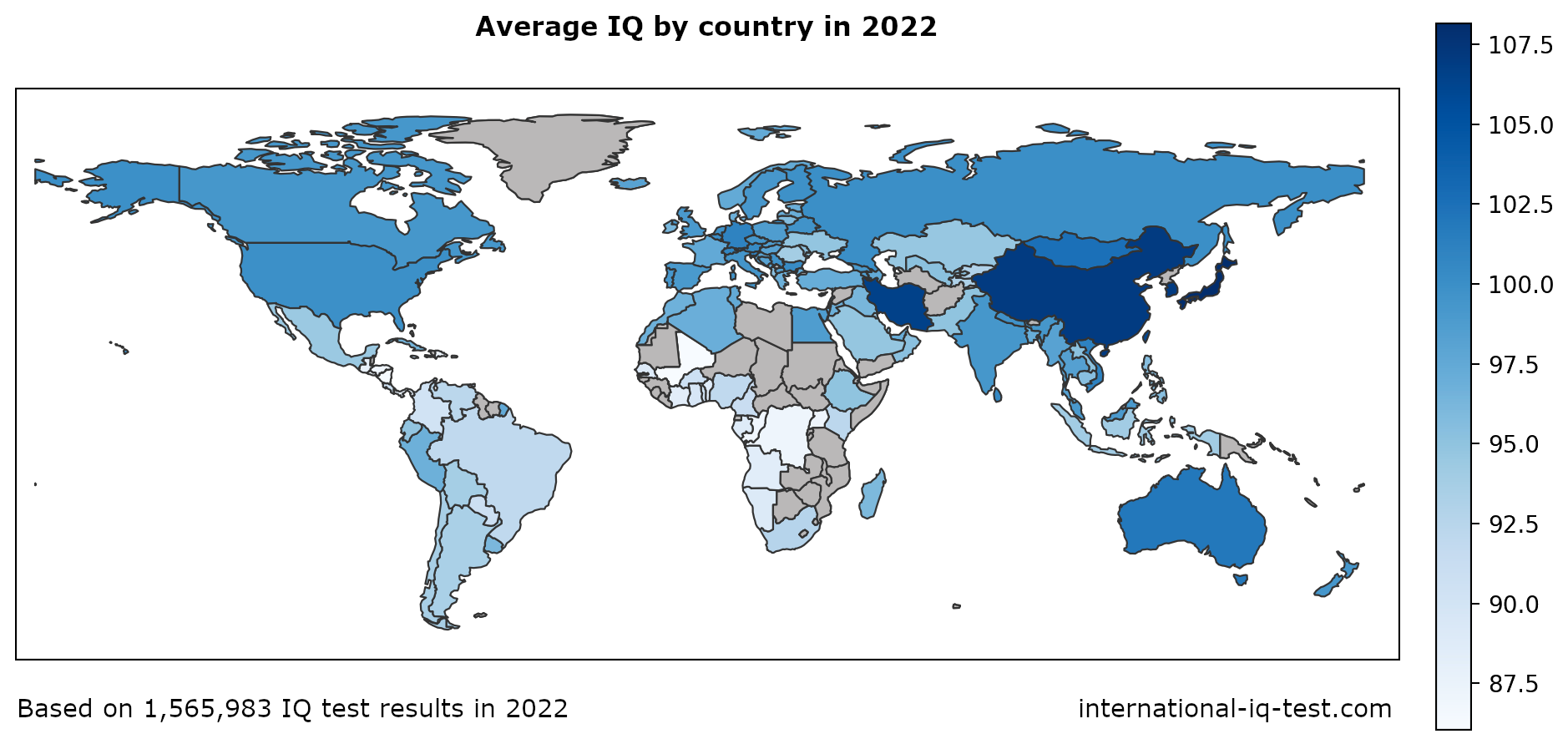
What is the most accurate way to measure national intelligence? There is no single "IQ" score for a country. The most accurate approach involves assessing a combination of educational attainment, the Global Innovation Index (GII), and the volume of high-impact scientific research. These indices account for both theoretical potential and practical application.
Can a country lose its status as a top intellectual power? Yes. Intellectual leadership is highly dependent on policy. A decline in funding for education, a withdrawal from international scientific cooperation, or the erosion of academic freedom can lead to a "brain drain," where top talent leaves for more supportive environments, quickly diminishing a nation’s relative standing.
Why is public education so critical to national success? Public education acts as the pipeline for a nation’s future workforce. Without a robust system that identifies and nurtures talent across all socioeconomic strata, a country loses out on the contributions of a vast portion of its population, effectively capping its potential for innovation.
How does technology influence a country’s intellectual ranking? Technology acts as both a multiplier and a result. Access to high-tech infrastructure allows researchers to work more efficiently, while the successful deployment of new technology proves that a country’s scientific output has practical, market-ready utility.
Next Steps for Policy and Development
For observers, policymakers, and private citizens, the goal is not to merely track which country is the "smartest," but to understand the mechanisms that foster that intelligence. If you are involved in institutional strategy or personal development, prioritize engagement with educational networks and research clusters located in these leading hubs. Supporting open-science initiatives and investing in regional education infrastructure remain the most effective ways to contribute to the global expansion of knowledge. The future of global progress depends on the continued ability of the world’s most advanced nations to share, refine, and apply the insights that drive human development.
Image Gallery