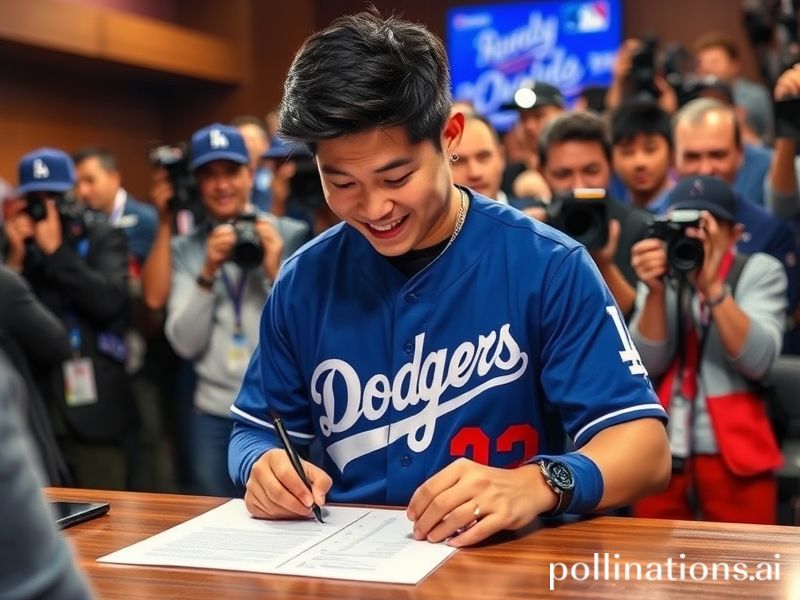
Shohei Ohtani Contract: Guaranteed Terms and Financial Implications
Shohei Ohtani’s historic 10-year, $700 million contract with the Los Angeles Dodgers, signed in December 2023, is defined by unprecedented deferral structures that significantly alter the agreement's net present value. While the contra...
Shohei Ohtani’s historic 10-year, $700 million contract with the Los Angeles Dodgers, signed in December 2023, is defined by unprecedented deferral structures that significantly alter the agreement's net present value. While the contract guarantees $700 million in total compensation, the vast majority is deferred interest-free, fundamentally changing the luxury tax impact for the Dodgers and Ohtani’s effective annual salary for payroll calculation purposes.
Contents
The Structure of the Deal
The agreement between Ohtani and the Dodgers represents a landmark moment in Major League Baseball (MLB) history, not just due to the sheer volume of the contract, but because of its unique fiscal architecture. Unlike standard long-term contracts in professional sports that favor high annual payouts, Ohtani agreed to defer $680 million of his $700 million total compensation until after the conclusion of his 10-year playing term.
Under the terms, Ohtani receives $2 million annually during the life of the contract (2024–2033), with the remaining $680 million payable in installments between 2034 and 2043. Because the contract includes no interest on the deferred amounts, the actual cost of the contract to the Dodgers is significantly lower than the nominal $700 million headline figure when adjusted for inflation and the time value of money.
Luxury Tax and Competitive Balance Implications
One of the most critical aspects of the contract is its impact on the MLB Competitive Balance Tax (CBT), commonly referred to as the luxury tax. Under the Collective Bargaining Agreement (CBA), the value of a contract for luxury tax purposes is determined by its net present value (NPV) at the time it is signed.
Because of the massive deferrals, the MLB and the MLB Players Association (MLBPA) calculated the discounted value of the contract at approximately $460 million. This means that for the purpose of the luxury tax, the Dodgers are charged against their payroll at an annual average value (AAV) of roughly $46 million per season, rather than the $70 million that would have applied had the contract been paid out in standard yearly increments.
This structure grants the Dodgers substantial financial flexibility, allowing the organization to allocate resources toward other high-tier roster additions while remaining compliant with competitive spending thresholds. By lowering the annual CBT hit, the Dodgers maintained the financial capacity to build a championship-caliber team around Ohtani, which served as a primary incentive for the player's willingness to accept such extreme deferrals.
Comparative Breakdown of Contract Impact
To understand the financial implications, it is necessary to compare the nominal contract value against the tax-adjusted realities.
| Metric | Nominal Value | Tax-Adjusted Value |
|---|---|---|
| Total Contract Value | $700 Million | ~$460 Million |
| Annual Salary (Years 1–10) | $2 Million | $46 Million (CBT Impact) |
| Deferred Compensation | $680 Million | N/A |
| Payment Window | 2024–2043 | N/A |
The data illustrates that while the nominal total is $700 million, the operational reality for the team's balance sheet is closer to a mid-tier superstar contract in terms of luxury tax allocation. This disparity is the engine behind the team's ability to maximize its competitive window during the 10-year term.
The Role of Deferrals in Sports Finance
Deferrals are not unique to baseball, but the scale of Ohtani’s deferral is unprecedented. In professional sports, deferred compensation allows teams to manage cash flow and luxury tax thresholds. For the athlete, it provides long-term financial security and, in some cases, tax advantages depending on the residency status of the player during the payout years.
However, the "guaranteed" nature of the contract is absolute. The contract is fully guaranteed, meaning that regardless of performance or injury, the Dodgers are contractually obligated to pay the full $700 million. Even in the event of an early retirement or career-ending injury, the deferral schedule remains intact, providing Ohtani with a long-term revenue stream that extends well into his post-playing career.
Tax and Jurisdictional Considerations
For international athletes like Ohtani, residency at the time of payout is a significant factor. California has some of the highest state income tax rates in the United States. While the specifics of tax planning are private, the deferral of $680 million shifts the recognition of income into the future.
If Ohtani is no longer a resident of California when those payments are distributed between 2034 and 2043, the tax implications on that $680 million could be fundamentally different. This planning is a standard, albeit high-stakes, component of professional athlete wealth management, where the timing of income recognition is leveraged to optimize post-career fiscal positioning.
Risks and Operational Limitations
While the contract is highly favorable for the Dodgers' payroll flexibility, it is not without risks. The primary risk to the team is a loss of liquidity in the future. By locking in a $68 million annual outflow starting in 2034, the Dodgers are essentially committing to a high baseline of payroll obligations that will persist for a decade after Ohtani has likely retired.
For Ohtani, the primary risk is the erosion of purchasing power. Because the $680 million is interest-free, the real value of those payments will decrease over time due to inflation. However, this is largely mitigated by Ohtani’s immense earning potential through off-field endorsements, which arguably dwarf his on-field salary. The contract effectively acts as a foundation for his long-term wealth, while his global brand ensures high annual liquidity outside of his playing salary.
Frequently Asked Questions
Is the $700 million guaranteed if Shohei Ohtani gets injured?
Yes, the contract is fully guaranteed. MLB contracts are standard, meaning the organization is obligated to pay the agreed-upon amount regardless of injury or decline in performance, provided the player remains compliant with the terms of the MLB Uniform Player's Contract.
How does the deferral impact the Dodgers' luxury tax?
The MLB and MLBPA calculate the net present value of the contract. Because of the deferrals, the value is calculated at approximately $460 million, resulting in an annual luxury tax hit of about $46 million rather than the $70 million that a non-deferred $700 million contract would incur.
Why would a player agree to an interest-free deferral?
Ohtani’s decision was largely motivated by his desire to win. By accepting a lower annual tax hit, he provided the Dodgers with the financial room to sign additional high-impact players, which was a core component of his stated goal to maintain a competitive, championship-winning roster throughout his tenure.
Can the Dodgers trade Shohei Ohtani?
Technically, yes. Unless there is a specific no-trade clause in the contract, any MLB player can be traded. However, the complexity of his contract structure and his status as a marquee global asset make a trade highly unlikely, as his value is inextricably linked to the franchise’s long-term commercial and competitive strategy.
What happens to the deferred payments if the team is sold?
The contract is a legal obligation of the Dodgers organization, not the ownership group specifically. If the franchise is sold, the new ownership group inherits the debt and is legally responsible for fulfilling the terms of the contract as stipulated in the original agreement.
Next Actions and Strategic Outlook
For observers of professional sports finance, the Ohtani contract serves as a blueprint for how elite athletes can leverage their market value to influence team construction. Investors and fans should monitor the Dodgers' spending patterns in the coming seasons to see how the $24 million annual "savings" (compared to a non-deferred deal) are utilized in free agency and contract extensions. The success of this deal will ultimately be measured by the team's ability to convert this financial maneuvering into sustained on-field performance over the next decade.
Image Gallery