How to Read Foucault: Approaching Archaeological Method
Reading Michel Foucault’s archaeological works—most notably The Archaeology of Knowledge and The Order of Things—requires a fundamental shift in how you conceptualize history, discourse, and the nature of human knowledge. Rather than s...
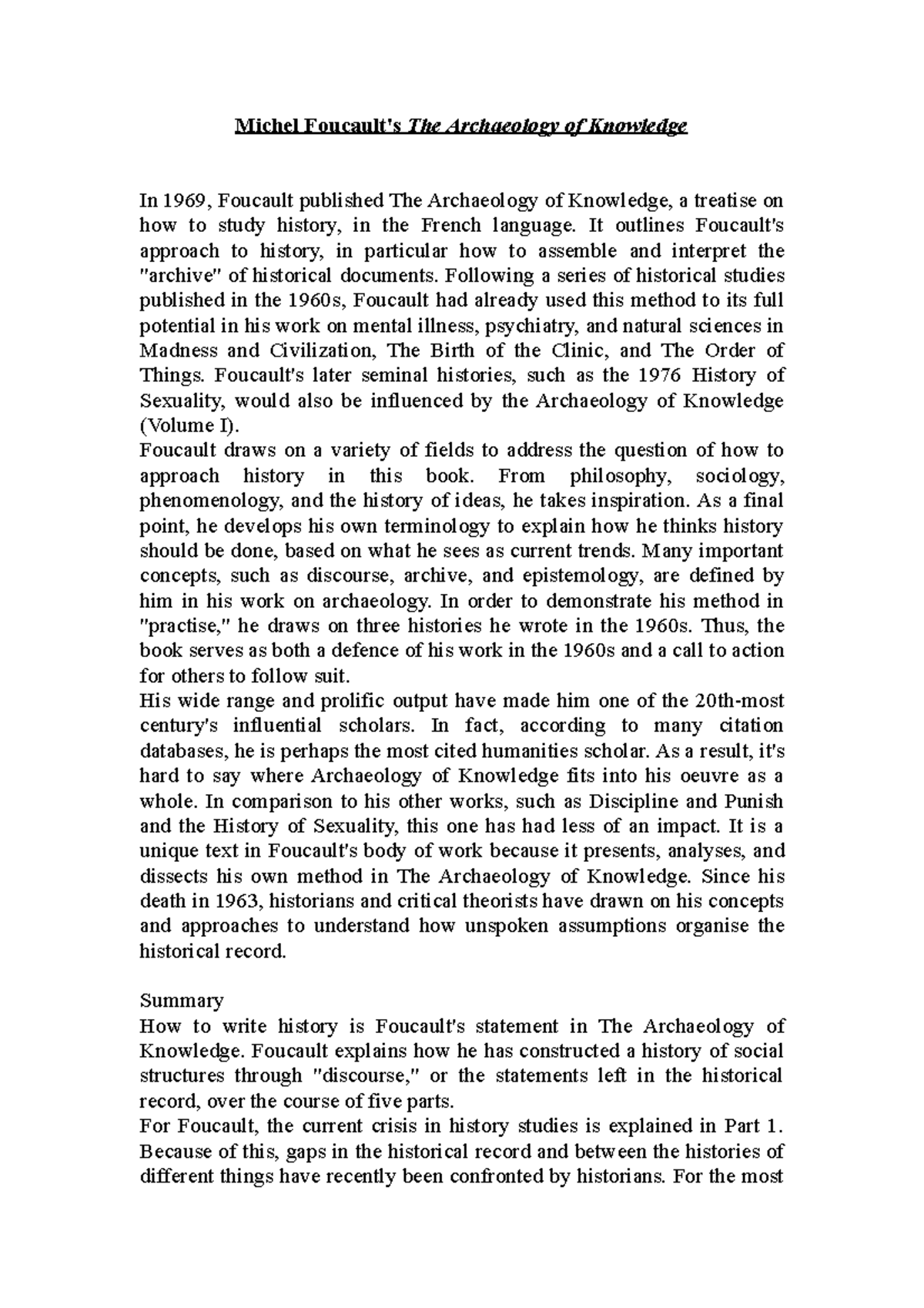
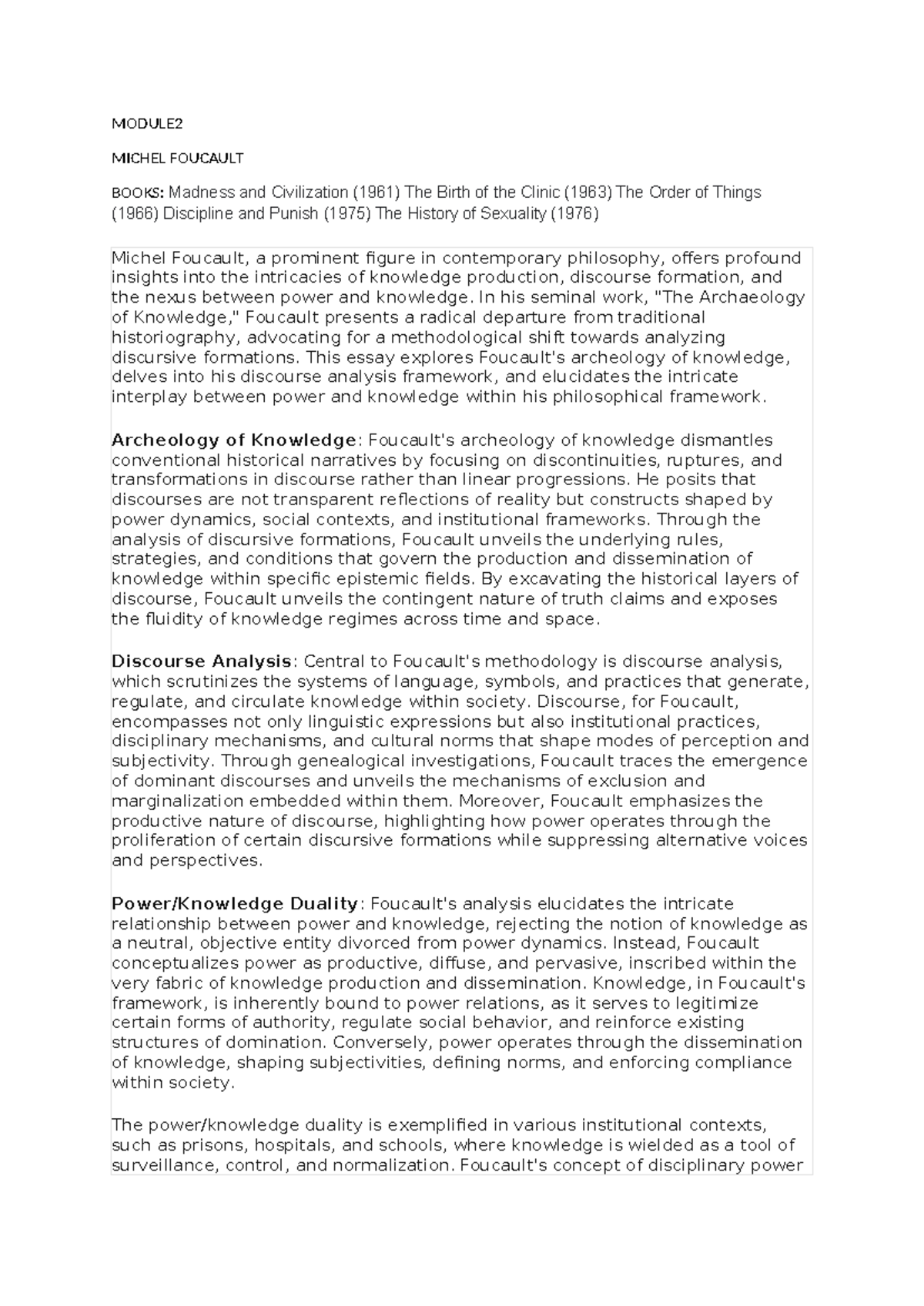
Reading Michel Foucault’s archaeological works—most notably The Archaeology of Knowledge and The Order of Things—requires a fundamental shift in how you conceptualize history, discourse, and the nature of human knowledge. Rather than seeking a linear narrative of progress or a deep hidden meaning behind historical events, you must learn to view texts as material artifacts that function within specific, rule-bound systems. Approaching these dense, structuralist-inflected texts involves abandoning traditional hermeneutics in favor of a descriptive analysis of the "episteme" or the underlying conditions that make certain statements possible at specific historical junctures.
Contents
Understanding the Archaeological Project
The core of Foucault’s archaeological period is the attempt to describe the "archive"—not as a collection of all texts, but as the law of what can be said. When you read Foucault, you are not looking for the intentions of the author or the "spirit of the age." Instead, you are looking for the structural regularities that define what was considered true, false, or even intelligible during a specific period.
Defining the Episteme
The "episteme" is the foundational concept of the archaeological method. It serves as the grid or the subterranean layer of thought that limits and enables the production of knowledge. To read Foucault effectively, you must identify the rules that govern the formation of statements in a given field. Think of the episteme as a historical a priori—the invisible set of constraints that dictated how natural history, economics, and linguistics were organized in the classical era compared to the modern era.
Moving Beyond Hermeneutics
Traditional reading often asks, "What does this text mean?" Foucault’s archaeology asks, "How does this text function within a system?" This distinction is critical. If you attempt to psychoanalyze Foucault’s subjects or look for a secret, underlying reality, you will miss the archaeological move. Foucault is interested in the surface—the dispersion of statements, the rules of their emergence, and the way they are modified, maintained, or replaced over time.
Essential Prerequisites for Engagement
Before engaging with the primary texts, familiarize yourself with the structuralist atmosphere of the mid-20th century, though recognize that Foucault eventually distanced himself from the label. Understanding the basic terminology of Ferdinand de Saussure—specifically the distinction between langue (the system of language) and parole (the act of speaking)—provides a helpful foundation for understanding how Foucault treats discourses as systematic structures.
Recommended Entry Points
Do not attempt to read The Archaeology of Knowledge first. It is a dense, theoretical meta-text that describes the method after Foucault had already put it into practice. Instead, begin with these texts in order:
- Madness and Civilization: A concrete application of archaeological methods to the history of psychiatry.
- The Order of Things: The most famous and comprehensive demonstration of the episteme.
- The Archaeology of Knowledge: The theoretical manual that explains the mechanics of the previous books.
A Comparative Guide to Foucault’s Methods
Distinguishing between the archaeological approach and Foucault’s later genealogical work is essential for preventing confusion. Use the table below to orient yourself when navigating his bibliography.
| Feature | Archaeological Method | Genealogical Method |
|---|---|---|
| Primary Goal | Describing the rules of discourse. | Analyzing the relations of power. |
| Temporal Focus | Stable "epistemes" or blocks of time. | Discontinuous, shifting struggles. |
| Key Question | How is knowledge formed? | How is power exercised? |
| Main Metaphor | The archive (the law of statements). | The battlefield (strategy and tactics). |
Practical Steps for Close Reading
Reading Foucault effectively is a process of unlearning. As you work through the chapters, employ the following analytical strategies to maintain your focus on his specific methodology.
1. Identify the Discursive Formations
Focus on how Foucault groups specific types of knowledge. When he discusses "Natural History," he is not talking about nature itself, but about the discourse of natural history. Pay attention to the objects being named, the types of statements being made, and the institutional settings (hospitals, clinics, museums) that legitimize these statements.
2. Track the "Enunciative Modalities"
Ask yourself who is speaking, from what position, and with what institutional authority. In archaeology, the "subject" is not an individual creator but a position that can be occupied. Determine how the text requires the speaker to be a "doctor," "historian," or "economist" to be heard.
3. Account for Discontinuity
Foucault rejects the idea that history is a steady march toward enlightenment. If you find yourself frustrated by his lack of causal connections between events, recognize this as a feature, not a bug. He highlights the "ruptures" and "breaks" where one way of thinking becomes impossible and another emerges. Embrace the fragmentation of his arguments; it is designed to prevent you from imposing an artificial unity on the history of thought.
Common Pitfalls and How to Avoid Them
The most frequent mistake readers make is attempting to force Foucault into a Marxist or Hegelian framework. Avoid looking for a dialectical progression or an economic base that determines the intellectual superstructure. Foucault’s work is intentionally resistant to these totalizing theories.
- Do not seek "hidden meanings": If a paragraph seems opaque, it is likely because you are looking for a depth that isn't there. Re-read it as a purely technical description of how a statement functions.
- Don't ignore the footnotes: Foucault’s references are often to obscure, technical treatises of the 17th or 18th century. These are the "data" of his archaeology. While you don't need to read them all, understanding the types of documents he chooses is vital to understanding his argument.
- Avoid the "Author-Function" trap: Do not mistake Foucault's own voice for the final authority. He famously critiqued the way we treat authors as sources of truth. Read his books as if they, too, are part of the archive you are analyzing.
Frequently Asked Questions
Is it necessary to know French to read Foucault?
No. While certain nuances of his wordplay are lost in translation, the English editions—such as the widely used A.M. Sheridan Smith translations—are highly regarded and sufficient for academic and philosophical study.
Why does Foucault write in such a complex style?
Foucault’s style is an intentional challenge to conventional academic prose. By using dense, layered sentences, he forces the reader to slow down and prevents them from slipping into the comfort of familiar, "obvious" historical narratives.
How do I reconcile the contradiction in his early and late work?
Do not reconcile them. Foucault’s career was characterized by shifts in method. Reading his work as a series of distinct intellectual experiments is more productive than trying to create a unified, consistent "Foucauldian system."
Can I skip the dense theoretical chapters?
If you are reading for historical application, you can skim the more abstract sections of The Archaeology of Knowledge. However, if you are studying his methodology, these sections are the heart of his contribution to structuralism.
Where should I look for further context?
Consult the Cambridge Companion to Foucault. It provides excellent historical and theoretical context that can help illuminate the specific academic climate of the 1960s and 1970s that shaped his writing.
Final Recommendation
To master the archaeological method, commit to one primary text for an extended period. Read the first three chapters of The Order of Things twice: once to grasp the breadth of his historical scope, and a second time to track the specific "rules" he observes in the classical episteme. If you approach his work as a map of the conditions of thought rather than a story of historical development, you will find his archaeological texts not only legible but profoundly transformative.
Image Gallery