The Moon’s Rotation Time Explained: Understanding Synchronous Rotation and Lunar Days
The Moon rotates on its axis once every 27.322 days. This timeframe is identical to the period it takes to complete one orbit around the Earth, a state known as synchronous rotation. Consequently, the Moon always shows the same face to...
The Moon rotates on its axis once every 27.322 days. This timeframe is identical to the period it takes to complete one orbit around the Earth, a state known as synchronous rotation. Consequently, the Moon always shows the same face to Earth, while the "far side" remains hidden from terrestrial observers.
Contents
Understanding the Moon’s rotation requires a distinction between how we measure time in space. While we often think of a "day" as the time between sunrise and sunset, the physics of the Earth-Moon system creates two distinct ways to define the Moon's rotation and orbital cycle: the sidereal month and the synodic month.
The Mechanics of Lunar Rotation: Sidereal vs. Synodic Time
When discussing the Moon’s rotation time, astronomers use two primary measurements based on different frames of reference. These measurements are critical for navigating spacecraft, planning lunar landings, and understanding the lunar environment.
The Sidereal Month (27.3 Days)
The sidereal month is the true rotational period of the Moon relative to the distant "fixed" stars. If you were standing at a fixed point in deep space and watched the Moon complete one full 360-degree turn on its axis, it would take exactly 27.32166 days. This is also the exact amount of time it takes for the Moon to complete one orbit around the Earth relative to those same stars. Because these two numbers match perfectly, the Moon is said to be in a state of 1:1 spin-orbit resonance.
The Synodic Month (29.5 Days)
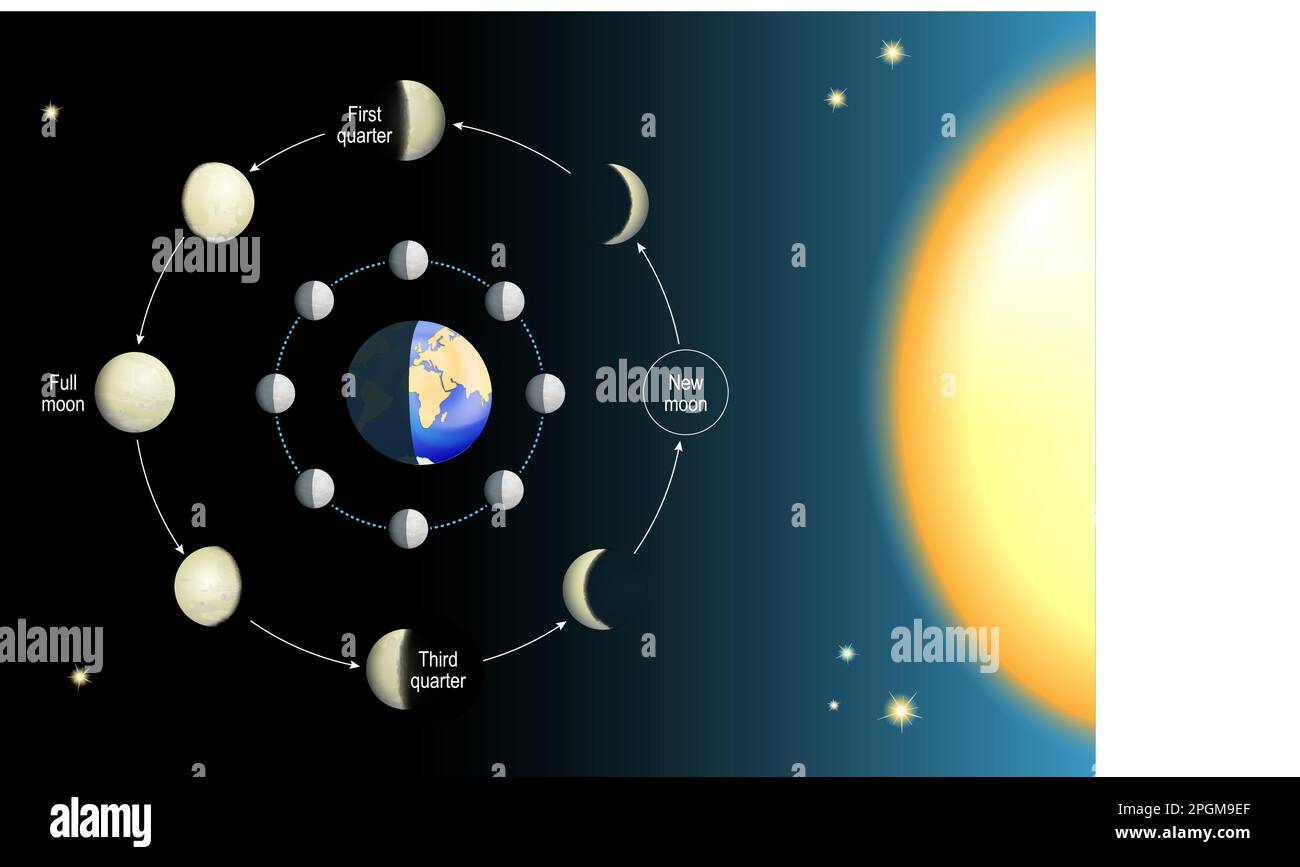
The synodic month is what we perceive as the cycle of lunar phases (from New Moon to New Moon). This takes approximately 29.53 days. The reason for this 2.2-day discrepancy is the Earth’s own movement. As the Moon orbits the Earth, the Earth is also orbiting the Sun. After the Moon completes one 360-degree rotation (a sidereal month), the Earth has moved significantly along its path around the Sun. To return to the same phase (such as a Full Moon), the Moon must travel a little further in its orbit to reach the same relative alignment between the Earth and the Sun.
This distinction is vital for mission planning in 2026. While the physical rotation of the Moon is constant, the lighting conditions for solar-powered equipment on the lunar surface are dictated by the 29.5-day synodic cycle.
Why Does the Moon Always Face Earth? (Synchronous Rotation)
One of the most common questions in astronomy is why we never see the "back" of the Moon from Earth. This is the result of synchronous rotation. If the Moon did not rotate at all, we would see all sides of it as it circled our planet. If it rotated faster than it orbited, we would also eventually see the entire surface.
Because the rotation rate and the orbital rate are perfectly synchronized, the same hemisphere (the near side) is always locked toward the Earth’s center of mass. This creates the illusion that the Moon is not spinning, but it is actually rotating very slowly. To visualize this, imagine walking around a chair while always keeping your face turned toward the seat. By the time you complete one circle around the chair, you will have also completed one full rotation of your body.
The Myth of the "Dark Side"
The term "dark side of the Moon" is a persistent scientific misnomer. In reality, the far side of the Moon receives just as much sunlight as the near side. During a New Moon (when the side facing Earth is dark), the far side is fully illuminated by the Sun. The only time a portion of the Moon is truly "dark" for an extended period is during its two-week lunar night, which affects every part of the Moon's surface at different times during the synodic month.
The Science of Tidal Locking
The reason the Moon’s rotation and orbit are synchronized today is a process called tidal locking. This was not always the case; billions of years ago, the Moon likely rotated much faster than it does now.
Gravitational Torques and Friction
The Earth’s massive gravitational pull exerts "tidal forces" on the Moon. Just as the Moon pulls on Earth’s oceans to create tides, Earth pulls on the Moon’s solid crust, creating a "tidal bulge." Because the Moon was once spinning faster, this bulge was constantly being pulled out of alignment with Earth.
Gravity acted as a brake. Earth’s pull on that misaligned bulge created a torque—a twisting force—that gradually slowed the Moon’s rotation. Over millions of years, this gravitational friction bled away the Moon’s rotational energy until its rotation slowed to match its orbital period. At that point, the bulge stayed permanently aligned with Earth, and the "braking" force ceased, leaving the Moon in its current locked state.
Conservation of Angular Momentum
While the Moon’s rotation slowed down, the "lost" energy had to go somewhere. It was transferred into the Moon's orbital energy. This is why the Moon is slowly moving away from Earth at a rate of approximately 3.8 centimeters (1.5 inches) per year. As the Moon moves further away, its orbital period increases, and eventually, its rotation will slow even further to remain synchronized.
Lunar Libration: Seeing the "Hidden" 9%
While we say we only see one side of the Moon, we actually see about 59% of the lunar surface over time due to a phenomenon called libration. This is essentially a series of "wobbles" that allow us to peek around the edges of the Moon.
| Type of Libration | Cause | Effect on Observation |
|---|---|---|
| Libration in Longitude | The Moon's elliptical orbit (speed varies, but rotation is constant). | We see slightly around the eastern and western limbs (sides). |
| Libration in Latitude | The Moon's 5-degree tilt relative to its orbital plane. | We see slightly "over" the north and south poles. |
| Diurnal Libration | The observer's position on Earth changing as the Earth rotates. | Provides a slightly different perspective from moonrise to moonset. |
Libration in longitude occurs because the Moon's orbital speed follows Kepler’s laws—it moves faster when it is closer to Earth (perigee) and slower when it is further away (apogee). However, its rotation speed remains perfectly steady. This slight mismatch in "timing" between the orbit and the rotation causes the Moon to appear to shake its head "no" from our perspective, revealing extra slivers of the lunar terrain.
Rotation and Temperature Extremes
The slow rotation of the Moon has profound consequences for its surface environment. On Earth, a 24-hour cycle allows for relatively moderate temperature shifts. On the Moon, a single "day" (one rotation) lasts nearly a month.
- Extreme Heat: Any given point on the lunar equator is exposed to direct, unfiltered sunlight for roughly 14 Earth days. Without an atmosphere to circulate heat, temperatures can soar to 127°C (260°F).
- Extreme Cold: Once the Sun sets, that same point enters a 14-day night. Without an atmosphere to trap heat (no greenhouse effect), temperatures plummet to -173°C (-280°F).
For upcoming lunar missions in 2026, these 14-day cycles are the primary engineering hurdle. Habitats and rovers must be designed with massive battery arrays or nuclear power sources (like Radioisotope Thermoelectric Generators) to survive the long, frigid lunar night when solar panels are useless.
Comparison of Rotation Across the Solar System
The Moon is not the only body in the solar system that is tidally locked. In fact, most large moons in our solar system, including Jupiter's Galilean moons (Io, Europa, Ganymede, and Callisto), are tidally locked to their parent planets.
| Celestial Body | Rotation Period | Orbital Period | Relationship Type |
|---|---|---|---|
| Moon | 27.3 days | 27.3 days | Synchronous (Tidally Locked) |
| Earth | 23.9 hours | 365.25 days | Prograde (Independent) |
| Mercury | 58.6 days | 88.0 days | 3:2 Spin-Orbit Resonance |
| Venus | 243.0 days | 224.7 days | Retrograde (Slowest Rotation) |
| Charon | 6.4 days | 6.4 days | Mutually Locked (Faces Pluto) |
Mercury offers a unique comparison. For a long time, scientists believed Mercury was tidally locked to the Sun. However, we now know it is in a 3:2 resonance, meaning it rotates three times for every two orbits it completes. The Moon’s 1:1 resonance is the ultimate "final state" for most satellite-planet relationships.
Common Misconceptions About Lunar Motion
"The Moon doesn't rotate at all." This is the most common error. As explained via the synchronous rotation model, if the Moon did not rotate, we would see all 360 degrees of its surface over the course of one month as it moved around the Earth. The fact that we only see one side is proof that it is rotating at a rate that matches its orbit.
"The Moon’s rotation affects the tides on Earth." Actually, it is the Moon’s mass and orbital position that affect Earth’s tides. The rotation of the Moon itself has a negligible effect on Earth. Conversely, Earth’s gravity has a massive effect on the Moon’s rotation, having dictated its speed through tidal locking over billions of years.
"The Moon rotates once every 24 hours like Earth." If the Moon rotated every 24 hours, we would see the entire lunar surface every single day. Because it rotates roughly 27 times slower than Earth, the "scenery" of the Moon changes very slowly from our perspective.
Practical Implications for 2026 Lunar Missions
As of 2026, international space agencies and private enterprises are increasingly focused on the lunar south pole. The rotation time of the Moon is a central factor in these mission designs.
- Peaks of Eternal Light: Due to the Moon's slight axial tilt and slow rotation, certain high-altitude rims of craters at the poles are in nearly constant sunlight. These locations are "prime real estate" because they provide a constant source of solar energy, avoiding the 14-day night problem.
- Permanently Shadowed Regions (PSRs): Conversely, the floors of deep polar craters never see sunlight. These areas are some of the coldest places in the solar system and are believed to harbor water ice, which is essential for long-term human habitation.
- Communication Latency: Because the Moon always faces Earth, near-side missions can communicate directly with ground stations. However, any mission to the far side (where rotation has turned the "back" away from us) requires relay satellites, such as the Queqiao-2, to bounce signals back to Earth.
Final Recommendation for Observers
To truly appreciate the Moon's rotation, observe the "terminator" line—the boundary between light and dark—over several nights. You will notice that the shadows move across the lunar landscape very slowly. This slow progression is a direct visual manifestation of the Moon's 27.3-day rotation. For those interested in the physics of our solar system, tracking the Moon's phases alongside its position in the sky is the best way to visualize the complex interplay between sidereal and synodic time.
Frequently Asked Questions
Does the Moon rotate clockwise or counter-clockwise? When viewed from above the Earth's North Pole, the Moon rotates and orbits in a counter-clockwise direction. This is the same direction in which the Earth rotates and orbits the Sun.
How fast is the Moon spinning in miles per hour? At its equator, the Moon rotates at about 10.3 miles per hour (16.5 kilometers per hour). For comparison, the Earth rotates at roughly 1,000 miles per hour at its equator. This slow speed is why a single "lunar day" lasts so long.
Will the Moon ever stop rotating? No. While its rotation has slowed significantly due to tidal locking, it will continue to rotate as long as it orbits the Earth. In the very distant future, the Earth’s rotation may slow down enough to be tidally locked to the Moon, meaning only one side of the Earth would ever see the Moon.
What is a "Lunar Day" exactly? A lunar day (a synodic day) is the time it takes for the Sun to return to the same position in the lunar sky. It lasts approximately 29.5 Earth days. This is different from the sidereal rotation period of 27.3 days.
Image Gallery