J.P. Morgan Ultra High Net Worth Services: Comprehensive Guide to Wealth Management and Family Office Solutions
J.P. Morgan ultra high net worth services provide bespoke wealth management, institutional investment strategies, custom liquidity solutions, and multi-generational estate structuring to affluent individuals, family offices, and busine...
J.P. Morgan ultra high net worth services provide bespoke wealth management, institutional investment strategies, custom liquidity solutions, and multi-generational estate structuring to affluent individuals, family offices, and business founders. Delivered primarily through J.P. Morgan Private Bank and its Global Family Office unit, these services target accounts with $10 million to over $100 million in investable assets, linking clients directly to the institution's global capital markets and advisory infrastructure.
Contents
Disclaimer: Financial, tax, and legal strategies discussed herein are for informational purposes only. Ultra-high-net-worth estate planning, credit structuring, and private market investing carry unique risks, regulatory requirements, and jurisdictional variations. Consult qualified wealth advisors, CPAs, and legal counsel prior to executing any financial strategy.
Wealth Tiers and Access Thresholds at J.P. Morgan
J.P. Morgan structures its wealth offerings across distinct client divisions based on total liquid assets, balance sheet complexity, and institutional needs. While standard wealth management handles accounts under $10 million, the J.P. Morgan Private Bank caters explicitly to high-net-worth (HNW) and ultra-high-net-worth (UHNW) segments.
Understanding the specific asset thresholds ensures that prospective clients engage the appropriate division:
- J.P. Morgan Wealth Management ($1M – $10M): Focuses on affluent investors requiring holistic financial planning, managed accounts, standard lending, and basic wealth transfer strategies.
- J.P. Morgan Private Bank ($10M – $100M): The core entry tier for UHNW individuals and business owners. Provides dedicated team coverage (Private Banker, Investment Specialist, Wealth Planner, and Credit Specialist), customized discretionary portfolios, structured lending, and direct alternative asset access.
- Global Family Office & 23 Wall ($100M+): Tailored for single-family offices, multi-generational dynasties, and mega-wealth holders. The 23 Wall unit specifically integrates the private bank with J.P. Morgan’s Corporate & Investment Bank (CIB), granting ultra-wealthy clients co-investment rights, syndicate access, capital market execution, and institutional trading desks reserved for global institutions.
| Tier | Features and Services |
|---|---|
| 23 Wall / Global Family Office ($100M+) | CIB Direct Integration | Co-Investments | Institutional Trading Desks |
| J.P. Morgan Private Bank ($10M - $100M) | Dedicated Advisory Team | Custom Credit | Alternative Investments |
| J.P. Morgan Wealth Management ($1M - $10M) | Wealth Planning | Discretionary Portfolios | Standard Lending |
Core Investment Strategies and Private Market Access
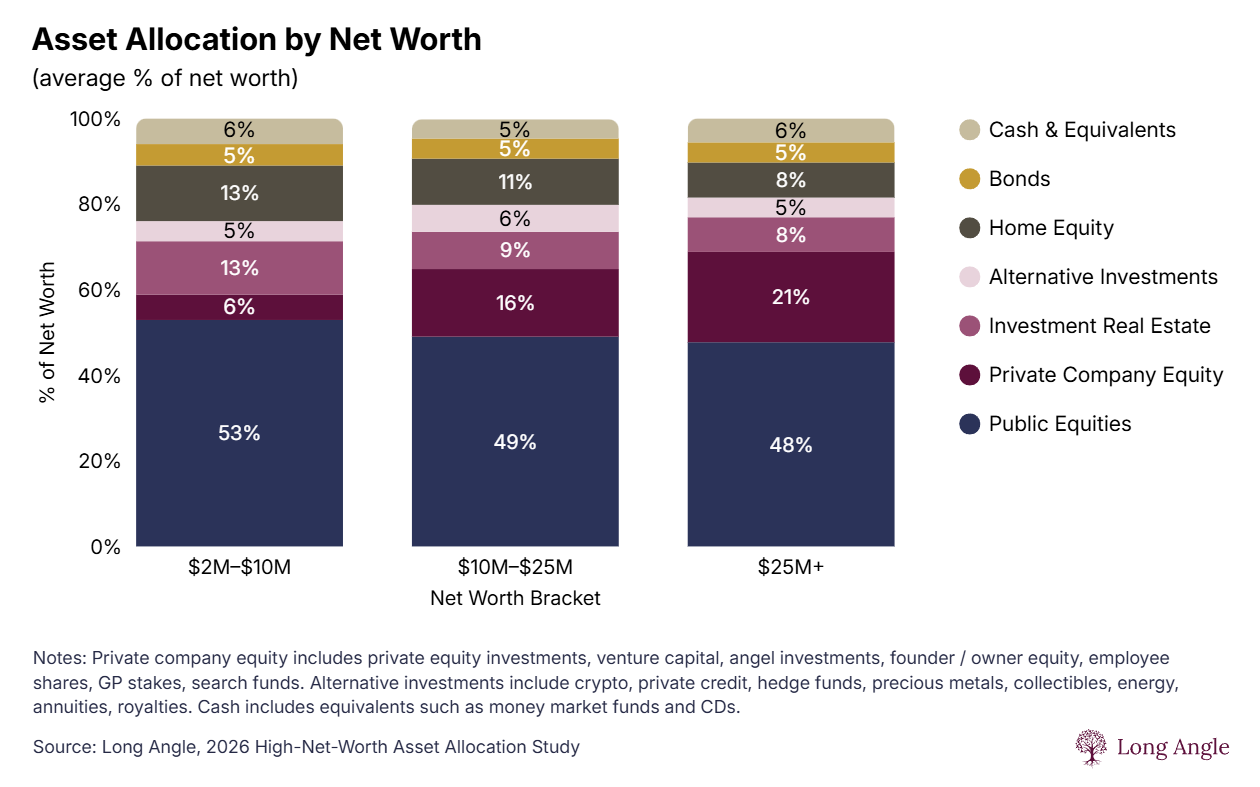
UHNW clients require asset management that goes far beyond traditional 60/40 stocks-and-bonds allocation. J.P. Morgan’s investment division leverages the firm's global scale to construct bespoke portfolios designed for tax efficiency, downside protection, and long-term capital preservation.
1. Private Equity and Venture Capital Access
Through institutional deal flow, UHNW clients gain access to primary private equity funds, secondary markets, and early-stage venture capital. Rather than relying solely on third-party fund-of-funds, J.P. Morgan negotiates lower management fees and lower investment minimums for its private banking clients, facilitating direct co-investment opportunities alongside elite global buyout funds.
2. Private Credit and Direct Lending
In higher-interest environments, private credit has become an essential income generator. J.P. Morgan provides allocation options across senior secured direct loans, mezzanine financing, and distressed debt vehicles. These yield-focused allocations provide predictable cash flows with lower volatility than publicly traded fixed-income markets.
3. Real Estate and Real Assets
Clients can allocate capital across physical real estate portfolios, infrastructure projects, timberland, and agricultural land. Direct real estate strategies encompass core, value-add, and opportunistic commercial properties across North America, Europe, and Asia-Pacific regions, managed either through segregated accounts or private real estate investment trusts (REITs).
4. Custom Discretionary & Separately Managed Accounts (SMAs)
For public equity and fixed-income positions, J.P. Morgan utilizes direct indexing and customized SMAs. Direct indexing allows clients to own individual underlying equities rather than ETFs, enabling aggressive tax-loss harvesting strategies and customized Environmental, Social, and Governance (ESG) or sector exclusions.
Custom Credit and Specialized Financing
Liquidity management for ultra-high-net-worth individuals often involves non-traditional balance sheets heavy with illiquid assets, concentrated equity positions, or private operating companies. J.P. Morgan’s specialized lending group designs custom credit facilities to release liquidity without triggering premature capital gains taxes.
UHNW Credit Facility Types:
Securities-Based Lending (SBL): SBLOC lines against liquid securities
Real Estate & Mortgage Debt: Custom residential & commercial loans
Concentrated Stock Hedging & Credit: Pre-paid forward contracts, equity collar financing
Specialty Asset Financing: Art, Aircraft, Yacht financing
Securities-Based Lending (SBL): Flexible revolving lines of credit secured by public stock, bond, and mutual fund portfolios. Borrowers maintain investment exposures while obtaining immediate liquidity for land acquisitions, business capital calls, or personal purchases.
Concentrated Equity Monetization: For executive founders and shareholders holding substantial stock in a single public company, J.P. Morgan constructs equity derivative structures—such as equity collars, variable prepaid forwards, and margin loans—to limit downside exposure and unlock cash without violating SEC insider rules.
Luxury & Specialized Asset Financing: Custom loans underwritten against non-traditional collateral, including fine art collections, private aircraft, mega-yachts, and commercial real estate assets. The bank employs specialized in-house art advisors and maritime/aviation finance legal teams to evaluate and title these assets.
Capital Call Lines for Family Offices: Specialized credit facilities extended to family offices and private investment vehicles to bridge funding gaps between private equity capital calls and distributions.
Estate Planning, Wealth Structuring, and Governance
Preserving wealth across generations requires sophisticated legal structures, cross-border tax strategy, and structured family governance frameworks. J.P. Morgan Trust Company acts as corporate trustee or co-trustee, providing fiduciary continuity across multiple decades.
Advanced Trust Architecture
The bank assists in designing and administering irrevocable trust structures tailored to client domiciles and jurisdictional preferences:
- Dynasty Trusts: Established in favorable jurisdictions (such as Delaware, South Dakota, or Nevada) to eliminate state income taxes and pass wealth across infinite generations without triggering generation-skipping transfer (GST) taxes.
- Grantor Retained Annuity Trusts (GRATs): Designed to transfer rapid asset appreciation to beneficiaries tax-free by retaining an annuity interest for a term of years.
- Intentional Defective Grantor Trusts (IDGTs): Utilized to freeze estate values by selling appreciated assets to an irrevocable trust in exchange for a promissory note.
- Charitable Remainder & Lead Trusts (CRTs / CLTs): Dual-purpose estate vehicles that combine philanthropic giving with upfront income tax deductions and long-term wealth transfer.
Cross-Border Tax and Regulatory Compliance
For multinational families with dual citizenships, foreign assets, or resident beneficiaries in multiple countries, J.P. Morgan synchronizes compliance across complex international regimes, including the Foreign Account Tax Compliance Act (FATCA), Common Reporting Standard (CRS), and complex local transfer tax laws.
Family Governance and Education
To prevent intergenerational wealth destruction, J.P. Morgan conducts structured family assembly meetings, constitution drafting, and financial literacy programs for Next-Generation ("NextGen") heirs. These sessions cover investment fundamentals, fiduciary responsibilities, and private business stewardship.
Global Family Office (GFO) and 23 Wall Services
For single-family offices managing $100 million or more, standard wealth management infrastructure is often insufficient. J.P. Morgan’s Global Family Office group operates as an institutional service provider to family office executives, CFOs, and Chief Investment Officers (CIOs).
| Investment & Capital Markets | Operational & Administrative Support |
|---|---|
| - Direct Investment Syndication | - Global Custody & Consolidated Reporting |
| - Prime Brokerage Services | - Cybersecurity & Physical Risk Advisory |
| - Foreign Exchange (FX) Hedging | - Entity Level Bill Pay & Cash Management |
| - Co-Investment Deals via 23 Wall | - General Ledger Accounting System Integration |
Strategic Institutional Capabilities:
- Global Custody and Safe-Keeping: Institutional-grade custody services securing global equities, fixed income, cash equivalents, and physical gold across dozens of global markets.
- Consolidated Wealth Reporting: Multi-custodial data aggregation platforms that combine J.P. Morgan holdings with external private bank accounts, private equity capital calls, real estate positions, and non-bank assets into unified performance dashboards.
- Institutional Investment Banking Direct Access (23 Wall): Enables single-family offices to participate in institutional private placements, M&A advisory, initial public offerings (IPOs), and direct venture debt investments normally restricted to institutional fund managers.
- Operational Risk and Cybersecurity: Advisory services designed to audit and harden family office IT networks, secure private communications, and establish physical security protocols for high-profile principals.
Comparative Matrix: Wealth Service Tiers at J.P. Morgan
To evaluate how J.P. Morgan’s UHNW services compare across client segments, review the functional matrix below:
| Feature / Capability | Wealth Management | Private Bank (HNW/UHNW) | Global Family Office / 23 Wall |
|---|---|---|---|
| Minimum Asset Threshold | $1,000,000 | $10,000,000 | $100,000,000+ |
| Primary Account Manager | Wealth Advisor | Dedicated Private Banker | Senior Institutional Relationship Executive |
| Investment Strategy | Asset allocation models, mutual funds, ETFs | Custom SMAs, direct indexing, private markets | Co-investments, customized liquidity derivatives, institutional trading desks |
| Lending & Credit Capabilities | Mortgages, standard lines of credit | Custom SBLOCs, art/yacht/aircraft financing, concentrated equity leverage | Complex corporate debt, bridge financing, capital call lines |
| Trust & Estate Support | Standard trust administration, estate templates | Custom trust drafting, corporate trustee services, tax structuring | Multi-jurisdictional dynasty trusts, complex tax mitigation |
| Institutional CIB Access | No | Limited (via private placements) | Full direct integration (M&A, IPO allocation, capital markets) |
| Reporting Services | Standard account statements | Integrated digital performance dashboards | Multi-custodial consolidated reporting & API accounting feeds |
Fee Structures and Pricing Expectations
J.P. Morgan Private Bank operates on a multi-tiered pricing schedule that varies depending on total Assets Under Management (AUM), asset complexity, credit usage, and specialized transaction fees.
1. Investment Management Fees (AUM-Based)
Management fees for investment portfolios are assessed annually as a percentage of assets under management, calculated on a sliding scale that decreases as asset levels rise:
- First $10M - $25M: Typically ranges between 0.60% and 0.90% for discretionary equities and fixed income.
- $25M - $100M: Blended tiering reduces fees to roughly 0.40% to 0.65%.
- Above $100M: Custom negotiated fee schedules, frequently dipping below 0.30% for passive/core strategies, plus direct vehicle costs.
Note: Alternative investment funds (Private Equity, Real Estate, Hedge Funds) incur separate underlying fund management fees (typically 1.0%–1.5%) and performance incentives (carried interest, typically 10%–20%).
2. Trust and Fiduciary Administration Fees
Corporate trustee services are billed based on trust market value or fixed retainer schedules:
- Annual Administrative Trustee Fee: Generally starts at 0.20% to 0.50% on the first $10 million in trust assets, with marginal tiering for larger trust balances.
- Special Assets Fee: Assets such as closely held operating businesses, real estate, or mineral rights held within trusts incur additional evaluation and maintenance fees.
3. Credit and Lending Rates
Securities-based lending and custom mortgages are priced based on benchmark interest rates—such as the Secured Overnight Financing Rate (SOFR)—plus an agreed-upon credit margin dependent on loan-to-value (LTV) ratios and relationship pricing:
- SBL Margin: Spread typically ranges from SOFR + 1.00% to SOFR + 2.25%, with significant spread reductions available for high-balance borrowers.
Onboarding and Evaluating J.P. Morgan UHNW Services
Transitioning a complex financial infrastructure to J.P. Morgan Private Bank involves an extensive audit and onboarding procedure. Prospective clients should execute the following steps to ensure smooth execution:
- Step 1: Balance Sheet Audit & KYC Compliance
- Step 2: Dedicated Team Matching & RFP Review
- Step 3: Wealth & Asset Structuring Discovery
- Step 4: Custody Transfer & Portfolio Implementation
Step 1: Complete Comprehensive Balance Sheet Auditing
Gather detailed documentation regarding asset titling, existing trust agreements, tax returns (past 3 years), corporate operating agreements, and valuation metrics for private holdings. Due to strict Anti-Money Laundering (AML) regulations and Know Your Customer (KYC) requirements enforced by global regulators like FINRA and the Office of the Comptroller of the Currency (OCC), verifying source of wealth is mandatory before account setup.
Step 2: Request formal Proposals and RFP Presentations
Meet with prospective Private Banking teams to review competitive proposals. Evaluate:
- Demonstrated performance across similar UHNW family profiles.
- Transparency in underlying investment management and vehicle fees.
- Depth of local team presence versus global product access.
Step 3: Align Investment Policy Statement (IPS) and Tax Boundaries
Work with the designated Investment Specialist to author a customized Investment Policy Statement. Define explicit constraints, including liquidity cushions, currency exposures, tax-loss harvesting mandates, ESG restrictions, and risk parameters.
Step 4: Execute Custody and Asset Transfer Sequences
Initiate Automated Customer Account Transfer Service (ACATS) transfers for liquid public securities to minimize cash drag and market exit risk. Coordinate re-registration of private equity capital call accounts and direct deeds for physical real estate holding entities.
Frequently Asked Questions
What is the absolute minimum asset requirement for J.P. Morgan Private Bank?
While J.P. Morgan Wealth Management handles affluent accounts starting at $1 million, full J.P. Morgan Private Bank coverage generally requires $10 million in investable wealth. Specialized institutional family office services through 23 Wall typically require $100 million or more in liquid net worth.
How does J.P. Morgan Private Bank handle single-stock concentration risk?
J.P. Morgan employs dedicated equity derivatives desks to construct custom risk-mitigation strategies. These include equity collars (buying puts while selling covered calls), prepaid variable forward contracts, exchange funds (swapping concentrated stock for an interest in a diversified fund pool tax-free), and securities-backed credit lines that enable liquidity without triggering immediate capital gains taxes.
Can clients select their own external attorneys and CPAs while using J.P. Morgan Private Bank?
Yes. J.P. Morgan’s wealth planners and trust officers regularly collaborate with a client's existing independent tax accountants, corporate attorneys, and estate counsel. The bank can execute corporate trustee duties while managing wealth plans in tandem with outside professional advisors.
How does J.P. Morgan protect ultra-high-net-worth clients against operational and digital fraud?
J.P. Morgan implements institutional-grade security protocols, including dual-factor transaction authorization, hardware security keys, out-of-band voice verification for major transfers, continuous dark-web monitoring, and custom cyber-risk consulting designed specifically for family office staff and household employees.
What is the difference between J.P. Morgan Private Bank and J.P. Morgan Wealth Management?
J.P. Morgan Wealth Management serves mass-affluent investors using broad advisory solutions, online investment tools, and standardized credit. J.P. Morgan Private Bank provides high-net-worth and ultra-high-net-worth clients with access to dedicated four-person specialist teams, institutional investment banking access, custom asset-based lending, cross-border tax structuring, and corporate trustee services.
Actionable Next Steps
To engage J.P. Morgan ultra high net worth services effectively:
- Audit Liquid vs. Illiquid Asset Allocations: Differentiate assets requiring immediate operational liquidity from long-term capital suited for private equity, credit locks, or irrevocable trusts.
- Evaluate Current Fiduciary & Trustee Relationships: Determine whether your current corporate or individual trustees possess the global infrastructure required to manage complex multi-generational transfers.
- Schedule an Initial Private Banking Consultation: Request a preliminary prospective account review through an official J.P. Morgan Private Bank office (major centers include New York, London, Geneva, Singapore, Miami, San Francisco, and Chicago) to evaluate competitive fee tiers and customized asset allocation proposals.
Image Gallery