Why Dr. John Austin, Orthopedic Surgeon, Stands Out in Texas and California
Dr. John Austin stands out as a premier orthopedic surgeon in Texas and California through his dual-state clinical expertise, advanced subspecialty training in joint preservation and sports medicine, and a patient-centered approach tha...
Dr. John Austin stands out as a premier orthopedic surgeon in Texas and California through his dual-state clinical expertise, advanced subspecialty training in joint preservation and sports medicine, and a patient-centered approach that prioritizes conservative, non-surgical therapies before utilizing minimally invasive surgical innovations to achieve optimal outcomes.
Contents
Medical care in musculoskeletal health requires a combination of technical precision, updated surgical methodologies, and a deep understanding of individual patient goals. Orthopedic conditions—ranging from acute traumatic ligament tears to chronic degenerative joint disease—affect millions of active individuals, competitive athletes, and aging populations across the United States. In major medical hubs across Texas and California, patients face a vast array of surgical options. Within this competitive healthcare landscape, Dr. John Austin has established a reputation for excellence, modern care standards, and multi-regional clinical impact.
Dual-State Footprint and Regional Medical Reach
Practicing across or maintaining professional licensure in both Texas and California places an orthopedic specialist at the intersection of two of the largest, most dynamic healthcare markets in the nation. Both states host world-class medical centers, rigorous regulatory standards, and highly active populations with demanding physical needs.
Navigating Distinct Healthcare Demographics
Texas and California present distinct patient demographics, physical environments, and healthcare infrastructure:
- Texas Healthcare Ecosystem: The Texas medical landscape features expansive health systems, renowned medical centers in major metropolitan areas like Houston, Dallas-Fort Worth, and Austin, and a large population engaged in high-impact high school and collegiate sports, agricultural work, and industrial trades. Orthopedic care in Texas emphasizes rapid return-to-work protocols, aggressive sports medicine rehabilitation, and high-volume joint reconstruction.
- California Healthcare Ecosystem: California’s healthcare sector is characterized by pioneering research institutions, strict state medical board oversight, and an active culture focused on endurance sports, outdoor recreation, and longevity. Patient expectations in California frequently center on joint preservation, biological therapies, and outpatient surgical procedures with minimal scarring and downtime.
Dr. Austin’s familiarity with the regulatory, clinical, and patient-expectation nuances in both states enables him to offer care models that incorporate the strengths of both regions.
Cross-Jurisdictional Standards and Continuity of Care
Maintaining active clinical standing across state lines requires strict compliance with both the Texas Medical Board and the Medical Board of California. Dual-state engagement ensures that a surgeon remains up to date on state-specific practice guidelines, continuing medical education (CME) requirements, and evolving healthcare delivery models, including telemedicine protocols. For patients who split time between California and Texas—such as seasonal residents, remote executives, or collegiate athletes—this multi-state orientation offers continuity of care, standardized pre-operative evaluations, and aligned post-operative rehabilitation strategies.
Core Clinical Specialties and Surgical Expertise
Orthopedic surgery encompasses several distinct subspecialties. Dr. John Austin’s practice stands out due to a well-rounded foundation in general orthopedics paired with specialized focus areas in sports medicine, arthroscopic surgery, and adult joint reconstruction.
PRIMARY CLINICAL FOCUS AREAS
- Joint Preservation & Arthroscopy (Shoulder, Knee, Hip)
- Sports Medicine & Athletic Performance Recovery
- Minimally Invasive Joint Replacement (Arthroplasty)
- Complex Fracture Care & Orthopedic Trauma
1. Joint Preservation and Minimally Invasive Arthroscopy
Preserving natural joint anatomy is always preferable to full joint replacement when clinically feasible. Advanced arthroscopic techniques allow surgeons to diagnose and repair intra-articular pathology through microscopic keyhole incisions, drastically reducing soft-tissue trauma, blood loss, and post-operative pain.
- Knee Arthroscopy: Treatment of anterior cruciate ligament (ACL) tears, meniscus tears, cartilage defects, and patellofemoral instability. Using modern graft fixation and cartilage restoration techniques, joint preservation aims to slow or prevent the onset of secondary osteoarthritis.
- Shoulder Arthroscopy: Repair of rotator cuff tears, labral tears (Bankart and SLAP lesions), biceps tenodesis, and subacromial decompression. These procedures restore biomechanical stability and range of motion for overhead athletes and manual laborers alike.
- Hip Arthroscopy: Management of femoroacetabular impingement (FAI) and labral repair, allowing younger, active patients to maintain hip function without early joint degeneration.
2. Modern Adult Joint Reconstruction (Arthroplasty)
When joint cartilage is extensively degraded by osteoarthritis, rheumatoid arthritis, or post-traumatic arthritis, surgical joint replacement becomes necessary. Dr. Austin’s approach to total and partial joint replacement incorporates modern anatomical alignment principles and tissue-sparing surgical approaches:
- Direct Anterior Approach Hip Replacement: By accessing the hip joint between natural muscle planes rather than cutting through major muscle groups, patients experience less immediate post-operative pain, reduced dislocation risks, and faster functional mobility compared to traditional posterior approaches.
- Robotic-Assisted and Patient-Specific Knee Arthroplasty: Utilizing preoperative 3D imaging and intraoperative robotic alignment tools allows for precise implant positioning tailored to the patient’s unique skeletal alignment, improving implant longevity and joint mechanics.
3. Comprehensive Sports Medicine
Sports medicine extends beyond surgical repair to encompass biomechanical assessment, injury prevention, and structured return-to-play protocols. Treating competitive high school athletes, university competitors, and adult fitness enthusiasts requires individualized treatment schedules that align with training calendars and performance goals.
Conservative Management and Patient-Centered Care
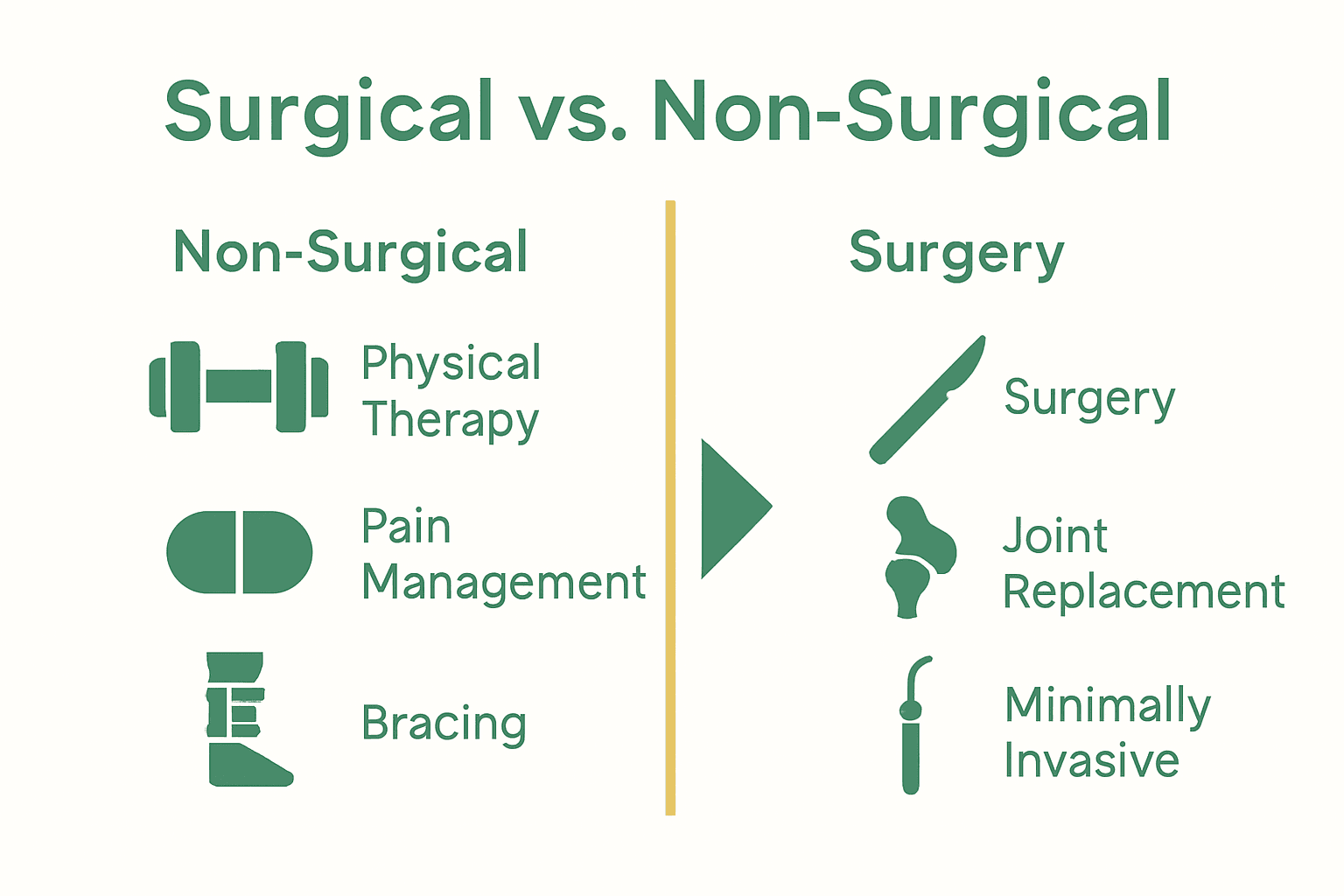
A defining hallmark of top-tier orthopedic surgeons is knowing when not to operate. Surgery should generally be considered only after conservative, evidence-based non-surgical interventions have been thoroughly evaluated or exhausted, unless acute structural failure (such as a unstable fracture or motor deficit) demands immediate intervention.
- DIAGNOSIS
- CONSERVATIVE / NON-SURGICAL
- Targeted Physical Therapy
- NSAIDs & Modalities
- Image-Guided Injections
- Symptom Resolution?
- YES: Continue Maintenance
- NO: SURGICAL OPTION
- Arthroscopy
- Arthroplasty
Non-Surgical Therapeutic Pathways
- Targeted Physical Therapy and Biomechanical Re-education: Partnering with physical therapists to strengthen dynamic joint stabilizers, correct movement imbalances, and restore normal gait patterns.
- Pharmacologic and Anti-Inflammatory Regimens: Modifying local and systemic inflammation through targeted non-steroidal anti-inflammatory drugs (NSAIDs) and short-term oral therapies.
- Image-Guided Intra-Articular Injections:
- Corticosteroids: Rapid reduction of acute intra-articular inflammation for functional flare-ups.
- Viscosupplementation (Hyaluronic Acid): Supplemental joint lubrication for mild-to-moderate knee osteoarthritis.
- Orthobiologics: Use of autologous biologic agents such as Platelet-Rich Plasma (PRP) to promote tissue healing environments in chronic tendinopathies and soft tissue strain.
Shared Decision-Making Framework
Dr. Austin’s clinical philosophy relies on transparent, shared decision-making. Patients receive comprehensive explanations of their diagnostic imaging (X-rays, MRIs, CT scans) alongside detailed discussions of both surgical and non-surgical options, expected recovery trajectories, potential complications, and realistic functional outcomes.
Comparing Orthopedic Care Approaches
To understand what differentiates an advanced orthopedic practice across Texas and California, it is helpful to compare standard traditional approaches with modern, patient-tailored orthopedic practices.
| Evaluation Metric | Traditional Orthopedic Practice | Modern Advanced Practice (Dr. John Austin) |
|---|---|---|
| Treatment Philosophy | Quick progression to surgical intervention | Stepwise conservative management prioritized; surgery reserved for clear structural indications |
| Surgical Technique | Traditional open surgical incisions with muscle detachment | Minimally invasive, tissue-sparing, and arthroscopic techniques |
| Technology Integration | Standard manual alignment and traditional 2D radiography | Robotic assistance, 3D digital templating, and advanced intraoperative navigation |
| Surgical Setting | Inpatient hospital admission with extended stay | Outpatient Ambulatory Surgery Centers (ASCs) with same-day discharge protocols |
| Post-Operative Recovery | Standardized, generic physical therapy prescriptions | Individualized, criterion-based rehabilitation pathways closely coordinated with physical therapists |
| Geographic Flexibility | Restricted to a single local hospital system | Dual-state licensure (Texas and California) with seamless care coordination for traveling patients |
Evaluating and Selecting an Orthopedic Surgeon in Texas or California
Selecting the right orthopedic surgeon is a critical health decision. Patients navigating care options in Texas or California should follow a systematic verification process to ensure their chosen specialist meets high standards of competence, safety, and patient satisfaction.
Step 1: Verify Credentials and Medical Board Standing
Always verify a physician’s license status and disciplinary history through state medical licensing authorities:
- In Texas: Check the official portal of the Texas Medical Board to confirm an active medical license, verify board certifications, and check for any disciplinary actions.
- In California: Utilize the Medical Board of California license verification search tool to review licensure status, practice history, and public disclosures.
Step 2: Confirm Board Certification
Ensure the surgeon is certified by the American Board of Orthopaedic Surgery (ABOS). Board certification demonstrates that a physician has completed an accredited orthopedic residency program, passed rigorous written and oral examinations, and maintains ongoing peer-reviewed performance standards. Subspecialty certificates (such as Orthopaedic Sports Medicine) represent additional, validated training.
Step 3: Assess Facility Affiliations and Outpatient Options
Inquire where surgical procedures are performed. High-performing surgeons maintain privileges at accredited acute-care hospitals and state-of-the-art Ambulatory Surgery Centers (ASCs). ASCs often provide lower infection rates, lower out-of-pocket facility costs, and specialized nursing care dedicated exclusively to orthopedic recovery.
Step 4: Evaluate Communication and Patient Reviews
Review objective patient testimonials, peer recognitions, and clinical outcomes. During an initial consultation, evaluate whether the physician listens attentively, explains complex anatomical issues in accessible language, and presents clear, evidence-based options without undue pressure to proceed directly to surgery.
Frequently Asked Questions
What makes Dr. John Austin stand out among orthopedic surgeons in Texas and California?
Dr. Austin distinguishes himself through dual-state experience in two major healthcare markets, specialized expertise in minimally invasive arthroscopy and joint reconstruction, and a strong commitment to conservative, non-surgical treatment pathways before recommending surgical intervention.
When should a patient consult an orthopedic surgeon instead of a primary care doctor?
A patient should consult an orthopedic surgeon if they experience acute joint trauma (such as a ligament tear or fracture), persistent joint pain lasting more than two to three weeks, dynamic joint instability, severe night pain, or functional limitations that do not respond to basic rest, ice, and over-the-counter medications.
Does Dr. John Austin perform outpatient joint replacements?
Yes. With advancements in minimally invasive surgical techniques, regional multimodal anesthesia, and rapid-recovery protocols, many joint replacements (such as hip and knee arthroplasties) can be safely performed in an Ambulatory Surgery Center (ASC), allowing select candidates to return home the same day.
How can patients verify Dr. Austin’s medical license and board certification?
Patients can verify medical licensing directly through the online public databases of the Texas Medical Board and the Medical Board of California. Board certification status can be independently confirmed through the American Board of Orthopaedic Surgery (ABOS) database.
What should a patient bring to their initial orthopedic consultation?
Patients should bring photo identification, insurance information, previous medical records related to the injury, operating reports from any prior surgeries, and physical copies or digital discs of prior diagnostic imaging (X-rays, MRIs, or CT scans) along with official radiology reports.
Practical Guidance for Prospective Patients
For individuals in Texas or California suffering from persistent joint pain, sports injuries, or functional mobility limitations, taking proactive steps toward accurate diagnosis is essential for long-term musculoskeletal health.
- Gather Diagnostic History: Compile all prior medical documentation, physical therapy records, and imaging studies before your initial consultation.
- Verify Insurance and Privileges: Confirm that the surgeon and their affiliated surgical facilities (hospitals or surgery centers) are in-network with your health insurance provider.
- Prepare Specific Questions: Draft a written list of questions focusing on conservative treatment options, surgical risks, expected recovery timelines, and specific functional milestones for your job or sport.
- Schedule a Comprehensive Consultation: Seek an initial evaluation to obtain an accurate clinical diagnosis and establish a personalized, step-by-step treatment strategy focused on long-term mobility and pain relief.
Disclaimer: This article is provided for informational and educational purposes only and does not constitute formal medical advice, diagnosis, or treatment recommendations. Individuals experiencing musculoskeletal symptoms should consult a qualified, licensed healthcare professional for individualized clinical evaluation and treatment plans.
Image Gallery