Personal Jurisdiction Analysis: Choosing Between Hanson v. Denckla and McGee v. International Life Insurance
When choosing between Hanson v. Denckla and McGee v. International Life Insurance Co. for legal analysis, the decision depends on whether the defendant's contact with the forum state resulted from their own deliberate actions or the un...
When choosing between Hanson v. Denckla and McGee v. International Life Insurance Co. for legal analysis, the decision depends on whether the defendant's contact with the forum state resulted from their own deliberate actions or the unilateral activity of the plaintiff. McGee supports jurisdiction when a defendant reaches into a state to establish a relationship, while Hanson restricts it when the defendant’s connection to the forum is merely incidental to the plaintiff's movement.
Contents
The Evolution of Personal Jurisdiction Standards
To understand the choice between Hanson and McGee, one must first recognize their position within the lineage of the Due Process Clause of the Fourteenth Amendment. Before these mid-20th-century cases, the Supreme Court established the foundational "minimum contacts" test in International Shoe Co. v. Washington (1945). This test moved the judiciary away from the rigid territoriality of Pennoyer v. Neff, focusing instead on whether a defendant has sufficient ties to a state such that being sued there does not offend "traditional notions of fair play and substantial justice."
By 2026, these cases remain the twin pillars of specific jurisdiction analysis. While International Shoe provided the framework, McGee and Hanson defined the outer boundaries of that framework. McGee represents the high-water mark of jurisdictional expansion, emphasizing the state’s interest and the convenience of the plaintiff. In contrast, Hanson serves as the essential "check" on that expansion, introducing the requirement of "purposeful availment."
McGee v. International Life Insurance: The Expansion of Reach
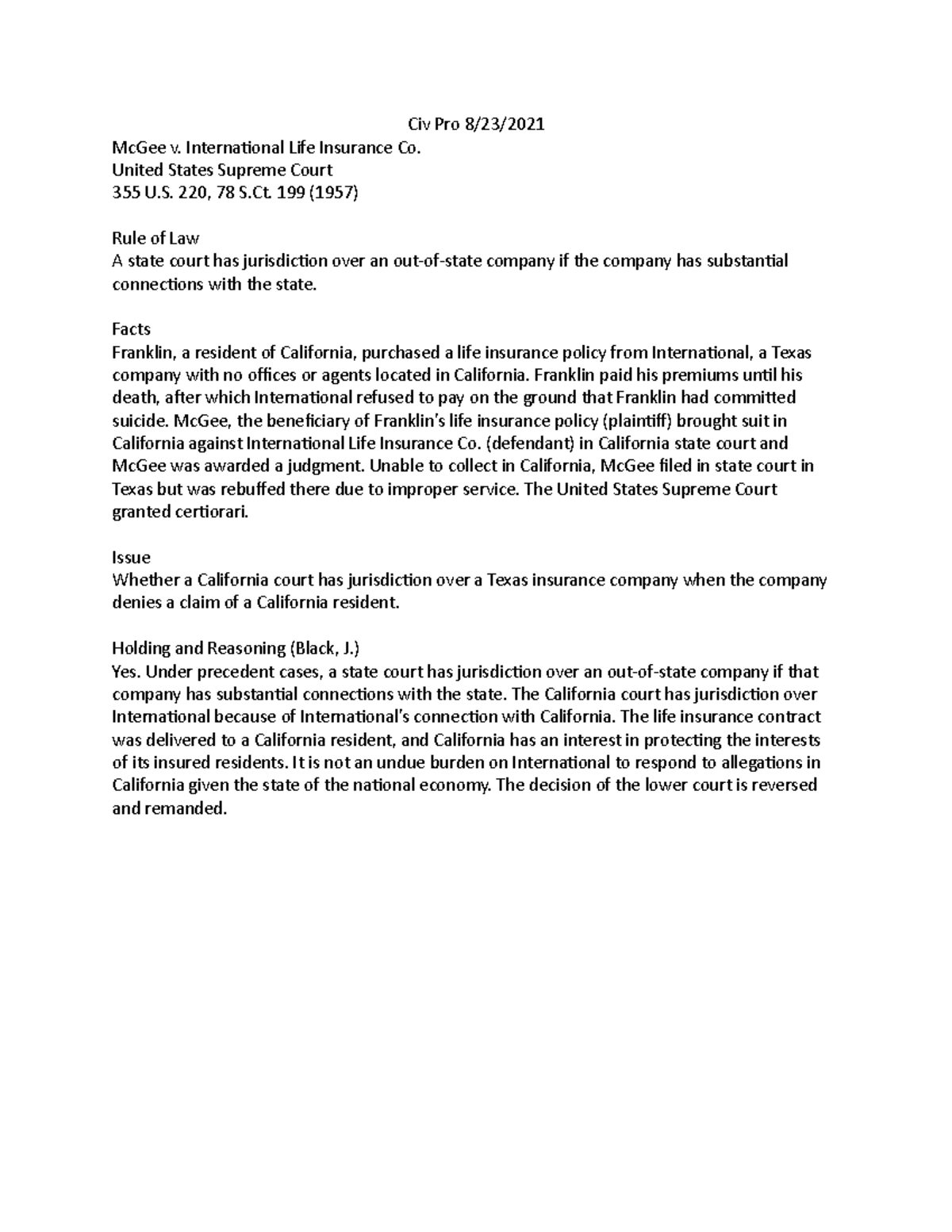
Decided in 1957, McGee v. International Life Insurance Co. is the primary precedent used to argue in favor of exercising jurisdiction over an out-of-state defendant, even when contacts are minimal.
The Factual Context of McGee
The case involved a California resident, Lowell Franklin, who purchased a life insurance policy from an Arizona company. Later, a Texas-based company, International Life Insurance, took over the policy and mailed a reinsurance certificate to Franklin in California. Franklin paid premiums from California to Texas until his death. When the insurer refused to pay the claim, his beneficiary (McGee) sued in California. The defendant had no offices or agents in California and had never done any other business there.
The Court’s Reasoning
Justice Black, writing for a unanimous court, upheld jurisdiction. The Court’s rationale rested on three primary pillars:
- The Nature of the Contract: The suit was based on a contract that had a "substantial connection" with the forum state.
- Modern Commercial Reality: The Court noted that the increasing nationalization of commerce made it much less burdensome for a party to defend itself in a state where it engages in economic activity.
- The State’s Interest: California had a "manifest interest" in providing effective means of redress for its residents when insurers refused to pay claims.
When to Apply McGee
Use McGee as your primary authority when the defendant has reached across state lines to solicit business or enter into a long-term obligation with a forum resident. It is the strongest precedent for "single-act" jurisdiction—where one solitary contact is so significant to the cause of action that it justifies the exercise of power.
Hanson v. Denckla: The Purposeful Availment Limitation
Only one year after McGee, the Supreme Court issued Hanson v. Denckla (1958), which significantly narrowed the scope of personal jurisdiction by focusing on the defendant's intent rather than the plaintiff's convenience.
The Factual Context of Hanson
The case involved a trust established in Delaware by a woman who later moved to Florida. While living in Florida, she continued to receive trust income and exercised her power of appointment to name beneficiaries. After her death, a dispute arose among her heirs. The Florida courts attempted to assert jurisdiction over the Delaware trustee.
The "Purposeful Availment" Rule
Chief Justice Warren, writing for the majority, famously declared: "The unilateral activity of those who claim some relationship with a nonresident defendant cannot satisfy the requirement of contact with the forum State."
The Court held that for jurisdiction to be valid, there must be "some act by which the defendant purposefully avails itself of the privilege of conducting activities within the forum State, thus invoking the benefits and protections of its laws." Because the Delaware trustee did not choose to do business in Florida—it was simply the client who moved there—the trustee had not "purposefully availed" itself of Florida law.
When to Apply Hanson
Use Hanson when a defendant’s connection to a forum is the result of the plaintiff's independent choices. If a customer buys a product in State A and carries it to State B, or if a client moves to a new state and continues a pre-existing relationship, Hanson is the shield used to prevent the defendant from being "haled into court" in a distant, unpredictable forum.
Key Differences: McGee vs. Hanson
Understanding which case to prioritize requires a side-by-side comparison of their legal mechanics and factual drivers.
| Feature | McGee v. International Life | Hanson v. Denckla |
|---|---|---|
| Direction of Contact | Defendant reached into the forum. | Plaintiff moved; defendant stayed put. |
| Core Legal Standard | Substantial connection/State interest. | Purposeful availment of forum benefits. |
| Defendant's Role | Active solicitation/Reinsurance offer. | Passive response to a client's relocation. |
| Jurisdictional Outcome | Jurisdiction Upheld (Pro-Plaintiff). | Jurisdiction Denied (Pro-Defendant). |
| Modern Application | Specific jurisdiction for contracts. | Specific jurisdiction for torts/unilateral acts. |
| Primary Quote | "Manifest interest in providing redress." | "The unilateral activity of [the plaintiff] cannot satisfy..." |
Synthesizing the Two in a 2026 Legal Landscape
In 2026, courts do not treat McGee and Hanson as conflicting rules, but rather as two sides of the same coin. The "purposeful availment" test from Hanson is now considered a mandatory prerequisite for any exercise of specific jurisdiction. McGee is interpreted as a specific example of what constitutes purposeful availment: when you mail a contract to a person in another state, you are purposefully availing yourself of that state's market.
When drafting a motion or an exam response, the analytical steps should flow as follows:
- Identify the Contacts: List every interaction between the defendant and the forum.
- Analyze the "Why": Did the defendant initiate these contacts (McGee) or did they happen because the plaintiff moved (Hanson)?
- Evaluate the "Relatedness": Does the lawsuit arise directly from those specific contacts?
- Assess Reasonableness: Even if there is purposeful availment, would jurisdiction be so burdensome as to be unconstitutional? (This brings in the "Five Factor" test often associated with later cases like World-Wide Volkswagen and Burger King).
Practical Scenarios for Choosing Your Precedent
Scenario A: E-Commerce Sales
If an out-of-state vendor operates an interactive website and ships a custom order to a buyer in the forum state, you should cite McGee. The vendor knowingly entered into a contract with a forum resident and sent goods into the state, creating a substantial connection.
Scenario B: Professional Services
If a lawyer in New York represents a client who lives in New York, and that client later moves to California and sues the lawyer for malpractice in a California court, you should cite Hanson. The lawyer’s "contact" with California was created solely by the client’s unilateral decision to move, which does not constitute purposeful availment by the lawyer.
Scenario C: Nationwide Distribution
In cases where a manufacturer puts a product into the "stream of commerce" without targeting a specific state, the tension between McGee and Hanson becomes acute. While McGee suggests the state has an interest in protecting its consumers, modern Supreme Court jurisprudence (such as J. McIntyre Machinery, Ltd. v. Nicastro) has leaned heavily on the Hanson requirement of purposeful, state-specific targeting.
Frequently Asked Questions
Is McGee still good law in 2026?
Yes, McGee remains a foundational case for specific jurisdiction, particularly in contract disputes. However, its "substantial connection" language is now always read in conjunction with the "purposeful availment" requirement established in Hanson. It is rarely cited alone to justify jurisdiction without a showing that the defendant intentionally targeted the forum.
How does "Purposeful Availment" differ from "Minimum Contacts"?
"Minimum Contacts" is the broad umbrella term from International Shoe. "Purposeful Availment" is a specific quality those contacts must have. A defendant could have many "contacts" with a state (like their products being sold there by a third party), but if they didn't "purposefully avail" themselves of that state's market, those contacts don't count for personal jurisdiction.
Can a single contact really satisfy McGee?
Yes. In McGee, the mailing of a single reinsurance certificate and the acceptance of premiums was sufficient. However, the contact must be "substantial" and directly related to the cause of action. A single, unrelated contact (like a defendant driving through a state) would not suffice for a breach of contract claim happening elsewhere.
Why did the court rule differently in Hanson?
The Court in Hanson was concerned with predictability and fairness. If a defendant could be sued anywhere a plaintiff chose to move, defendants would have no way to structure their conduct to avoid out-of-state litigation. By requiring "purposeful availment," the Court ensured that jurisdiction is based on the defendant's actions, not the plaintiff's.
Which case is more important for the "Stream of Commerce" theory?
Hanson v. Denckla is more influential in modern "Stream of Commerce" debates. It established the principle that a defendant must do more than simply foresee that a product might end up in a state; they must intentionally target that state. This was reaffirmed in later cases like Bristol-Myers Squibb Co. v. Superior Court.
Strategic Recommendation
To effectively choose between these two precedents, focus on the initiation of the relationship. If the defendant is the "aggressor" who sought out the forum's residents or markets, McGee is your strongest ally for establishing jurisdiction. If the defendant is "passive" and was brought into the forum's orbit by the plaintiff’s independent movement or the wandering of a product, Hanson provides the necessary legal framework to challenge jurisdiction. In 2026, a successful jurisdictional argument must harmonize both: using McGee to show the strength of the connection and Hanson to prove the defendant's intent.
Image Gallery