EB-5 Investment Requirements Explained: The Definitive 2026 Investor’s Guide
To qualify for an EB-5 visa in 2026, an investor must commit a minimum of $800,000 in a Targeted Employment Area (TEA) or $1,050,000 in a non-TEA project. The investment must create at least 10 permanent full-time jobs for U.S. workers...
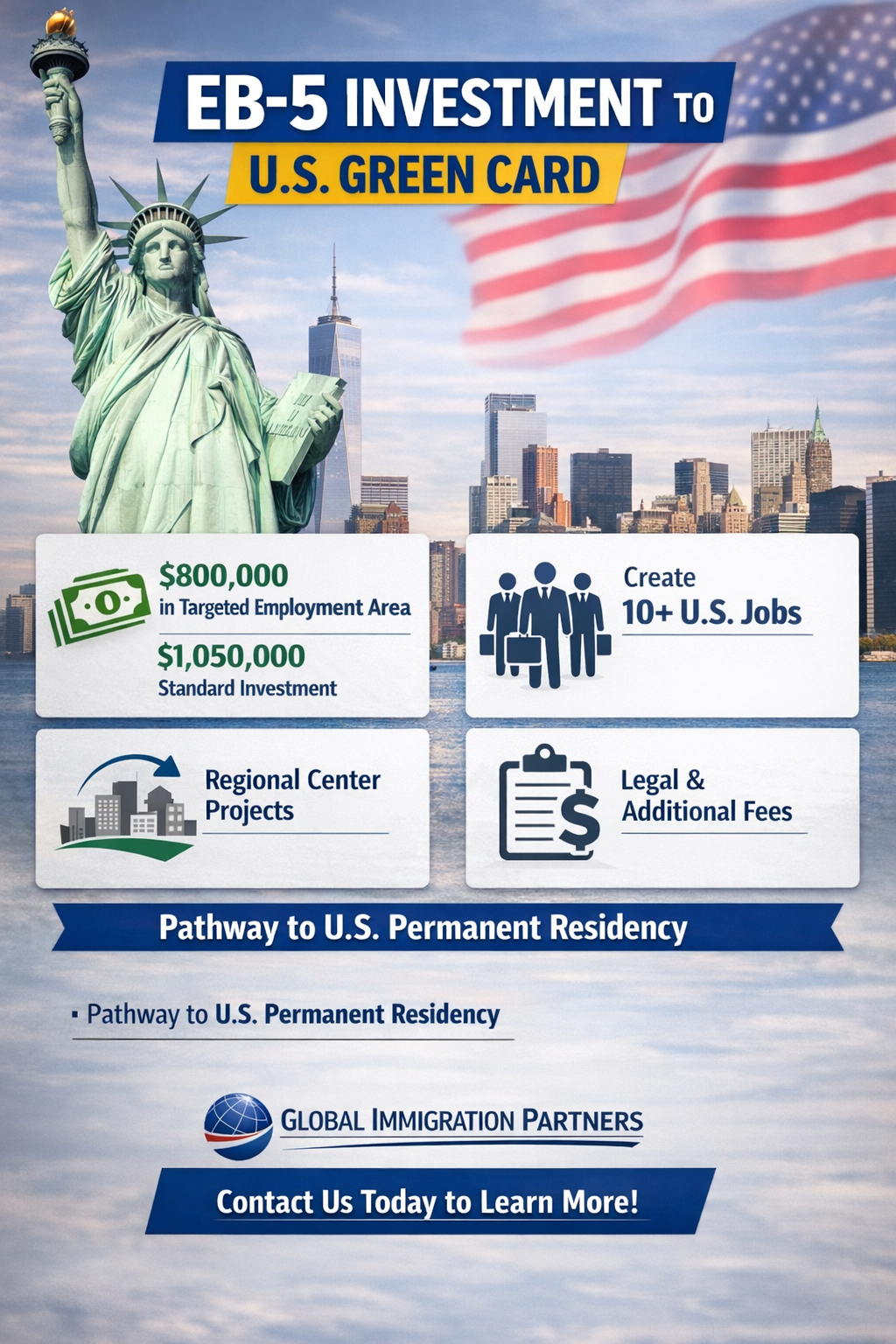
To qualify for an EB-5 visa in 2026, an investor must commit a minimum of $800,000 in a Targeted Employment Area (TEA) or $1,050,000 in a non-TEA project. The investment must create at least 10 permanent full-time jobs for U.S. workers and be supported by exhaustive documentation proving the capital was obtained through lawful sources.
Contents
The EB-5 Immigrant Investor Program remains one of the most direct paths to U.S. permanent residency (a Green Card) for high-net-worth individuals. However, the regulatory environment is complex, governed largely by the EB-5 Reform and Integrity Act of 2022 (RIA). This legislation introduced strict oversight, transparency requirements, and specific "set-aside" visa categories that significantly impact processing times. Understanding these requirements is the first step toward a successful petition.
Understanding the EB-5 Capital Requirements
The primary requirement for the EB-5 program is the "at-risk" investment of capital into a New Commercial Enterprise (NCE). As of 2026, the investment thresholds established by the RIA remain the standard. These amounts are subject to inflation adjustments every five years, with the next potential adjustment scheduled for 2027.
Targeted Employment Areas (TEA) vs. Standard Investments
The required investment amount depends entirely on the geographical location or the nature of the project:
- Targeted Employment Areas (TEA): $800,000. This lower threshold applies if the project is located in a rural area or an area with high unemployment.
- Rural Areas: Defined as any area outside a metropolitan statistical area (MSA) or outside the boundary of any city or town with a population of 20,000 or more.
- High Unemployment Areas: Defined as census tracts that experience an unemployment rate of at least 150% of the national average.
- Standard (Non-TEA) Investments: $1,050,000. If a project does not meet TEA criteria, the investor must contribute the full standard amount.
- Infrastructure Projects: $800,000. A specific category introduced by the RIA for projects administered by a governmental entity (such as a port or public transit system) that creates jobs and promotes economic growth.
The capital must be "at-risk," meaning there can be no guarantee of a return on investment or a contractual right to a refund. The investor must demonstrate that the capital is fully committed to the enterprise and available for job-creating activities.
The Job Creation Mandate: 10 Permanent Roles
The fundamental goal of the EB-5 program is economic stimulation. To satisfy USCIS requirements, every EB-5 investment must result in the creation of at least 10 full-time positions for qualifying U.S. workers.
A qualifying worker is a U.S. citizen, permanent resident, or other immigrant authorized to work in the United States. The investor and their immediate family members (spouse and children) do not count toward this requirement.
Direct vs. Indirect Job Counting
How these jobs are measured depends on the investment structure:
- Direct Investment: The investor must show that the specific business they invested in hired 10 W-2 employees directly. This is common for franchises or smaller service businesses.
- Regional Center Investment: This is the choice for over 90% of applicants. Regional Centers are USCIS-approved entities that manage EB-5 projects. They are permitted to use economic methodologies to count "indirect" and "induced" jobs. This means jobs created in the wider community as a result of the project’s construction and operations (e.g., suppliers, local retail growth) can count toward the 10-job requirement.
For construction projects lasting more than 24 months, indirect jobs can satisfy the entire requirement. If the construction is shorter, only a portion of the job count can come from indirect sources.
Proving the Lawful Source of Funds (SOF)
The most rigorous aspect of the EB-5 application is the Source of Funds (SOF) requirement. USCIS requires investors to prove "by a preponderance of the evidence" that their capital was obtained through lawful means. This requirement also applies to any administrative fees paid to a Regional Center.
Commonly accepted sources of funds include:
- Employment Earnings: Salary, bonuses, and dividends supported by tax returns and bank statements.
- Business Ownership: Profits from a business, often requiring audited financial statements and corporate records.
- Real Estate Sales: Capital gains from the sale of property, requiring proof of the original purchase (to show how that money was initially earned) and the final sale documents.
- Gifts and Inheritances: The donor must provide the same level of SOF documentation as if they were the investor.
- Loans: The RIA allows for loans, but the loan must be secured by the investor’s own assets, and the source of those assets must be documented.
The "Path of Funds" is equally important. Investors must show a clear, unbroken trail of the money from its origin (e.g., a business account) to the investor's personal account, and finally to the EB-5 project’s escrow account. This can be particularly challenging in countries with strict currency export controls.
Choosing the Investment Vehicle: Regional Center vs. Direct
Investors must decide between managing their own business or participating in a managed project through a Regional Center. In 2026, the Regional Center model remains the most popular due to the flexibility of job counting and the passive nature of the investment.
| Feature | Regional Center Investment | Direct EB-5 Investment |
|---|---|---|
| Minimum Investment (TEA) | $800,000 | $800,000 |
| Job Creation Type | Direct, Indirect, and Induced | Direct (W-2 employees only) |
| Management Role | Passive (Limited Partner) | Active (Policy formulation/Day-to-day) |
| Project Types | Large-scale (Hotels, Condos, Infrastructure) | Small scale (Franchises, Retail, Tech) |
| Visa Set-Asides | Highly eligible for Rural/High Unempl. | Limited to project location |
| USCIS Filing Fee (2026) | $12,160 (Form I-526E) | $12,160 (Form I-526) |
Visa Set-Asides and Priority Processing
One of the most significant changes introduced by the RIA is the creation of "Reserved" or "Set-Aside" visa categories. These categories allow investors to bypass the years-long backlogs (retrogression) that affect applicants from high-demand countries like China and India.
In the 2026 Visa Bulletin, the set-asides are allocated as follows:
- Rural Areas (20%): These receive the highest priority. USCIS is mandated to provide "priority processing" for Rural I-526E petitions, often resulting in approvals much faster than the standard processing times.
- High Unemployment Areas (10%): These are reserved for projects in urban TEAs.
- Infrastructure Projects (2%): A smaller pool for public-works-style projects.
For investors currently in the U.S. on other non-immigrant visas (such as H-1B or F-1), the RIA allows for Concurrent Filing. This means the investor can file their EB-5 petition (I-526E) and their adjustment of status (I-485) at the same time. This grants the investor "quasi-status," including a work permit and travel authorization, while they wait for their Green Card approval.
Associated Costs and Official Fees in 2026
Beyond the $800,000 or $1,050,000 investment, applicants must budget for significant administrative and legal costs. Following the fee schedule updates in April 2024, the government costs for EB-5 remain high in 2026.
- Form I-526/I-526E Filing Fee: $12,160.
- Integrity Fund Fee: $1,000 (for individuals) or $2,000 (for larger entities/Regional Centers). This fee was established to fund USCIS audits and site visits to prevent fraud.
- Regional Center Administrative Fees: Typically ranging from $50,000 to $80,000. This covers the project’s marketing, legal structure, and management.
- Legal Fees: Specialized immigration attorneys usually charge between $25,000 and $40,000 to handle the complex SOF documentation and petition filing.
- Form I-829 Filing Fee: $9,525 (paid at the end of the two-year conditional residency period to remove conditions).
The Path to Permanent Residency: A Two-Step Process
The EB-5 program does not grant a permanent Green Card immediately. It is a two-step process designed to ensure the investment and jobs are sustained.
Step 1: Conditional Residency (The I-526 Petition)
Once the I-526 (Direct) or I-526E (Regional Center) petition is approved, the investor and their family undergo consular processing or an adjustment of status. Upon approval, they receive a Conditional Green Card valid for two years.
Step 2: Removal of Conditions (The I-829 Petition)
Within the 90-day window before the two-year conditional Green Card expires, the investor must file Form I-829. To succeed, they must prove:
- The full capital was invested and sustained throughout the two years.
- The 10 required jobs were created (or can be expected to be created within a reasonable time).
Once the I-829 is approved, the conditions are removed, and the investor and their family receive permanent 10-year Green Cards.
FAQ
Can I use a loan or a gift for my EB-5 investment?
Yes, you can use gifted funds or loan proceeds for an EB-5 investment. However, the donor of the gift must provide complete documentation of how they lawfully acquired the money. For loans, the investor must prove that the loan is secured by their own personal assets and that the path of the loan proceeds is transparently documented from the lender to the project.
What happens to my investment if the project fails?
The EB-5 program requires that capital remains "at-risk." If a project fails before the job creation requirement is met, the investor may lose both their capital and their path to a Green Card. This is why due diligence is critical. However, if the jobs were already created before the business failed, the investor might still be able to remove conditions on their residency, though their capital return would be at risk.
How long is the EB-5 processing time in 2026?
Processing times vary wildly based on the project type. Rural projects currently receive priority processing, with some I-526E petitions being adjudicated in 12 to 18 months. Standard urban TEA projects may take 2 to 4 years. Investors from backlogged countries (China, India) should prioritize "Reserved" visa categories to avoid waiting an additional 5 to 10 years for a visa number to become available.
Do I have to live near the project I invest in?
No. If you invest through a Regional Center, you are generally considered a limited partner and can live anywhere in the United States. You are not required to participate in the day-to-day management of the project. If you choose a Direct Investment, you must be involved in the management or policy formulation of the enterprise, but you still have significant flexibility in where you reside.
Can my children be included in the EB-5 application?
Yes, an investor’s spouse and unmarried children under the age of 21 are included in the petition. They will receive their own Green Cards based on the single investment. Under the RIA, there are "age-out" protections that help preserve the eligibility of children who might turn 21 during long processing delays, provided the initial petition was filed correctly.
Next Actions for Prospective Investors
The complexity of the EB-5 program in 2026 necessitates a team of professionals. Prospective investors should first consult with a qualified immigration attorney specializing in EB-5 to review their Source of Funds. Simultaneously, investors should engage a third-party due diligence firm to evaluate the financial viability and immigration compliance of specific Regional Center projects. Selecting a project with a track record of I-526 and I-829 approvals is the most effective way to mitigate the inherent risks of the program.
Image Gallery