What Changed in North Carolina Workers’ Compensation: 2026 Comprehensive Guide
As of 2026, North Carolina workers’ compensation has evolved through adjusted maximum benefit rates, refined pharmaceutical utilization rules, and significant judicial clarifications regarding remote work and the "Right to Control" tes...
As of 2026, North Carolina workers’ compensation has evolved through adjusted maximum benefit rates, refined pharmaceutical utilization rules, and significant judicial clarifications regarding remote work and the "Right to Control" test for contractors. These updates ensure that the North Carolina Industrial Commission (NCIC) remains aligned with shifting economic conditions and modern workplace dynamics.
Contents
Navigating the complexities of workers' compensation in North Carolina requires an understanding of both the statutory framework—the North Carolina Workers’ Compensation Act—and the administrative rules established by the North Carolina Industrial Commission. While the core principles of the "no-fault" system remain intact, the specific financial caps, medical protocols, and legal interpretations regarding who qualifies as an employee have seen meaningful shifts over the last two years.
Updated Benefit Rates and Financial Thresholds for 2026
The most consistent change in North Carolina workers’ compensation is the annual adjustment of the maximum weekly benefit. Under N.C. Gen. Stat. § 97-29, the North Carolina Industrial Commission calculates the maximum weekly benefit based on the state’s average weekly wage as determined by the Division of Employment Security.
The 2026 Maximum Weekly Benefit
For injuries occurring on or after January 1, 2026, the maximum weekly benefit has been adjusted to reflect the economic growth and wage increases seen throughout 2025. This cap applies to all disability benefits, including Temporary Total Disability (TTD) and Permanent Partial Disability (PPD).
- 2026 Maximum Rate: The rate has increased to approximately $1,432.00 (subject to final NCIC certification), up from the 2025 rate of $1,388.00 and the 2024 rate of $1,346.00.
- Minimum Rate: The minimum benefit remains at $30.00 per week unless the employee’s actual average weekly wage was lower than that amount at the time of the injury.
Mileage Reimbursement for Medical Travel
Injured workers in North Carolina are entitled to reimbursement for travel to and from medical appointments, provided the round trip is 20 miles or more. As of early 2026, the reimbursement rate follows the Internal Revenue Service (IRS) standard business mileage rate. For the 2026 calendar year, this rate is maintained at 67 cents per mile, ensuring that workers are not financially penalized for seeking necessary specialist care located far from their residence.
| Benefit Category | 2024 Threshold | 2025 Threshold | 2026 Current Status |
|---|---|---|---|
| Max Weekly Benefit | $1,346.00 | $1,388.00 | $1,432.00 (Est.) |
| Mileage (per mile) | $0.67 | $0.67 | $0.67 |
| Death Benefits | 500 Weeks | 500 Weeks | 500 Weeks |
| Funeral Expenses | $10,000 | $10,000 | $10,000 |
| Waiting Period | 7 Days | 7 Days | 7 Days |
Legislative Shifts: First Responders and Mental Health
One of the most significant legislative trends reaching full implementation in 2026 involves the expansion of coverage for first responders suffering from Post-Traumatic Stress Disorder (PTSD). Historically, North Carolina has been a "physical-mental" state, meaning a worker generally had to suffer a physical injury to receive compensation for a secondary psychological condition.
The First Responder Protection Act Updates
Following legislative momentum in the 2023–2024 sessions, 2026 marks a period where the North Carolina Industrial Commission has formalized the evidentiary standards for "mental-mental" claims among law enforcement, firefighters, and EMS personnel.
Under these updated guidelines, first responders may qualify for benefits if they can prove that a specific "extraordinary" traumatic event occurred within the scope of their employment, leading to a diagnosis of PTSD by a licensed psychologist or psychiatrist. This shift acknowledges the unique hazards of public safety professions and moves North Carolina closer to the standards adopted by several other Southeastern states.
Administrative Changes in Medical Management
The North Carolina Industrial Commission has continued to refine its Medical Fee Schedule and Utilization Rules to combat the opioid crisis and manage the rising costs of specialty pharmaceuticals.
Opioid and Controlled Substance Rules
As of 2026, the NCIC "Rules for the Utilization of Opioids, Related Prescriptions, and Pain Management" are more strictly enforced than ever. Key requirements for physicians treating workers' compensation patients include:
- Strict Day Limits: Initial prescriptions for acute pain are generally limited to a 5-to-7-day supply.
- NC CSRS Checks: Physicians must consult the North Carolina Controlled Substances Reporting System (CSRS) before every prescription of a targeted controlled substance to prevent "doctor shopping."
- Urine Drug Screening: Mandatory periodic testing for patients on long-term opioid therapy to ensure compliance and identify potential substance abuse.
Telemedicine and Remote Independent Medical Exams (IMEs)
While the surge in telemedicine began during the pandemic, 2026 sees it codified as a standard tool for follow-up care. However, the NCIC has clarified that for Independent Medical Examinations (IMEs)—often used to resolve disputes regarding disability ratings or the necessity of surgery—the default remains an in-person evaluation unless both parties consent to a virtual examination. This ensures that the high-stakes assessments used for determining permanent impairment are as accurate as possible.
Judicial Interpretations: Remote Work and the "Coming and Going" Rule
With a significant portion of the North Carolina workforce continuing in hybrid or fully remote roles in 2026, the courts have been forced to redefine the "Coming and Going Rule." Traditionally, an injury occurring during a commute was not compensable.
The "Home Office" as a Fixed Premises
Recent North Carolina Court of Appeals decisions have clarified that if an employee’s primary place of business is their home, the "premises" extends to the designated workspace. In 2026, practitioners must look closely at the specific circumstances of a fall or injury at home. To be compensable, the injury must:
- Occur during designated working hours.
- Occur while the employee is performing an activity that benefits the employer.
- Arise from a risk inherent to the employment, rather than a "neutral" risk of the home environment (e.g., tripping over a pet vs. tripping over a company-issued laptop cord).
Independent Contractor vs. Employee Status
North Carolina continues to adhere to the traditional "Right to Control" test rather than the "ABC test" used in some other states. However, in 2026, the North Carolina Industrial Commission and the courts are applying higher scrutiny to "gig economy" platforms. If an employer dictates the hours, provides the tools, and maintains the right to fire the worker at will, the worker is likely an employee entitled to workers' compensation benefits, regardless of any "independent contractor agreement" they may have signed.
Understanding the 500-Week Cap and Permanent Disability
A pivotal part of North Carolina law that remains a point of contention in 2026 is the 500-week cap on Temporary Total Disability (TTD) benefits, which was part of the 2011 Reform Act.
The 500-Week Limitation
Most injured workers can only receive weekly disability checks for a maximum of 500 weeks. Once this limit is reached, benefits cease unless the worker can prove they have suffered a "total loss of wage-earning capacity."
Exceptions for Permanent and Total Disability
In 2026, the legal threshold for qualifying for lifetime benefits remains high. A worker must demonstrate one of the following under N.C. Gen. Stat. § 97-29(c):
- Loss of both hands, arms, feet, legs, or eyes (or any combination of two).
- Permanent and total paralysis.
- Severe brain injury resulting in permanent cognitive impairment.
- Other conditions that result in a total and permanent inability to earn wages.
Workers approaching their 400th week of benefits should begin the process of filing a Form 33 Request for Hearing to seek an extension if they believe their disability is permanent.
Essential Steps for Filing a Claim in 2026
If you are injured on the job in North Carolina, the procedural requirements have not changed, but the efficiency of the electronic filing system (EDEP) has increased.
- Report the Injury Immediately: Notify your employer orally and in writing as soon as possible. Under the law, you have 30 days to provide written notice.
- Seek Medical Attention: In North Carolina, the employer (or their insurance carrier) generally has the right to direct medical care. Use the physician they authorize to ensure the bills are covered.
- File Form 18 with the NCIC: This is the most critical step. Reporting the injury to your boss is not the same as filing a legal claim. You must file Form 18 (Notice of Accident to Employer and Claim of Employee) with the Industrial Commission, usually within two years of the injury.
- Monitor Your Benefits: Ensure your "Average Weekly Wage" is calculated correctly, including overtime, bonuses, and allowances, as this determines your benefit amount for the duration of the claim.
Frequently Asked Questions
Can I choose my own doctor in North Carolina? Generally, no. Under North Carolina law, the employer or their insurance carrier has the right to select the treating physician. If you are dissatisfied with the care, you can petition the Industrial Commission for a "Change of Physician," but you must demonstrate that the current care is not providing the necessary relief or that the provider is not providing reasonable treatment.
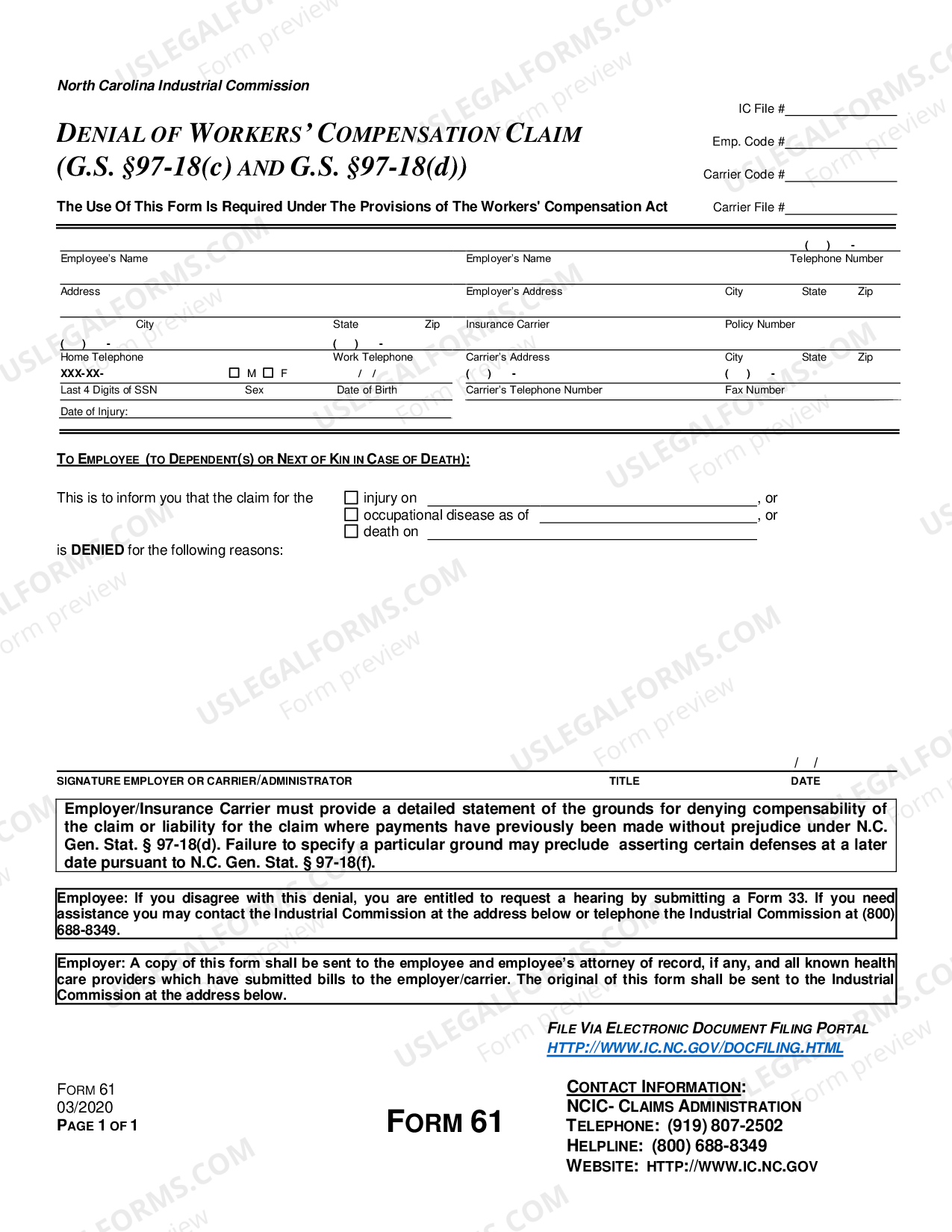
What happens if my claim is denied? If your claim is denied (via a Form 61), you have the right to request a hearing before a Deputy Commissioner. This process usually begins with mandatory mediation, where both parties attempt to settle the case with the help of a neutral third party. In 2026, most mediations are conducted virtually via secure video conferencing.
Is COVID-19 still covered under North Carolina Workers’ Comp? As of 2026, there are no longer broad "presumptions" for COVID-19 coverage for most workers. To receive benefits, a worker must prove that the contraction of the virus was "due to causes and conditions characteristic of and peculiar to" their particular employment, which is a difficult legal standard to meet for common illnesses.
How is Permanent Partial Disability (PPD) calculated? Once you reach Maximum Medical Improvement (MMI), your doctor will assign an impairment rating to the injured body part (e.g., 10% rating to the back). North Carolina uses a "Schedule of Injuries" (N.C. Gen. Stat. § 97-31) that assigns a specific number of weeks of compensation to each body part. Your payment is calculated by multiplying the rating percentage by the number of weeks assigned to that body part, at your weekly compensation rate.
Final Recommendation
The landscape of North Carolina workers’ compensation in 2026 emphasizes accurate wage reporting and adherence to strict medical protocols. Because the statutes involve rigid deadlines and complex calculations, injured workers should verify their "Average Weekly Wage" immediately after an accident. If you encounter a claim denial or an "Opinion and Award" that seems insufficient, consulting with a board-certified specialist in North Carolina Workers’ Compensation law is recommended to ensure your rights under the 2026 benefit schedules are fully protected.
Disclaimer: This article provides general information and does not constitute legal advice. Workers' compensation laws are subject to change by the North Carolina General Assembly and judicial interpretation. Always consult with a licensed attorney regarding the specifics of your case.
Image Gallery