Why Australian Business Loans Matter for Your Growth and Stability in 2026
Australian business loans serve as a critical catalyst for enterprise growth, providing the necessary liquidity to fund expansion, manage seasonal cash flow fluctuations, and invest in essential equipment. In 2026, these financial prod...
Australian business loans serve as a critical catalyst for enterprise growth, providing the necessary liquidity to fund expansion, manage seasonal cash flow fluctuations, and invest in essential equipment. In 2026, these financial products are vital strategic tools that allow small-to-medium enterprises (SMEs) to seize market opportunities and maintain operational resilience without exhausting their immediate cash reserves.
Contents
The Strategic Importance of Capital Access in the Australian Market
For the Australian business owner, capital is not merely a survival mechanism; it is a strategic asset. As of 2026, the Australian economy continues to be driven by a robust SME sector that accounts for a significant portion of national employment and GDP. However, the gap between having a viable business idea and executing it often boils down to available credit. Business loans matter because they allow you to decouple your growth ambitions from your current bank balance.
When you utilize a business loan, you are effectively "buying" time and opportunity. Instead of waiting three years to save enough profit to open a second location or upgrade a manufacturing line, a loan allows you to execute that plan today. This speed-to-market is crucial in an environment where consumer preferences shift rapidly and technological obsolescence is a constant threat. By leveraging debt responsibly, Australian businesses can scale at a rate that outpaces competitors who rely solely on organic growth.
Furthermore, the Australian lending landscape has evolved significantly. While traditional "Big Four" banks remain dominant, the proliferation of non-bank lenders and fintech platforms has increased competition. This competition matters for you because it results in more tailored financial products, faster approval times, and more flexible security requirements. Understanding these options is the first step toward building a sustainable financial structure for your company.
Bridging the Cash Flow Gap
Cash flow volatility remains one of the leading causes of business insolvency in Australia. Even a profitable business can fail if it lacks the liquid funds to meet its short-term obligations, such as payroll, rent, or supplier payments. This is where specific types of business loans, such as lines of credit or invoice finance, become indispensable.
In industries like construction, wholesale trade, or seasonal retail, there is often a significant delay between incurring costs and receiving payment from clients. A business loan acts as a buffer, ensuring that your operations do not grind to a halt while you wait for invoices to be settled. In 2026, the integration of real-time accounting software with lending platforms allows for "just-in-time" borrowing, where businesses can access funds almost instantly to cover temporary shortfalls.
Managing this gap effectively preserves your relationship with suppliers and employees. Consistent, on-time payments build a reputation for reliability, which can lead to better credit terms with vendors in the future. Therefore, a business loan is not just about the money borrowed; it is about protecting the operational integrity and reputation of your brand.
Types of Australian Business Loans and Their Applications
Choosing the right financial instrument is as important as the decision to borrow. The Australian market offers a variety of structures designed for different business needs. Using the wrong type of loan for a specific task can lead to unnecessarily high interest costs or restrictive repayment schedules.
Term Loans (Secured and Unsecured)
Term loans provide a lump sum of capital that is repaid over a fixed period with interest. Secured loans are backed by an asset, typically residential or commercial property, which often results in lower interest rates and longer repayment terms. Unsecured loans do not require physical collateral but usually carry higher interest rates and shorter terms, relying instead on the business's creditworthiness and cash flow history. In 2026, unsecured lending has become much more accessible for service-based businesses that do not own significant physical assets.
Equipment Finance and Asset Leasing
For businesses in transport, medical, or manufacturing sectors, equipment finance is a primary growth driver. This allows you to acquire machinery, vehicles, or technology by using the asset itself as security. The advantage here is twofold: you preserve your working capital for other uses, and you can often benefit from specific tax treatments, such as the instant asset write-off or depreciation claims, depending on current Australian Taxation Office (ATO) guidelines.
Invoice Finance and Factoring
This is a specialized form of lending where a business borrows against its accounts receivable. If you have $200,000 in outstanding invoices due in 60 days, an invoice finance provider might advance you 80-90% of that value immediately. This is particularly relevant for Australian B2B companies that deal with long payment cycles.
| Loan Type | Primary Use Case | Common Security | Typical Repayment Term |
|---|---|---|---|
| Term Loan | Major expansion, acquisitions | Property or General Security Agreement | 1 to 7 years |
| Line of Credit | Managing daily cash flow | Property or Unsecured | Ongoing / Annual Review |
| Equipment Finance | Purchasing vehicles or machinery | The asset being purchased | 3 to 5 years |
| Invoice Finance | Bridging payment gaps | Accounts receivable (Invoices) | Linked to invoice due dates |
| Business Credit Card | Small incidental expenses | Personal guarantee | Monthly revolving |
Eligibility and the 2026 Lending Criteria
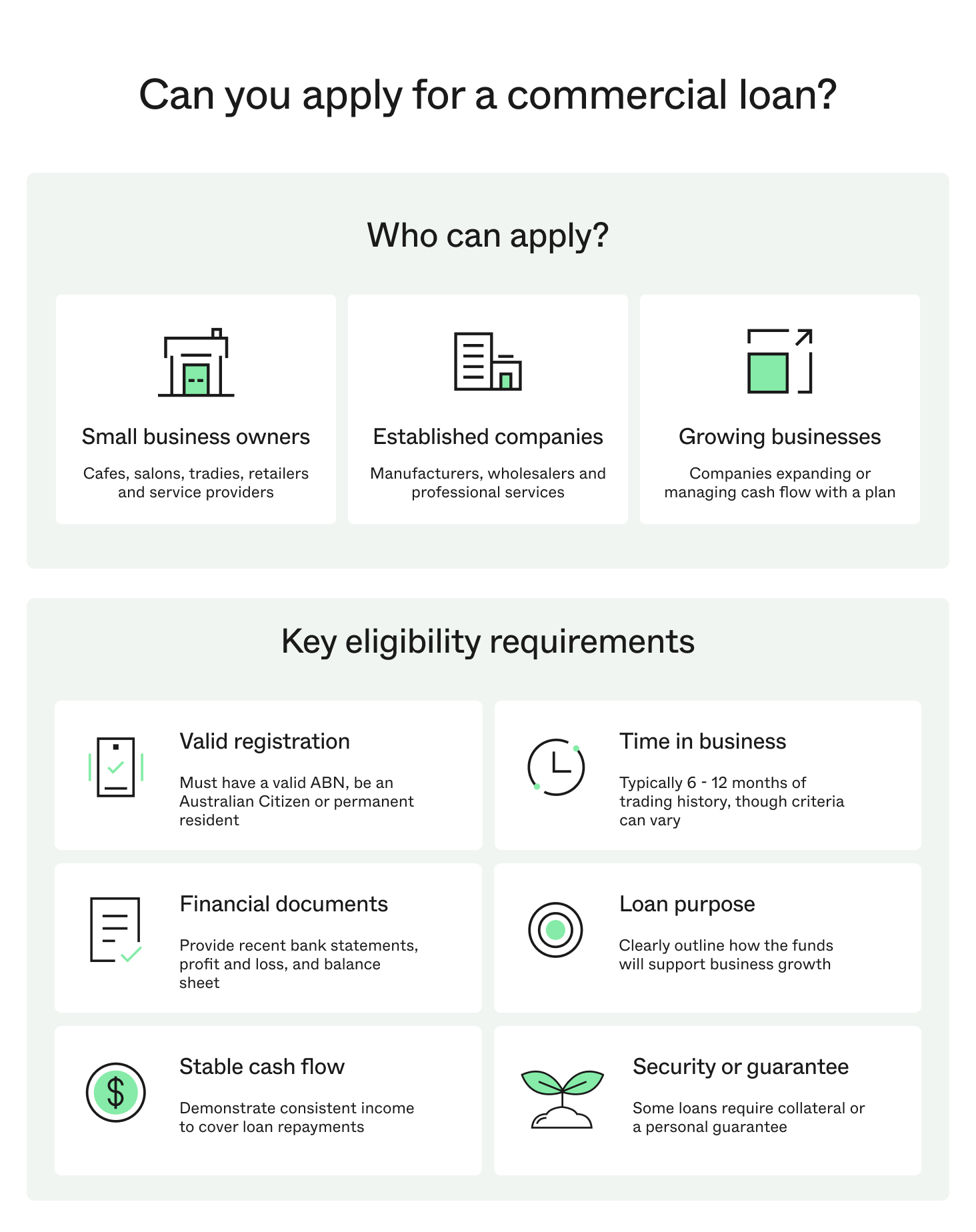
To benefit from these financial products, Australian business owners must meet specific eligibility criteria that have become more data-driven in recent years. Lenders in 2026 look beyond just a simple credit score; they analyze the "holistic health" of the business through integrated data feeds.
- Trading History: Most lenders require a minimum of 6 to 12 months of active trading. Startups may find it more difficult to secure traditional bank loans and may need to look toward venture debt or specialized "early-stage" lenders.
- Revenue Thresholds: A minimum monthly or annual turnover is usually required. For many fintech lenders, this might be as low as $10,000 per month, while major banks may have higher entry points.
- Credit Quality: This includes both your personal credit score and the business's credit file. Clean repayment histories on existing debts and a lack of defaults are paramount.
- Financial Documentation: You will typically need to provide Business Activity Statements (BAS), Profit and Loss (P&L) statements, and bank statements. In 2026, many of these are shared via "Open Banking" protocols, allowing for near-instant verification.
It is important to note that the Australian Securities and Investments Commission (ASIC) regulates many aspects of lending, and while commercial loans are not always subject to the same "responsible lending" obligations as consumer loans, reputable lenders still perform rigorous serviceability checks to ensure you can afford the repayments.
Tax Benefits and the Real Cost of Borrowing
One of the primary reasons Australian business loans matter is their tax efficiency. Generally, the interest paid on a loan used for business purposes is a tax-deductible expense. This effectively reduces the "net" cost of the loan. For example, if your business is taxed at a corporate rate of 25% and your loan interest rate is 8%, the effective after-tax cost of that debt is approximately 6%.
Additionally, the way a loan is structured can impact your balance sheet. Operating leases, for instance, might be treated differently than chattel mortgages. Business owners should consult with a qualified accountant to understand how different loan structures interact with the Australian Accounting Standards. This strategic approach to debt can improve your return on equity and provide a more favorable financial position for future investment.
Avoiding Common Pitfalls in Business Lending
While loans are powerful tools, they carry inherent risks. Over-leveraging—taking on more debt than the business can comfortably service—can lead to severe financial distress. In 2026, the risk is compounded by fluctuating interest rates. Fixed-rate loans offer certainty, while variable-rate loans might offer lower initial costs but expose you to market volatility.
Another common mistake is failing to read the fine print regarding "hidden" fees. These can include application fees, monthly service fees, early exit fees, and "drawdown" fees for lines of credit. Always calculate the Annual Percentage Rate (APR) or the total cost of capital rather than just looking at the headline interest rate.
Furthermore, many business loans require a Personal Guarantee. This means that if the business cannot repay the debt, the lender can pursue the business owner's personal assets. Understanding the implications of a personal guarantee is vital for risk management and asset protection.
Frequently Asked Questions
Can I get a business loan with a bad credit score in Australia?
Yes, it is possible, but it is more challenging and expensive. There are "sub-prime" or specialist lenders who focus on your business's current cash flow rather than past credit issues. However, you should expect significantly higher interest rates and potentially shorter repayment terms. Improving your credit score by paying down existing debts and ensuring all tax obligations are met is the best long-term strategy.
What is the difference between a secured and an unsecured business loan?
A secured loan requires an asset (like a house or commercial warehouse) as collateral. If you default, the lender can seize the asset. Because this reduces the lender's risk, interest rates are lower. An unsecured loan does not require physical collateral but relies on your business's financial strength. These are faster to process but carry higher rates and usually require a personal guarantee.
How long does the application process take in 2026?
Thanks to digital integration and Open Banking, many fintech lenders can provide "conditional approval" within minutes and fund the loan within 24 to 48 hours. Traditional banks have also sped up their processes, though they may still take 1 to 2 weeks for complex commercial loans involving property security.
Are there government-backed business loans available?
While specific pandemic-era schemes have concluded, the Australian Government often provides support through various initiatives like the Export Finance Australia for exporters or specialized grants and loan guarantees for regional development and green energy projects. Always check current offerings on the Business.gov.au portal.
What is a General Security Agreement (GSA)?
A GSA is a common document used by Australian lenders to register a security interest over all the assets of a company (such as inventory, equipment, and accounts receivable). This is registered on the Personal Property Securities Register (PPSR). It gives the lender a priority claim over those assets if the business becomes insolvent.
Taking the Next Step
To determine if a business loan is right for you in 2026, start by conducting a thorough "use of funds" analysis. Clearly define how the capital will be used and calculate the expected Return on Investment (ROI). If the profit generated by the borrowed funds significantly exceeds the cost of the interest and fees, the loan is likely a sound strategic move.
Begin by organizing your financial statements and checking your credit file. Compare at least three different lenders—ideally one major bank, one non-bank lender, and one specialist fintech—to ensure you are receiving competitive terms. Consulting with a commercial finance broker can also provide access to "wholesale" rates and products not available directly to the public.
Financial Disclaimer: This article is provided for general informational purposes only and does not constitute financial, legal, or tax advice. Australian credit laws and tax regulations are subject to change. You should consult with a licensed financial advisor, accountant, or legal professional before making any significant financial decisions.
Image Gallery