The Story of Pilot Colin Kelly in Aviation History: Heroism, Myth, and Legacy
Captain Colin P. Kelly Jr. stands as one of the most prominent early aviation heroes in American military history. On December 10, 1941, just three days after the attack on Pearl Harbor, Kelly sacrificed his life over the Philippines t...
Captain Colin P. Kelly Jr. stands as one of the most prominent early aviation heroes in American military history. On December 10, 1941, just three days after the attack on Pearl Harbor, Kelly sacrificed his life over the Philippines to save his B-17 Flying Fortress crew, earning the Distinguished Service Cross and becoming a symbol of wartime courage.
Contents
Who Was Captain Colin Kelly Jr.? Early Life and Flight Training
Colin Purdie Kelly Jr. was born on July 11, 1915, in Madison, Florida. Raised with a strong sense of civic duty and academic focus, Kelly sought a military career from an early age. He secured an appointment to the United States Military Academy at West Point, graduating in the Class of 1937.
Following his commission as a second lieutenant in the United States Army, Kelly chose to pursue military aviation, entering the United States Army Air Corps (USAAC). He completed primary and basic flight training at Randolph Field in Texas, followed by advanced bomber training at Kelly Field. Recognized for his leadership abilities, technical precision, and calm demeanor under pressure, Kelly was assigned to multi-engine bomber operations—a discipline undergoing rapid development during the late 1930s.
By 1940, Kelly was assigned to the 19th Bombardment Group, one of the premier heavy bomber formations in the Air Corps. In late 1941, as diplomatic relations between the United States and the Empire of Japan degraded, the U.S. military dispatched elements of the 19th Bombardment Group, including Kelly's 14th Bombardment Squadron, to Clark Field on the island of Luzon in the Philippines. Their mission was to act as a strategic deterrent against potential Japanese expansion into Southeast Asia.
The December 10, 1941 Mission over Luzon
On December 7, 1941, the Japanese attack on Pearl Harbor brought the United States directly into World War II. Simultaneously, Japanese naval and air forces launched strikes against Allied installations across the Pacific, including airfield strikes in the Philippines on December 8 that destroyed nearly half of the USAAF heavy bombers on the ground at Clark Field.
Captain Colin Kelly’s Boeing B-17C Flying Fortress (serial number 40-2045) was one of the few heavy bombers to survive the initial air attacks. On the morning of December 10, 1941, Kelly and his crew were ordered to conduct a strike against a Japanese naval task force conducting amphibious landings off the coastal town of Aparri, located on the northern tip of Luzon.
Kelly took off from Clark Field without fighter escort, operating under austere combat conditions. The bomber reached its target area at an altitude of approximately 20,000 feet. Spotting a cluster of enemy warships supporting landing operations, Kelly maneuvered B-17 #40-2045 into a bombing run.
Bombardier Sergeant Meyer Levin released three 600-pound demolition bombs targeting a major Japanese surface combatant. Observers aboard the B-17 reported direct hits and heavy smoke billowing from the targeted vessel. With their ordnance expended, Kelly turned the bomber south to return to Clark Field for refueling and rearming.
Combat Interception and the Ultimate Sacrifice
During the return flight, Kelly’s unescorted B-17 was spotted and intercepted by Japanese Mitsubishi A6M2 Zero fighters from the elite Tainan Air Group. Among the attacking pilots was Saburo Sakai, who would later become one of Japan's highest-scoring fighter aces.
Sakai and his wingmen launched repeated diving attacks against the B-17C. Unlike later production variants (such as the B-17F and B-17G), early B-17 models lacked power-operated defensive gun turrets, tail guns, and self-sealing fuel tanks, leaving severe defensive blind spots that enemy fighters quickly exploited.
- Japanese A6M2 Zero Interceptors
- Repeated High-Angle Strafing Runs
- B-17C Flying Fortress (#40-2045)
- Port wing & oxygen system ignited
- Interior fires spread to flight deck
- Captain Colin Kelly's Command Decision:
- Maintain manual flight control in severe fire
- Order all crew members to abandon aircraft
- Hold bomber level to allow successful parachuting
- Outcomes:
- 6 Crew Members Survive (Bailed Out Successfully)
- 2 Airmen Perish (Capt. Kelly & Sgt. Delehanty)
Fencing off aircraft cannon and machine-gun fire, the Zero fighters struck the B-17’s port wing, severing fuel lines and setting the wing tanks ablaze. Flames quickly engulfed the waist section and flight deck, while dense smoke filled the cabin, destroying the crew’s oxygen system. Flight Engineer Technical Sergeant William J. Delehanty was killed during the initial cannon passes.
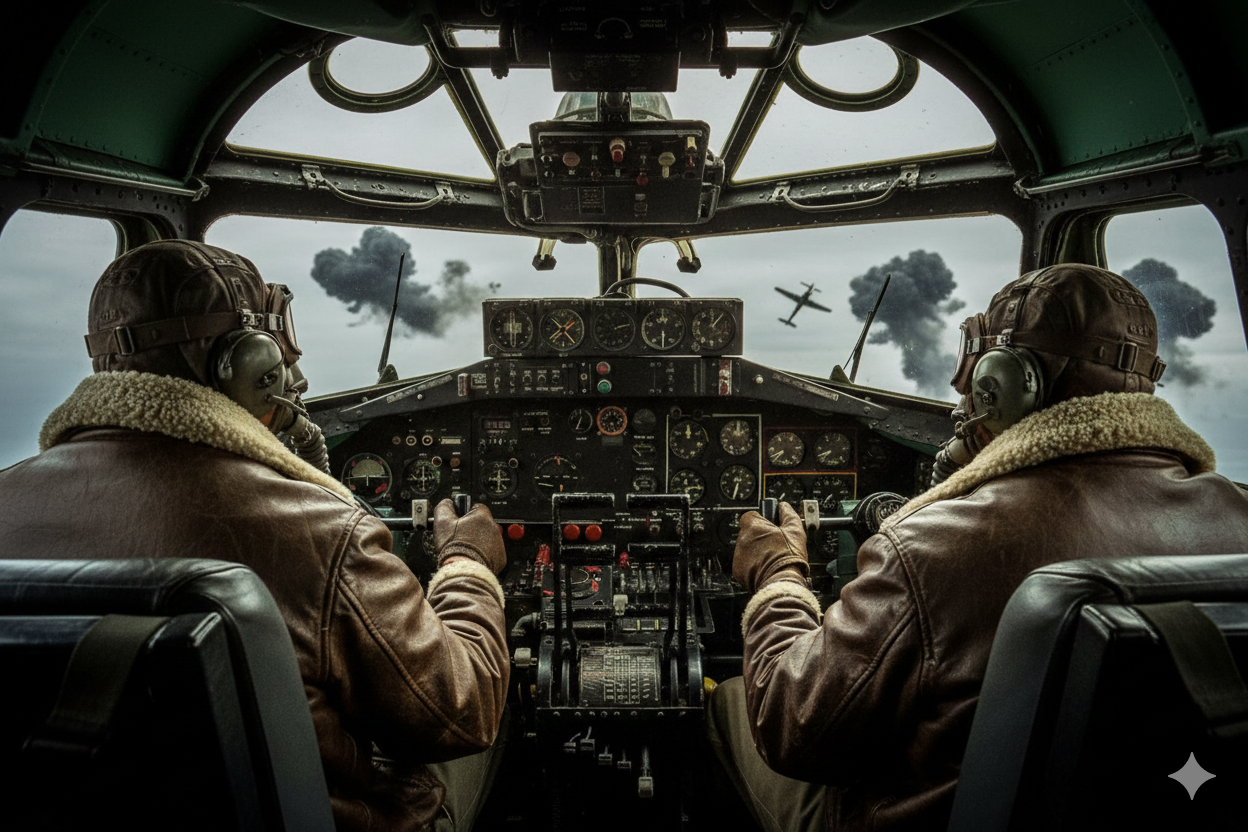
Realizing the aircraft was doomed and incapable of reaching the airfield, Captain Kelly ordered the surviving crew members to don their parachutes and bail out. Despite the cockpit rapidly filling with fire and toxic fumes, Kelly remained at the controls, exerting heavy manual force on the control yoke to keep the burning aircraft stable.
His refusal to abandon his post immediately gave the crew the precious seconds required to exit the escape hatches. Co-pilot First Lieutenant Donald Robins, navigator First Lieutenant Eugene L. Eubank, bombardier Sergeant Meyer Levin, radio operator Sergeant James T. Halkyard, and gunners Sergeant Robert E. Altman and Private Willard L. Jordan successfully parachuted out.
Just as the last surviving crew member cleared the hatch, the fire ignited the remaining fuel vapor and oxygen lines, causing the bomber to explode in mid-air. The wreckage crashed near Mount Arayat, near Clark Field. Captain Colin Kelly was killed in the explosion, giving his life so that his crew might live.
Historical Reality vs. Wartime Propaganda: The "Haruna" Myth
In the days immediately following the disaster at Pearl Harbor, the American public desperately needed positive news. War correspondents and military public relations officers seized upon initial operational reports from the Philippines, transforming Colin Kelly’s mission into an instant national legend.
Initial news dispatches erroneously reported that Captain Kelly had single-handedly bombed and sunk the Japanese battleship Haruna, a major capital ship of the Imperial Japanese Navy. Kelly was hailed across American newspapers and radio broadcasts as the man who sank an enemy battleship.
Post-war evaluations of official military records, combined with Imperial Japanese Navy operational logs, revealed a different historical reality:
- Target Identity: The Japanese battleship Haruna was nowhere near Luzon on December 10, 1941; it was operating hundreds of miles away off the coast of Malaya.
- Actual Vessel Hit: Historical evidence indicates Kelly’s crew bombed either the light cruiser Natori or the heavy cruiser Ashigara, inflicting minor to moderate damage, or hit the transport vessel Takao Maru, which was grounded and damaged during the landing operations.
- The True Act of Heroism: The sensationalized media focus on sinking a battleship initially obscured Kelly's actual achievement. His true heroics lay not in the destruction of enemy naval hardware, but in his airmanship, tactical execution, and self-sacrifice to preserve the lives of his aircrew under heavy fire.
Military historians emphasize that Kelly’s actions represent the highest standard of aviation command: placing the safety of subordinates above one's own survival.
Technical and Operational Profile of Mission #40-2045
Understanding the technological context of December 1941 explains the severe vulnerabilities Kelly and his crew faced over the Philippines. The Boeing B-17C was an early operational variant that had not yet incorporated the defensive refinements learned from European combat operations.
| Parameter / Feature | Historical Specification / Mission Detail |
|---|---|
| Aircraft Model | Boeing B-17C Flying Fortress |
| USAAF Serial Number | 40-2045 |
| Unit Assignment | 14th Bombardment Squadron, 19th Bombardment Group |
| Mission Date | December 10, 1941 |
| Target Location | Japanese Invasion Fleet off Aparri, Luzon, Philippines |
| Primary Target Hit | Light Cruiser Natori / Transport Takao Maru (Damaged) |
| Ordnance Carried | Three 600 lb Demolition Bombs |
| Intercepting Unit | Tainan Air Group, Imperial Japanese Navy Air Service |
| Key Intercepting Ace | Saburo Sakai |
| Crew Status | 6 Survived (Bailed Out), 2 Killed (Kelly, Delehanty) |
| Posthumous Honor | Distinguished Service Cross (DSC) |
The lack of armor plating around the pilot stations, absence of self-sealing fuel cells, and limited defensive armament made early B-17 variants highly susceptible to fire when engaged by 20mm cannon fire from enemy interceptors.
The Roosevelt Letter and Long-Term Legacy
Captain Colin Kelly’s death resonated deeply across the United States. He was posthumously awarded the Distinguished Service Cross for extraordinary heroism in connection with military operations against an armed enemy.
One of the most remarkable personal chapters in American presidential history involved Kelly’s infant son, Colin P. Kelly III, who was only nineteen months old when his father died. On December 17, 1941, President Franklin D. Roosevelt wrote a unique letter titled "To the President of the United States in 1960":
"I am writing this letter as a tribute to the memory of Captain Colin P. Kelly, Jr., who gave his life in heroic devotion to his country... I desire to request that you, if you are then President of the United States, consider appointing Colin P. Kelly III to the United States Military Academy."
In 1959, as the year 1960 approached, President Dwight D. Eisenhower honored Roosevelt's request by granting Colin P. Kelly III an appointment to West Point. Colin Kelly III entered the Academy and graduated with the Class of 1963, later serving as an officer in the U.S. Army and subsequently entering the priesthood.
Beyond military appointments, Colin Kelly’s legacy was commemorated across the nation:
- Maritime Honors: A World War II Liberty ship was christened the SS Colin P. Kelly Jr. in 1942.
- Public Infrastructure: Multiple schools, parks, and streets across Florida and the broader United States carry his name.
- Aviation Doctrine: Kelly's mission highlighted the urgent need for armored crew protection, self-sealing fuel tanks, and defensive tail-gun positions, accelerating engineering retrofits for later B-17 variants (D, E, F, and G models).
Lessons in Leadership and Pilot Command
The story of Captain Colin Kelly remains a foundational case study in military flight leadership and aviation ethics. His actions illustrate core tenets of airmanship that continue to be taught in military flight training:
- Uncompromised Duty of Care: The pilot-in-command holds final responsibility for crew safety. Kelly demonstrated that maintaining control of a crippled aircraft to permit evacuation takes precedence over personal survival.
- Operational Adaptability: Flying without fighter support into contested airspace requires precise navigation and tactical discipline, even when operating with unproven equipment.
- Separating Fact from Propaganda: Modern military history relies on rigorous post-action analysis rather than wartime journalism. Kelly's true legacy rests on verified leadership and sacrifice rather than exaggerated claims of naval destruction.
Frequently Asked Questions About Pilot Colin Kelly
What is Captain Colin Kelly famous for in aviation history?
Captain Colin Kelly Jr. is famous for his heroism on December 10, 1941, during World War II. After bombing Japanese naval targets off Luzon, Philippines, his B-17 Flying Fortress was severely damaged by enemy fighters. Kelly held the burning aircraft steady so his crew members could safely parachute out, sacrificing his own life in the process.
Did Colin Kelly actually sink the Japanese battleship Haruna?
No. While wartime news reports widely claimed Kelly sank the battleship Haruna, postwar military analysis confirmed that the Haruna was operating elsewhere at the time. Kelly’s crew actually bombed and damaged a Japanese cruiser or transport ship. His heroic reputation rests on saving his crew under lethal fire, not on sinking a battleship.
What aircraft was Colin Kelly flying during his final mission?
Captain Kelly was flying a Boeing B-17C Flying Fortress, carrying USAAF serial number 40-2045. The B-17C was an early model of the Flying Fortress that lacked later defensive upgrades like tail gun positions and self-sealing fuel tanks.
What medal was awarded to Captain Colin Kelly posthumously?
Captain Colin Kelly was posthumously awarded the Distinguished Service Cross (DSC), the United States Army's second-highest military decoration for valor, recognizing his extraordinary heroism in combat.
Who was the Japanese pilot involved in attacking Colin Kelly's bomber?
The attack on Kelly’s B-17 was led by flight leader Saburo Sakai, along with his wingmen from the Tainan Air Group of the Imperial Japanese Navy Air Service. Sakai later became one of Japan's top fighter aces and documented the engagement in his post-war memoirs.
What was the letter written by President Franklin D. Roosevelt regarding Colin Kelly's son?
On December 17, 1941, President Franklin D. Roosevelt wrote a letter addressed to the future President of the United States in 1960, requesting an appointment to the U.S. Military Academy at West Point for Kelly's infant son, Colin P. Kelly III. President Dwight D. Eisenhower honored the request in 1959, and Kelly III graduated from West Point in 1963.
Historical Assessment and Further Resources
Captain Colin P. Kelly Jr. remains an enduring figure in aviation history because his story captures the stark realities of early World War II aerial combat: outdated equipment, overwhelming odds, and profound personal sacrifice. For researchers, students, and aviation historians seeking to explore his legacy further, the official records preserved at the National Museum of the United States Air Force and the U.S. National Archives provide primary documentation of the 19th Bombardment Group's operations during the Philippines Campaign of 1941–1942.
Image Gallery