Why Residential Solar Panel Installation in Reston Works
Residential solar panel installation in Reston works exceptionally well due to favorable net metering policies, robust federal tax incentives, ample annual sunshine in Northern Virginia, and progressive local community standards that s...
Residential solar panel installation in Reston works exceptionally well due to favorable net metering policies, robust federal tax incentives, ample annual sunshine in Northern Virginia, and progressive local community standards that support renewable energy adoption. Homeowners can significantly offset high electricity costs while increasing their property value.
Contents
Understanding the Reston Solar Landscape
The decision to adopt solar energy in a planned community like Reston involves a unique blend of geographic, regulatory, and financial factors. Homeowners evaluating residential solar panel installation in Reston must look beyond basic panel efficiency to understand how local climate conditions, utility structures, and community association guidelines intersect.
Northern Virginia experiences a balanced mix of seasonal weather patterns, offering ample sunlight during spring, summer, and fall, alongside sufficient winter daylight to maintain steady photovoltaic production. When combined with Virginia's evolving regulatory framework for renewable energy, Reston provides an economically viable environment for homeowners seeking long-term energy independence.
The Role of Net Metering and Utility Policies
A primary driver of residential solar viability in Reston is net metering, regulated primarily through utility providers such as Dominion Energy. Net metering allows homeowners with grid-tied solar energy systems to send excess electricity back to the local grid. In exchange, the utility provides credits on the homeowner's electricity bill, effectively rolling the meter backward.
- Credit Accumulation: Excess generation during peak daylight hours accumulates as kilowatt-hour credits.
- Nighttime and Seasonal Balancing: These accumulated credits offset electricity drawn from the grid during cloudy days or nighttime hours.
- Policy Stability: State-level legislative mandates have protected net metering structures, ensuring that residential producers receive fair value for the surplus energy they supply to the shared grid.
Architectural and Community Guidelines in Reston
Installing solar panels in a master-planned community requires navigating specific architectural controls. Reston is well-known for its strict design guidelines administered by the Reston Association (RA) and various cluster associations. Understanding these rules before purchasing equipment prevents costly project delays.
Navigating the Reston Association Covenants
The Reston Association maintains covenants designed to preserve the aesthetic harmony and environmental balance of the community. Fortunately, Virginia state law (Virginia Code § 55.1-3329) explicitly prohibits community associations from adopting covenants or rules that impose an unreasonable restriction on the installation of solar energy collection devices.
Despite this legal protection, homeowners must still submit architectural modification applications. The review process typically evaluates:
- Roof Integration: Panels should be mounted parallel to the roofline and kept flush to minimize visual elevation.
- Color and Finish: Dark-colored frames and backsheets are generally preferred to blend seamlessly with dark asphalt or architectural shingles.
- Wiring Conduits: Exterior wiring and conduit lines must be painted to match the surrounding siding or roof color, reducing visibility from neighboring properties and pathways.
Financial Incentives and Return on Investment
The financial mechanics of residential solar panel installation in Reston rely heavily on a combination of federal tax credits and local market dynamics. These mechanisms shorten the payback period and enhance the long-term return on investment (ROI).
The Federal Residential Clean Energy Credit
Homeowners across the United States can leverage the federal Residential Clean Energy Credit. This incentive allows individuals to claim a tax credit for a percentage of the total solar photovoltaic system cost, including equipment, permitting, and labor.
- Credit Percentage: The incentive provides a tax credit covering 30% of the total installation expenditure.
- Tax Liability Application: The credit applies directly to federal income tax liability, and any unused portion can be carried forward to subsequent tax years.
- Eligibility Requirements: The homeowner must own the system outright (either via cash purchase or a solar loan) rather than entering into a third-party lease or Power Purchase Agreement (PPA).
Property Value Enhancement
Real estate studies consistently show that homes equipped with owned solar panel systems command higher resale values than non-solar properties. Because Reston housing stock features active real estate demand, energy-efficient upgrades serve as a strong market differentiator. Buyers increasingly value predictable utility expenses, translating capital investments in solar technology directly into equity gains.
| Financial Factor | Impact on Reston Homeowners | Notes |
|---|---|---|
| Federal Tax Credit | High | 30% reduction in total system cost via IRS guidelines. |
| Net Metering | Medium-High | Offsets utility bills via excess generation credits through Dominion Energy. |
| Property Tax Exemption | Moderate | Virginia allows localities to exempt solar equipment from local property assessments. |
| Maintenance Costs | Low | Modern solar panels feature minimal upkeep, typically requiring only periodic washing. |
Technical Specifications and System Siting
Maximizing solar efficiency in Reston requires careful technical planning regarding roof orientation, tilt angle, and shading analysis. Professional installers use advanced solar design software to model annual energy production based on local meteorological data.
Roof Orientation and Tilt
The ideal orientation for residential solar panels in the Northern Hemisphere is due south. However, roofs facing southeast or southwest also yield excellent production levels, capturing morning and afternoon sunlight effectively.
- Tilt Angle: The optimal tilt angle generally mirrors the local latitude (approximately 38° to 39° for Northern Virginia), though flush-mounted rack systems attached directly to standard roof pitches perform exceptionally well with minimal seasonal adjustment.
- Shading Mitigation: Mature canopy trees throughout Reston neighborhoods provide desirable shade for homes but can reduce photovoltaic output if they cast shadows over the array during peak sun hours. Microinverters or DC optimizers help mitigate partial shading issues by ensuring that shaded panels do not drag down the performance of the entire string.
Frequently Asked Questions
Do I need approval from the Reston Association before installing solar panels?
Yes. While Virginia law prevents homeowners associations from banning solar energy, you must still submit an architectural application to the Reston Association (and your specific cluster association, if applicable) to ensure compliance with aesthetic guidelines regarding placement and conduit visibility.
How do Northern Virginia winters affect solar panel efficiency?
Cold winter temperatures actually improve the electrical efficiency of solar photovoltaic cells. Although shorter days and occasional snow cover reduce total energy generation, snow typically slides off tilted panels quickly due to radiant heat loss, and annual production models already account for seasonal weather variations.
Can I install solar panels if my roof is old?
It is strongly recommended to replace or repair an aging roof prior to solar panel installation. Because photovoltaic systems are designed to operate efficiently for 25 to 30 years, removing panels to conduct roof repairs later incurs significant uninstallation and reinstallation labor costs.
What happens to my solar system during a grid outage?
Standard grid-tied solar systems automatically shut down during a power outage for safety reasons, preventing electricity from backfeeding into lines where utility workers may be performing repairs. To maintain power during an outage, homeowners must pair their solar array with a home battery storage system.
How long does the entire installation process take?
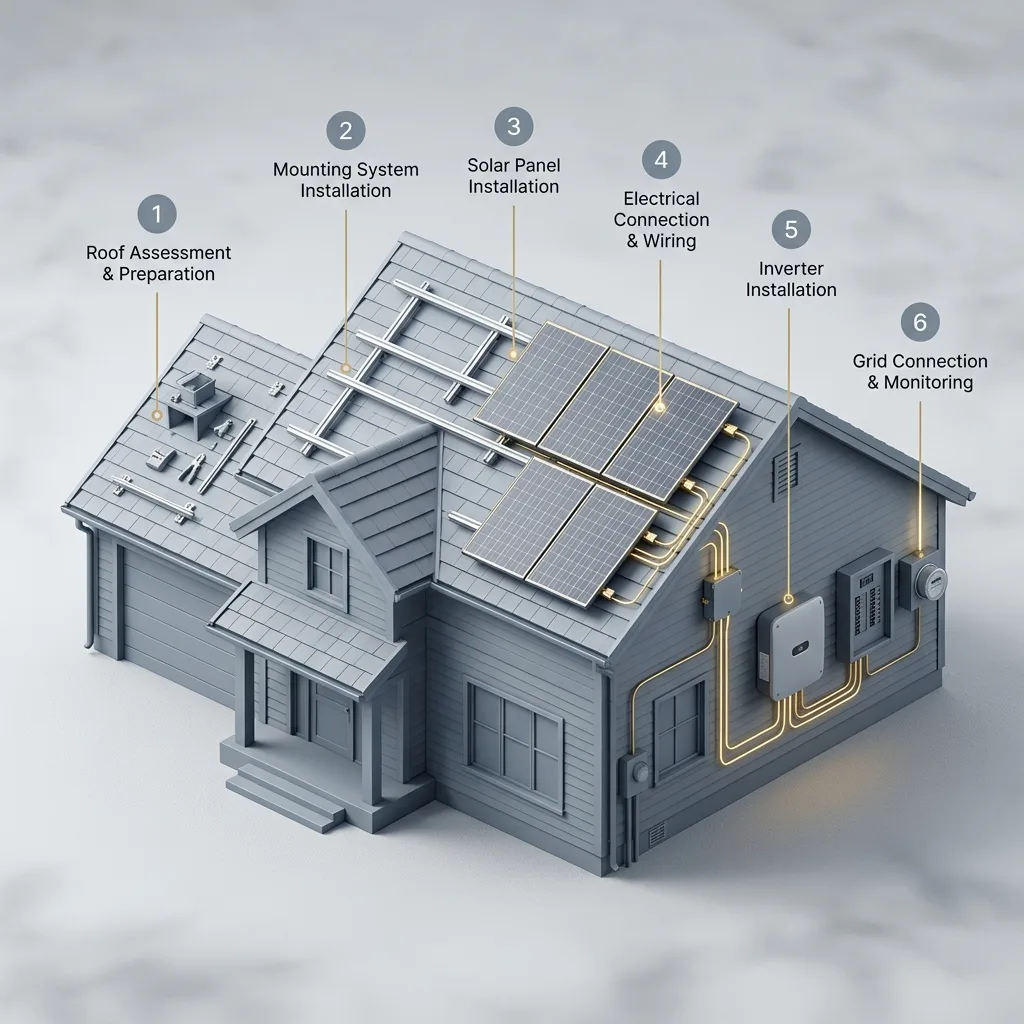
From initial site assessment and architectural design review to final utility interconnection approval, the residential solar installation process in Reston typically spans six to twelve weeks. The physical installation on the roof generally takes only one to three days.
Next Actions for Reston Homeowners
Homeowners ready to explore residential solar panel installation in Reston should begin by conducting a comprehensive energy audit to evaluate current electricity consumption patterns. The next step involves gathering multiple quotes from licensed, NABCEP-certified solar contractors familiar with Fairfax County permitting protocols and Reston Association design covenants. Verifying contractor credentials and requesting detailed production estimates ensures a transparent, efficient transition to renewable household energy.
Image Gallery