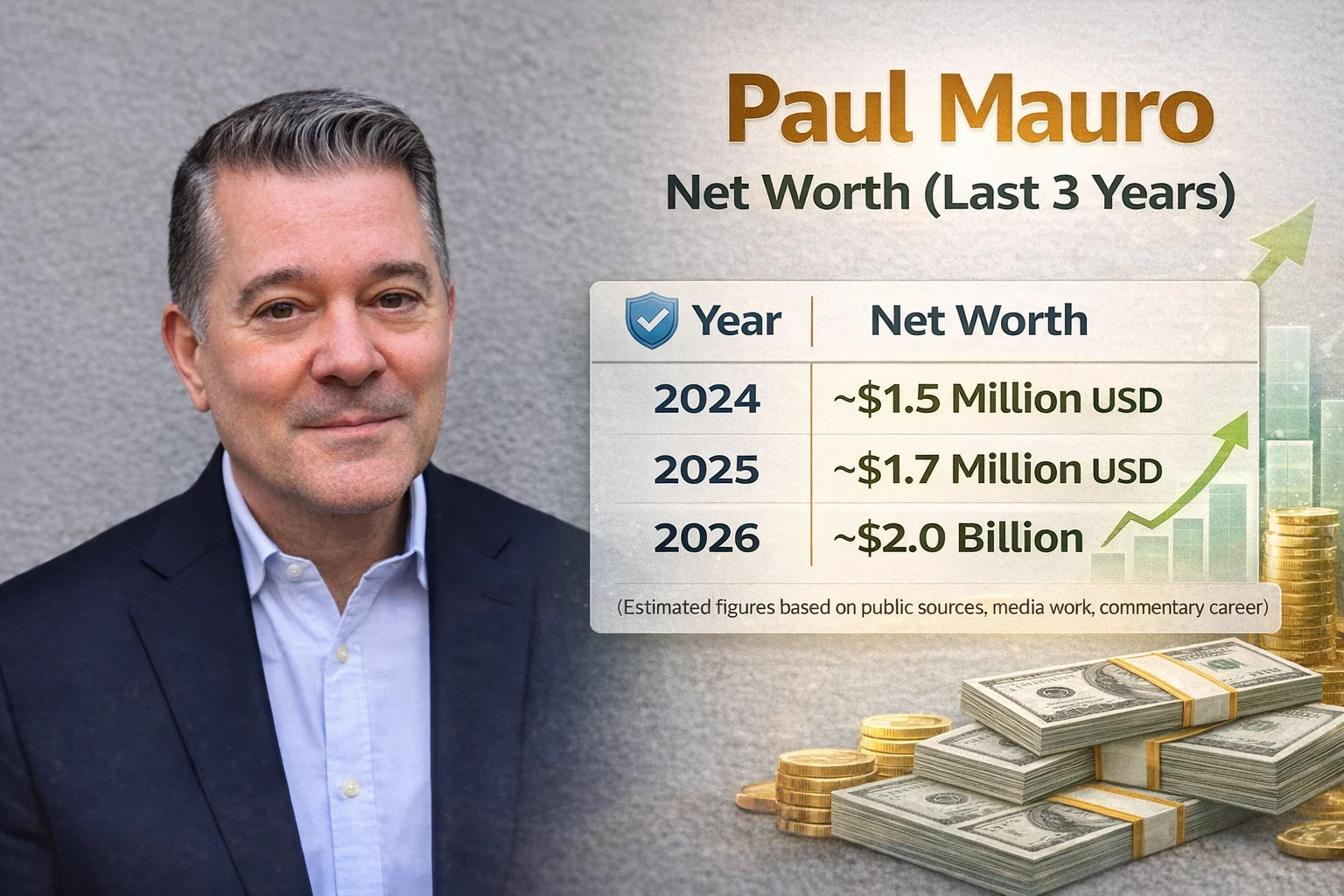
Paul Tooreall Net Worth: Understanding Financial Transparency and Public Figures
Paul Tooreall, a figure frequently discussed within niche online communities, is often the subject of public curiosity regarding his professional accomplishments and financial standing. As of 2026, there is no verified public record, r...
Paul Tooreall, a figure frequently discussed within niche online communities, is often the subject of public curiosity regarding his professional accomplishments and financial standing. As of 2026, there is no verified public record, regulatory filing, or audited financial statement that provides a definitive net worth for Paul Tooreall. The ambiguity surrounding his financial status stems from the absence of public corporate leadership roles or institutional wealth disclosures typically associated with high-net-worth individuals.
Contents
In the digital age, speculation regarding the net worth of various public figures often arises from social media trends, anecdotal reports, and the conflation of professional success with personal liquid assets. It is essential to distinguish between verified financial data—such as tax records, public company shareholdings, and real estate filings—and speculative estimates often found on unauthorized biography websites. For individuals who do not hold prominent positions in publicly traded companies, such as CEOs or high-ranking government officials, accurate net worth information remains private and protected by financial privacy standards.
The Reality of Financial Privacy for Private Individuals
Financial privacy is a fundamental standard for individuals who are not required to file disclosures with bodies such as the Securities and Exchange Commission (SEC) or similar regulatory authorities. For a person like Paul Tooreall, who does not appear to be a principal officer of a publicly reporting entity, there is no legal obligation to publish balance sheets, profit-and-loss statements, or comprehensive lists of assets.
Most websites that claim to provide exact net worth figures for private citizens rely on algorithmic estimations rather than empirical evidence. These platforms typically aggregate data from disparate, often unrelated sources—such as estimates of average salaries in specific industries or presumed earnings from social media engagement—to create an appearance of insight. Readers should approach these figures with significant skepticism, as they lack the audit trails required to be classified as factual financial reporting.
Factors That Shape Public Perception of Wealth
Public perception of an individual’s wealth is often influenced by external indicators rather than internal financial realities. These markers, while visible, are poor predictors of actual net worth:
- Public Visibility: Individuals with a high volume of social media interactions or those involved in content creation are often perceived as wealthier than they may be, as public attention is frequently mistaken for revenue generation.
- Industry Association: Being associated with high-growth sectors, such as technology or venture capital, often leads observers to inflate estimates of an individual's personal capital.
- Lifestyle Signaling: Publicly displayed assets, such as vehicles, real estate, or travel, are often financed through debt or lease structures that do not accurately represent an individual's equity position.
- Conflicting Data Aggregation: Minor mentions of an individual in news articles, industry blogs, or forums can be scraped and re-indexed by search engines, creating a "data loop" that reinforces unverified financial claims.
Navigating Financial Information Disclosures
To evaluate the financial status of any professional, it is necessary to identify the types of documentation that constitute credible evidence. Relying on unauthorized third-party trackers often results in misinformation. Understanding where financial data originates can help clear up misconceptions.
Types of Reliable Financial Data
| Data Type | Source Authority | Reliability |
|---|---|---|
| SEC Filings (Form 4/10-K) | SEC EDGAR Database | High (Verified) |
| Real Estate Records | County Assessor Offices | Moderate (Asset-specific) |
| Corporate Articles of Incorporation | Secretary of State Offices | High (Ownership confirmation) |
| Salary Surveys | Bureau of Labor Statistics | Moderate (Broad averages) |
| Unauthorized Biography Sites | Various Private Web Entities | Very Low (Speculative) |
When seeking accurate information, the primary indicator of status is institutional or legal documentation. If an individual does not appear in filings provided by regulatory entities, the conclusion should be that there is insufficient public information to determine their net worth.
Common Misconceptions Regarding Wealth Estimation
The primary reason for the proliferation of "net worth" queries is the normalization of financial tracking in modern media. However, these estimations often fail to account for the core components of net worth, which are significantly more complex than simple income.
Liabilities vs. Assets
A common mistake in non-professional financial analysis is the failure to account for liabilities. Even if an individual earns a high income, their net worth is calculated as: Total Assets - Total Liabilities = Net Worth
Without access to an individual's debt obligations—such as mortgages, business loans, tax liabilities, or personal guarantees—any attempt to calculate net worth is purely speculative. In the case of private individuals, these liabilities are never public information.
The Impact of Private Investment
Many individuals hold wealth in private equity, non-publicly traded businesses, or trusts. These assets do not generate the public records that stock holdings do. Because these assets are not reflected in real-time market data, they remain invisible to the public eye. Any entity claiming to know the value of such private holdings is speculating without access to private financial records.
Evaluating Sources and Information Integrity
When searching for information on individuals like Paul Tooreall, users encounter a vast landscape of websites that prioritize search engine optimization over factual accuracy. These sites operate by generating content based on common search queries, often using standardized templates to fill in gaps where actual data is missing.
To protect yourself from misinformation, apply these criteria before trusting a source:
- Attribution: Does the article cite a primary source, such as a SEC filing or a direct statement from the individual?
- Date of Publication: Is the information recent and relevant to the current fiscal year?
- Editorial Standards: Does the website have a known history of investigative journalism or financial reporting, or is it a generic aggregator?
- Conflicts of Interest: Is the information provided on a site that earns revenue from traffic driven by curiosity-based queries?
Addressing Frequently Asked Questions
1. Is there an official net worth for Paul Tooreall? No. There are no official, verified, or audited records that provide a specific net worth for Paul Tooreall. Information found on third-party biography websites is speculative and not based on official financial disclosures.
2. Why do websites list specific amounts for people with no public records? Many websites use automated algorithms to populate pages based on high-traffic search queries. These sites often use unverified data points or mathematical projections based on industry averages to generate figures that appear authoritative but are not rooted in fact.
3. How can I verify someone's financial status? For individuals involved in public companies, you can check the SEC’s EDGAR database for executive compensation and stock ownership. For private individuals, this information is protected by law and is not publicly accessible.
4. Does wealth always correlate with public fame? No. Many high-net-worth individuals choose to maintain a low public profile, while individuals with high social media visibility may have significant expenses that affect their actual net worth.
5. What should I do if I find conflicting net worth reports? Assume that any report without a primary, verifiable source (such as a regulatory filing) is incorrect. Conflicting reports are typical when websites scrape and repurpose unverified data from one another.
Recommendation for Further Investigation
If you are researching the financial history of a professional individual for business, investment, or due diligence purposes, avoid relying on commercial "net worth" biography websites. Instead, focus your search on professional databases such as LinkedIn for career history, state-level business registries for ownership in incorporated entities, and industry-specific trade publications that report on verified business activity. If the information is not available through these legitimate channels, it is likely that the data is not publicly recordable, and no reliable estimate can be produced.
Image Gallery