Beyoncé’s Iconic Grammy Fashion: A Definitive History of Red Carpet Excellence
Beyoncé’s Grammy Award dresses represent a masterclass in visual storytelling, evolving from hand-stitched Destiny’s Child ensembles to museum-quality Haute Couture. As the most awarded artist in Grammy history, her sartorial choices—r...
Beyoncé’s Grammy Award dresses represent a masterclass in visual storytelling, evolving from hand-stitched Destiny’s Child ensembles to museum-quality Haute Couture. As the most awarded artist in Grammy history, her sartorial choices—ranging from Peter Dundas to Schiaparelli—function as cultural milestones that reflect her musical eras, personal growth, and commitment to Black artistry.
Contents
The Evolution of a Fashion Icon: From Homemade to Haute Couture
Beyoncé’s journey through the Grammy Awards is not merely a record of musical achievement but a chronological map of fashion’s most significant shifts over the last two decades. In the early 2000s, during the peak of Destiny’s Child, Beyoncé’s wardrobe was famously curated and often constructed by her mother, Tina Knowles. These early looks featured vibrant colors, intricate beadwork, and a distinct "glam-pop" aesthetic that prioritized group cohesion over individual branding.
As Beyoncé transitioned into a solo powerhouse, her fashion strategy shifted toward global luxury houses. This transition was marked by a move away from the "costume" feel of girl-group attire and toward the structural sophistication of high fashion. By the mid-2010s, her Grammy appearances became highly anticipated "cultural drops," where the dress was as much a part of the performance as the music. The technical depth of these garments—incorporating custom metalwork, hand-sewn lace, and symbolic embroidery—elevated her from a pop star to a living gallery of contemporary design.
The 2017 "Sun Goddess" Gown: A Masterclass in Symbolism
Perhaps the most analyzed ensemble in Grammy history is the gold gown worn by Beyoncé during the 59th Annual Grammy Awards in 2017. Designed by Peter Dundas, this look was his first eponymous creation after leaving Roberto Cavalli. The dress was not just a garment; it was a complex narrative of motherhood, divinity, and heritage.
Technical and Symbolic Construction
The gown was constructed from gold silk lace and featured intricate embroidery that took weeks of manual labor to complete. At the center of the dress was a likeness of Beyoncé’s own face, framed by two cherubs, symbolizing her pregnancy with twins Rumi and Sir Carter.
The aesthetic drew heavily from the iconography of Oshun, the Yoruba deity of love, beauty, and fertility. By incorporating sunburst motifs and a golden crown, the look challenged traditional red-carpet norms, replacing standard glamour with regal, spiritual symbolism. This move signaled a shift in how celebrities utilize the Grammys: no longer just a place to look "pretty," but a platform for high-concept performance art.
Technical Excellence: The Designers Behind the Masterpieces
Beyoncé’s relationship with designers is collaborative rather than transactional. She often selects houses that can translate her current musical "universe" into fabric.
- Michael Costello (2014): For the "Drunk in Love" era, Beyoncé wore a white floral lace gown that became an instant classic. The technical challenge of this dress was its "second-skin" fit, achieved through a strategic illusion of sheerness and precision-placed floral appliqués that maintained modesty while projecting a bold, romantic silhouette.
- Schiaparelli Haute Couture (2021): When Beyoncé became the most decorated female artist in Grammy history, she did so in a custom Black leather mini-dress by Daniel Roseberry for Schiaparelli. The look featured "trompe l'oeil" gold fingernails integrated into the leather gloves, a signature Schiaparelli move that blended surrealism with modern power dressing.
- Gucci and Balmain (2023): During the Renaissance era, Beyoncé embraced metallic textures and structural corsetry. Her 2023 Gucci gown featured a silver ruffled hem and a mixed-metal bodice, reflecting the "disco-futurism" of her album. Later that year, her collaboration with Olivier Rousteing for Balmain resulted in a full couture collection inspired by her tracks, some of which were showcased in private Grammy events.
A Comparative Look at Beyoncé’s Most Influential Grammy Appearances
The following table outlines the technical and cultural significance of her most prominent Grammy looks over the years.
| Year | Designer | Primary Material/Style | Cultural Significance |
|---|---|---|---|
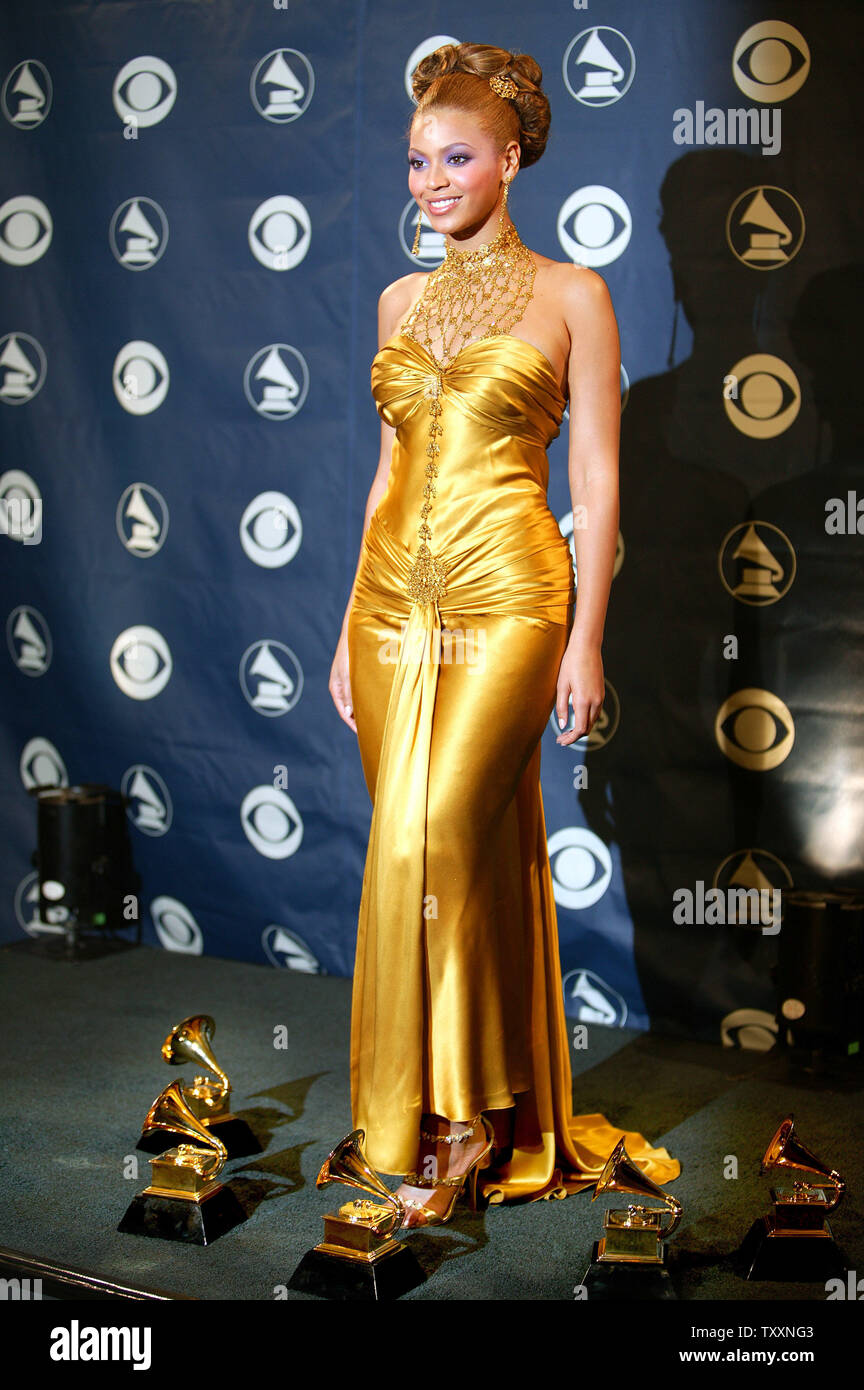
| 2004 | Dolce & Gabbana | Gold Silk / Formal Gown | Her solo debut; established her as a red-carpet powerhouse. |
| 2014 | Michael Costello | White Floral Lace / Sheer | Defined the "naked dress" trend with high-fashion elegance. |
| 2017 | Peter Dundas | Gold Embroidery / Art Deco | A celebration of Black motherhood and Yoruban divinity. |
| 2021 | Schiaparelli | Black Leather / Surrealist | Marked her record-breaking 28th Grammy win with architectural edge. |
| 2023 | Gucci | Metallic Silver / Ruffled Silk | Aligned with the Renaissance era's club-culture aesthetic. |
| 2024 | Louis Vuitton | Leather / Western (Cowboy) | Teased the Cowboy Carter era with Pharrell Williams' debut aesthetic. |
The Shift Toward Black Heritage and "Cowboy Core"
In recent years, specifically leading into 2024 and 2025, Beyoncé has utilized her Grammy fashion to highlight specific subcultures within the Black experience. At the 66th Annual Grammy Awards (2024), her choice of a Louis Vuitton leather studded suit paired with a white Stetson cowboy hat was a calculated move.
Designed by Pharrell Williams, the look served as a visual prologue to her Cowboy Carter album. This approach—using the red carpet as a "teaser" for upcoming artistic projects—has become a hallmark of her career. The technical execution involved custom-tooled leather and hardware that referenced traditional Western wear but was reimagined through a luxury streetwear lens. By doing so, she reclaimed the "cowboy" aesthetic for Black culture, proving that a dress (or suit) at the Grammys can be a potent tool for historical revisionism.
The "Beyoncé Effect" on Luxury Brand Valuation
When Beyoncé wears a designer to the Grammys, the impact is measurable. According to data from various fashion analytics platforms, a Grammy appearance by Beyoncé can generate millions of dollars in Media Impact Value (MIV) for a brand.
For example, after her 2021 appearance in Schiaparelli, searches for the brand spiked by over 200%. This "Beyoncé Effect" allows her to negotiate unique creative partnerships. Unlike other celebrities who may wear off-the-rack runway pieces, Beyoncé’s garments are almost exclusively custom-made. This requires a high level of technical coordination between her stylist, Marni Senofonte, and the ateliers in Paris and Milan. The garments are often built with internal structures to support the weight of heavy beading or metallic elements, ensuring she can move comfortably while maintaining a statuesque silhouette.
Maintaining the Legacy: How Beyoncé Redefines the Red Carpet
As we look at the landscape of the Grammys in 2026, Beyoncé’s influence remains the gold standard. Her strategy has moved away from the "shock factor" of the early 2010s and toward a more refined, archival approach. She often pairs her custom gowns with historic jewelry—most notably from Tiffany & Co.—integrating multi-million dollar diamonds that emphasize her status as music royalty.
The "Beyoncé dress" is no longer just a fashion choice; it is a meticulously planned event. From the choice of color palette to the specific choice of a designer’s debut or finale collection, every detail is intentional. This level of detail has forced other artists to elevate their own red-carpet presence, turning the Grammy Awards into the premier fashion event of the music industry, rivaling even the Met Gala in terms of global reach and cultural conversation.
Frequently Asked Questions
Who has designed the most Grammy dresses for Beyoncé?
While Beyoncé has worked with many designers, Givenchy (under Riccardo Tisci) and Peter Dundas have provided some of her most iconic looks. However, in recent years, she has favored Schiaparelli and Balmain for their ability to create sculptural, high-concept pieces that align with her status as a record-breaking artist.
Was the 2017 "Sun Goddess" dress heavy?
Yes, the Peter Dundas gown worn in 2017 was reportedly very heavy due to the extensive hand-beading and gold metallic thread work. To manage this, the dress was custom-fitted to her pregnancy silhouette, with internal corsetry designed to distribute the weight evenly across her shoulders and hips.
What is the most expensive dress Beyoncé has worn to the Grammys?
While the exact cost of custom Haute Couture is rarely disclosed, her 2017 Dundas gown and her 2021 Schiaparelli look are estimated to be worth over $100,000 each in labor and materials. When including the Tiffany & Co. jewelry she frequently wears, the total value of her Grammy ensembles often exceeds several million dollars.
Does Beyoncé keep all of her Grammy dresses?
Beyoncé maintains an extensive private archive of her performance and red-carpet wardrobes. These garments are stored in a climate-controlled environment to preserve the delicate fabrics and beadwork. Many of these pieces have been loaned to museums, such as the Rock & Roll Hall of Fame, for exhibition.
How does Beyoncé choose her Grammy designers?
The selection process is led by her longtime stylist, Marni Senofonte, in collaboration with Beyoncé. The choice is usually dictated by the theme of her current musical era. For example, the Renaissance era (2023) focused on house music and ballroom culture, leading to the selection of metallic, structural designs from Gucci and Balmain.
Final Recommendation for Fashion Enthusiasts
To truly appreciate Beyoncé's Grammy fashion, one should look beyond the aesthetic and investigate the designer’s creative direction at the time of the event. Beyoncé rarely chooses a dress simply because it is trendy; she chooses it to celebrate a specific milestone or to amplify a cultural message. For those interested in the technical side of fashion, studying the Recording Academy's archives or Vogue’s retrospective galleries offers deeper insight into the craftsmanship required to create these legendary looks.
Image Gallery