How Car Title Loans Work in Fort Worth
Car title loans in Fort Worth operate as short-term, high-interest loans where a borrower’s vehicle serves as collateral. Regulated by both Texas state law and specific Fort Worth city ordinances, these loans allow residents to access...
Car title loans in Fort Worth operate as short-term, high-interest loans where a borrower’s vehicle serves as collateral. Regulated by both Texas state law and specific Fort Worth city ordinances, these loans allow residents to access cash based on their vehicle's equity, typically requiring a clear title, proof of income, and a physical vehicle inspection.
Contents
Navigating the financial landscape in Tarrant County requires a clear understanding of how "Credit Access Businesses" (CABs) function. In Fort Worth, title lending is not just a simple agreement between a lender and a borrower; it is a multi-tiered transaction governed by strict local transparency and repayment rules designed to prevent "debt traps." As of 2026, the market remains a frequent resource for those with subprime credit, but the costs and legal protections have evolved significantly over the last decade.
The Role of the Credit Access Business (CAB) in Texas
To understand how car title loans work in Fort Worth, one must first understand the legal structure of lending in Texas. Most title loan storefronts in Fort Worth are not "lenders" in the traditional sense. Instead, they are registered as Credit Access Businesses (CABs) under Chapter 393 of the Texas Finance Code.
A CAB acts as an intermediary. When you walk into a title loan office on Camp Bowie Boulevard or Jacksboro Highway, the company you are speaking with is essentially a broker. They connect you with a third-party lender (often an out-of-state entity) and guarantee your loan. Because the CAB is "arranging" the credit rather than lending its own money, it can charge "service fees" that are not technically classified as interest under state law.
In 2026, these service fees remain the primary cost driver. While the actual interest rate on the loan might be capped at a relatively low 10%, the CAB fees often result in an Annual Percentage Rate (APR) exceeding 200% or 300%. Understanding this distinction is vital: your monthly payment is primarily paying for the CAB’s "service" of facilitating the loan, while only a small portion goes toward the interest and the principal balance.
Fort Worth City Ordinances and Local Regulations
While Texas state law provides the broad framework for title lending, the City of Fort Worth has its own set of ordinances (originally adopted in 2013 and refined since) that provide additional protections for residents. These local laws are more stringent than state requirements and are designed to ensure borrowers have a realistic path to repayment.
Loan Amount Limitations
In Fort Worth, a CAB cannot facilitate a title loan for any amount. The loan is strictly limited by the borrower’s income and the vehicle’s value. Specifically, the loan amount cannot exceed:
- 3% of the borrower's gross annual income, or
- 70% of the vehicle’s retail value, whichever is less.
This "3% rule" is a critical protection for Fort Worth residents. For example, if a borrower earns $40,000 a year, the maximum title loan they could legally secure in the city is $1,200, even if their truck is worth $20,000.
The "Right to Pay Down" and Renewal Limits
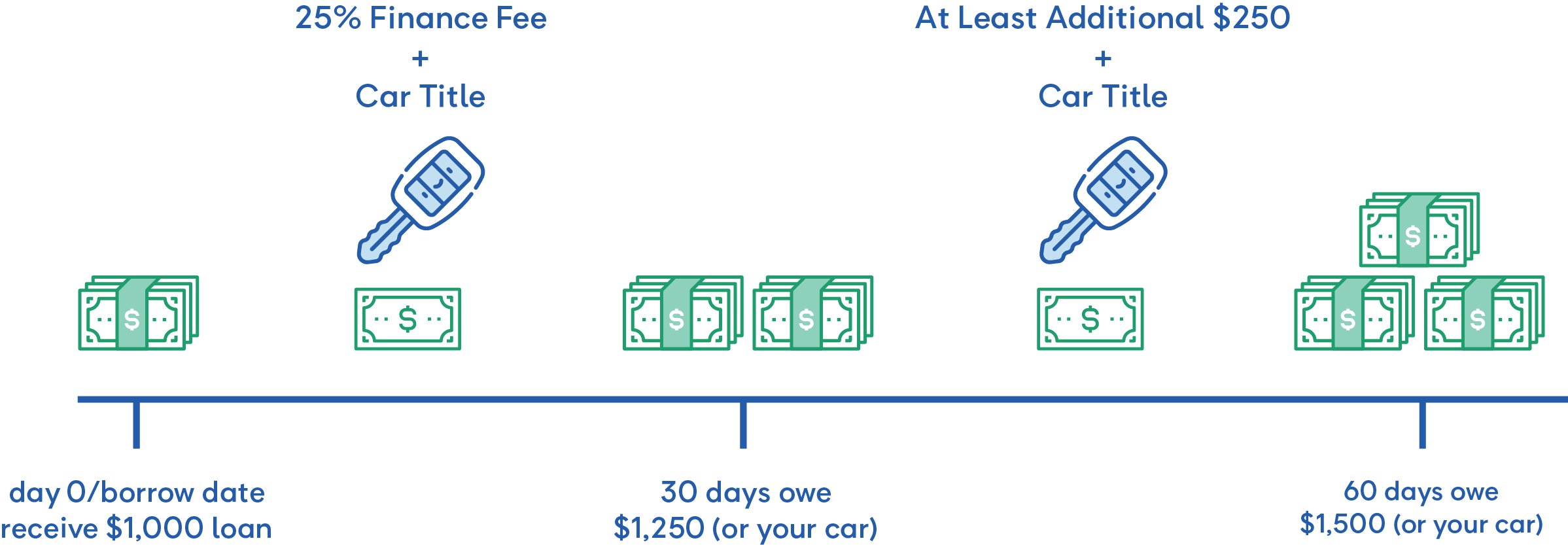
Fort Worth law also limits how many times a loan can be renewed or "rolled over." A loan can generally only be renewed up to three times. Most importantly, for a renewal to be valid in Fort Worth, the borrower must pay down at least 25% of the original principal in addition to the interest and fees due. This prevents the common cycle of "interest-only" payments that kept borrowers in debt for years prior to these local regulations.
Eligibility Requirements for Fort Worth Residents
Securing a title loan in Fort Worth is generally faster than a bank loan, but the requirements are firm. Because the vehicle's value is the primary security, credit scores are often secondary or ignored entirely.
- Clear Title (Pink Slip): The vehicle must be paid off. You cannot get a title loan if you are still making payments to a dealership or another bank. The title must be in your name and free of any liens.
- Government-Issued ID: A valid Texas driver’s license or state ID is required to verify identity and age (must be at least 18).
- Proof of Income: Since Fort Worth ordinances tie the loan amount to your annual income, you must provide recent pay stubs, bank statements, or disability/Social Security award letters.
- Residency Verification: You must show proof that you live in the area, typically through a utility bill or lease agreement.
- Vehicle Inspection: The lender will physically inspect the car to determine its "Blue Book" or "Black Book" value. They look at the mileage, engine condition, and exterior/interior wear and tear.
The Step-by-Step Application Process
If you decide to proceed with a title loan in Fort Worth in 2026, the process typically follows this sequence:
1. Application and Documentation
You can often start the application online, but Texas law usually requires a physical visit to the storefront to finalize the contract. You will submit your ID, title, and income proof.
2. Vehicle Appraisal
A staff member will go out to the parking lot to examine your vehicle. They are looking for "resale potential." A well-maintained vehicle with low mileage will command a higher loan offer than one with mechanical issues, regardless of the income-based caps.
3. Contract Review
This is the most critical stage. The CAB must provide you with a Consumer Disclosure that clearly states the APR, the total cost of the loan if paid on time, and the schedule of payments. Under Fort Worth ordinance, this document must be provided in the language used to negotiate the loan (e.g., Spanish or English).
4. Funding
Once you sign the agreement, you hand over the physical car title. In exchange, the CAB places a lien on the vehicle with the Texas Department of Motor Vehicles (TxDMV). You receive your funds—often via direct deposit, a printed check, or a prepaid debit card—usually within the same business day.
5. Retaining Possession
Unlike a pawn shop, you keep your car. You continue to drive it to work and for daily errands while you repay the loan. However, the lender may install a GPS tracking device or a starter-interrupt device if permitted by the contract, which allows them to locate or disable the vehicle if you default.
Comparative Costs of Lending in Texas (2026 Estimates)
| Loan Type | Typical APR Range | Collateral Required | Maximum Term |
|---|---|---|---|
| Car Title Loan (Fort Worth) | 200% – 350% | Vehicle Title | 30 days (up to 3 renewals) |
| Payday Loan | 300% – 500% | Future Paycheck | 14 – 30 days |
| Pawn Loan | 120% – 240% | Physical Asset | 30 – 60 days |
| Personal Loan (Credit Union) | 8% – 18% | Unsecured / Signature | 12 – 60 months |
| Traditional Auto Loan | 4% – 12% | Vehicle | 36 – 72 months |
Default and Repossession in Tarrant County
If a borrower fails to make payments, the CAB or the third-party lender has the legal right to repossess the vehicle. In Fort Worth, the repossession process must follow the Texas Business and Commerce Code.
- Notice of Default: While Texas is a "self-help" repossession state (meaning they can take the car without a court order if they don't "breach the peace"), many lenders provide a grace period or a notice of default.
- Right to Cure: Borrowers should check their specific contract to see if they have a "right to cure," which is a window of time to pay the past-due amount and fees to stop the repossession.
- Sale of the Vehicle: After repossession, the lender will sell the vehicle at a private sale or auction. If the car sells for more than what you owe (plus repossession fees), you are theoretically entitled to the surplus. However, if it sells for less, you may still be liable for the "deficiency balance."
Alternatives for Fort Worth Residents
Before committing to a title loan, residents should consider local resources that offer lower-cost financial assistance.
- Community Action Partners (CAP): A City of Fort Worth program that provides financial assistance for utilities and other emergency needs to eligible low-income residents.
- Catholic Charities Fort Worth: Known for their financial coaching and "St. Joseph’s Microloan" program, which helps people refinance high-interest predatory debt into low-interest, manageable loans.
- Local Credit Unions: Institutions like Unity One or EECU often have "credit builder" loans or small-dollar personal loans for members, even those with less-than-perfect credit.
- Payment Plans: If the loan is needed for a utility bill or medical debt, most Fort Worth providers (like Oncor or local hospitals) offer interest-free payment plans that are much cheaper than a title loan.
Frequently Asked Questions
Can I get a title loan in Fort Worth if the title is in someone else's name?
No. To secure a title loan, the person applying for the loan must be the legal owner listed on the vehicle title. If the car was a gift or a recent purchase, you must first visit the Tarrant County Tax Assessor-Collector’s office to transfer the title into your name before applying.
What happens if I can't pay the full amount at the end of 30 days?
In Fort Worth, you may be able to renew the loan, but you must pay all interest and fees due plus at least 25% of the original principal. You are limited to three such renewals. If you still cannot pay after that, the loan must be settled, or the lender may begin repossession proceedings.
Do title loan companies in Fort Worth check my credit score?
Most do not perform a "hard" credit pull through the major bureaus (Equifax, Experian, or TransUnion). Instead, they use specialized services like Teletrack to see your history with other short-term lenders. The primary factor in approval is the equity in your vehicle and your ability to prove a steady income.
Is there a limit on how much interest they can charge in Fort Worth?
While interest is technically capped by the Texas Finance Code (often around 10%), the "service fees" charged by Credit Access Businesses (CABs) are not. These fees can be substantial. However, the total amount of the loan itself is strictly capped by Fort Worth ordinance to 3% of your annual income or 70% of the vehicle value.
Can I get a title loan on a car that isn't paid off yet?
Generally, no. Most Fort Worth lenders require a "clear" or "unencumbered" title. This means no other bank or dealership can have a lien on the vehicle. Some lenders may offer a "buyout" where they pay off your remaining small balance to take the primary lien position, but this is rare and usually only applies if you owe a very small amount relative to the car's value.
Are there any "no-inspection" title loans in Fort Worth?
In 2026, a physical or high-quality virtual inspection is almost always required. Because the vehicle is the only thing securing the loan, the lender must verify its condition and existence. Be wary of any offer that does not require an inspection, as it may be a scam or involve hidden, predatory terms.
Recommendation for Borrowers
If you are considering a car title loan in Fort Worth, first exhaust all local non-profit and credit union options. If you must proceed, ensure you are working with a CAB that is fully compliant with the Fort Worth City Ordinance. Verify that your loan amount does not exceed 3% of your gross annual income, and ensure you have a clear plan to pay down at least 25% of the principal if you are forced to renew. Always read the Consumer Disclosure carefully to understand the total cost—including fees—expressed as an APR.
Image Gallery