How the Appellate Court of Maryland Operates: Structure, Process, and Rules
The Appellate Court of Maryland operates as the state's intermediate appellate court, reviewing decisions rendered by circuit courts and orphans' courts across all 24 Maryland jurisdictions. Composed of 15 judges, the court evaluates l...
The Appellate Court of Maryland operates as the state's intermediate appellate court, reviewing decisions rendered by circuit courts and orphans' courts across all 24 Maryland jurisdictions. Composed of 15 judges, the court evaluates legal errors, interprets state statutes, and issues written opinions primarily through three-judge panels, ensuring standardized application of law across civil, criminal, and administrative matters.
Contents
- Circuit Court / Orphans' Final Judgment
- Notice of Appeal (30-Day Window)
- Record Assembly & MDEC Filing
- Briefing Phase & Record Extracts
- Three-Judge Panel Review / Oral Arguments (Annapolis, MD)
- Written Opinion & Issued Mandate
- Petition for Certiorari (Optional to Supreme Court of Maryland)
Constitutional Mandate and Institutional Structure
Formerly known as the Court of Special Appeals, the tribunal was renamed the Appellate Court of Maryland following a voter-approved constitutional amendment in November 2022 (effective December 14, 2022). This structural update aligned Maryland’s judicial naming conventions with the majority of U.S. state court systems, simultaneously renaming the state's highest tribunal from the Court of Appeals to the Supreme Court of Maryland.
The court functions primarily under mandatory jurisdiction. Unlike the Supreme Court of Maryland, which exercises discretionary review over most matters, the Appellate Court of Maryland must hear virtually all appeals properly filed from final judgments of the Circuit Courts and Orphans' Courts. This includes civil litigation, criminal prosecutions, family law matters, juvenile proceedings, and administrative agency decisions.
- Supreme Court of Maryland (Discretionary Review / Certiorari)
- Appellate Court of Maryland (Mandatory Intermediate Appellate)
- Circuit Courts (General Civil & Criminal)
- Orphans' Courts (Wills, Estates, Probate)
- Appellate Court of Maryland (Mandatory Intermediate Appellate)
The tribunal is authorized for 15 active judges appointed by the Governor of Maryland and confirmed by the Maryland State Senate. To preserve geographical representation, judges are appointed from each of the state's six appellate judicial circuits, alongside at-large appointments.
After initial appointment, judges must stand for an uncontested retention election at the first general election occurring at least one year after their appointment, and every ten years thereafter. The Chief Judge of the Appellate Court of Maryland is designated by the Governor and serves as the administrative head of the institution.
The Step-by-Step Appellate Workflow
Appellate practice in Maryland is governed by Title 8 of the Maryland Rules. Appeals move through a structured sequence of procedural milestones, from initiating notices to final mandates.
1. Initiating the Appeal and Jurisdictional Prerequisites
An appeal begins in the trial court (the Circuit Court or Orphans' Court), not in the appellate court itself. Under Maryland Rule 8-202, a party must file a Notice of Appeal with the clerk of the trial court within 30 days after the entry of the judgment or order from which the appeal is taken.
- The Final Judgment Rule: With limited statutory exceptions (such as interlocutory orders granting injunctions or appointing receivers under Maryland Code, Courts and Judicial Proceedings Section 12-303), appeals can only be taken from a final judgment that resolves all claims against all parties.
- Filing Fees: The appellant must pay the required docketing fees to the clerk of the circuit court and the appellate court, unless granted a public defender representation status or a fee waiver based on indigence.
- Transcripts and Record Assembly: The appellant must order transcripts of all trial court proceedings relevant to the issues raised on appeal. The circuit court clerk compiles the original papers, exhibits, and transcripts into the record on appeal and transmits it to the Appellate Court of Maryland.
2. Electronic Filing and the Briefing Phase
All attorneys practicing before the Appellate Court of Maryland are required to file documents electronically using the Maryland Electronic Courts (MDEC) system. Pro se litigants (unrepresented parties) may file electronically or submit paper documents.
The briefing schedule dictates the timeline for written arguments:
- Appellant’s Brief and Record Extract: Filed within 40 days after the record is filed with the appellate court. The appellant must compile a Record Extract containing key parts of the trial court record—such as pleadings, rulings, and transcript excerpts—necessary for deciding the appeal.
- Appellee’s Brief: Filed within 30 days after the service of the appellant’s brief. The appellee presents counter-arguments and may include a supplemental record extract if relevant items were omitted by the appellant.
- Appellant’s Reply Brief: Optional, filed within 20 days after service of the appellee’s brief, focusing strictly on rebutting new arguments raised by the appellee.
Strict formatting rules apply to briefs under Maryland Rule 8-503, governing margins, font size (typically 13-point Century Schoolbook or Georgia), page limits (or word-count limits of 9,100 words for principal briefs), and cover colors (yellow for appellant, green for appellee, red for reply).
Timeline of the Briefing Phase:
- Record Transmitted to Appellate Court
- Within 40 Days: Appellant's Brief & Record Extract (Max 9,100 Words / Yellow Cover)
- Within 30 Days: Appellee's Brief (Max 9,100 Words / Green Cover)
- Within 20 Days: Appellant's Reply Brief (Optional) (Max 3,900 Words / Red Cover)
3. Panel Assignment, Oral Arguments, and En Banc Hearing
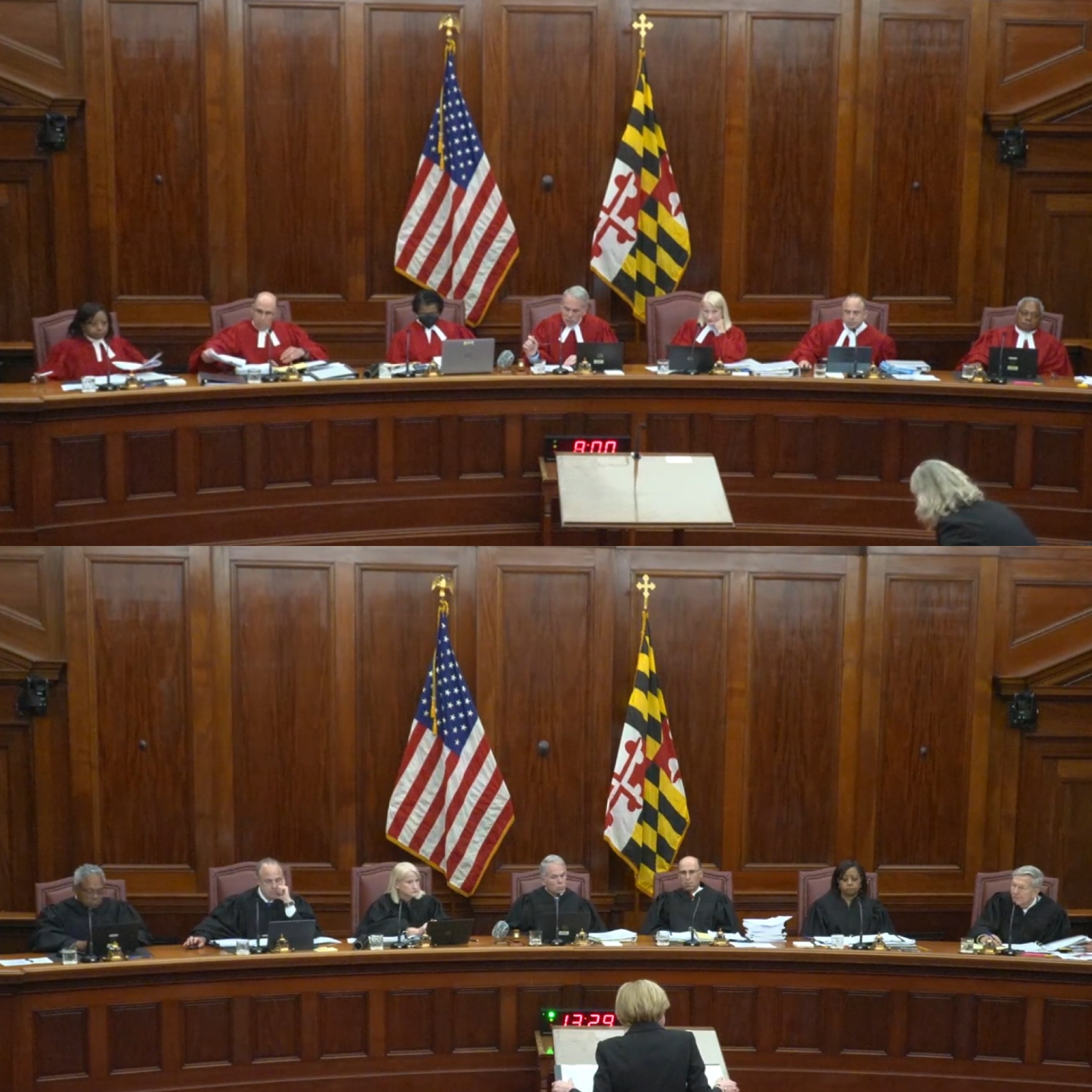
The Appellate Court of Maryland operates primarily through panels of three judges. Panel assignments are rotated periodically by the Chief Judge to ensure balanced judicial workloads.
- Oral Arguments: Cases are scheduled for oral argument from September through June in the Edward F. Borgerding Judicial Center or the Court of Appeals Building in Annapolis. Each side typically receives 20 to 30 minutes to present oral arguments before the three-judge panel. The panel frequently questions counsel regarding legal precedents, statutory interpretation, and the practical consequences of their position.
- Submission on Briefs: Under Maryland Rule 8-523, the court may determine that oral argument is unnecessary if the legal questions are straightforward or the briefs thoroughly cover the issues. In these instances, the case is submitted on the briefs for panel review without in-person argument.
- En Banc Review: On rare occasions, a case may be heard or reheard en banc—meaning all 15 active judges sit together to decide the matter. En banc proceedings occur when an appeal raises issues of exceptional public importance or to maintain uniformity in the court's decisions.
Standards of Review and Types of Judicial Opinions
Appellate courts do not retry facts, take new testimony, or evaluate witness credibility. Instead, they examine the record from the lower court to determine whether legal errors occurred.
Applicable Standards of Appellate Review
| Standard of Review | Primary Application | Judicial Deference Level |
|---|---|---|
| De Novo | Pure Questions of Law | Zero deference to trial court |
| Clearly Erroneous | Trial Judge Findings of Fact (Bench Trials) | High deference; reversed only if unsupported by competent evidence |
| Abuse of Discretion | Discretionary Orders (Evidentiary Rulings, Motions for New Trial) | Maximum deference; reversed only if ruling is wildly unreasonable |
- De Novo Review: Applied to pure questions of law, such as statutory interpretation or contract construction. The appellate court accords no deference to the trial court’s legal conclusions and evaluates the issue independently.
- Clearly Erroneous: Applied to factual findings made by a trial judge during a bench (non-jury) trial under Maryland Rule 8-131(c). The appellate court accepts the trial judge's factual determination unless it is completely unsupported by competent evidence in the record.
- Abuse of Discretion: Applied to trial management decisions, such as admitting evidence, granting continuances, or ruling on motions for a new trial. A trial court abuses its discretion only when its ruling is guided by erroneous legal principles or is manifestly unreasonable, arbitrary, or outrageous.
Types of Opinions: Reported vs. Unreported
After panel deliberations, one judge is assigned to draft the court's opinion. The resulting decision falls into one of two primary classifications:
- Reported Opinions: Opinions designated for official publication in the Maryland Appellate Reports. Reported opinions carry binding legal precedent (stare decisis) for all trial courts in Maryland.
- Unreported Opinions: Decisions intended solely to resolve the specific dispute between the immediate parties without establishing new precedent. Historically, unreported opinions could not be cited as precedent. However, under Maryland Rule 1-104 (amended in recent years), unreported opinions issued on or after July 1, 2023, may be cited for persuasive value, though they remain non-binding on other courts.
Comparison: Appellate Court vs. Supreme Court of Maryland
Understanding how the intermediate appellate court functions requires comparing its operational scope with the state's court of last resort, the Supreme Court of Maryland.
| Operational Feature | Appellate Court of Maryland | Supreme Court of Maryland |
|---|---|---|
| Jurisdictional Type | Intermediate Appellate Court | State Court of Last Resort |
| Docket Control | Mandatory Jurisdiction (must hear valid appeals) | Discretionary Jurisdiction (via Writ of Certiorari) |
| Bench Composition | 15 Judges | 7 Justices |
| Hearing Format | Three-Judge Panels (En Banc optional) | Full Court (All 7 Justices sit together) |
| Primary Mandate | Error correction and statutory application | Formulating policy, constitutional review, resolving intra-state legal conflicts |
| Precedential Value | Reported opinions bind circuit/district courts | Opinions bind all Maryland state courts |
| Filing Deadlines | Notice of Appeal within 30 days of trial ruling | Certiorari Petition within 15 days of mandate (or before ACM judgment) |
Post-Decision Procedures and Appeals to the Supreme Court
Once an opinion is filed by the Appellate Court of Maryland, the case enters its final administrative phases:
Post-Decision Workflow:
- Appellate Court Issues Opinion
- Motion for Reconsideration leading to Panel Decision
- No Motion
- Mandate Issued (Day 30)
- Optional: Petition for Certiorari
- Supreme Court of Maryland
1. Motion for Reconsideration
Under Maryland Rule 8-605, any party may file a Motion for Reconsideration within 30 days after the filing of the court’s opinion. The motion must state specific points of law or fact that the court overlooked or misapprehended. Filing this motion pauses the issuance of the mandate.
2. Issuance of the Mandate
The mandate is the official order that transmits the appellate judgment back to the trial court, directing the circuit court on how to proceed (e.g., affirming the judgment, reversing the judgment, or remanding for a new trial). Per Maryland Rule 8-606, the clerk issues the mandate 30 days after the opinion is filed, unless a Motion for Reconsideration is pending or the court orders otherwise.
3. Petitioning for Certiorari
A party dissatisfied with the Appellate Court's decision may petition the Supreme Court of Maryland for a Writ of Certiorari.
- The petition must demonstrate that further review is "desirable and in the public interest."
- Under Maryland Rule 8-302, a petition for certiorari must be filed no later than 15 days after the Appellate Court of Maryland issues its mandate, or no later than 30 days after the filing of the Appellate Court's opinion, whichever is earlier.
- Alternatively, a party may file a petition for certiorari prior to judgment, asking the Supreme Court to bypass the intermediate court entirely in cases of extreme urgency or paramount public interest.
Practical Rules and Operational Best Practices
Litigants navigating the Appellate Court of Maryland must adhere to procedural and administrative standards detailed in the official Maryland Rules of Procedure.
- Strict Final Judgment Compliance: Filing an appeal prematurely—before a final judgment resolving all claims has been entered—will result in an immediate dismissal for lack of appellate jurisdiction under Maryland Rule 8-602.
- Preservation of Issues Below: The Appellate Court will generally not consider any issue unless it was raised in or decided by the trial court (Maryland Rule 8-131(a)). Failure to object to evidentiary rulings or jury instructions at trial waives those claims on appeal.
- Record Extract Accuracy: Omitting vital trial testimony or exhibits from the Record Extract can lead to sanctions, including dismissal of the appeal under Maryland Rule 8-501. Practitioners must coordinate extract contents with opposing counsel whenever possible.
- Adherence to Page and Word Limits: Appellate clerks strictly enforce font sizes, line spacing, and word counts. Filings that exceed word limits (verified by an attorney certificate of compliance) are routinely rejected by the MDEC electronic filing system.
Frequently Asked Questions
What changed when the court was renamed in 2022?
In December 2022, Maryland Ballot Question 1 took effect, changing the court's name from the "Court of Special Appeals" to the "Appellate Court of Maryland." The name change altered terminology and judicial titles (e.g., judges are no longer referred to as judges of the Court of Special Appeals), but did not alter the court's underlying jurisdiction, procedural rules, or internal panel structures.
Does the Appellate Court of Maryland retry cases or hear new evidence?
No. The Appellate Court of Maryland is an error-correcting judicial tribunal, not a trial court. It does not accept witness testimony, take new physical evidence, or re-weigh credibility. The court evaluates only the written record generated in the Circuit Court or Orphans' Court to determine if legal errors occurred.
How long does an appeal typically take in the Appellate Court of Maryland?
From the date the record is transmitted, an appeal in the Appellate Court of Maryland generally takes between 6 to 12 months to resolve. The briefing process consumes roughly 3 to 4 months, followed by oral arguments or submission on briefs, with written opinions typically issued within several months after submission.
What is the difference between a reported and an unreported opinion?
A reported opinion establishes binding legal precedent for all lower courts across Maryland and is published in official state law reporters. An unreported opinion resolves only the specific case between the litigants involved. Under amended Maryland Rule 1-104, unreported opinions issued after July 1, 2023, may be cited for persuasive value, but they do not hold binding precedential authority.
What happens if I miss the 30-day deadline to file a Notice of Appeal?
The 30-day deadline for filing a Notice of Appeal under Maryland Rule 8-202 is jurisdictional. If a party misses this deadline, the Appellate Court of Maryland generally lacks legal authority to hear the case, and the appeal will be dismissed. Limited exceptions exist for certain post-judgment motions that toll the deadline (e.g., timely motions for a new trial).
Next Steps and Actionable Guidance
Litigants preparing to appeal a trial court decision or defend a favorable judgment in Maryland should follow these immediate steps:
- Verify the Final Judgment Date: Review trial court dockets via Maryland Judiciary Case Search to pinpoint the exact entry date of the final order, establishing the 30-day deadline for filing the Notice of Appeal.
- Order Transcripts Immediately: Request transcripts from court reporters for all relevant trial proceedings immediately upon filing the Notice of Appeal to avoid record transmission delays.
- Consult the Maryland Rules: Review Title 8 of the Maryland Rules of Procedure carefully for mandatory guidelines regarding electronic filing via MDEC, brief formatting, record extracts, and citation rules.
- Engage Qualified Appellate Counsel: Because intermediate appellate practice revolves around formal legal writing and complex standards of review, litigants should consult an attorney admitted to the Maryland Bar who specializes in appellate advocacy.
Image Gallery