Understanding How Many Times Your Salary Is Typical for a Home Purchase
The general rule of thumb suggests that an affordable home price is approximately 2.5 to 3 times your gross annual household income. However, in the 2026 housing market, this multiplier is increasingly viewed as a baseline rather than...
The general rule of thumb suggests that an affordable home price is approximately 2.5 to 3 times your gross annual household income. However, in the 2026 housing market, this multiplier is increasingly viewed as a baseline rather than a strict mandate, as individual financial variables such as debt-to-income ratios, interest rates, and localized cost-of-living adjustments play a decisive role in determining sustainable borrowing limits.
Contents
The Evolution of the 3x Salary Rule
For decades, the "three-times-salary" rule served as the gold standard for personal finance. This conservative benchmark was designed to ensure that homeowners did not become "house poor"—a state where mortgage payments, property taxes, insurance, and maintenance costs consume such a large portion of a monthly budget that the owner has little disposable income for savings, emergencies, or lifestyle expenses.
While this guideline provides a useful starting point for first-time buyers, it was formulated during eras when home price appreciation and interest rate environments looked vastly different from the current 2026 landscape. Today, high-interest rate environments and surging property values in metropolitan hubs mean that many buyers are forced to re-evaluate what constitutes a "typical" purchase price relative to their earnings.
Key Factors That Influence Your Personal Multiplier
While calculators might suggest a specific multiple, lenders focus on your Debt-to-Income (DTI) ratio. This is a clearer indicator of financial health than a simple salary multiplier. Most traditional mortgage lenders prefer a total DTI ratio of 36% or less, meaning that all your monthly debt payments—including your proposed new mortgage, credit cards, student loans, and auto loans—should not exceed 36% of your gross monthly income.
1. Interest Rates and Loan Terms
In 2026, even a minor fluctuation in mortgage interest rates can significantly shift your purchasing power. A lower interest rate allows you to borrow more while maintaining the same monthly payment, effectively allowing you to increase your "salary-to-house" ratio without increasing your financial risk. Conversely, when rates rise, your maximum purchase price should theoretically decrease to keep your debt service manageable.
2. Down Payment Size
A larger down payment acts as a hedge against the salary multiplier. If you have significant savings, you may be able to afford a home that is 4 or 5 times your annual salary because your loan-to-value (LTV) ratio is lower, which reduces the monthly principal and interest payment. Lenders view borrowers with 20% or more down as lower risk, which can lead to better interest rate offerings.
3. Regional Variations
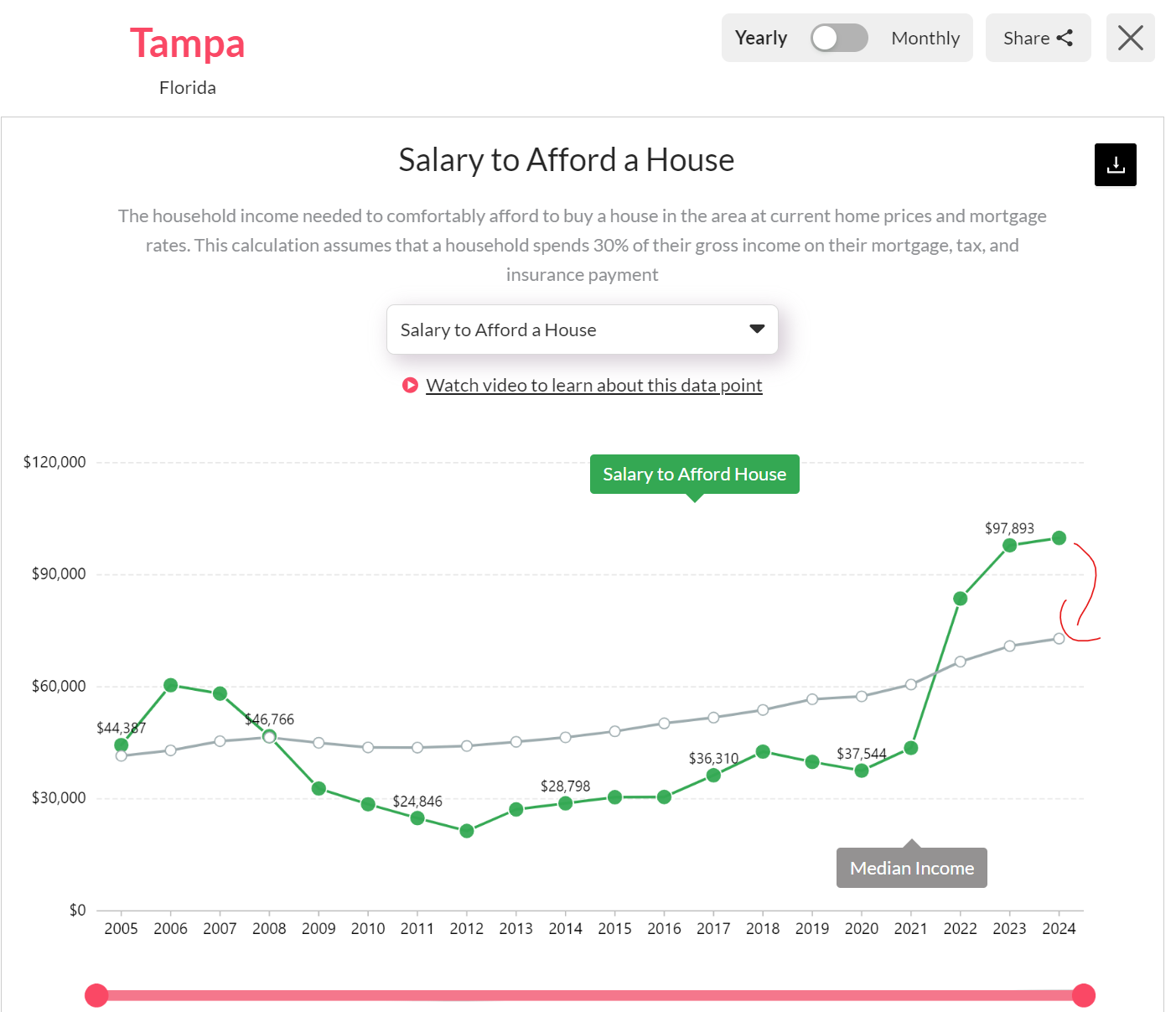
The "typical" multiplier varies wildly based on geography. In rural areas or secondary markets, a 2.5x salary multiplier might allow you to purchase a detached single-family home with relative ease. In major urban centers or high-demand coastal regions, a 2.5x multiplier may be insufficient to secure even a small condominium. In these high-cost environments, it is common to see households spend 4x to 6x their annual income, though this requires aggressive budgeting in other areas.
Financial Comparison: Multiplier vs. Monthly Payment
When determining how much you can afford, it is more effective to shift your focus from the total purchase price to the "all-in" monthly payment. The table below illustrates how different salary-to-price ratios interact with potential monthly obligations.
| Annual Salary | Multiplier | Home Price | Estimated Monthly P&I | Risk Level |
|---|---|---|---|---|
| $80,000 | 2.5x | $200,000 | ~$1,300 | Conservative |
| $80,000 | 3.5x | $280,000 | ~$1,800 | Moderate |
| $80,000 | 5.0x | $400,000 | ~$2,600 | High |
Note: Estimates assume a 20% down payment and a standard 30-year fixed-rate mortgage at 2026 market averages. Figures exclude taxes, insurance, and HOA fees.
The Dangers of Maximizing Your Borrowing Power
It is a common mistake for buyers to look at "maximum loan approval" rather than "maximum comfortable budget." Mortgage lenders use a formula to determine the most they are willing to lend you based on your income, but they do not account for your personal financial goals, such as retirement contributions, childcare costs, or travel.
If you max out your borrowing capacity (often 5x to 6x your salary), you leave yourself vulnerable to "lifestyle creep" or unforeseen economic shocks. A common rule of thumb for sustainable homeownership is the 28/36 rule: your mortgage payment (including property taxes and insurance) should not exceed 28% of your gross monthly income, and your total debt payments should not exceed 36%.
Assessing Your Readiness Beyond Salary
Before applying for a mortgage, consider the following checklist to determine if your current salary can support the home price you have in mind:
- Emergency Fund: Do you have 3 to 6 months of living expenses saved? If you move into a home at 4x your salary, your cash flow will be tighter, making this buffer essential for unexpected home repairs.
- Maintenance Budget: Aim to set aside 1% to 2% of the home's purchase price annually for maintenance. This cost is often overlooked by first-time buyers but is critical when you exceed the 3x salary multiplier.
- Career Trajectory: If your income is expected to grow significantly over the next few years, a slightly higher initial multiplier may be mathematically acceptable. If your income is stable or stagnant, stick to the 2.5x–3x range to avoid long-term financial strain.
Frequently Asked Questions
Does the salary rule include bonuses or commissions? Lenders generally require two years of consistent, documented history of bonuses or commissions to include them in your income calculation. If your income is highly variable, lenders will often use an average, which may be lower than your "good" years, resulting in a lower maximum loan amount.
Why do lenders approve me for more than I can afford? Lenders are concerned with your ability to repay the specific loan based on your debt history and income. They do not have access to your personal goals or your habits regarding lifestyle spending. Their approval is a statement of their risk appetite, not a recommendation for your personal financial health.
Is it ever okay to exceed the 3x multiplier? Yes, if you have a significant down payment, low existing debt, and a high credit score. If your monthly housing cost remains below 30% of your net (take-home) pay, you are likely in a safe position, even if the purchase price is 4 or 5 times your gross annual salary.
How do interest rates change my affordability? Interest rates dictate the cost of borrowing. A 1% increase in interest rates can reduce your purchasing power by approximately 10%. When rates are higher, your salary must go further, meaning you are forced to look at homes with lower multipliers to maintain the same monthly payment.
Next Steps for Prospective Homebuyers
To accurately determine what you can afford, begin by pulling your credit report and calculating your current debt-to-income ratio. Use an online mortgage calculator to input your specific salary, anticipated down payment, and current local interest rates. Rather than focusing on a single "multiplier," calculate your monthly payment and test your budget by setting aside that amount each month for six months into a separate savings account. If you can do this without lifestyle stress, you have found your sustainable purchase price.
Image Gallery