What is the Best Book About WWII? A Comprehensive Guide to Essential Histories
Identifying the single best book about World War II depends on your specific interest—whether it is military strategy, political intrigue, or the human experience. However, most historians and critics regard Antony Beevor’s "The Second...
Identifying the single best book about World War II depends on your specific interest—whether it is military strategy, political intrigue, or the human experience. However, most historians and critics regard Antony Beevor’s "The Second World War" as the premier single-volume history for its balance of global scope and personal narrative, while Rick Atkinson’s "Liberation Trilogy" stands as the definitive account of the American experience in the European theater.
Contents
World War II remains the most documented conflict in human history. With hundreds of thousands of volumes published since 1945, the "best" book is often a matter of perspective. A reader looking for a bird’s-eye view of the entire global struggle requires a different text than someone seeking the harrowing details of the Eastern Front or the psychological toll of the Pacific island-hopping campaign. As of 2026, the scholarship surrounding the war continues to evolve, with new access to international archives and fresh sociological perspectives refining our understanding of the 20th century's defining catastrophe.
Determining the "Best" Based on Narrative Scope
To find the right book, you must first categorize what kind of history you are looking for. World War II literature generally falls into three categories: grand strategy (the big picture), operational history (specific battles and campaigns), and social history (the experience of civilians and individual soldiers).
The Definitive Single-Volume Overviews
For those who want a comprehensive understanding of the war from the invasion of Poland to the Japanese surrender, a single-volume history is the best place to start. These books are massive undertakings, often exceeding 800 pages, but they provide the necessary context to see how events in North Africa influenced decisions in the Kremlin or the Pacific.
- "The Second World War" by Antony Beevor: Published in 2012, this remains a modern masterpiece. Beevor excels at "grand narrative" history, shifting seamlessly from the maps of General Staffs to the frozen trenches of a private. His work is particularly noted for its inclusion of the Eastern Front, which was often downplayed in older Western histories.
- "The Storm of War" by Andrew Roberts: Roberts provides a more traditional military and political analysis. His central thesis revolves around how Hitler’s strategic errors—driven by ideology rather than military logic—led to the inevitable defeat of the Axis. It is highly readable and meticulously researched, making it a favorite for those interested in leadership and decision-making.
- "All Hell Let Loose" (published as "Inferno" in some regions) by Max Hastings: While Beevor and Roberts focus heavily on strategy, Hastings focuses on the "human experience." He uses thousands of letters and diaries to illustrate that for most participants, the war was not about grand maneuvers but about survival, fear, and administrative chaos.
The Best Books on Specific Theaters of War
Sometimes the best book isn't the one that covers everything, but the one that masters a specific slice of the conflict. Because the war was fought across disparate environments—from the jungles of Burma to the streets of Stalingrad—niche focus often yields deeper insights.
The War in the Pacific
The Pacific theater was characterized by vast distances and a level of racial animosity that differed from the European war.
- "The Pacific War Trilogy" by Ian W. Toll: Consisting of Pacific Crucible, The Conquering Tide, and Twilight of the Gods, this is widely considered the definitive naval history of the conflict. Toll captures the transition from the battleship era to the carrier-dominated warfare that redefined the ocean.
- "With the Old Breed: At Peleliu and Okinawa" by E.B. Sledge: This is not a strategic overview but a memoir. Many historians cite it as the finest soldier’s-eye view of combat ever written. Sledge describes the dehumanizing nature of the Pacific war with a brutal honesty that served as a primary source for the HBO miniseries The Pacific.
The Eastern Front (The Great Patriotic War)
The war between Nazi Germany and the Soviet Union was the largest and most lethal confrontation in history.
- "Stalingrad" by Antony Beevor: This book arguably put Beevor on the map as the preeminent historian of the era. It details the turning point of the war with a focus on the sheer physical misery of the soldiers and the civilians trapped in the city.
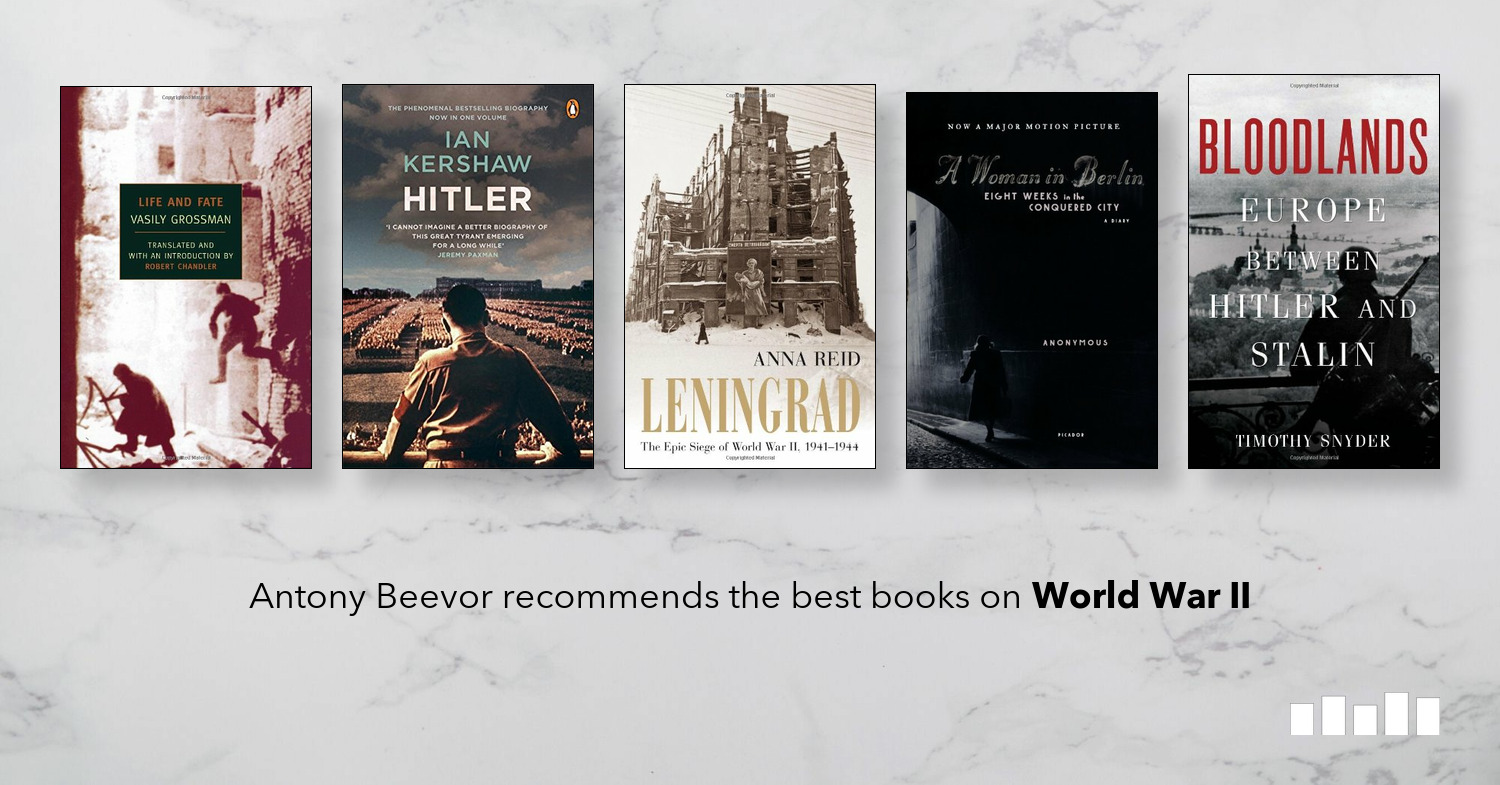
- "Bloodlands: Europe Between Hitler and Stalin" by Timothy Snyder: While not strictly a military history, this is essential for understanding the geography of the war’s worst atrocities. Snyder explains how the overlapping ambitions of two totalitarian regimes turned Eastern Europe into a killing field.
The Western Front and the Liberation of Europe
- "The Liberation Trilogy" by Rick Atkinson: This series (An Army at Dawn, The Day of Battle, and The Guns at Last Light) follows the U.S. Army from its entry into North Africa through the fall of Berlin. Atkinson’s prose is legendary; he manages to make logistical reports and troop movements read like high-stakes drama.
Analyzing the Human and Political Dimensions
Beyond the battlefield, the "best" books often explore the "why" and the "how" of the war's occurrence and its moral complexities.
The Rise of the Third Reich
To understand the war, one must understand the regime that started it in Europe. "The Rise and Fall of the Third Reich" by William L. Shirer is a classic. While some modern historians criticize its sociological theories, Shirer was an American journalist in Berlin during the 1930s. His firsthand observations of the Nazi leadership provide a visceral reality that purely archival histories sometimes lack. For a more modern academic approach, Richard J. Evans’ "The Third Reich Trilogy" is the current scholarly standard.
The Holocaust and Ethics
The Holocaust is inseparable from World War II. "Ordinary Men" by Christopher Browning is a chilling but necessary read. It examines how a unit of middle-aged German policemen became mass murderers, focusing on the social psychology of "following orders" rather than innate monstrosity. Additionally, "If This Is a Man" by Primo Levi remains the most profound memoir of the concentration camps, offering a philosophical inquiry into what it means to remain human in the face of absolute evil.
Comparison of Top-Rated WWII Histories
The following table compares the most frequently recommended books to help you decide which aligns with your reading preferences in 2026.
| Book Title | Author | Primary Focus | Perspective | Difficulty |
|---|---|---|---|---|
| The Second World War | Antony Beevor | Global Overview | Balanced Strategic/Personal | Moderate |
| The Liberation Trilogy | Rick Atkinson | Western Front | U.S. Military Operational | High (Lengthy) |
| With the Old Breed | E.B. Sledge | Pacific Theater | Individual Marine Memoir | Easy/Graphic |
| The Storm of War | Andrew Roberts | Grand Strategy | Political/Military Leadership | Moderate |
| Ordinary Men | Christopher Browning | The Holocaust | Sociological/Psychological | Moderate |
| The Pacific War Trilogy | Ian W. Toll | Naval Warfare | Strategic/Naval Operations | Moderate |
| Rise & Fall of the Third Reich | William L. Shirer | Nazi Germany | Journalistic/Historical | High (Detailed) |
Frequently Asked Questions
Which WWII book should a beginner read first?
For a beginner, "The Second World War" by Antony Beevor is the best starting point. It provides a chronological flow that is easy to follow without getting bogged down in overly technical military jargon. It covers all major theaters—Europe, the Pacific, and the Eastern Front—giving the reader a solid foundation before they dive into more specialized topics.
What is the most accurate book on World War II?
Accuracy in history is often about the use of primary sources. "The Storm of War" by Andrew Roberts and "The Liberation Trilogy" by Rick Atkinson are renowned for their extensive use of declassified documents, diaries, and unit records. However, keep in mind that "accuracy" also depends on when the book was written; books written after the 1970s benefit from the declassification of the Ultra secret (the breaking of the Enigma code), which fundamentally changed our understanding of Allied intelligence.
Is there a "best" book about the civilian experience?
"All Hell Let Loose" by Max Hastings is widely regarded as the best account of the civilian experience on a global scale. Hastings makes a concerted effort to document the lives of those in occupied territories, those starving in Leningrad, and those working in the factories of the "Arsenal of Democracy." For a more personal civilian account, "The Diary of a Young Girl" by Anne Frank remains the most significant and poignant primary source.
Why is "The Rise and Fall of the Third Reich" still so popular?
Despite being published in 1960, William Shirer's work remains popular because of his narrative style and his status as an eyewitness to history. He was present at many of the rallies and press conferences he describes. While modern historians have corrected some of his conclusions regarding German history, his ability to capture the atmosphere of 1930s Berlin is unmatched.
Are there any good books focused specifically on the Blitz or the air war?
"The Splendid and the Vile" by Erik Larson (published in 2020) is an excellent, fast-paced account of Winston Churchill and London during the Blitz. For a broader look at the strategic bombing campaigns, "Masters of the Air" by Donald L. Miller provides a comprehensive and often harrowing look at the American eighth air force.
Final Recommendation: How to Choose Your Next Read
If you are looking for a singular experience that captures the gravity and complexity of the conflict, start with Antony Beevor. His work bridges the gap between academic history and engaging storytelling. If you find yourself drawn to the personal stories of the "Greatest Generation," move toward Rick Atkinson or E.B. Sledge.
World War II is a subject of such magnitude that no single book can ever truly be "the best" for everyone. The best approach is to start with a broad overview to understand the timeline, then follow your interests into specific campaigns, biographies, or memoirs. By 2026, many of these classic texts have been updated with new forewords or supplemental research, ensuring that they remain relevant for modern readers seeking to understand the war that shaped the modern world.
Image Gallery