MetLife Group Life Insurance Conversion: Guide to Rules, Costs, and Deadlines
MetLife group life insurance conversion allows departing employees and covered dependents to transition their employer-sponsored group term life coverage into an individual permanent whole life insurance policy. This process requires n...
MetLife group life insurance conversion allows departing employees and covered dependents to transition their employer-sponsored group term life coverage into an individual permanent whole life insurance policy. This process requires no medical examination or health questions, provided the completed application and initial premium payment are submitted within 31 days of group coverage termination.
Contents
Disclaimer: Life insurance guidelines, state insurance regulations, and individual employer contract terms vary. This guide provides general informational coverage of group life insurance conversion concepts and is not individual legal, tax, or financial advice.
What Is MetLife Group Life Insurance Conversion?
Group life insurance provided through an employer is typically written as group term life insurance. When an employee resigns, retires, experiences a reduction in working hours, or loses coverage due to employer plan changes, their active group coverage ends. The conversion privilege is a contractually guaranteed right embedded in standard MetLife group life policies (and mandated under most state insurance laws) that allows the insured individual to convert that group term policy into an individual permanent life insurance policy without undergoing medical underwriting.
Under standard group insurance terms, medical underwriting involves answering health questionnaires, permitting access to medical records, or undergoing physical exams. If an individual has developed chronic medical conditions, experienced severe illnesses, or advanced in age while employed, securing a new life insurance policy on the open market might be prohibitively expensive or denied entirely.
The primary advantage of conversion is guaranteed issue. MetLife cannot deny a conversion application based on your medical history, current health status, or pre-existing conditions, provided you satisfy the eligibility requirements and meet the strict administrative deadline.
However, converted policies differ substantially from original group policies:
- Policy Type: Conversion generally transitions a term policy into an individual Whole Life policy, which provides permanent protection for your entire lifetime (provided premiums are paid) and builds cash value over time.
- Premium Responsibility: While an employer often subsidizes basic group term coverage, the former employee pays 100% of the premium for a converted individual policy.
- Pricing Structure: Converted premiums are calculated based on your attained age (your age at the time of conversion) and standard risk classes, making converted whole life insurance considerably more expensive per dollar of coverage than employer-subsidized group term insurance.
Conversion vs. Portability: Understanding Your Options
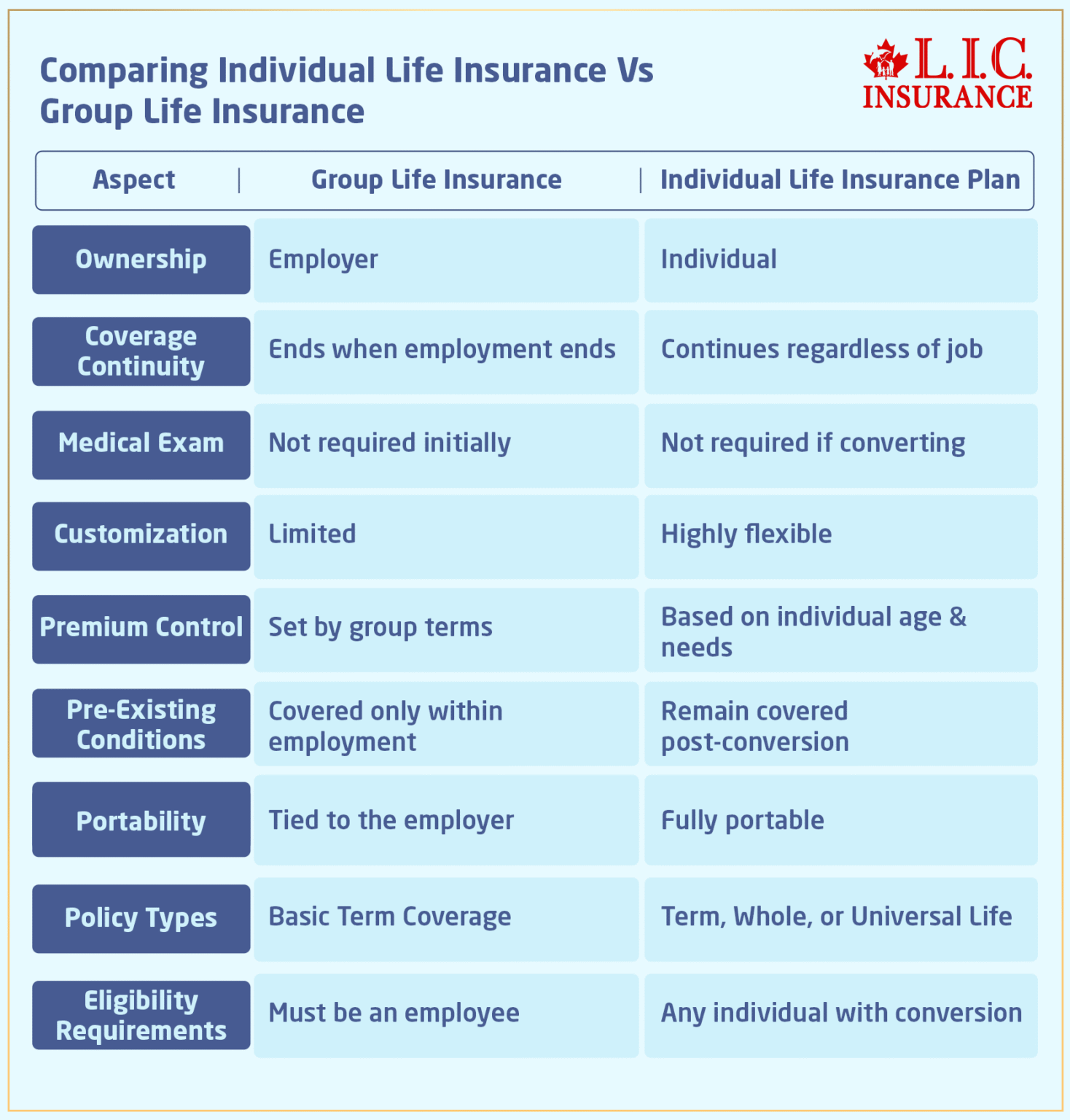
When leaving an employer that offers MetLife benefits, individuals frequently confuse conversion with portability. While both allow you to maintain life insurance coverage after leaving a job, their rules, policy types, and eligibility requirements differ significantly.
Group Coverage Terminated:
- CONVERSION OPTION
- Individual Permanent (Whole Life) Policy
- No Health Questions
- Higher cost (Whole Life)
- Guaranteed Issue
- PORTABILITY OPTION
- Group Term Policy
- Requires baseline health or active status
- Term rates (increases in 5-year age bands)
1. Conversion
- Policy Issued: Individual Whole Life (Permanent).
- Medical Underwriting: None required (Guaranteed Issue).
- Cost Structure: Higher initial cost because it is permanent coverage building cash value.
- Eligibility: Available upon termination of employment, reduction of hours, or termination of the master group policy.
2. Portability
- Policy Issued: Portable Group Term Insurance.
- Medical Underwriting: May require evidence of insurability (answering medical questions), though some policies permit limited portable amounts without health screening if ported within the allowed timeline.
- Cost Structure: Term insurance rates, which are lower initially than whole life rates but typically increase in 5-year age brackets (e.g., ages 40–44, 45–49).
- Eligibility: Usually requires that the employee was actively at work and not leaving due to injury or illness. Portability is not offered by all employer group plans.
Key Comparison Table
| Feature | MetLife Conversion | MetLife Portability | New Individual Policy (Open Market) |
|---|---|---|---|
| Policy Type | Individual Permanent (Whole Life) | Group Term Life | Individual Term or Permanent |
| Medical Exams / Health Questions | None required (Guaranteed Issue) | Minimal to Full (Depends on group policy) | Full Medical Underwriting Required |
| Premium Rates Based On | Attained Age (Standard Non-Tobacco) | Group Term Age-Band Rates | Underwritten Health Class & Age |
| Max Coverage Amount | Equal to lost group coverage amount | Varies (often capped by employer master policy) | Dependent on income and financial need |
| Cash Value Accumulation | Yes (Whole Life builds cash value) | No (Pure term protection) | Yes (if permanent policy selected) |
| Best Option For | Individuals with pre-existing health conditions | Healthy individuals wanting temporary term rates | Healthy individuals needing long-term low-cost term |
Eligibility Criteria and Qualifying Trigger Events
To exercise the MetLife group life conversion privilege, you must meet specific qualifying conditions outlined in the employer’s master policy and applicable state statutes.
Qualifying Events for Employees
You are typically eligible to convert your coverage if you lose group life coverage due to:
- Termination of Employment: Voluntary resignation, involuntary termination, layoff, or retirement.
- Loss of Eligible Class Status: A reduction in working hours from full-time to part-time, or a transfer to an employment category not covered by the benefit plan.
- Termination or Amendment of the Master Policy: If the employer cancels its group life contract with MetLife or amends the contract to terminate coverage for an entire class of employees, employees who have been insured under the policy for a minimum required period (typically 5 consecutive years) usually gain conversion rights, subject to maximum dollar caps defined by state law.
Qualifying Events for Dependents
Spouses and eligible child dependents covered under a MetLife group plan also hold conversion rights if their coverage ends due to:
- Termination of the primary employee's employment or eligibility.
- Death of the primary employee.
- Divorce or legal separation from the covered employee.
- A child reaching the maximum age limit for dependent coverage under the policy terms.
The 31-Day Conversion Window: Rules and Timeline
The most critical aspect of converting MetLife group life insurance is strict adherence to the application timeframe.
- Coverage Ends (Day 0)
- Notice Received (HR / Mail)
- 31-Day Window Opens (Statutory Period)
- Application & Premium Received by MetLife (Deadline: Postmarked by Day 31)
Standard 31-Day Rule
In most jurisdictions, an insured individual has 31 calendar days from the date their group coverage terminates to complete the conversion application and submit the first premium payment to MetLife.
During this 31-day transition period, the original group life insurance protection typically remains in effect automatically. If the departing employee dies within this 31-day window, the group life benefit is usually paid out under the original group policy rules, even if the conversion application has not yet been processed or submitted.
Extension of Time for Notice
State insurance regulations generally mandate that employers or group policyholders provide written notice of conversion rights to departing employees.
- If written notice of conversion rights is delayed, many state laws grant an extension of time to apply for conversion (often an additional 15 to 30 days following receipt of notice).
- However, most state laws impose an absolute outer limit (such as 60 to 90 days from the initial termination date), after which conversion rights expire permanently regardless of notice.
Caution: Never rely on an extension. Because verifying exact notice dates can become disputed, administrative best practice is to complete and postmark conversion paperwork within 31 days of your official coverage end date.
How Much Does MetLife Conversion Cost?
The cost of converting MetLife group term coverage to an individual whole life policy is often significantly higher than what employees were accustomed to paying via payroll deduction. Understanding the pricing factors helps avoid unexpected financial surprises.
1. Attained Age Pricing
Group insurance rates are averaged across large pools of employees. Conversion premiums, conversely, are based entirely on your attained age at the exact time of conversion. A 55-year-old converting coverage will pay rates designed specifically for a 55-year-old purchasing individual whole life insurance.
2. Whole Life Structure
Because converted policies are permanent Whole Life insurance, premiums are structured to remain level for life while generating cash value over time. Permanent insurance carries inherently higher premium costs per thousand dollars of coverage ($1,000 face value) than term insurance.
3. Standard Non-Tobacco Risk Class
Because MetLife cannot evaluate your health during conversion, premiums are typically billed at standard non-tobacco (or standard tobacco, if applicable) rates. You do not receive preferred health discounts, but you are also not penalized or rated up for severe health conditions.
Cost Example Concept
- Active Group Term Cost: A 45-year-old employee might pay $15 to $30 per month for $200,000 of group term coverage through payroll deduction.
- Converted Whole Life Cost: Converting that full $200,000 into an individual permanent whole life policy at age 45 could cost several hundred dollars per month, as rates reflect individual permanent policy structures rather than subsidized group term rates.
Step-by-Step Guide: How to Convert Your Coverage
Converting your MetLife policy involves coordinating with your former employer’s human resources department and MetLife’s conversion administration unit.
- STEP 1: Obtain Form
- Request the "Notice of Conversion Rights" form from your HR/Benefits department.
- STEP 2: Confirm Coverage Amounts
- HR completes Employer Portion confirming loss of coverage date and maximum amount.
- STEP 3: Request Rate Quote & Application
- Contact MetLife Conversion Administration to obtain specific Whole Life rates.
- STEP 4: Submit Application & First Premium
- Complete employee section; attach check/payment; postmark within 31 days.
Step 1: Request the Conversion Notice from HR
Upon notification of termination or retirement, request a Notice of Conversion Rights (or Group Life Conversion Notice) from your employer's HR or benefits administrator.
Step 2: Ensure Employer Information Is Complete
The employer must complete their portion of the form, which details:
- The date group coverage ended.
- The reason for coverage termination.
- The exact dollar amount of basic and supplemental life coverage in effect on the termination date.
Step 3: Calculate Premium & Select Coverage Amount
You do not have to convert the entire amount of your former group coverage. You may choose to convert a partial amount (e.g., converting $50,000 out of a $200,000 group benefit) to fit your personal budget. Contact MetLife’s Group Conversion Unit directly or consult the conversion rate tables provided with your application package to determine your exact premium.
Step 4: Complete and Mail the Application Package
Complete the insured's portion of the application. Include your initial premium payment (typically payable by check, money order, or electronic bank draft as specified by MetLife).
Mail the completed application, HR certification form, and payment to the designated MetLife conversion address. Ensure the package is postmarked within the 31-day eligibility window, and retain proof of mailing for your records.
Evaluating the Pros and Cons
Deciding whether to convert your MetLife policy requires balancing immediate protection needs against ongoing financial costs.
Benefits of Conversion
- No Medical Exams or Health Screenings: Uninsurable individuals or those with significant health impairments (e.g., cancer history, cardiovascular disease, diabetes) can maintain life insurance protection that would otherwise be unavailable on the private market.
- Guaranteed Lifetime Coverage: Unlike term insurance, which expires after a fixed number of years, a whole life policy remains active for your entire lifetime as long as premiums are paid on schedule.
- Fixed Premiums: Premiums remain level and will not increase as you grow older.
- Cash Value Growth: The policy accumulates tax-deferred cash value over time, which can be accessed via policy loans or surrenders.
Drawbacks of Conversion
- High Premium Costs: Whole life premiums are substantially higher than group term or individual term insurance rates.
- Limited Options: Conversion is typically limited to standardized standard whole life products rather than competitive term or universal life options.
- Potential Over-Insurance: Converting the full face amount of a high-value group policy may lead to unsustainable monthly expenses.
Smart Alternatives to Conversion
If you are leaving your employer, conversion is not your only path forward. Consider these alternatives based on your current health status and financial goals:
1. Purchase an Individual Term Policy on the Open Market
If you are in good or average health, applying for a private individual term life insurance policy through an independent broker is almost always significantly cheaper than converting to a whole life policy. A 10-, 20-, or 30-year individual term policy offers high coverage amounts for low monthly premiums.
2. Utilize Portability (If Offered)
If your employer's MetLife plan includes a portability provision and you meet the health criteria, electing to port your term policy lets you retain term insurance pricing without converting to expensive permanent insurance.
3. Rely on a New Employer's Group Plan
If you are transitioning directly to another company that offers employer-sponsored group life insurance, you can often obtain basic life coverage without medical underwriting under the new plan's guaranteed issue limits.
Frequently Asked Questions
What happens if I miss the 31-day MetLife conversion deadline?
If you miss the 31-day window without a statutorily recognized extension of notice, your right to convert without medical underwriting expires permanently. You will then need to apply for life insurance through standard channels, which require medical questionnaires and underwriting.
Can I convert supplemental or voluntary life insurance along with basic life insurance?
Yes. In most MetLife group contracts, both employer-paid basic group term life and employee-paid supplemental or voluntary term life coverage are eligible for conversion, up to the total combined coverage limit held prior to termination.
Can I convert my spouse’s or child’s group life coverage?
Yes. If your dependents were covered under your group plan and lose eligibility (due to your termination, death, divorce, or a child reaching the age cap), they have independent rights to convert their coverage to individual whole life policies within the 31-day window.
Does a converted MetLife policy build cash value immediately?
Because converted policies are standard Whole Life insurance products, they do build cash value over time. However, cash value accumulation typically takes several years of premium payments before reaching meaningful levels, as early premiums cover mortality costs and administrative issuance fees.
Summary and Next Steps
Converting a MetLife group life insurance policy provides a crucial safety net for departing employees who cannot pass medical underwriting due to health conditions. While conversion premiums are higher than active employer term rates, the guarantee of uninterrupted coverage without medical exams makes it an invaluable option under the right circumstances.
Recommended Next Actions:
- Check Your Date of Termination: Identify your official coverage end date to establish your 31-day postmark deadline.
- Request Forms Immediately: Ask your HR department for the MetLife Group Life Conversion Notice on your last day of employment or immediately following notice of termination.
- Assess Your Health Realistically:
- If in poor health: Calculate the cost of converting all or part of your MetLife coverage to maintain guaranteed issue protection.
- If in good health: Get quotes for an individual term life policy on the open market before committing to permanent whole life conversion rates.
- Submit Paperwork Early: Mail your completed application and initial premium payment well before the 31-day window closes, utilizing certified mail for delivery verification.
Image Gallery