Understanding the Delaware Corporations Division for Your Business
The Delaware Division of Corporations is the state-level regulatory body responsible for the formation, filing, and governance of business entities. It functions as the administrative backbone for the Delaware General Corporation Law (...
The Delaware Division of Corporations is the state-level regulatory body responsible for the formation, filing, and governance of business entities. It functions as the administrative backbone for the Delaware General Corporation Law (DGCL), providing services such as entity registration, document certification, and franchise tax collection to ensure businesses remain in legal good standing.
Contents
The state of Delaware remains the preeminent jurisdiction for American business entities. As of 2026, more than 65% of Fortune 500 companies and the vast majority of initial public offerings (IPOs) are incorporated here. Navigating the Delaware Division of Corporations is not merely a bureaucratic necessity; it is a strategic requirement for any business seeking to leverage the state’s sophisticated legal environment and specialized court systems. Understanding how this division operates, what it requires from your business, and how to maintain compliance is essential for protecting your corporate veil and ensuring long-term operational stability.
The Role and Structure of the Delaware Division of Corporations
The Delaware Division of Corporations is a subset of the Delaware Department of State. Unlike many other states where business filings might be handled by the Secretary of State's general office, Delaware’s dedicated division is specifically optimized for high-volume corporate transactions. Its primary mandate is to process the formation of various legal entities, including C-Corporations, S-Corporations, Limited Liability Companies (LLCs), Limited Partnerships (LPs), and Statutory Trusts.
One of the most critical distinctions for business owners to understand is the relationship between the Division and the Delaware Court of Chancery. While the Division handles the administrative paperwork—such as filing certificates of incorporation or collecting taxes—the Court of Chancery handles the legal disputes. Because the Division operates so efficiently, it provides a stable administrative foundation that allows the court system to focus on complex corporate litigation, creating a predictable legal climate that investors and boards of directors value.
Administrative Oversight
The Division is responsible for maintaining the official public record of all business entities authorized to do business within the state. This includes:
- Entity Formation: Reviewing and filing Certificates of Incorporation and Certificates of Formation.
- Status Management: Issuing Certificates of Good Standing, which are often required by banks for lending or by other states for "foreign qualification."
- Document Preservation: Holding historical records of corporate amendments, mergers, and dissolutions.
- Revenue Collection: Administering the assessment and collection of Delaware Franchise Taxes.
Why Businesses Prioritize the Delaware Jurisdiction
The reason so many businesses interact with the Delaware Division of Corporations rather than their home state's equivalent often comes down to the Delaware General Corporation Law (DGCL). The DGCL is widely considered the most advanced and flexible business statute in the United States. It provides a level of predictability that is unmatched elsewhere, largely because the Division of Corporations has a century-long history of processing these filings with consistent standards.
For a business, incorporating through this division offers several advantages:
- Privacy Protections: In Delaware, the names and addresses of the initial directors or members of an LLC do not have to be disclosed in the public formation documents. This provides a layer of privacy for high-net-worth individuals and sensitive ventures.
- Efficiency: The Division offers "Expedited Services" that are among the fastest in the country. In 2026, businesses can still request one-hour or two-hour processing for critical filings like mergers or acquisitions, which is vital for time-sensitive deals.
- Venture Capital Requirements: Most venture capital firms and angel investors require startups to be Delaware C-Corporations before they will issue funding. This is because the legal framework is so well-understood by attorneys nationwide.
Essential Requirements for Business Entities
Interacting with the Division requires adherence to specific structural mandates. You cannot simply file a form and walk away; the state requires ongoing points of contact and specific organizational disclosures.
The Registered Agent Requirement
According to Delaware Code, Title 8, Section 132, every business entity must have and maintain a Registered Agent within the State of Delaware. The Registered Agent acts as the bridge between the Division of Corporations and the business. They are responsible for receiving service of process (legal notices) and official communications from the Division, such as franchise tax notices.
Because many businesses incorporated in Delaware do not have a physical office in the state, they must hire a commercial registered agent. The Division maintains a list of authorized agents, but it does not provide these services itself. Failure to maintain a registered agent will result in the business losing its "Good Standing" status, which can lead to the administrative dissolution of the company.
Authorized Shares and Par Value
When filing a Certificate of Incorporation for a corporation, the Division requires a statement of the total number of authorized shares and their par value. Unlike some states that have moved away from the concept of par value, Delaware still utilizes it for the calculation of franchise taxes. Business owners must be careful here: authorizing a massive number of shares (e.g., 10 million) with no par value can result in an unexpectedly high tax bill, as the Division uses a specific formula to calculate taxes based on those numbers.
Navigating the Filing Process in 2026
The Delaware Division of Corporations has moved almost entirely to a digital-first model via the eCorp portal. While paper filings are technically still possible in some legacy scenarios, the vast majority of business is conducted through the online system or via authorized service providers.
Step-by-Step Entity Formation
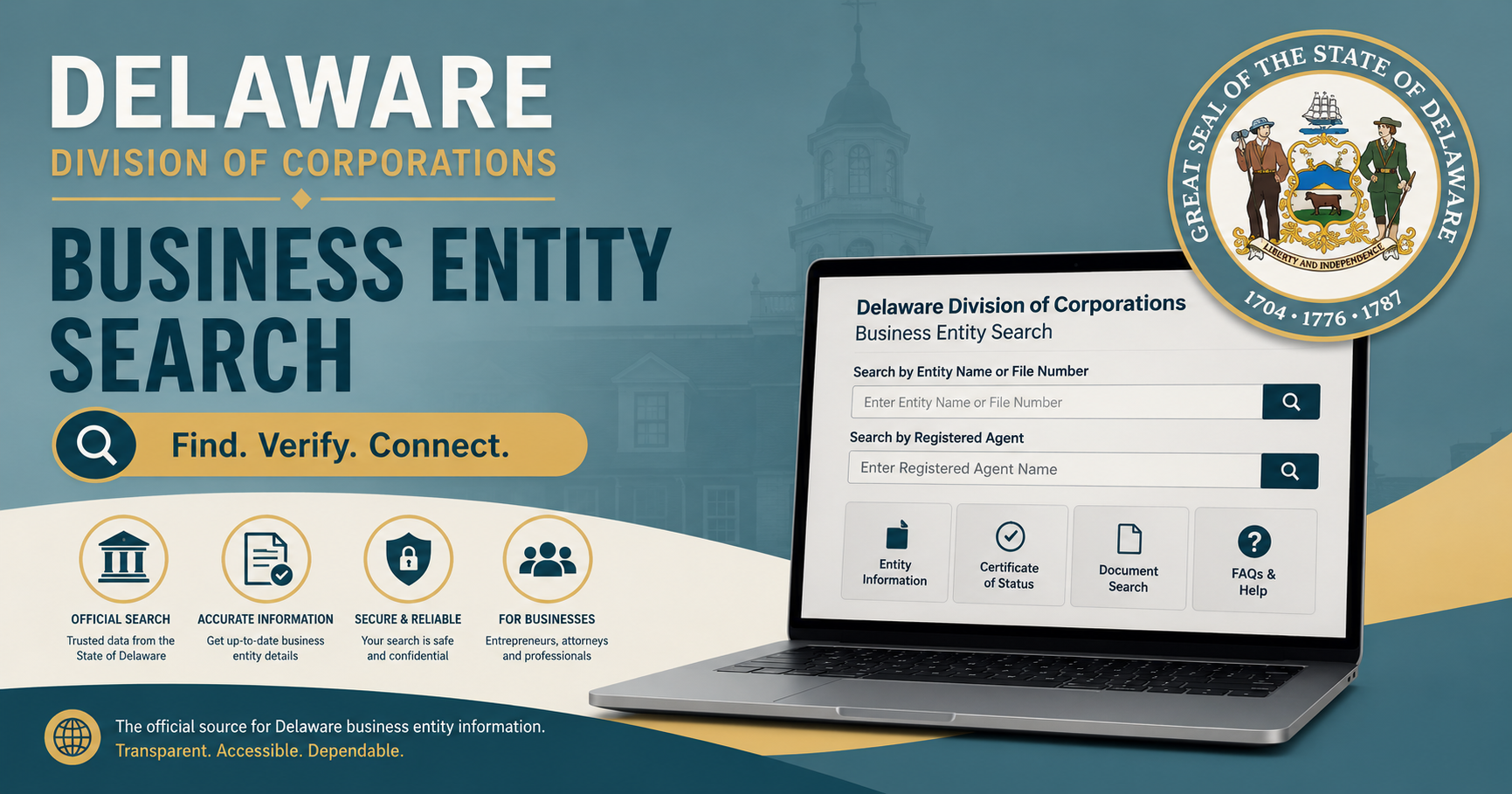
- Name Reservation: Before filing, use the Division’s online search tool to ensure your desired business name is "distinguishable upon the records." You can reserve a name for up to 120 days for a fee.
- Selection of Entity Type: Decide between a Corporation, LLC, or LP. This choice dictates which specific forms you will submit to the Division.
- Filing the Certificate: For a corporation, you file a Certificate of Incorporation. For an LLC, it is a Certificate of Formation. This document must include the entity name, the registered agent’s info, and (for corporations) the share structure.
- Payment of Fees: Filing fees vary by entity type and the number of pages in the document. As of 2026, the minimum filing fee for a corporation remains approximately $89, which includes the Division's assessment and the courthouse fee.
Obtaining a Certificate of Good Standing
A Certificate of Good Standing is a document issued by the Division of Corporations certifying that a company is legally incorporated and has paid all its taxes. Businesses frequently need this when:
- Opening a corporate bank account.
- Registering to do business in another state (Foreign Qualification).
- Closing a round of financing or a sale of the company.
These can be ordered directly through the Division’s website for a small fee and are usually delivered electronically within minutes.
Franchise Taxes and Annual Reports
Perhaps the most frequent interaction a business has with the Division is the annual filing requirement. Every entity incorporated in Delaware must pay an annual Franchise Tax for the privilege of incorporating in the state.
Deadlines and Penalties
For the 2026 calendar year, the deadlines are as follows:
- Corporations: Must file an Annual Report and pay Franchise Tax by March 1.
- LLCs and LPs: Must pay an annual tax of $300 by June 1. LLCs do not have to file an annual report, only pay the tax.
Failure to meet these deadlines results in a $200 penalty plus interest (currently 1.5% per month). If a business misses these payments for two consecutive years, the Division will declare the entity "Void" or "Dissolved," and the business will lose its legal protections until a revival process is completed.
Calculating Corporate Franchise Tax
Corporations have two methods for calculating their tax. The Division will default to the method that results in the lower tax, provided the corporation provides the necessary "Total Gross Assets" and "Issued Shares" data.
| Method | Best For... | Description |
|---|---|---|
| Authorized Shares Method | Small businesses with few shares. | Tax is based solely on the number of shares authorized in the Certificate of Incorporation. |
| Assumed Par Value Capital Method | High-growth startups and large corps. | Uses a complex formula involving total assets and issued vs. authorized shares to often reduce the tax significantly. |
| Flat Tax (LLC/LP) | All LLCs and LPs. | A simple, flat annual fee regardless of revenue or assets. |
The Assumed Par Value Capital Method is particularly useful for companies that have authorized 10 million shares but only have $1,000,000 in assets. Using the authorized shares method, that company might owe $85,000 in taxes; using the assumed par value method, that tax could drop to the minimum of $400.
Common Mistakes and Troubleshooting
Dealing with a state agency can be daunting, and small errors often lead to "rejected" filings. Common issues businesses encounter with the Division include:
- Inconsistent Names: The name on the filing must exactly match the name on the Registered Agent’s records, including punctuation (e.g., "ABC, LLC" vs "ABC LLC").
- Incorrect Tax Calculation: Many corporations overpay because they do not provide the asset data required for the Assumed Par Value calculation.
- Failure to Update Registered Agent: If your agent moves or you stop paying them, they will resign. Once the Division receives a resignation notice, you have 30 days to appoint a new one before the entity is cancelled.
- Missing the March 1st Deadline: Unlike federal taxes, which are often April 15th, the Delaware corporate deadline is strictly March 1st. Many entrepreneurs miss this and incur the $200 penalty immediately.
If a filing is rejected, the Division generally provides a reason code. Corrections must be made and the document refiled, often requiring a new filing fee unless the error was on the Division's part.
Frequently Asked Questions
Do I need to live in Delaware to use the Division of Corporations?
No. There is no requirement for directors, officers, or members to reside in Delaware. You only need a Registered Agent with a physical address in the state to act as your point of contact for the Division.
What is the difference between the Division of Corporations and the Division of Revenue?
The Division of Corporations handles entity formation and Franchise Tax (the tax for "existing"). The Delaware Division of Revenue handles state income tax and business licenses (the tax for "doing business" physically within the state). Most Delaware-incorporated companies that do not physically operate in the state only deal with the Division of Corporations.
Can I change my business type through the Division?
Yes. Delaware allows for "Conversion." You can convert an LLC into a Corporation or vice-versa by filing a Certificate of Conversion and a new formation document with the Division. This preserves the "age" of the entity and its existing contracts.
How do I close a business with the Division?
To legally end a business, you must file a Certificate of Dissolution (for corporations) or a Certificate of Cancellation (for LLCs). All taxes must be paid up to the date of filing before the Division will accept the closure paperwork.
Is the Delaware Division of Corporations open on weekends?
The Division's office is closed on weekends and state holidays. However, the eCorp online system is generally available for searches and status checks 24/7, though document processing only occurs during business hours unless high-tier expedited service is purchased.
Final Recommendations for Business Owners
To successfully manage your relationship with the Delaware Division of Corporations in 2026, you should prioritize three actions. First, appoint a reputable commercial Registered Agent; they serve as your early warning system for tax deadlines and legal notices. Second, calendar your tax deadlines (March 1 for Corporations, June 1 for LLCs) to avoid unnecessary penalties and interest. Finally, if your corporation grows in value or share count, consult with a CPA or legal counsel familiar with Delaware’s Assumed Par Value Capital Method to ensure you are not overpaying your franchise taxes.
By maintaining your entity’s "Good Standing" with the Division, you ensure that your business remains a valid legal person, capable of entering contracts, suing for damages, and protecting its owners from personal liability.
Image Gallery