What It Is Like Being a Medical Assistant: A Comprehensive Guide
Being a medical assistant is a fast-paced, multi-faceted role that bridges the gap between clinical care and administrative management. In 2026, the position requires a unique blend of technical proficiency, such as performing phleboto...
Being a medical assistant is a fast-paced, multi-faceted role that bridges the gap between clinical care and administrative management. In 2026, the position requires a unique blend of technical proficiency, such as performing phlebotomy and EKG testing, alongside administrative expertise in managing electronic health records and coordinating patient flow in high-volume environments.
Contents
The medical assistant (MA) is often the first and last person a patient interacts with during a healthcare visit. This role is foundational to the modern outpatient setting, ensuring that clinics run efficiently while physicians remain focused on diagnosis and treatment. To understand what it is truly like to work in this field, one must look at the daily workflow, the emotional demands, and the technical evolution of the profession.
The Dual Nature of the Medical Assistant Role
The most defining characteristic of being a medical assistant is the "dual-threat" nature of the work. Unlike specialized roles like a phlebotomist or a medical biller, an MA is expected to pivot between clinical tasks and administrative duties seamlessly.
Clinical Responsibilities (Back-Office)
Clinical work is what many envision when they think of medical assisting. On any given day, an MA is responsible for rooming patients, which involves more than just walking them to an exam room. It includes performing a "huddle" with the physician to review the day's cases, taking accurate vital signs (blood pressure, pulse, temperature, and respiration), and documenting the patient’s chief complaint in the Electronic Health Record (EHR).
In 2026, clinical duties have expanded to include higher-level technical tasks. Medical assistants frequently perform:
- Venipuncture and Lab Processing: Drawing blood and preparing specimens for transport or in-house testing.
- Pharmacology Assistance: Preparing and administering non-intravenous injections and assisting with prescription refills under physician supervision.
- Minor Surgical Assistance: Setting up sterile fields for procedures such as biopsies or laceration repairs and providing "surgical hands" to the physician.
- Diagnostic Testing: Performing EKGs, pulmonary function tests, and rapid screenings (e.g., COVID-19, Strep, or Flu).
Administrative Responsibilities (Front-Office)
The administrative side is equally critical. Without the MA’s coordination, the clinical side would descend into chaos. This involves managing the front desk, answering high-volume phone lines, and navigating the complexities of medical insurance. In the current 2026 landscape, this also includes managing telehealth portals and using AI-assisted scheduling tools to maximize clinic efficiency.
A Typical Day in the Life
The rhythm of a medical assistant's day is dictated by the appointment schedule. Most MAs work in outpatient clinics, which typically operate on a standard 8:00 AM to 5:00 PM schedule, though urgent care centers may require evening or weekend shifts.
The Morning Rush
The day usually begins 30 minutes before the first patient arrives. The MA checks the "crash cart" for emergency supplies, calibrates diagnostic equipment, and ensures all exam rooms are stocked with gloves, gowns, and specula. Once the doors open, the pace accelerates. A typical MA may see 15 to 25 patients a day. This requires rapid-fire transitions: rooming a patient, performing a blood draw, cleaning the room, and then immediately jumping to the front desk to handle a prior authorization for a medication.
The Mid-Day Transition
By noon, the focus often shifts to "callbacks." This is where the MA contacts patients with lab results, coordinates specialist referrals, and manages the physician’s inbox. This period requires meticulous attention to detail; a single miscommunication regarding a dosage or a follow-up date can have significant clinical consequences.
The Afternoon and Closing
The afternoon often brings more complex procedures or "walk-in" emergencies. At the end of the shift, the MA is responsible for biohazard waste disposal, ensuring all EHR charts are closed and "signed off," and preparing the clinic for the following day. It is a physically demanding role that involves standing for most of the day and frequent movement.
Technical and Emotional Competencies
To thrive as a medical assistant, one must possess a specific set of hard and soft skills. The technical requirements are rigorous, but the emotional intelligence required is often what separates a good MA from a great one.
Technical Proficiency
MAs must be experts in HIPAA (Health Insurance Portability and Accountability Act) compliance to protect patient privacy. They must also understand medical terminology and basic anatomy to communicate effectively with providers. In 2026, digital literacy is paramount. Most clinics utilize advanced EHR systems that integrate with patient wearables and home monitoring devices; the MA is often the one who interprets this data for the initial intake.
The "Soft" Side: Empathy and De-escalation
Medical assistants work with people who are often scared, in pain, or frustrated by the healthcare system. Being a medical assistant means being a "buffer." You are the person who calms a child before an immunization or explains a complex insurance rejection to an elderly patient. This requires extreme patience and a high degree of emotional resilience. Compassion fatigue is a real risk in this profession, making self-care and professional boundaries essential.
Education, Certification, and the 2026 Standards
Entering the field requires formal training, usually through a certificate, diploma, or associate degree program. While some states allow on-the-job training, most employers in 2026 require graduation from an accredited program and national certification.
The Importance of Accreditation
Programs should be accredited by the Commission on Accreditation of Allied Health Education Programs (CAAHEP) or the Accrediting Bureau of Health Education Schools (ABHES). This ensures the curriculum covers both the clinical and administrative competencies needed for the role.
Certification Paths
Certification is the gold standard for employment. It proves a baseline of knowledge and a commitment to the profession. The most recognized credentials include:
- Certified Medical Assistant (CMA): Awarded by the American Association of Medical Assistants (AAMA).
- Registered Medical Assistant (RMA): Awarded by American Medical Technologists (AMT).
- Certified Clinical Medical Assistant (CCMA): Awarded by the National Healthcareer Association (NHA).
| Feature | CMA (AAMA) | RMA (AMT) | CCMA (NHA) |
|---|---|---|---|
| Eligibility | Graduate of CAAHEP/ABHES program | Education or Work Experience | High school diploma + Training program |
| Exam Focus | Comprehensive Clinical/Admin | Clinical and Administrative | Primarily Clinical |
| Recertification | Every 60 months | Every 3 years | Every 2 years |
| Common Setting | Specialized & Primary Care | General Clinics | Urgent Care & Large Systems |
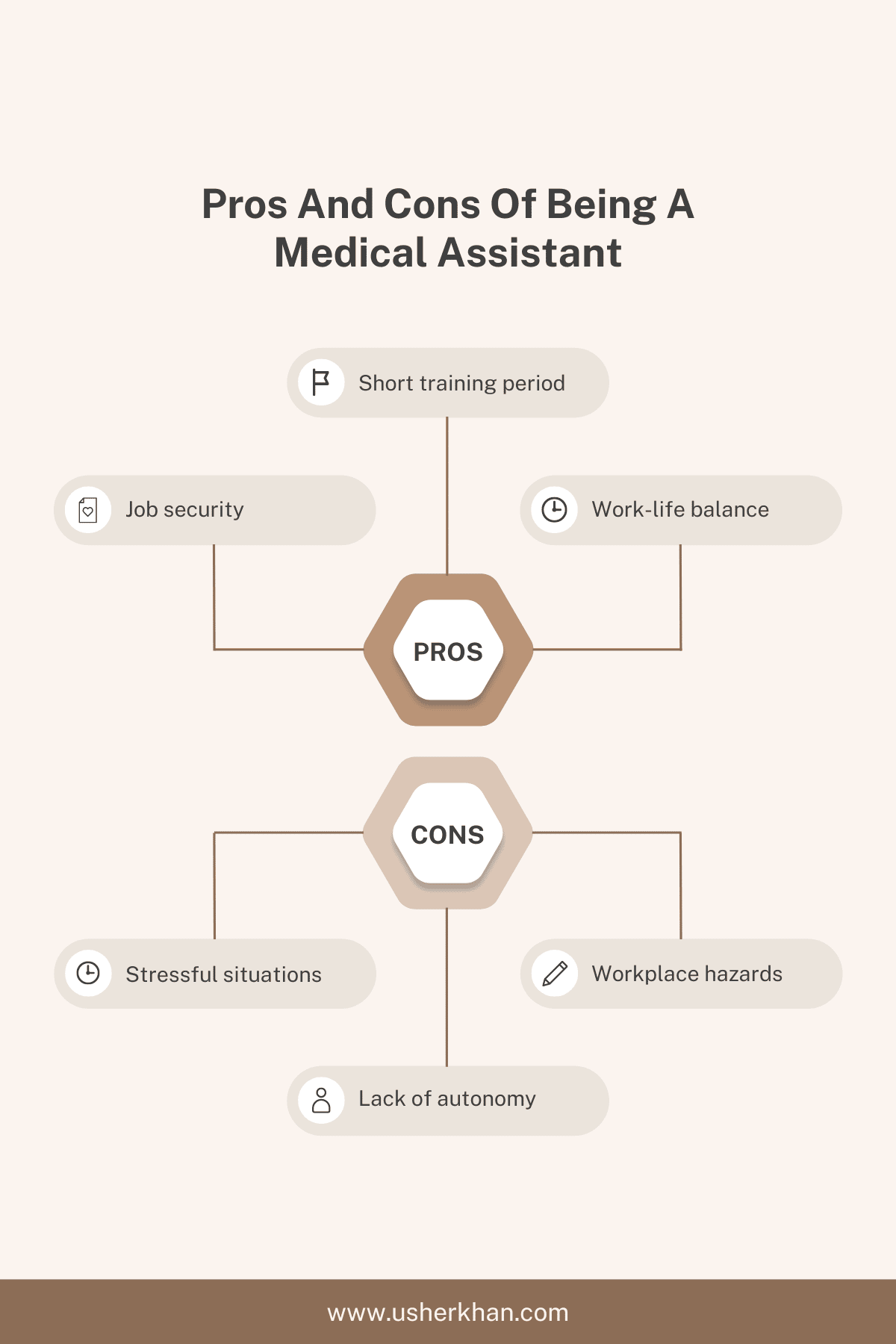
The Realities: Pros and Cons of the Profession
Prospective medical assistants should weigh the rewards against the inherent challenges of the healthcare environment.
The Advantages
- Job Security: According to the Bureau of Labor Statistics, employment for medical assistants is projected to grow much faster than the average for all occupations through the end of the decade.
- Short Training Period: You can enter the workforce in as little as 9 to 18 months.
- Career Ladder: The role is an excellent stepping stone to nursing (RN), physician assistant (PA) studies, or healthcare administration.
- Meaningful Impact: MAs provide direct support to patients, often forming long-term relationships in primary care settings.
The Challenges
- Physical Strain: The job involves long hours on your feet, lifting patients, and repetitive motions.
- Stress and Pace: Clinics are often understaffed, leading to high-pressure environments where "multi-tasking" is an understatement.
- Exposure Risks: Constant contact with bloodborne pathogens and infectious diseases requires strict adherence to safety protocols.
- Wage Ceiling: While salaries have risen, there is often a cap on earning potential unless you move into management or further clinical education.
Career Outlook and Compensation in 2026
As of 2026, the demand for medical assistants remains at an all-time high due to the aging "baby boomer" population and the continued shift toward outpatient preventive care. Salaries vary significantly based on geography, specialization, and certification.
An MA working in a specialized field—such as dermatology, cardiology, or oncology—generally earns a higher hourly rate than one in general family practice. Furthermore, MAs in metropolitan areas or those employed by large hospital systems often receive comprehensive benefit packages, including tuition reimbursement for those wishing to pursue nursing or advanced clinical degrees.
Frequently Asked Questions
What is the difference between a Medical Assistant and a Licensed Practical Nurse (LPN)?
While both work in patient care, an LPN has a broader scope of practice, particularly regarding medication administration and inpatient care. LPN training is typically longer (12–18 months) and more clinical-focused, whereas medical assisting includes a significant administrative component designed for outpatient settings.
Can a medical assistant work in a hospital?
Yes, though the majority of MAs work in physician offices. In a hospital setting, MAs are often found in outpatient departments, specialty clinics, or emergency rooms where they assist with patient intake and basic clinical tasks, though inpatient bedside care is usually reserved for CNAs and nurses.
How hard is the certification exam?
The exams (like the CMA or RMA) are comprehensive, covering anatomy, physiology, medical law, ethics, and clinical procedures. Most students who graduate from an accredited program find that their coursework prepares them well, but dedicated study of practice exams is highly recommended.
Is being a medical assistant a good career for introverts?
The role requires constant interaction with patients, doctors, and staff. While "administrative-only" roles exist, most MA positions require a high degree of social engagement. However, introverts who enjoy one-on-one interaction and structured technical tasks often find great success in the clinical side of the role.
What are the advancement opportunities for MAs?
MAs can advance into roles such as Clinical Office Manager, Lead Medical Assistant, or EHR Specialist. Many use the experience to transition into Nursing, Phlebotomy, or Medical Coding through additional certification or schooling.
Final Recommendation
If you are looking for a career that allows you to enter the medical field quickly and provides a variety of daily tasks, medical assisting is a premier choice. To succeed, focus on obtaining certification from a recognized body like the AAMA or AMT and seek out externship opportunities in diverse clinical settings. This profession is best suited for those who are organized, empathetic, and thrive in environments where no two days are exactly the same.
Image Gallery