A Comprehensive Guide on How to Prove the Derivative of Inverse Trig Functions
Proving the derivatives of inverse trigonometric functions relies on the application of implicit differentiation combined with the fundamental trigonometric identity $\sin^2(x) + \cos^2(x) = 1$. By expressing an inverse function as a s...
Proving the derivatives of inverse trigonometric functions relies on the application of implicit differentiation combined with the fundamental trigonometric identity $\sin^2(x) + \cos^2(x) = 1$. By expressing an inverse function as a standard trigonometric relationship, you can differentiate both sides with respect to the variable and solve for the derivative, eventually substituting back to reach an algebraic expression.
Contents
Fundamental Prerequisites and Conceptual Foundations
Before attempting to derive the formulas for inverse trigonometric functions, it is essential to have a firm grasp of three core concepts in calculus and trigonometry: the chain rule, implicit differentiation, and the Pythagorean identities.
The chain rule is necessary because when you differentiate an inverse function, you are often working with functions defined in terms of $y$ rather than $x$. Implicit differentiation allows you to treat $y$ as a differentiable function of $x$ without needing to solve for $y$ explicitly, which is the exact scenario presented by inverse functions like $y = \arcsin(x)$.
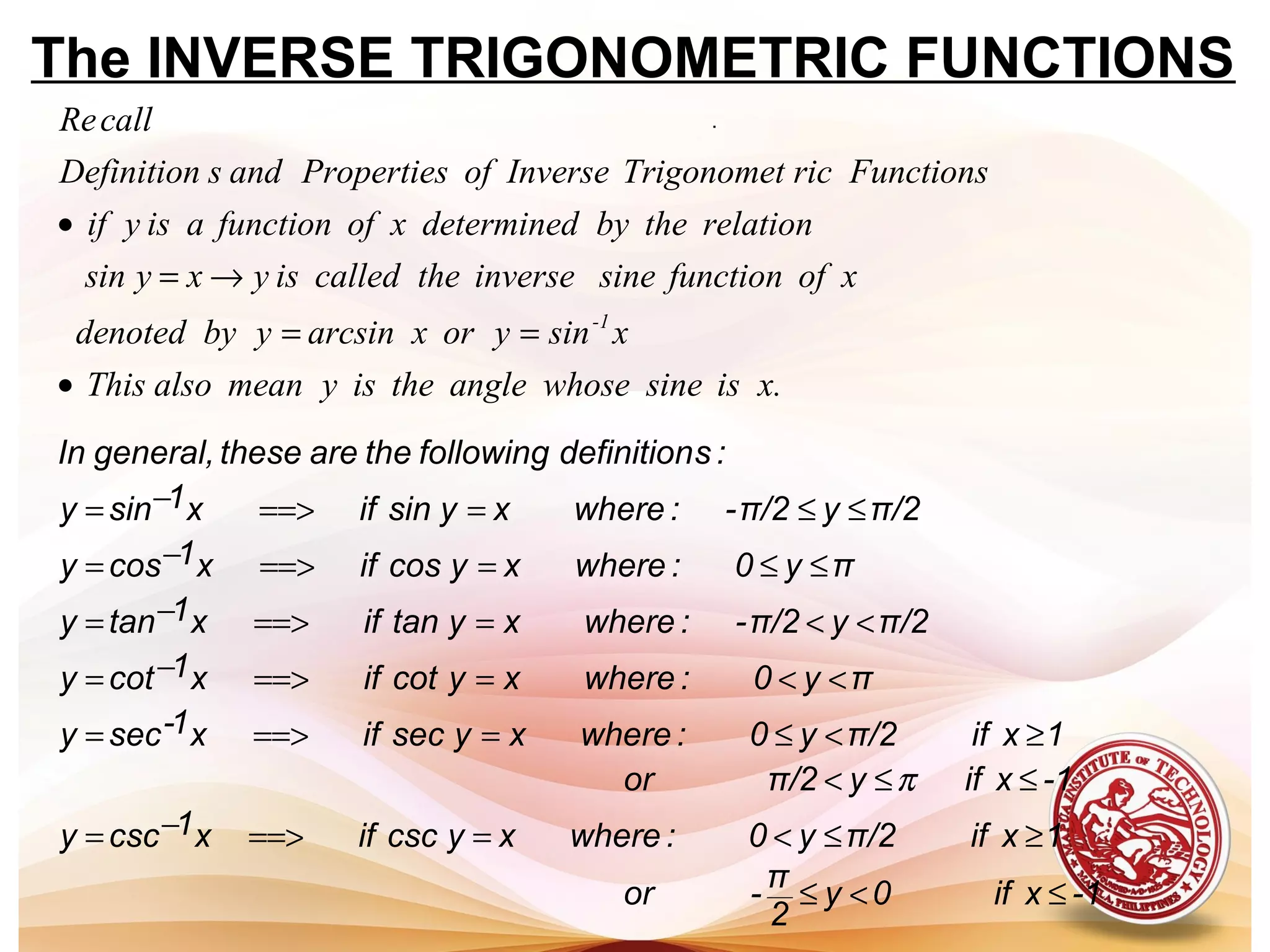
Furthermore, recall that inverse trigonometric functions are restricted to specific domains and ranges to remain true functions. For example, the function $f(x) = \sin(x)$ is not one-to-one over its entire domain. By restricting the domain to $[-\pi/2, \pi/2]$, we allow for the existence of its inverse, $\arcsin(x)$. Understanding these domain constraints is vital, as the resulting derivative formulas are only valid within these defined intervals.
The General Procedure for Proof
The methodology for proving the derivative of any inverse trigonometric function follows a standardized four-step process. We will use $\arcsin(x)$ as our primary demonstration, as it serves as the foundation for the others.
- Set the Function: Define the inverse function in equation form: $y = \arcsin(x)$.
- Convert to Trigonometric Form: Apply the inverse property to isolate $x$, resulting in $x = \sin(y)$.
- Implicit Differentiation: Differentiate both sides of the equation with respect to $x$. Since $x$ is the independent variable, the derivative of $x$ is 1, and the derivative of $\sin(y)$ requires the chain rule, yielding $\cos(y) \cdot \frac{dy}{dx}$.
- Solve and Substitute: Isolate $\frac{dy}{dx}$ to get $\frac{1}{\cos(y)}$. Finally, use trigonometric identities to express $\cos(y)$ in terms of $x$.
Step-by-Step Proof: $f(x) = \arcsin(x)$
Starting with $y = \arcsin(x)$, we have $x = \sin(y)$. Differentiating both sides with respect to $x$: $$\frac{d}{dx}[x] = \frac{d}{dx}[\sin(y)]$$ $$1 = \cos(y) \cdot \frac{dy}{dx}$$ $$\frac{dy}{dx} = \frac{1}{\cos(y)}$$
To express $\cos(y)$ in terms of $x$, use the identity $\sin^2(y) + \cos^2(y) = 1$. Rearranging gives $\cos(y) = \sqrt{1 - \sin^2(y)}$. Since $x = \sin(y)$, we substitute to get $\cos(y) = \sqrt{1 - x^2}$. Thus: $$\frac{d}{dx}[\arcsin(x)] = \frac{1}{\sqrt{1 - x^2}}$$
Step-by-Step Proof: $f(x) = \arctan(x)$
The proof for the arctangent function follows a similar trajectory but employs the identity $1 + \tan^2(y) = \sec^2(y)$.
- Start with $y = \arctan(x)$, which implies $x = \tan(y)$.
- Differentiate both sides: $1 = \sec^2(y) \cdot \frac{dy}{dx}$.
- Solve for the derivative: $\frac{dy}{dx} = \frac{1}{\sec^2(y)}$.
- Use the identity $\sec^2(y) = 1 + \tan^2(y)$. Since $\tan(y) = x$, we substitute $x$ into the identity to get $\sec^2(y) = 1 + x^2$.
- Final result: $\frac{d}{dx}[\arctan(x)] = \frac{1}{1 + x^2}$.
Comparative Summary of Inverse Derivatives
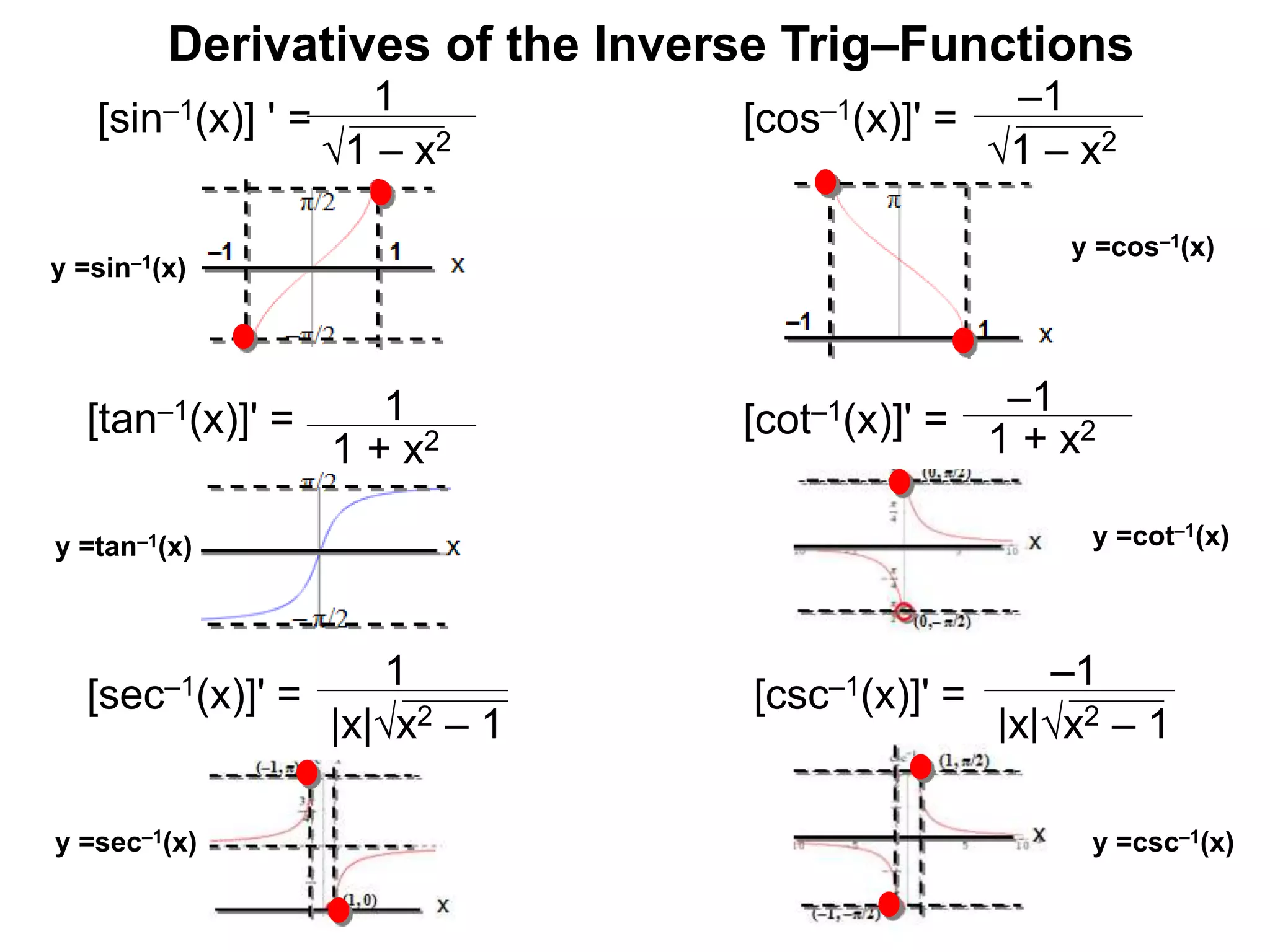
The following table summarizes the derivatives of the three most common inverse trigonometric functions. Note that the co-functions (arccosine, arccotangent, and arccosecant) differ from their counterparts only by a negative sign, which can be verified through the same implicit differentiation process.
| Function | Derivative | Domain |
|---|---|---|
| $\arcsin(x)$ | $1 / \sqrt{1 - x^2}$ | $ |
| $\arccos(x)$ | $-1 / \sqrt{1 - x^2}$ | $ |
| $\arctan(x)$ | $1 / (1 + x^2)$ | All real numbers |
| $\text{arccot}(x)$ | $-1 / (1 + x^2)$ | All real numbers |
Common Pitfalls and Troubleshooting
When performing these proofs, students often encounter issues with the sign of the square root during the $\arccos$ or $\arcsin$ steps. It is critical to remember that the range of $\arcsin(x)$ is restricted to $[-\pi/2, \pi/2]$. In this interval, the cosine function is always non-negative, which is why we take the positive root $\sqrt{1 - x^2}$.
Another common error involves forgetting the chain rule when differentiating the trigonometric function. If you are differentiating a composite function, such as $\arcsin(u(x))$, you must multiply by $u'(x)$ at the final step. Forgetting this component is a frequent source of errors in advanced calculus applications. If your result does not match standard tables, check if you properly applied the chain rule to the internal variable $u(x)$.
Frequently Asked Questions
Why are the derivative formulas for co-functions negative? The negative sign arises because the derivative of the underlying trigonometric function (e.g., $\cos(y)$) is negative. When you solve $\frac{dy}{dx} = \frac{1}{-\sin(y)}$, that negative sign carries over to the final expression for the inverse derivative.
Can I prove these using the limit definition of a derivative? While possible, using the limit definition is significantly more difficult than implicit differentiation. It requires advanced trigonometric angle-sum formulas and careful handling of limit indeterminate forms, making implicit differentiation the standard academic approach.
Do these proofs work for all real numbers? Most of these derivatives have domain restrictions. For $\arcsin$ and $\arccos$, the derivative is undefined at $x = 1$ and $x = -1$ because the denominator becomes zero, resulting in a vertical tangent line at those endpoints.
What is the best way to memorize these? Group them into pairs. $\arcsin$ and $\arccos$ are identical except for the sign. The same logic applies to $\arctan$ and $\text{arccot}$. Focusing on the underlying identity ($\sin^2 + \cos^2 = 1$ or $1 + \tan^2 = \sec^2$) makes the formulas easier to derive if you forget them.
How do I handle the derivative of $\text{arcsec}(x)$? The proof for $\text{arcsec}(x)$ uses the identity $1 + \tan^2(y) = \sec^2(y)$ and requires an absolute value term in the denominator: $\frac{1}{|x|\sqrt{x^2-1}}$. This is due to the domain of the secant function and the properties of the absolute value derivative.
Final Recommendation
To master these proofs, practice the derivation for each of the six inverse trigonometric functions without referencing the textbook. Focus on identifying which trigonometric identity is required to convert the $\sec^2(y)$ or $\cos(y)$ term back into $x$. Understanding the "why" behind the identity substitution is more valuable for your long-term retention than rote memorization of the final formulas.
Image Gallery