Why the Employment Labor Law Poster Matters for Offices
Compliance with federal and state regulations is an essential duty for office managers and business owners, and displaying the correct employment labor law poster is a foundational legal requirement that ensures employees are informed...
Compliance with federal and state regulations is an essential duty for office managers and business owners, and displaying the correct employment labor law poster is a foundational legal requirement that ensures employees are informed of their rights regarding minimum wage, workplace safety, and anti-discrimination laws.
Contents
Operating an office environment requires strict adherence to various regulatory mandates, and one of the most visible yet frequently overlooked obligations is the display of mandatory labor law posters. These physical or electronic notices, issued by federal, state, and sometimes municipal agencies, inform workers of their rights under labor and employment statutes. Failing to post these notices properly can lead to substantial financial penalties, failed audits, and weakened legal defenses in employment disputes. Understanding why these notices matter, what they must contain, and how to maintain them correctly helps organizations mitigate liability and foster a transparent workplace culture.
The Legal Foundation of Workplace Postings
Federal and state laws mandate that employers display specific notices informing workers of their legal protections, compensation rights, and safety standards. These requirements stem from legislation passed by governing bodies such as the U.S. Department of Labor (DOL).
Statutes like the Fair Labor Standards Act (FLSA), the Occupational Safety and Health Act (OSHA), and Title VII of the Civil Rights Act explicitly require employers to keep workers informed. The rationale is straightforward: employees cannot exercise rights they do not know they possess. By mandating public display in common areas, regulators ensure that information regarding federal minimum wage, family medical leave, and equal employment opportunity remains accessible to all personnel without requiring them to request it from human resources.
Furthermore, these mandates apply universally to most private, non-profit, and public sector employers, regardless of headcount, though the specific mix of required notices changes based on company size, industry, and geographic location. Neglecting this baseline requirement introduces immediate compliance vulnerabilities during routine agency visits or employee-initiated investigations.
Key Statutory Requirements and Protected Rights
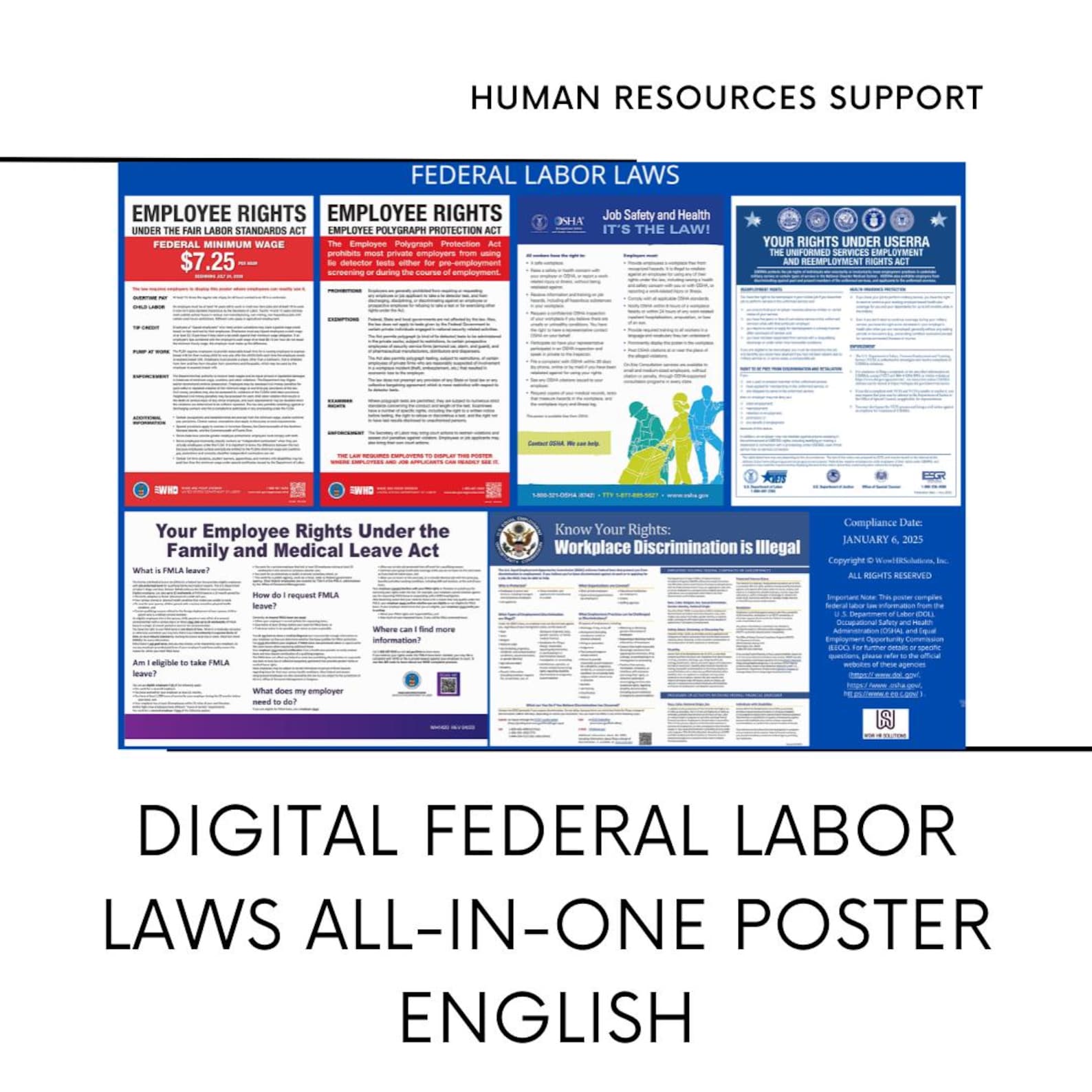
Employment posters consolidate complex legislation into summarized notices that cover several core areas of labor law. A compliant office poster typically aggregates multiple distinct federal mandates alongside mandatory state-level provisions.
The primary federal notices required in a standard office setting include:
- Fair Labor Standards Act (FLSA): Details federal minimum wage standards, overtime eligibility, and child labor restrictions.
- Family and Medical Leave Act (FMLA): Outlines eligibility criteria and protections for employees needing extended leave for medical or family reasons, typically applying to employers with 50 or more staff members.
- Occupational Safety and Health Act (OSHA): Informs workers of their right to a safe workplace and instructions on reporting safety hazards.
- Equal Employment Opportunity (EEO): Prohibits workplace discrimination based on race, color, religion, sex, national origin, age, disability, or genetic information.
- Uniformed Services Employment and Reemployment Rights Act (USERRA): Protects the job rights of individuals who leave civilian positions to perform military service.
- Employee Polygraph Protection Act (EPPA): Restricts the use of lie detector tests by private employers.
In addition to these federal mandates, every state enforces its own set of posters covering state-specific minimum wage rates, workers' compensation procedures, state family leave acts, whistleblowing protections, and anti-discrimination laws.
Consequences of Non-Compliance and Outdated Postings
Failing to display mandatory labor law posters or maintaining outdated versions exposes organizations to concrete legal and financial risks. Regulatory agencies routinely inspect workplaces and issue citations for missing or deficient postings.
When federal or state inspectors visit an office, the absence of proper labor law posters is often among the first items checked. Violations can trigger direct financial penalties from agencies like the DOL or OSHA. For example, individual OSHA posting violations carry statutory fines that adjust annually for inflation, and accumulating multiple infractions across different categories increases total liability.
| Regulatory Agency | Common Violation | Typical Consequence |
|---|---|---|
| U.S. Department of Labor (WH Division) | Missing FLSA or FMLA notices | Monetary civil money penalties per violation |
| Occupational Safety and Health Administration | Failure to display the OSHA "Job Safety and Health" poster | Citations and mandatory abatement fines |
| Equal Employment Opportunity Commission | Missing EEO notices in multi-employee offices | Heightened liability exposure during discrimination claims |
| State Labor Departments | Outdated state minimum wage or leave notices | State-level fines and audit compliance orders |
Beyond direct fines, outdated posters can undermine an employer's defense in litigation. If an employee claims they were unaware of internal reporting timelines or statutory rights due to a lack of posted information, courts may look unfavorably upon the employer's compliance history, potentially extending statutes of limitations or compounding damages.
Practical Implementation in Modern Office Environments
Maintaining compliance has evolved beyond simply purchasing a single laminated board. Modern office layouts, remote work arrangements, and frequent statutory updates require a structured approach to poster management.
Placement and Accessibility Rules
Regulators specify that notices must be displayed in conspicuous places where employees congregate and can easily read them. For a traditional office, break rooms, employee cafeterias, and primary corridors near timeclocks or bulletin boards serve as ideal locations. The posters must remain unobstructed by furniture, plants, or other notices, and they must be positioned at a height that allows average adults to read them clearly.
Managing Remote and Hybrid Workforces
The shift toward remote and hybrid work models introduces unique compliance challenges. Because traditional physical posters cannot be viewed by employees working from home, regulatory agencies have provided guidance on electronic compliance. Employers with remote workers must typically provide digital copies of all required federal and state notices via a secure company intranet, electronic portal, or desktop application where staff can readily access them. Providing a physical copy or ensuring digital availability is necessary to cover remote staff adequately.
Monitoring Regulatory Updates
Labor laws change frequently. State minimum wages adjust annually, federal leave thresholds evolve, and regulatory agencies periodically redesign mandatory notices with updated contact information or legal interpretations. Employers must audit their posting inventory at least annually to verify that every notice reflects current statutes. Purchasing consolidated, multi-agency posters from reputable compliance providers or subscribing to update services helps offices maintain continuous compliance without needing to track individual legislative amendments manually.
Frequently Asked Questions
Are employers required to display state and federal posters in languages other than English?
Federal and state regulations generally require posters in languages other than English if a significant percentage of the workforce speaks a primary language other than English and reads that language. For instance, many state labor departments mandate Spanish-language posters if a specific threshold of employees speaks Spanish, ensuring that all workers can understand their rights.
Can employers fulfill posting requirements by posting notices only on the company intranet?
For fully remote workers, electronic posting on a secure, easily accessible company intranet or document portal is generally accepted. However, for employees who report to a physical office, digital-only posting does not satisfy regulatory requirements. Physical copies must be displayed in common areas where personnel physically gather.
How often do employment labor law posters change?
Posters do not follow a fixed replacement schedule, but federal and state agencies update them whenever statutory thresholds—such as minimum wage rates, leave eligibility limits, or anti-discrimination definitions—change. Organizations typically review and update their posting inventory annually to capture any legislative adjustments enacted over the previous year.
What happens if an office occupies multiple floors in a commercial building?
If an employer occupies multiple distinct floors or separate suites in a building, mandatory notices must be posted in common areas on each floor where employees report. Notices should be placed in break rooms or centralized bulletin areas on every level to ensure that all workers have convenient access without needing to travel to a different floor.
Where can official labor law posters be obtained?
Official federal labor law notices can be downloaded directly from the relevant government websites, such as the U.S. Department of Labor, free of charge. However, because employers must combine federal, state, and local notices into a single cohesive display, many businesses purchase all-in-one laminated compliance posters from verified legal publishers or state commerce associations to ensure proper formatting and coverage.
Next Actions for Office Managers
To ensure your office maintains full regulatory compliance, begin by conducting a comprehensive audit of all physical workspace locations and digital employee portals. Verify that every mandatory federal, state, and local notice is prominently displayed in high-traffic common areas or accessible through your internal document management system. Replace any outdated posters immediately with current versions from official regulatory sources or verified compliance providers, and establish an annual calendar reminder to review all labor law requirements for subsequent updates.
Image Gallery