Where to Buy AC Pro Kits: Retail Options, Compatibility, and Buying Guide
A/C Pro recharge kits are widely available across major auto parts chains (such as AutoZone, O'Reilly Auto Parts, Advance Auto Parts, and NAPA), mass market retailers like Walmart, home improvement stores including Lowe's and Home Depo...
A/C Pro recharge kits are widely available across major auto parts chains (such as AutoZone, O'Reilly Auto Parts, Advance Auto Parts, and NAPA), mass market retailers like Walmart, home improvement stores including Lowe's and Home Depot, and online platforms like Amazon. Physical stores offer immediate local pickup, while online options provide delivery flexibility.
Contents
Top Retailers for Purchasing AC Pro Recharge Kits
Finding an A/C Pro automotive air conditioning recharge kit is straightforward due to broad distribution across physical brick-and-mortar stores and e-commerce platforms. Depending on whether you need immediate same-day repair or prefer delivery to your door, several primary retail channels stock these products.
| Physical Retailers | Online Retailers |
|---|---|
| • AutoZone | • Amazon |
| • O'Reilly Auto Parts | • Walmart.com |
| • Advance Auto Parts | • AutoZone / O'Reilly Direct |
| • NAPA Auto Parts | • CarParts.com |
| • Walmart Supercenters | • DoorDash / Instacart (Same-Day) |
| • The Home Depot / Lowe's |
1. Dedicated Auto Parts Specialty Stores
Specialty automotive retailers are often the best starting point because their staff can help verify kit compatibility and provide store-level services such as battery testing or loaner tool programs.
- AutoZone: Stocking a wide range of A/C Pro formulas, AutoZone carries both standard R-134a and modern R-1234yf kits. They offer buy-online-pickup-in-store (BOPIS) services, often ready within an hour.
- O'Reilly Auto Parts: O'Reilly features the full line of STP A/C Pro items, including high-mileage formulations, digital-gauge recharge kits, and standalone refill cans.
- Advance Auto Parts & Carquest: These stores frequently run seasonal promotions on climate-control chemicals and provide quick curbside pickup options.
- NAPA Auto Parts: NAPA services both professional mechanics and DIY motorists, carrying commercial-grade gauge assemblies alongside consumer A/C Pro kits.
2. Mass Merchandise Retailers
If cost optimization is your primary driver, national big-box stores usually offer competitive pricing on consumer chemical products.
- Walmart: Walmart Supercenters carry A/C Pro products in their automotive aisles. Pricing at Walmart is frequently lower than specialized auto stores, though staff assistance for technical questions may be limited.
- Target: Select larger Target locations carry basic A/C Pro R-134a kits in their auto care sections, though inventory varies significantly by region.
3. Home Improvement Centers
Home improvement warehouses maintain dedicated automotive chemical sections to serve customers managing home maintenance projects.
- The Home Depot & Lowe's: Both major home improvement chains stock select A/C Pro recharge kits, particularly during spring and summer peak driving months. Purchasing options include in-store pickup and local delivery.
4. E-Commerce Platforms and Delivery Services
For convenient delivery or pre-planned maintenance, online marketplaces offer complete catalog selection.
- Amazon: Amazon carries official A/C Pro kits, replacement hoses, and refill cans sold directly by authorized distributors. Be mindful of shipping rules, as compressed gas cans are subject to ground transportation requirements.
- Same-Day Delivery Services: Platforms such as Instacart, DoorDash, and Roadie partner with local auto parts stores and mass retailers to deliver A/C Pro kits to your home or garage within hours.
Selecting the Right AC Pro Kit: R-134a vs. R-1234yf
Before buying an A/C Pro kit, you must identify the exact type of refrigerant your vehicle uses. Connecting the wrong chemical compound can damage your vehicle's air conditioning compressor, contaminate the system, or cause mechanical failure.
Vehicle Refrigerant Type Identification:
- Open Hood & Find Emissions Label
- Determine Refrigerant Requirements:
- Label States R-134a:
- Common in vehicles ~1994–2016
- Uses standard quick-connect
- Black/Blue recharge kit fittings
- Label States R-1234yf:
- Standard in modern vehicles (2017+)
- Uses specific safety fitting
- Gray/Silver high-pressure fittings
- Label States R-134a:
Identifying Your Vehicle's Refrigerant Type
Vehicle manufacturers transitioned from R-134a refrigerant to R-1234yf (hydrofluoroolefin) to reduce global warming potential (GWP).
- R-134a: The standard automotive refrigerant for vehicles produced between 1994 and approximately 2016–2018.
- R-1234yf: Standard across almost all passenger cars and light trucks manufactured from 2021 onward, with widespread adoption starting around 2017.
To confirm your vehicle's requirement, open the hood and inspect the Vehicle Emissions Control Information (VECI) sticker attached to the underside of the hood, radiator support bracket, or strut tower. The sticker clearly displays the required refrigerant compound (e.g., HFC-134a or HFO-1234yf) and factory oil capacity.
Matching the Quick-Connect Coupler
A/C Pro designs its service couplers so that R-134a and R-1234yf kits are physically incompatible. You cannot accidentally snap an R-134a quick-connect fitting onto an R-1234yf low-side service port, providing a physical safety check against cross-contamination.
Gauge Configurations: Standard Analog vs. Digital Smart Gauges
When choosing your kit, consider the measurement tool included with the assembly:
- Analog Gauge Kits: Use a traditional dial gauge featuring color-coded pressure zones (low, correct, alert, red/overcharged). These are reliable, entry-level options for basic pressure tracking.
- Digital / Smart Gauge Kits: Incorporate backlit digital readouts that assist in setting ambient outdoor temperature inputs to give a precise pressure target range. Digital setups reduce user guesswork during application.
Formula Additives: Leak Sealers, Lubricants, and UV Dyes
A/C Pro canisters contain more than pure refrigerant gas. They feature integrated chemical blends formulated to restore system performance:
- PAG Oil Lubricants: Synthetic polyalkylene glycol (PAG) oil lubricates internal compressor seals, o-rings, and pistons to minimize mechanical friction.
- Conditioners & Conditioning Agents: Designed to soften and expand hardened rubber gaskets and o-rings, helping prevent tiny vacuum leaks.
- Epoxy-Free Sealants: Chemical sealers intended to seal minor leaks in rubber hoses and connection joints without reacting with moisture or clogging internal expansion valves.
- UV Leak Detection Dyes: Fluorescent dye pre-mixed into the formulation allows you to detect systemic leaks using an ultraviolet (UV) light after running the system.
Pricing Breakdown and Cost Considerations
Prices for A/C Pro kits vary depending on the chemical formulation, included hardware, canister weight, and current retail promotions.
| Kit Variant | Chemical Type | Average Retail Price Range | Included Hardware | Best Used For |
|---|---|---|---|---|
| A/C Pro All-in-One Standard Kit | R-134a (approx. 20 oz.) | $35 – $48 | Integrated reusable hose, analog gauge, quick-coupler | Standard DIY recharge for pre-2017 vehicles |
| A/C Pro Digital Gauge Kit | R-134a (approx. 20 oz.) | $45 – $60 | Digital pressure gauge, ultra-long hose, light-up port coupler | Drivers wanting precise pressure readouts |
| A/C Pro NextGen R-1234yf Kit | R-1234yf (approx. 8–14 oz.) | $55 – $90 | Specialized R-1234yf quick-connect coupler, targeted gauge | Modern vehicles (2017+) requiring R-1234yf gas |
| A/C Pro Refill Canister | R-134a or R-1234yf | $20 – $40 | Canister with self-sealing valve (no hose/gauge included) | Users who already own a reusable gauge & hose assembly |
| High-Mileage Formulation Kit | R-134a | $40 – $52 | Standard or digital gauge with anti-wear additives | Vehicles with over 100,000 miles |
Retailer Comparison for AC Pro Kits
When deciding where to purchase your kit, evaluate retail options based on price, immediate availability, product variety, and returns policy.
| Retailer | Availability & Stocking | Price Level | In-Store Pickup Option | Technical Customer Support |
|---|---|---|---|---|
| AutoZone | Excellent (Year-round stock) | Mid-to-High | Yes (Fast 1-Hour Pickup) | High (Staff can assist with part selection) |
| O'Reilly Auto Parts | Excellent (Full product range) | Mid-to-High | Yes (Curbside available) | High (In-store advice & lookup tools) |
| Advance Auto Parts | High (Varies by location) | Mid-to-High | Yes (1-Hour Pickup) | High (Counter advice available) |
| Walmart | High (Peak seasonal stock) | Low (Competitive pricing) | Yes (Store pickup available) | Low (Self-service shelf access) |
| The Home Depot / Lowe's | Moderate (Seasonal emphasis) | Mid | Yes (Locker / Counter pickup) | Moderate (General store assistance) |
| Amazon | Very High (Full catalog) | Varies | No (Ground delivery only) | Low (Product reviews / seller support) |
Legal Regulations and Environmental Restrictions
The sale and distribution of automotive refrigerants are subject to environmental regulations governed by the U.S. Environmental Protection Agency (EPA) under Section 609 of the Clean Air Act, alongside state-level environmental mandates.
Environmental & Legal Compliance Requirements:
- EPA Section 609 Federal Mandate
- Self-sealing valves mandated on small cans
- Non-venting quick-connect couplers required
- Ground shipping rules for compressed gas
- State-Specific Rules
- California (CARB): $10 can deposit
- NY/WA: Strict chemical handling laws
- Mandatory core-return programs
EPA Section 609 and Self-Sealing Valve Standards
Under federal guidelines:
- Small canisters of refrigerant (under 2 lbs) sold for DIY automotive use must feature self-sealing valves.
- When the service hose or gauge is unscrewed from an A/C Pro can, the internal valve closes automatically to prevent residual hydrofluorocarbons (HFCs) or hydrofluoroolefins (HFOs) from venting into the atmosphere.
- Always preserve your reusable hose assembly—modern refill cans rely on these self-sealing threaded valve connections.
State-Specific Restrictions and Can Deposit Programs
Certain states enforce stricter mandates regarding the purchase and disposal of DIY refrigerant containers:
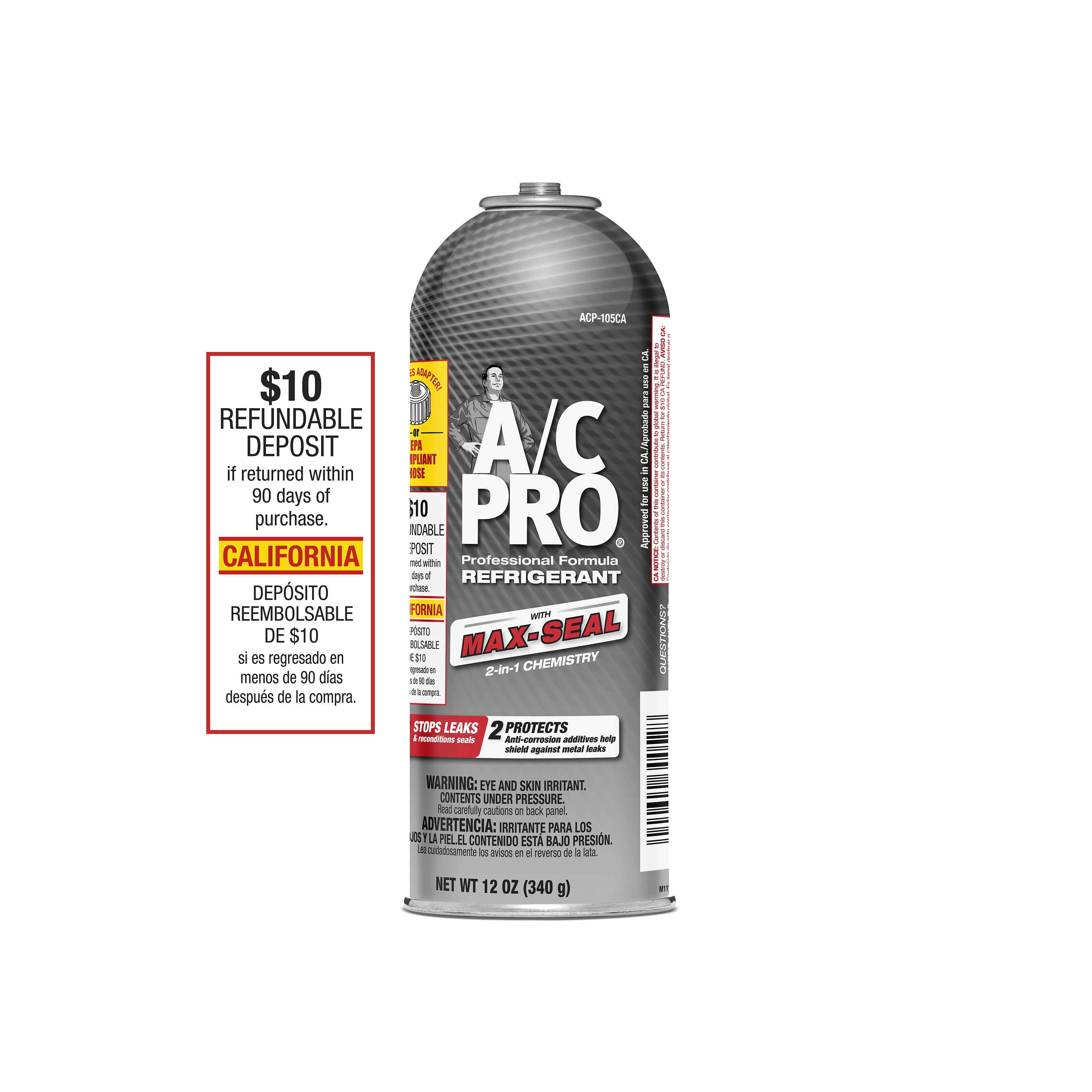
- California (CARB Deposit Program): The California Air Resources Board mandates a $10 container deposit on all DIY small-can refrigerant purchases. Retailers add a $10 deposit fee at checkout. Consumers receive a full $10 refund upon returning the used container to an authorized retailer within 90 days with their sales receipt.
- Washington State & New York: Enforce specific chemical handling guidelines, seasonal sale parameters, or transport regulations. Certain hazardous chemical shipping restrictions apply to online orders delivered into these states.
How to Verify Authenticity and Package Integrity Before Buying
Because refrigerant canisters are pressurized vessels containing specialized chemical formulas, verify the integrity of the product before completing your purchase.
Pre-Purchase Integrity Checklist:
Seal Verification: Inspect plastic safety pull-tabs & shrink bands.
Physical Condition: Ensure container is free from dents, corrosion, or leaks.
Valve Inspection: Confirm threads on top self-sealing valve are intact.
Expiration / Lot: Inspect base of canister for valid manufacturing lot code.
Check Safety Seals: Ensure the plastic tamper-evident tab or shrink band covering the gauge coupler thread is intact. Never buy a can with a broken safety seal.
Inspect Canister Condition: Avoid cans showing rust, physical dents, or severe scuffs around the top neck collar or bottom seam.
Confirm Hose and Trigger Function: If purchasing an all-in-one kit, confirm that the plastic trigger mechanism moves smoothly and that the pressure gauge dial rests naturally at zero when unpressurized.
Verify Expiration & Lot Codes: Check the bottom of the aerosol container for legible manufacturing date and lot stamps to ensure fresh stock.
Step-by-Step Guidance: Recharging Your A/C System
Recharging your vehicle's air conditioning system with an A/C Pro kit is straightforward when following proper procedure and safety precautions.
Safety Precautions Before You Begin
- Wear Protective Gear: Always wear protective eyewear (safety glasses) and durable work gloves. Liquid refrigerant can cause frostbite if it makes contact with bare skin.
- Operate in Well-Ventilated Areas: Work outdoors or in an open garage to prevent inhalation of chemical vapors.
- Keep Clear of Moving Parts: Engine components—including cooling fans, serpentine belts, and pulleys—will be running during the procedure. Keep hands, clothing, and tools clear.
Step 1: Locate the Low-Side Service Port
Identify your vehicle's low-pressure service port (marked with a cap labeled "L").
Important: Never connect an A/C Pro kit to the high-pressure side (marked "H"). The high-side port operates under pressures that can rupture consumer recharge equipment. The quick-connect fittings in A/C Pro kits are sized to fit only on the low-side port.
Engine Bay A/C Service Port Connections:
- Low-Side Port ("L")
- Smaller diameter fitting
- Located on larger aluminum tubing
- ATTACH RECHARGE KIT HERE
- High-Side Port ("H")
- Larger diameter fitting
- Located on smaller aluminum tubing
- DO NOT ATTACH RECHARGE KIT HERE
Step 2: Prepare the Kit and Start the Engine
- Start your vehicle's engine.
- Turn your air conditioner to MAX A/C, select the coldest temperature setting, and set the blower fan speed to HIGH.
- Allow the engine to idle for 3 to 5 minutes so the A/C compressor clutch can engage.
Step 3: Measure Baseline Pressure
- Attach the A/C Pro quick-connect coupler to the low-side port by pulling back the coupler ring, pressing it firmly onto the port valve, and releasing the collar until it snaps into place.
- Read the ambient air temperature outdoors.
- Check the pressure reading on your A/C Pro gauge dial or digital screen. If the reading is within the recommended green zone for your ambient temperature, your system does not require additional refrigerant. Low cooling may instead stem from a blown fuse, bad compressor clutch, or cabin air filter blockage.
Step 4: Add Refrigerant Safely
- If pressure is low, shake the can well.
- Squeeze the trigger to release refrigerant into the system while holding the can upright.
- Continuously rock the can back and forth from the 12 o'clock to 3 o'clock position while dispensing gas.
- Periodically release the trigger (every 10–15 seconds) to check the static pressure reading.
- Stop adding refrigerant once the needle enters the correct green pressure zone corresponding to your current outdoor temperature. Do not overcharge the system into the red zone.
Frequently Asked Questions
Can I buy A/C Pro recharge kits at gas stations or convenience stores?
While large truck stops or travel centers (such as Love's, Pilot Flying J, or TA) occasionally stock standard A/C Pro cans during summer months, neighborhood gas stations rarely carry them. Specialty auto parts stores or big-box stores are more reliable purchasing choices.
What should I do if my A/C system goes into the red (overcharged) zone?
If your gauge indicates an overcharged state, do not vent refrigerant into the air, as this violates federal environmental regulations under the Clean Air Act. You should take your vehicle to a licensed automotive repair shop equipped with a professional refrigerant recovery machine to evacuate the excess gas safely.
Is an R-134a kit compatible with a car that uses R-1234yf?
No. R-134a and R-1234yf are distinct chemical compounds operating under different pressure profiles, and their system oils are formulated differently. Connecting an R-134a kit to an R-1234yf system (or vice versa) can damage the compressor and seals. A/C Pro builds physically incompatible quick-connect couplers to prevent accidental cross-use.
Can I return an opened A/C Pro can if my vehicle's A/C still doesn't work?
Most auto parts stores and mass market retailers cannot accept returns on opened hazardous chemical canisters or used refrigerant products due to shipping regulations and environmental containment laws. If your system fails to hold a charge after application, an underlying mechanical fault—such as a failed compressor clutch, failed evaporator, or major line leak—likely requires professional repair.
Final Recommendation
When purchasing an A/C Pro kit, first open your vehicle's hood to confirm whether your system requires R-134a or R-1234yf refrigerant. For immediate repair needs, visit a local auto retailer like AutoZone or O'Reilly Auto Parts, where staff can help verify part compatibility and check your ambient temperature pressure targets. If you are ordering ahead for routine maintenance, online channels like Walmart.com or Amazon offer delivered convenience. Be sure to follow all local environmental regulations—such as returning used cans in California for your $10 deposit refund—and always wear eye protection and gloves during application.
Image Gallery