How Student Loan Interest Affects Your Taxes: A Comprehensive 2026 Guide
Paying student loan interest reduces your federal tax liability by allowing you to deduct up to $2,500 of interest paid during the year from your taxable income. This "above-the-line" deduction lowers your Adjusted Gross Income (AGI),...
Paying student loan interest reduces your federal tax liability by allowing you to deduct up to $2,500 of interest paid during the year from your taxable income. This "above-the-line" deduction lowers your Adjusted Gross Income (AGI), potentially qualifying you for additional credits and reducing the total tax you owe without requiring you to itemize deductions.
Contents
Understanding the Student Loan Interest Deduction
In the 2026 tax landscape, the student loan interest deduction remains one of the most accessible tax benefits for graduates and parents who have taken out loans to fund higher education. Under Section 221 of the Internal Revenue Code, taxpayers can subtract the interest they paid on "qualified student loans" from their gross income. This is categorized as an adjustment to income, which is significantly more beneficial for the average filer than a standard itemized deduction.
Because it is an above-the-line deduction, you do not need to choose between the standard deduction and the student loan interest deduction. You receive the benefit of the standard deduction (which has been adjusted for inflation in 2026) and then further reduce your taxable income by the amount of interest paid, up to the $2,500 cap. By lowering your Adjusted Gross Income (AGI), this deduction can also have a "ripple effect," potentially making you eligible for other income-restricted tax breaks, such as the Child Tax Credit or certain state-level education credits.
It is important to distinguish between the principal and the interest. Only the interest portion of your monthly payments is deductible. If you made voluntary payments during a period of non-payment or paid more than the minimum required, any portion of those payments that the servicer applied to accrued interest is also eligible for the deduction.
Eligibility Requirements for 2026
To claim the student loan interest deduction in 2026, several criteria must be met regarding the filer’s status, the nature of the loan, and the purpose of the funds. The IRS is strict about these definitions to ensure the benefit is used specifically for educational advancement.
Qualified Student Loans
A qualified student loan is any debt incurred by the taxpayer solely to pay "qualified higher education expenses." These expenses must have been for yourself, your spouse, or a person who was your dependent when you took out the loan. The student must have been enrolled at least half-time in a program leading to a degree, certificate, or other recognized educational credential at an eligible educational institution.
Eligible institutions include most accredited public, non-profit, and proprietary (privately owned, for-profit) postsecondary institutions. If the school is eligible to participate in a student aid program administered by the U.S. Department of Education, it almost certainly qualifies.
Filing Status Restrictions
Your filing status plays a critical role in your eligibility.
- Single, Head of Household, or Qualifying Surviving Spouse: You are generally eligible to claim the deduction if you meet the income requirements.
- Married Filing Jointly: You and your spouse can claim the deduction together. Even if both spouses have separate loans, the total deduction is still capped at $2,500 per return, not per person.
- Married Filing Separately: Individuals using this status are not eligible to claim the student loan interest deduction. This is a common pitfall for couples trying to manage Income-Driven Repayment (IDR) plans by filing separately; they must weigh the lower monthly loan payment against the loss of this tax deduction.
The Dependency Rule
You cannot claim the deduction if you are claimed as a dependent on someone else’s tax return. For example, if a recent graduate is living at home and their parents provide more than half of their support, the parents might claim the graduate as a dependent. In this scenario, the graduate cannot deduct the interest they paid on their own loans. Conversely, the parents can only deduct the interest if they were the ones legally obligated to pay the loan (such as a Parent PLUS loan).
Income Limits and Phase-outs in 2026
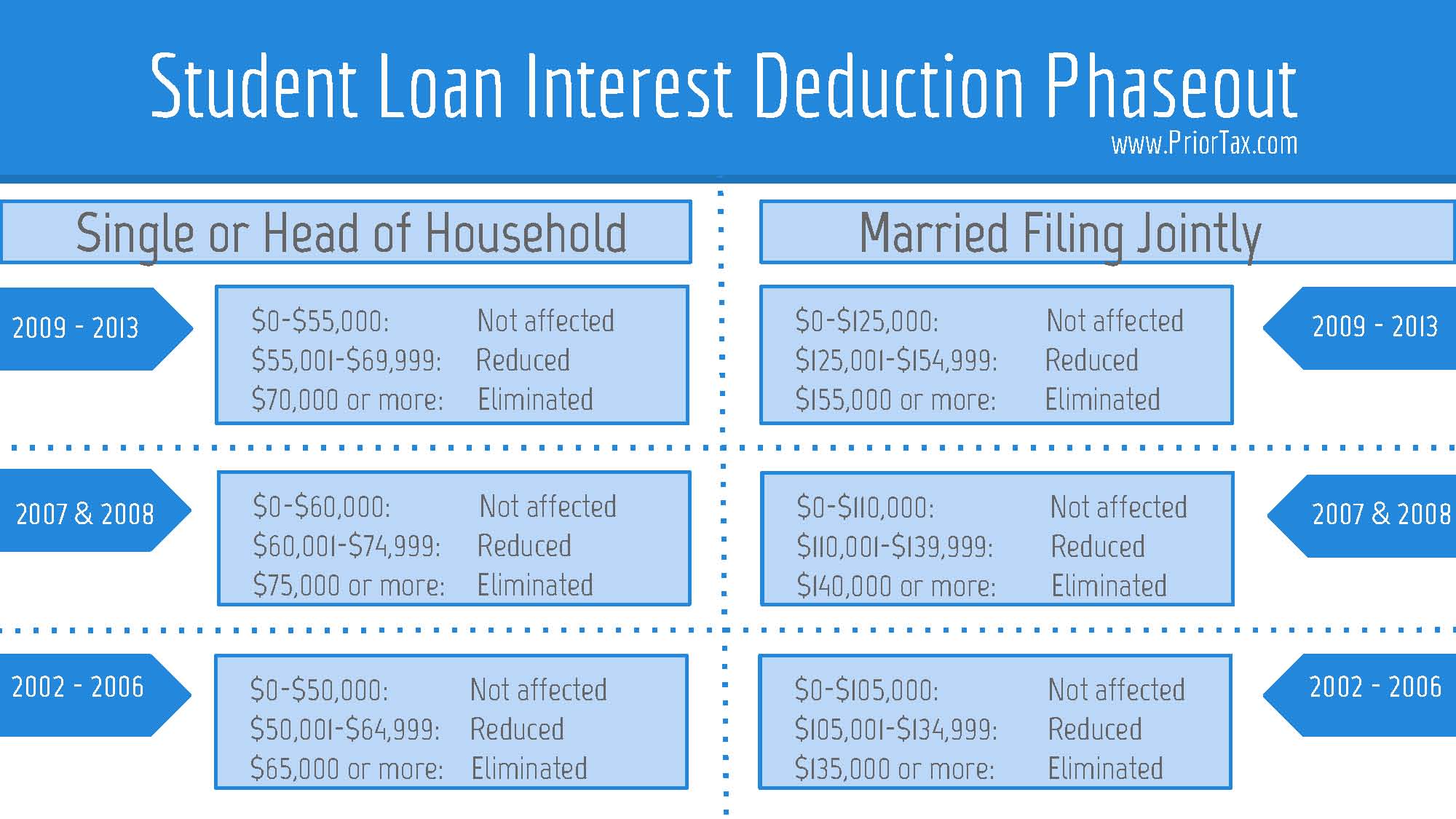
The student loan interest deduction is not available to high earners. The IRS utilizes Modified Adjusted Gross Income (MAGI) to determine the phase-out range. As your income rises through this range, the maximum $2,500 deduction gradually diminishes until it reaches zero.
For the 2026 tax year, these thresholds have been adjusted to reflect economic changes. While the specific inflation-adjusted numbers are finalized by the IRS annually, the mechanism remains consistent.
| Filing Status | Full Deduction Limit (MAGI) | Phase-out Range (Partial Deduction) | No Deduction Allowed (MAGI) |
|---|---|---|---|
| Single / Head of Household | Below $80,000 | $80,000 – $95,000 | Over $95,000 |
| Married Filing Jointly | Below $165,000 | $165,000 – $195,000 | Over $195,000 |
| Married Filing Separately | N/A | Not Eligible | Not Eligible |
Note: These figures are projected estimates for 2026 based on historical inflation adjustments. Always verify the final IRS Publication 970 for the exact dollar amounts for the current filing year.
If your MAGI falls within the phase-out range, you must use the Student Loan Interest Deduction Worksheet in the Form 1040 instructions to calculate your specific deduction. The formula essentially reduces your $2,500 cap by a percentage equal to how far you have progressed through the phase-out bracket.
Qualified Higher Education Expenses
The deduction only applies if the loan was used for specific costs. If you took out a personal loan or used a credit card to pay for tuition, that interest is generally not deductible unless the loan was used exclusively for the following:
- Tuition and Fees: The actual cost of enrollment.
- Room and Board: This is limited to the allowance for room and board included in the "cost of attendance" determined by the school for federal financial aid purposes.
- Books, Supplies, and Equipment: Necessary materials for your courses of study.
- Other Necessary Expenses: This includes transportation to and from school and other miscellaneous costs required by the institution.
It is vital to keep records of these expenses. If the IRS audits your return, they may ask for proof that the loan proceeds were spent on these items rather than general living expenses or luxury purchases.
How the Deduction Affects Your Tax Return
The primary benefit of the student loan interest deduction is that it reduces your "taxable income" by lowering your AGI. This is fundamentally different from a tax credit. A credit reduces your tax bill dollar-for-dollar, while a deduction reduces the amount of income you are taxed on.
For instance, if you are in the 22% tax bracket and you claim the full $2,500 deduction, you are effectively saving $550 on your tax bill ($2,500 x 0.22).
Impact on Other Tax Provisions
Because the deduction is "above-the-line," it reduces your AGI. Many other tax benefits are restricted based on AGI. By lowering this number, you might:
- Become eligible for the Earned Income Tax Credit (EITC).
- Increase the amount you can claim for the Child Tax Credit.
- Reduce the floor for deductible medical expenses (which must exceed 7.5% of your AGI).
- Avoid the phase-out of other education-related credits like the American Opportunity Tax Credit (AOTC).
Documentation and Form 1098-E
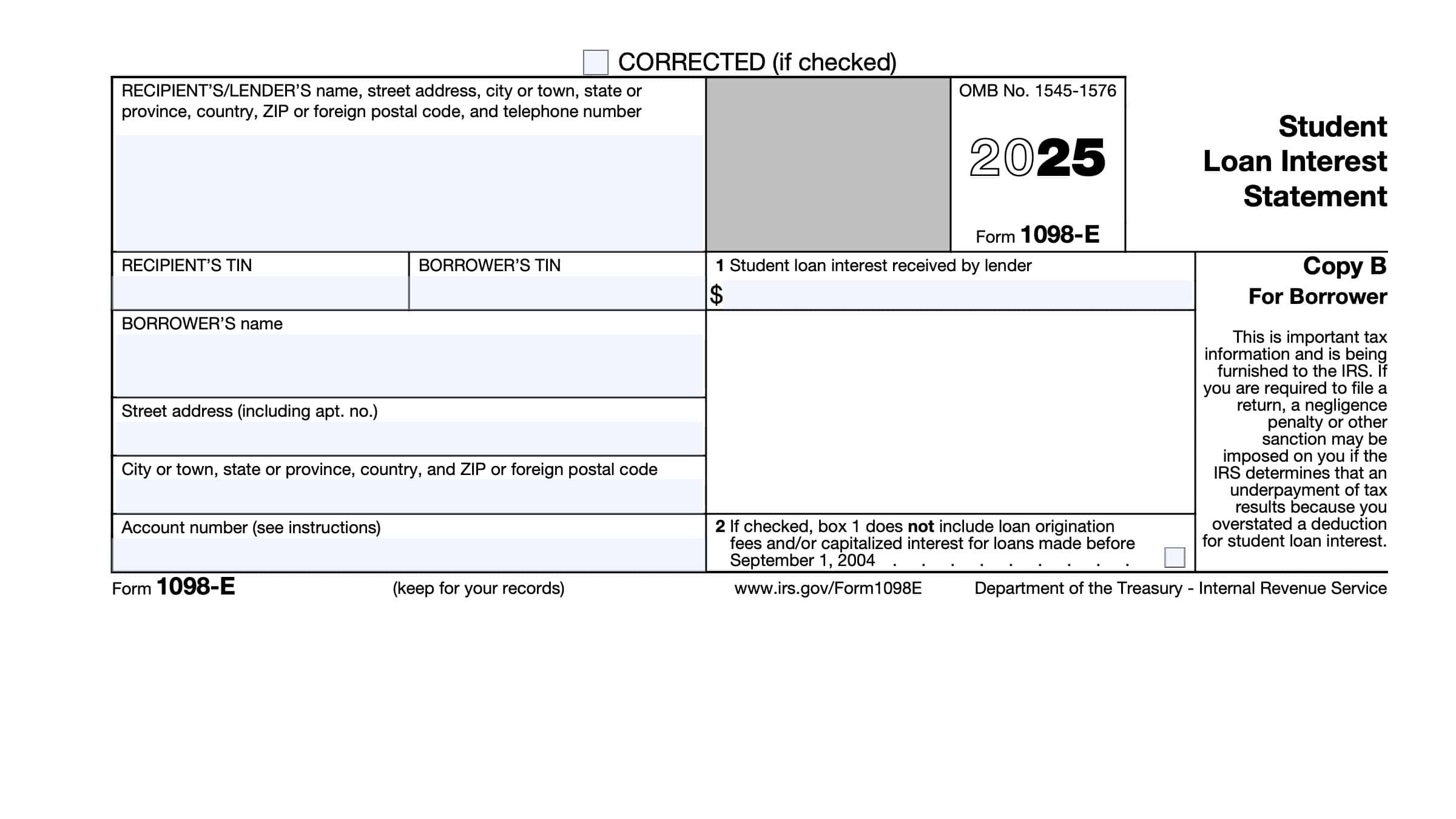
If you paid $600 or more in interest to a single student loan servicer during 2026, that servicer is required by law to send you Form 1098-E (Student Loan Interest Statement). This form will clearly state the amount of interest you paid.
Many modern servicers do not mail paper copies of these forms. You will likely need to log into your account on the servicer’s website (such as Nelnet, Mohela, or Aidvantage) in January or February 2027 to download the document.
What if you paid less than $600?
You can still deduct interest if you paid less than $600, but the servicer is not required to send you a 1098-E. In this case, you should check your year-end billing statements or your online payment history to calculate the total interest paid.
Capitalized Interest and Loan Origination Fees
One often overlooked aspect of the deduction is "capitalized interest." This is unpaid interest that is added to the principal balance of your loan (often happening after a period of deferment or forbearance). When you eventually make payments on the loan, the IRS considers a portion of those payments to be interest—even if they are technically paying off the capitalized amount. Loan origination fees are also considered interest and are deductible over the life of the loan.
Common Mistakes to Avoid
- Double-Dipping: You cannot claim a deduction for interest paid with tax-free funds. For example, if you used money from a 529 plan or a Coverdell Education Savings Account to pay your student loan interest, you cannot also claim the deduction on your tax return.
- Parent vs. Student Confusion: If a student pays interest on a loan that is in the parent's name (like a Parent PLUS loan), neither party can take the deduction. The parent cannot claim it because they didn't pay it, and the student cannot claim it because they are not legally obligated to pay the loan. To avoid this, the legal owner of the loan should be the one making the payments.
- Refinanced Loans: If you refinance your student loans with a private lender, the interest is still deductible as long as the new loan was used strictly to pay off the original qualified student loans. However, if you "cash out" some of the equity in your home to pay off student loans via a mortgage refinance, that interest is generally no longer considered "student loan interest" for tax purposes.
Frequently Asked Questions
Can I deduct interest on private student loans?
Yes. The IRS does not distinguish between federal and private student loans for this deduction. As long as the loan was used exclusively for qualified higher education expenses at an eligible institution, the interest is deductible regardless of the lender.
What happens if I paid interest while I was still in school?
You can deduct that interest. Even if you were not required to make payments because your loans were in deferment, any voluntary interest payments you made are deductible in the year you made them, provided you meet the other eligibility requirements.
Is the $2,500 limit per loan or per person?
The $2,500 limit is per tax return. If you are a single filer with five different loans, your total deduction for all five combined is capped at $2,500. If you are married filing jointly and both you and your spouse have loans, your combined deduction is still capped at $2,500 for the entire return.
Do I need to provide receipts for my books and room and board?
While you do not need to attach receipts to your tax return, you should keep them in your personal records. If the IRS questions the deduction, you will need to prove that the student loan funds were used for qualified expenses. The 1098-E proves how much interest you paid, but it does not prove how the loan principal was spent.
Does the deduction apply to international schools?
It can. Many international universities participate in the U.S. federal student aid program. If the international school has an "OPE ID" number and is listed as an eligible institution by the Department of Education, the interest on loans used to attend that school is deductible.
Practical Recommendation
To maximize your benefit for the 2026 tax year, ensure you download all Form 1098-E statements from every servicer you used. If you are near the MAGI phase-out threshold, consider contributing to a traditional IRA or a 401(k) to lower your AGI, which might bring you back into the full eligibility range for the student loan interest deduction. Finally, if you are married and usually file separately, run a comparison of your total tax liability for "Married Filing Jointly" to see if the ability to claim this deduction (and others) outweighs the benefits of filing separately for loan repayment purposes.
For further information on education-related tax benefits, refer to the IRS official guidance on educational credits.
Image Gallery