How Big Were Diamonds in History? Famous Gems, Sizes, and Evolution
Throughout human history, the physical size of discovered diamonds has varied dramatically based on geographic source, geological formation, and mining technology. While ancient Indian mines produced legendary individual gemstones weig...
Throughout human history, the physical size of discovered diamonds has varied dramatically based on geographic source, geological formation, and mining technology. While ancient Indian mines produced legendary individual gemstones weighing hundreds of carats, the discovery of South African kimberlite pipes in the late 19th century—exemplified by the 3,106-carat Cullinan diamond in 1905—revolutionized scale, yielding rough crystals far larger than any previously documented in human antiquity.
Contents
The Evolution of Diamond Discoveries Across Mining Eras
The history of diamond mining is divided into three major geological and historical epochs: the Indian (Golconda) Period, the Brazilian Period, and the Modern Kimberlite Era. Each era yielded vastly different average sizes and maximum dimensions for rough and polished gemstones.
| Historical Mining Era | Description |
|---|---|
| Golconda Era (Pre-1720s) | Alluvial river beds; rare giant stones |
| Brazilian Era (1720s-1860s) | Alluvial deposits; smaller gem average |
| Kimberlite Era (1860s-Present) | Primary pipe mining; massive rough gems |
1. The Golconda Era (Antiquity to the early 18th Century)
Before the 1720s, India was the world's primary source of diamonds, concentrated around the legendary kingdom of Golconda (modern-day Telangana and Andhra Pradesh). These diamonds were gathered entirely from alluvial deposits—riverbeds and eroded gravels—where natural weathering had separated the minerals from their host rock.
Because alluvial forces naturally tumble and fracture crystals over millions of years, most recovered stones were small pebbles under 2 carats. However, Golconda's unique geology occasionally yielded extraordinary ultra-large monocrystalline diamonds. Gems such as the original rough of the Koh-i-Noor, the Great Mogul (reported near 787 carats), and the Daria-i-Noor demonstrated that ancient alluvial deposits could yield monumental stones, even if everyday finds were modest.
The unit of measurement during this period relied on natural seeds. In India, the rati (based on the seed of the Abrus precatorius plant) served as the standard weight unit before standard international metric carat units (0.2 grams or 200 milligrams) were adopted in the early 20th century.
2. The Brazilian Diamond Boom (1720s to 1860s)
As Indian mines approached exhaustion in the early 18th century, Portuguese prospectors discovered rich diamond deposits in Minas Gerais, Brazil. Like India, Brazilian mining was initially alluvial. The average size of gem-quality diamonds recovered in Brazil was smaller than Indian specimens—typically ranging under 1 carat to 3 carats for standard gem stock.
However, Brazil became famous for producing monumental carbonado specimens—a rare, microcrystalline form of dark, porous diamond formed under distinct geological conditions. The largest carbonado ever recorded, named the Sergio, was unearthed in Bahia, Brazil, in 1895, weighing an extraordinary 3,167 carats.
3. The Kimberlite Era (1860s to Present)
The discovery of diamonds in South Africa in the late 1860s transformed global supply and diamond size scales. Rather than panning river gravels, miners began excavating primary volcanic pipes composed of kimberlite rock.
Mining directly into kimberlite allowed intact, massive diamond crystals to be recovered before atmospheric weathering and stream transport could break them apart. This operational shift led directly to the discovery of colossal rough crystals exceeding 500, 1,000, and 3,000 carats.
The Largest Historical Diamonds Ever Discovered
To understand how big historical diamonds were, gemologists categorize stones by their rough weight (un-cut crystal state) and their resulting polished weight (finished gemstone).
- Rough vs. Cut Weight Comparison:
- Cullinan Rough (1905): 3,106 Carats
- Cullinan I (Finished Gem): 530 Carats
- Lesedi La Rona (2015): 1,109 Carats
- Graff Lesedi (Finished): 302 Carats
- Cullinan Rough (1905): 3,106 Carats
The Cullinan Diamond (3,106 Carats Rough)
Discovered on January 26, 1905, at the Premier No. 2 mine in Cullinan, South Africa, the Cullinan diamond remains the largest gem-quality rough diamond ever found in recorded history. Weighing 3,106 carats (approximately 621.2 grams or 1.37 pounds), the crystal measured roughly 10 x 6.5 x 5 centimeters.
The crystal was so large that expert cleavers split it into nine major stones and 96 smaller brilliant gems. The largest cut stone, the Cullinan I (or the Star of Africa), weighs 530.2 carats and resides within the Sovereign's Sceptre with Cross in the British Crown Jewels, maintained at the Tower of London. Detailed histories of the British Regalia are documented by the Royal Collection Trust.
The Excelsior Diamond (971.8 Carats Rough)
Found in 1893 at the Jagersfontein Mine in South Africa, the Excelsior was the largest recorded rough diamond until the Cullinan was unearthed 12 years later. Featuring an unusual high-clarity bluish-white color, the shape resembled a jagged loaf of rye bread. Rather than being cut into a single monumental gem, the Excelsior was cleaved into 21 individual stones ranging from 1 to 70 carats, a decision modern gemologists often view as a commercial compromise of its historical integrity.
The Great Mogul Diamond (~787 Carats Rough)
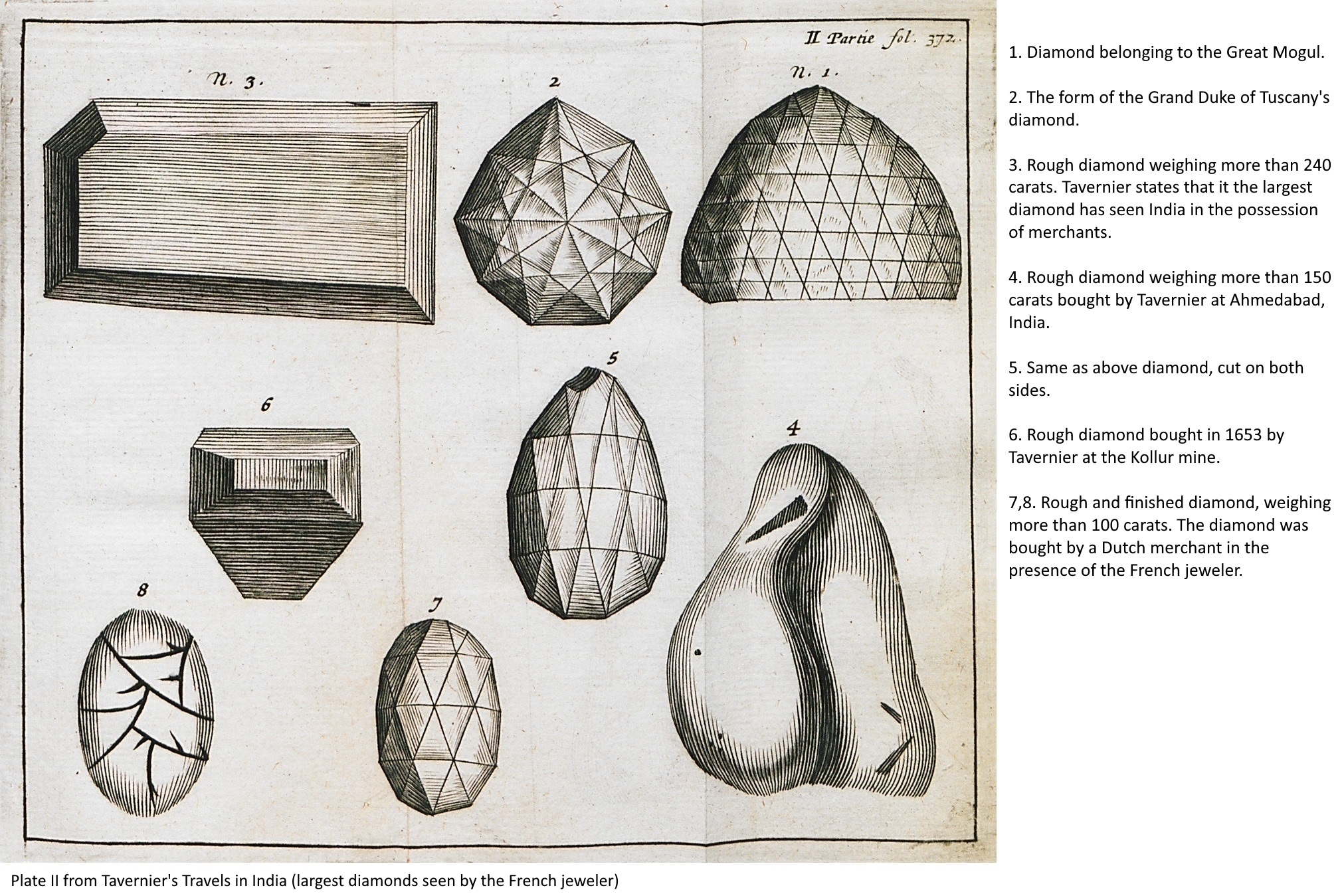
Described in 1665 by the French gem merchant Jean-Baptiste Tavernier at the court of the Mughal Emperor Aurangzeb, the Great Mogul is estimated to have weighed approximately 787.5 carats in its rough form (or around 280 carats in its initial cut state). The diamond subsequently vanished following the sack of Delhi by Nader Shah in 1739. Many gem historians hypothesize that portions of the Great Mogul were later recut into the Orlov Diamond (189.6 carats), which now rests in the Moscow Kremlin Diamond Fund.
The Koh-i-Noor (186 Carats Rough/Historical Cut to 105.6 Carats)
While not the largest diamond numerically, the Koh-i-Noor holds unmatched historical notoriety. Mentioned in historical chronicles across Persia, India, and Afghanistan, its historical cut weight was recorded at 186 metric carats when presented to Queen Victoria in 1850.
Dissatisfied with its asymmetrical, rose-cut appearance—designed according to Mughal tradition to preserve maximum mass rather than maximize light reflection—Prince Albert ordered the gemstone recut in 1852 by Coster Diamonds in Amsterdam. The recut shortened the diamond's mass by nearly 43%, producing an oval brilliant gem weighing 105.6 carats.
Modern Mega-Diamonds (21st Century Finds)
Advanced modern recovery techniques—specifically X-ray transmission (XRT) sorting technology—prevent large diamonds from being accidentally crushed during ore processing. This technology has led to a renaissance in ultra-large diamond discoveries:
- Lesedi La Rona (1,109 Carats): Discovered in 2015 at the Karowe mine in Botswana, this tennis-ball-sized rough stone was cut into the 302.37-carat Graff Lesedi along with 66 smaller stones.
- Sewelló (1,758 Carats): Uncovered at the Karowe mine in 2019, this massive near-gem quality stone demonstrated that South-Central Africa's kimberlite deposits remain capable of producing historical giants.
- Karowe 2,492-Carat Discovery: Mining operations at Botswana's Karowe deposit continued to yield extraordinary specimens, including a massive 2,492-carat rough crystal uncovered in August 2024, confirming that giant rough stones are not merely historic anomalies.
Comparison of Historic and Modern Large Diamonds
The following table details key metrics for the largest historically verified diamonds, contrasting their original rough weights, final primary cut weights, geographic origins, and current locations.
| Diamond Name | Discovery Year | Origin / Mine | Rough Weight (Carats) | Primary Cut Weight (Carats) | Historical & Current Status |
|---|---|---|---|---|---|
| Sergio | 1895 | Bahia, Brazil | 3,167.0 ct | Uncut Industrial | Carbonado black diamond; broken for industrial drills |
| Cullinan | 1905 | Premier Mine, South Africa | 3,106.0 ct | 530.2 ct (Cullinan I) | Part of the British Crown Jewels (Tower of London) |
| Karowe Find | 2024 | Karowe Mine, Botswana | 2,492.0 ct | Under Evaluation | Recovered using XRT optical sorting technology |
| Sewelló | 2019 | Karowe Mine, Botswana | 1,758.0 ct | Uncut / Specimen | Purchased by Louis Vuitton for jewelry/study |
| Lesedi La Rona | 2015 | Karowe Mine, Botswana | 1,109.0 ct | 302.37 ct (Graff Lesedi) | Cut by Graff; private collection |
| Excelsior | 1893 | Jagersfontein, South Africa | 971.8 ct | 69.68 ct (Excelsior I) | Split into 21 separate stones sold privately |
| Star of Sierra Leone | 1972 | Koidu, Sierra Leone | 968.9 ct | 53.96 ct (Primary) | Split into 17 gems by Harry Winston |
| Great Mogul | c. 1650 | Golconda, India | ~787.5 ct | ~280.0 ct | Lost post-1739; believed recut into the Orlov |
| Incomparable | 1984 | Mbuji-Mayi, DR Congo | 890.0 ct | 407.48 ct | Recut in 2022 into the 303.10-carat Golden Canary |
| Daria-i-Noor | Ancient | Golconda, India | Unknown | ~182.0 ct | Table-cut pink diamond; Iranian Crown Jewels |
| Koh-i-Noor | Ancient | Golconda, India | ~191.0 ct | 105.6 ct | Recut in 1852; set in British Queen Mother’s Crown |
| Hope Diamond | Ancient | Golconda, India | ~115.0 ct | 45.52 ct | Housed at the Smithsonian National Museum of Natural History |
Why Historical Cut Diamonds Were Smaller Than Their Rough Stone
When reading historical accounts of massive rough diamonds, readers often wonder why a 1,000-carat crystal yields a finished jewel of only 300 or 400 carats. The significant reduction in mass between rough and polished states is governed by crystallographic structure, inclusion removal, and cutting philosophies.
- Original Rough Diamond Mass (100%)
- Cleavage / Sawing Off Inclusions: Loss: ~15-25%
- Shaping & Girdle Bruting: Loss: ~15-20%
- Faceting & Final Polishing: Loss: ~15-25%
- Final Polished Gemstone Yield (30% - 50%)
Cleavage Planes and Internal Inclusions
Diamonds grow in octahedral crystals beneath intense mantle pressure and temperature. Internal fractures, structural distortion (graining), and foreign mineral inclusions (such as garnet or graphite) must be cut away to produce a eye-clean gemstone. If a 500-carat rough diamond has a deep internal fissure running through its center, gem cutters must split or saw the stone into multiple smaller, clean pieces, sacrificing substantial total mass.
Historical Cutting Philosophy: Carat Weight vs. Brilliance
Prior to the early 20th century, diamond cutters prioritized retaining total weight over maximizing light refraction. Ancient Indian cuts (such as the mogul cut or simple table cuts) followed the natural contour of the rough crystal, polishing superficial facets directly onto the surface to polish out rough spots while preserving mass.
This approach changed following Marcel Tolkowsky’s 1919 publication of Diamond Design, which mathematically derived the ideal angles for the modern Round Brilliant cut. Achieving optical perfection—where light entering the crown reflects internally off the pavilion facets and bounces back to the eye—requires sacrificing between 50% to 70% of the original rough weight.
- Historical Mogul Cut (Maximizes Weight Retention)
- Preserves crystal shape
- Lower light reflection
- Modern Brilliant Cut (Maximizes Light Performance)
- High material sacrifice (~50%+)
- Maximum brilliance and fire
Structural Risks in Historical Diamond Cutting
Before the invention of modern 3D laser mapping and micro-friction saws, cleaving a diamond was a nerve-wracking mechanical process. A cutter inserted a steel blade into a single scored notch along the crystal’s natural cleavage plane and struck it with a heavy mallet. A single mistake could cause an priceless historical stone to shatter into thousands of worthless fragments.
When Joseph Asscher was commissioned to cleave the 3,106-carat Cullinan diamond in Amsterdam in 1908, he spent months studying the crystal's stress lines before making the initial strike—which snapped his steel blade on the first attempt before successfully parting the crystal on the second.
Average Diamond Sizes Worn by Everyday People in History
While royal dynasties acquired massive gemstones weighing tens or hundreds of carats, everyday citizens possessed far smaller diamonds—or none at all—depending on the era. Detailed analysis of historical trade records by organizations such as the Gemological Institute of America (GIA) highlights how consumer access evolved over time.
| Era | Average Diamond Size | Notes |
|---|---|---|
| Roman & Medieval Eras | 0.05 ct - 0.20 ct | Uncut raw crystals; elite only |
| Victorian Era (1800s) | 0.10 ct - 0.40 ct | Rose & Old Mine cuts |
| Mid-20th Century | 0.35 ct - 0.65 ct | Commercial engagement rings |
| Modern (2020s-2026) | 1.00 ct - 2.00 ct | Mined & Lab-grown options |
Roman and Medieval Eras
During classical antiquity and the Middle Ages, diamonds were exceptionally rare in Western Europe. Uncut diamond crystals—often measuring under 0.25 carats—were set raw into iron or gold bands for kings, high-ranking clergy, and noblemen. Diamonds were valued for their legendary hardness and supposed mystical protective powers rather than their optical brilliance.
The Renaissance to the Victorian Era (16th–19th Centuries)
With the opening of oceanic trade routes between Europe and India, and later the discovery of Brazilian deposits, small cut diamonds entered aristocratic and wealthy merchant fashion.
Common settings featured rose cuts or old mine cuts ranging from 0.10 to 0.50 carats. Small diamond accent points (often under 0.05 carats) were used to encircle colored gemstones like rubies, sapphires, and emeralds.
The 20th Century and the Rise of Everyday Diamond Jewelry
The discovery of massive kimberlite pipes in South Africa flooded the market with diamonds, bringing the gem within financial reach of the growing middle class.
Following successful marketing campaigns in the late 1930s and 1940s, diamond engagement rings became standardized in Western culture. Throughout the mid-to-late 20th century, the average center stone for a consumer engagement ring hovered between 0.35 carats and 0.75 carats.
Frequently Asked Questions
What is the largest diamond ever found in recorded history?
The largest gem-quality rough diamond ever discovered is the Cullinan Diamond, weighing 3,106 carats (approx. 621.2 grams). It was found at the Premier No. 2 mine in Cullinan, South Africa, in 1905. If non-gem quality carbonados are included, the largest specimen ever found is the Sergio carbonado (3,167 carats), discovered in Brazil in 1895.
Why did historic diamond cuts lose so much carat weight?
Historical gem cutters had to remove internal inclusions, surface flaws, and structural stress lines from the rough crystal. Additionally, modern geometric cutting standards (such as the Round Brilliant cut) require removing up to 50% to 70% of the rough material to achieve optimal brilliance, symmetry, and light dispersion.
Were ancient diamonds larger than diamonds mined today?
Individual ancient rough stones were not inherently larger than today's finds. In fact, modern kimberlite pipe mining unearths massive rough stones (such as the 1,109-carat Lesedi La Rona and the 2,492-carat Karowe diamond found in 2024) far more frequently than ancient alluvial panners ever found in riverbeds.
What happened to the famous Great Mogul diamond?
The Great Mogul diamond (~787 carats rough, cut to ~280 carats) vanished after Persian ruler Nader Shah invaded Delhi in 1739. Historical consensus suggests the gem was subsequently broken down or recut into smaller stones, with many gemologists asserting that the 189.6-carat Orlov Diamond in the Russian Imperial Scepter is a major remnant of the original Great Mogul.
How were diamond carats measured in antiquity?
Before the metric carat (standardized as 0.2 grams in 1907–1913) was internationally adopted, historical cultures used natural weight units. In India, miners used rati seeds from the Abrus precatorius plant. Mediterranean traders used carob seeds (Ceratonia siliqua), from which the English word "carat" eventually derived.
Conclusion & Practical Guidance for Gemology Enthusiasts
Understanding historical diamond sizes requires looking past carat count alone to evaluate structural geometry, historical cutting techniques, and mining capabilities.
- For Collectors & Historians: When evaluating antique diamond jewelry (such as Old Mine or Rose Cut gems), remember that historical carat weights reflect crystal preservation rather than modern ideal proportions. An Old European Cut stone will often feature a higher crown, deeper pavilion, and larger culet than a modern diamond of equivalent weight.
- For Jewelry Buyers: Recognize that a historic gemstone's carat weight does not translate directly to physical face-up millimeter size. Historical cuts distribute weight downward into deeper pavilions, whereas modern cutting proportions maximize visible surface area (diameter) relative to total carat mass.
If you wish to study historic diamonds in person, major permanent public exhibits include the Tower of London (Cullinan I & II, Koh-i-Noor replica), the Smithsonian National Museum of Natural History in Washington, D.C. (Hope Diamond and Incomparable), and the Muséum National d'Histoire Naturelle in Paris (Grand Mazarin and Tavernier replicas).
Image Gallery