Mastering Wave Basics: A Comprehensive Guide and Educational Worksheet Framework
A worksheet on wave basics serves as an essential instructional tool designed to help students bridge the gap between abstract physics concepts and tangible, quantifiable problems. By combining core definitions of wavelength, frequency...
A worksheet on wave basics serves as an essential instructional tool designed to help students bridge the gap between abstract physics concepts and tangible, quantifiable problems. By combining core definitions of wavelength, frequency, amplitude, and wave speed with targeted practice calculations, these exercises ensure learners can reliably analyze both mechanical and electromagnetic wave phenomena.
Contents
Understanding the Foundation of Wave Mechanics
Before diving into practice problems or drafting a comprehensive educational worksheet on wave basics, educators and students must establish a firm grasp of what a wave represents physically. At its core, a wave is a disturbance that transfers energy through matter or empty space without permanently displacing the medium itself. Understanding this fundamental transfer mechanism is critical for solving analytical problems accurately.
Waves generally divide into two primary categories: mechanical and electromagnetic. Mechanical waves, such as sound waves or ripples on a water surface, require a physical medium to travel through, relying on particle-to-particle interactions. Electromagnetic waves, including visible light, radio waves, and X-rays, consist of oscillating electric and magnetic fields and can propagate through the vacuum of space. Recognizing these classifications prevents common errors in identifying wave properties and behaviors.
Transverse vs. Longitudinal Waves
Wave classification extends deeper into how the particles of the medium move relative to the direction of energy propagation. This distinction forms a staple component of any introductory wave physics worksheet.
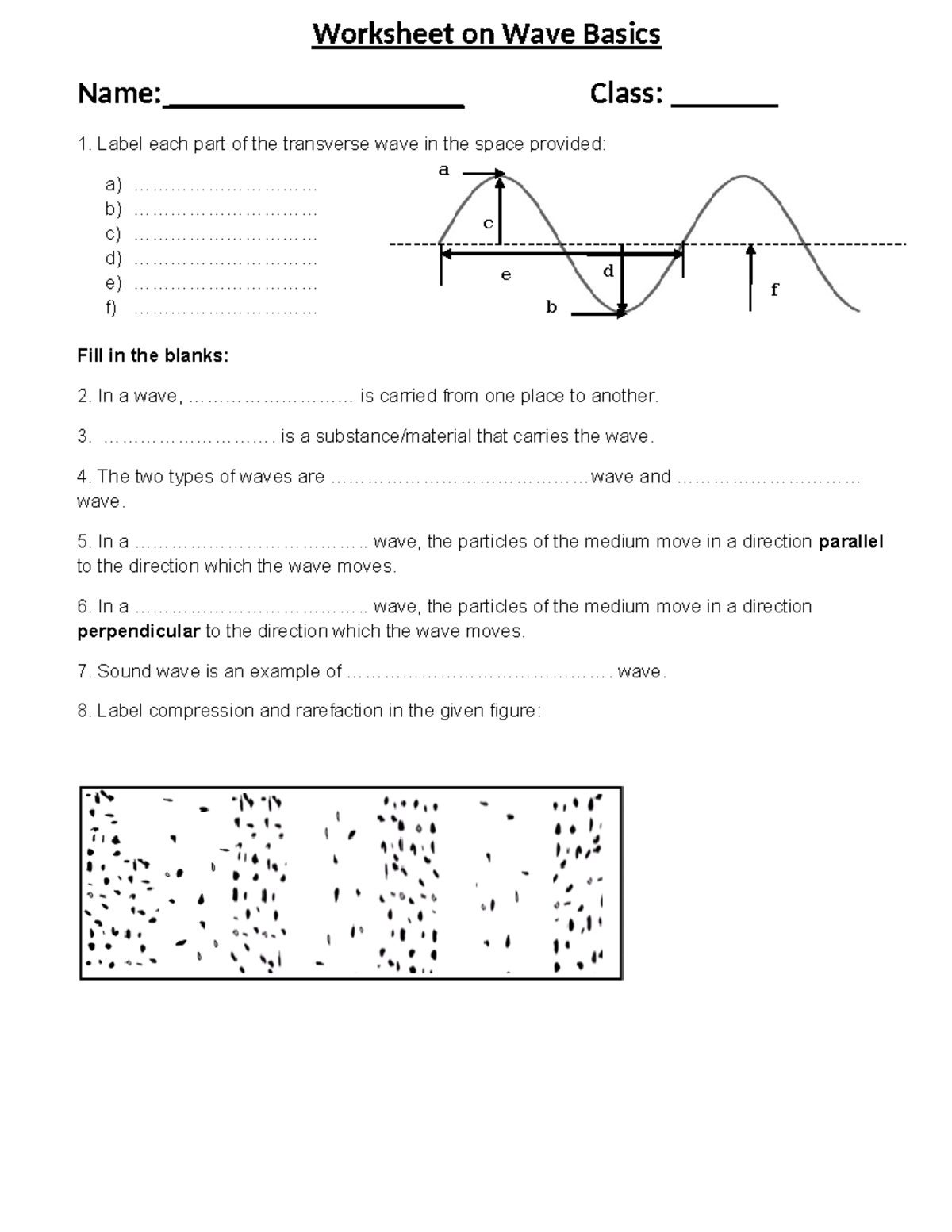
- Transverse Waves: In a transverse wave, the particle displacement is perpendicular to the direction of energy transport. Familiar examples include strings on a musical instrument and secondary earthquake waves (S-waves). Key features include crests (highest points) and troughs (lowest points).
- Longitudinal Waves: In a longitudinal wave, the particle displacement is parallel to the direction of energy transport. Sound waves and primary earthquake waves (P-waves) are classic examples. These waves travel via alternating regions of compression (high pressure and density) and rarefaction (low pressure and density).
Key Parameters and Mathematical Relationships
To make a worksheet on wave basics genuinely effective, it must integrate core mathematical formulas that govern wave behavior. Physics curricula universally center around a few foundational parameters, their standard units, and the equations binding them together.
| Parameter | Symbol | Standard SI Unit |
|---|---|---|
| Wavelength | $\lambda$ (lambda) | Meters (m) |
| Frequency | $f$ or $\nu$ (nu) | Hertz (Hz) or $s^{-1}$ |
| Period | $T$ | Seconds (s) |
| Wave Speed | $v$ | Meters per second (m/s) |
| Amplitude | $A$ | Meters (m) |
The relationship between frequency and period is inversely proportional, expressed mathematically as $T = \frac{1}{f}$ and $f = \frac{1}{T}$. This means a wave that oscillates very rapidly (high frequency) completes each cycle in a very short amount of time (low period).
The Universal Wave Equation
The single most critical calculation tested on any wave basics worksheet is the universal wave equation:
$$v = f \times \lambda$$
Where:
- $v$ represents the speed of the wave.
- $f$ represents the frequency of the wave.
- $\lambda$ represents the wavelength.
Mastering this equation allows students to calculate unknown variables when given any two of the parameters. For instance, if a sound wave travels through air at $343\text{ m/s}$ with a frequency of $440\text{ Hz}$ (musical note A4), rearranging the formula yields the wavelength:
$$\lambda = \frac{v}{f} = \frac{343\text{ m/s}}{440\text{ Hz}} \approx 0.78\text{ meters}$$
Designing Effective Sections for a Wave Basics Worksheet
When educators or curriculum designers build a worksheet on wave basics, a structured progression ensures students build confidence gradually. Randomly mixing complex mathematical derivations with basic identification questions leads to frustration. Instead, a well-rounded worksheet should move through distinct cognitive tiers.
Part 1: Conceptual Identification and Vocabulary Matching
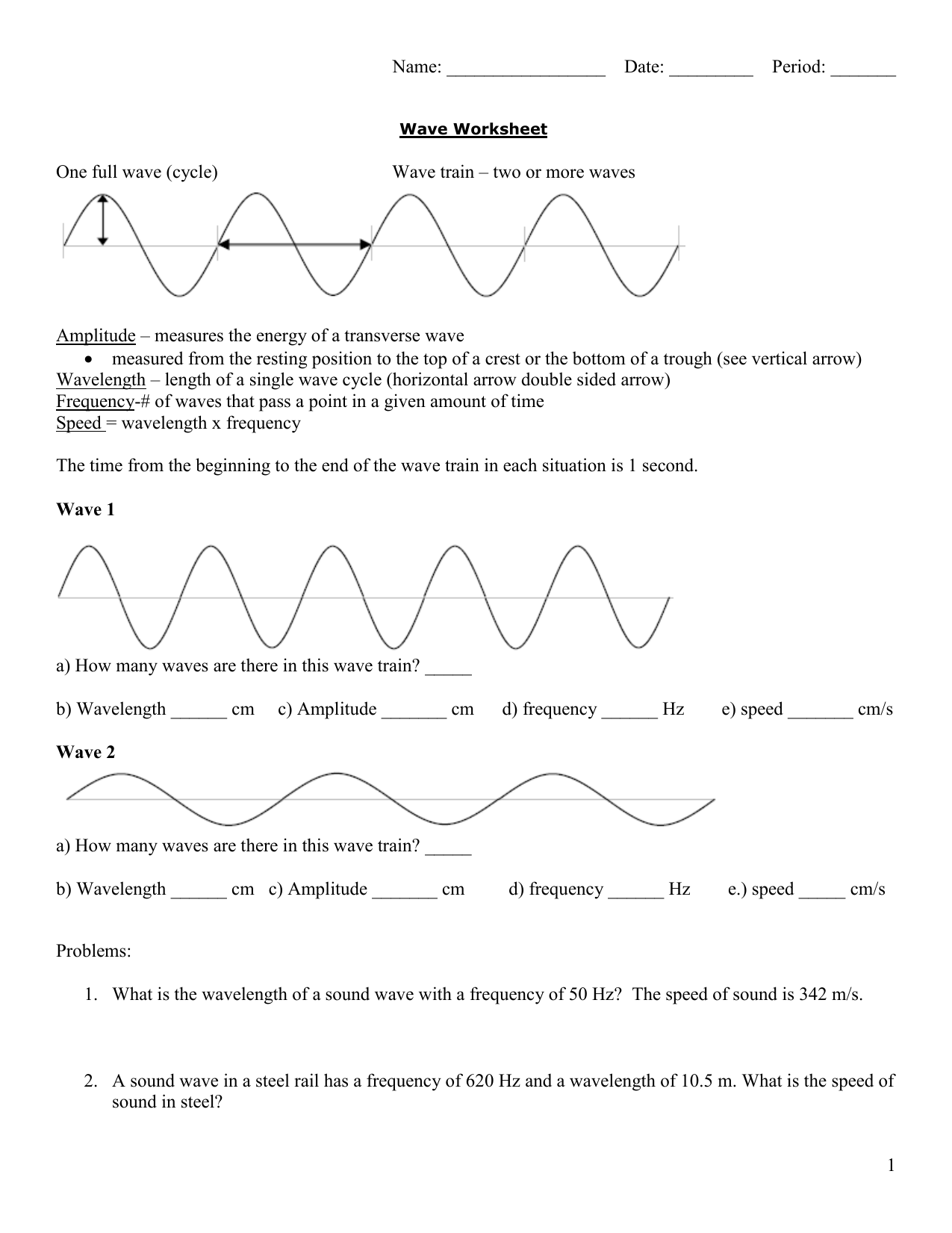
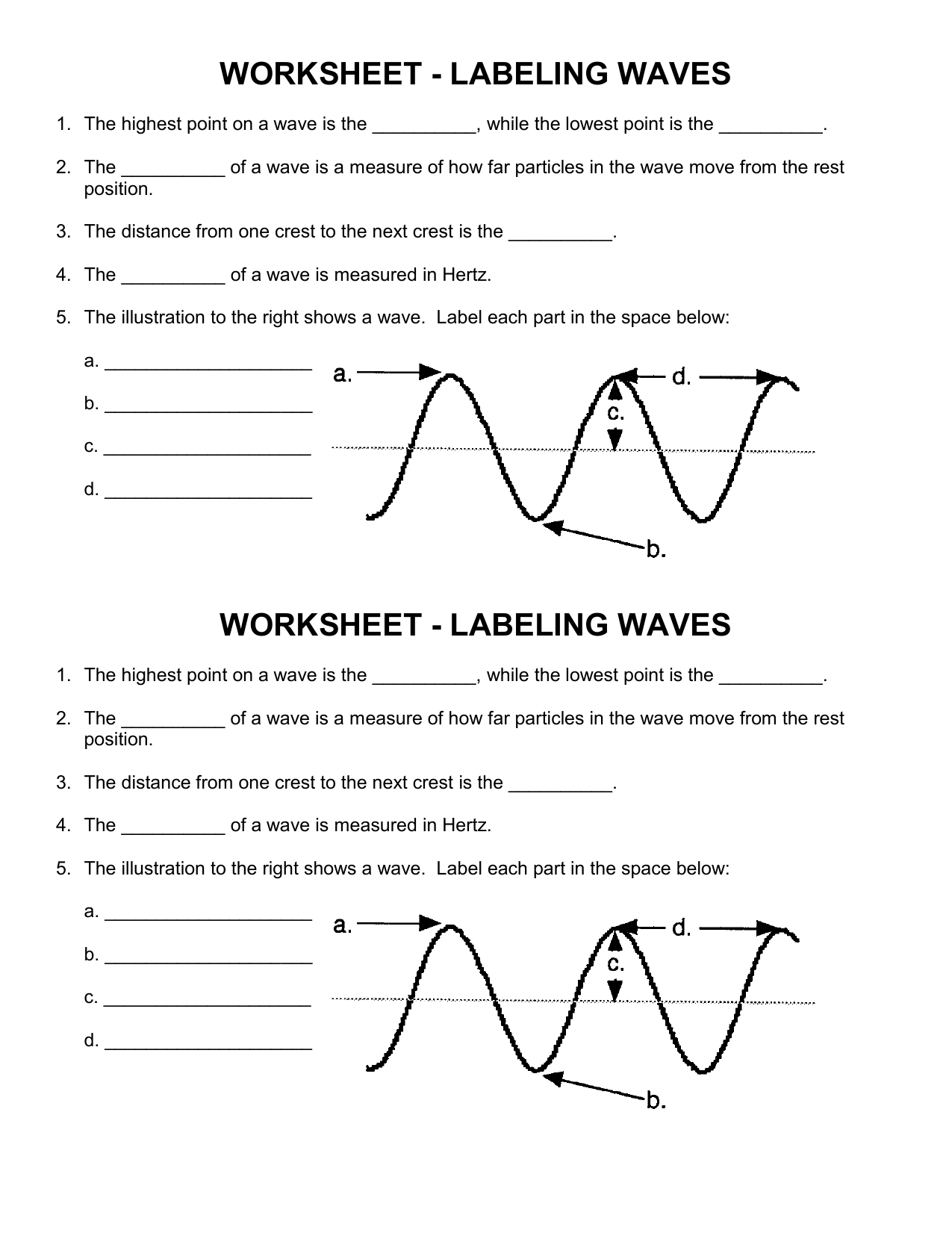
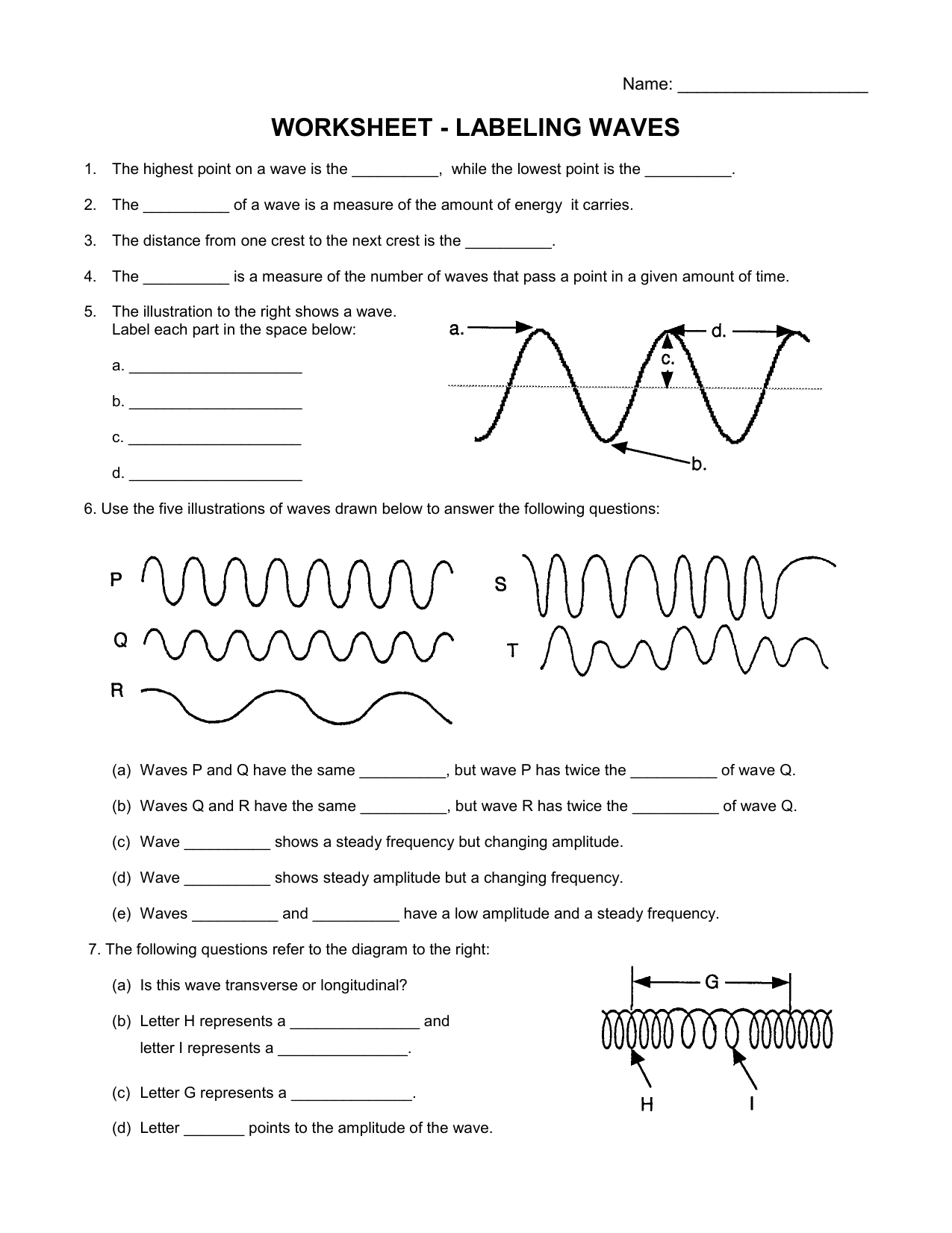
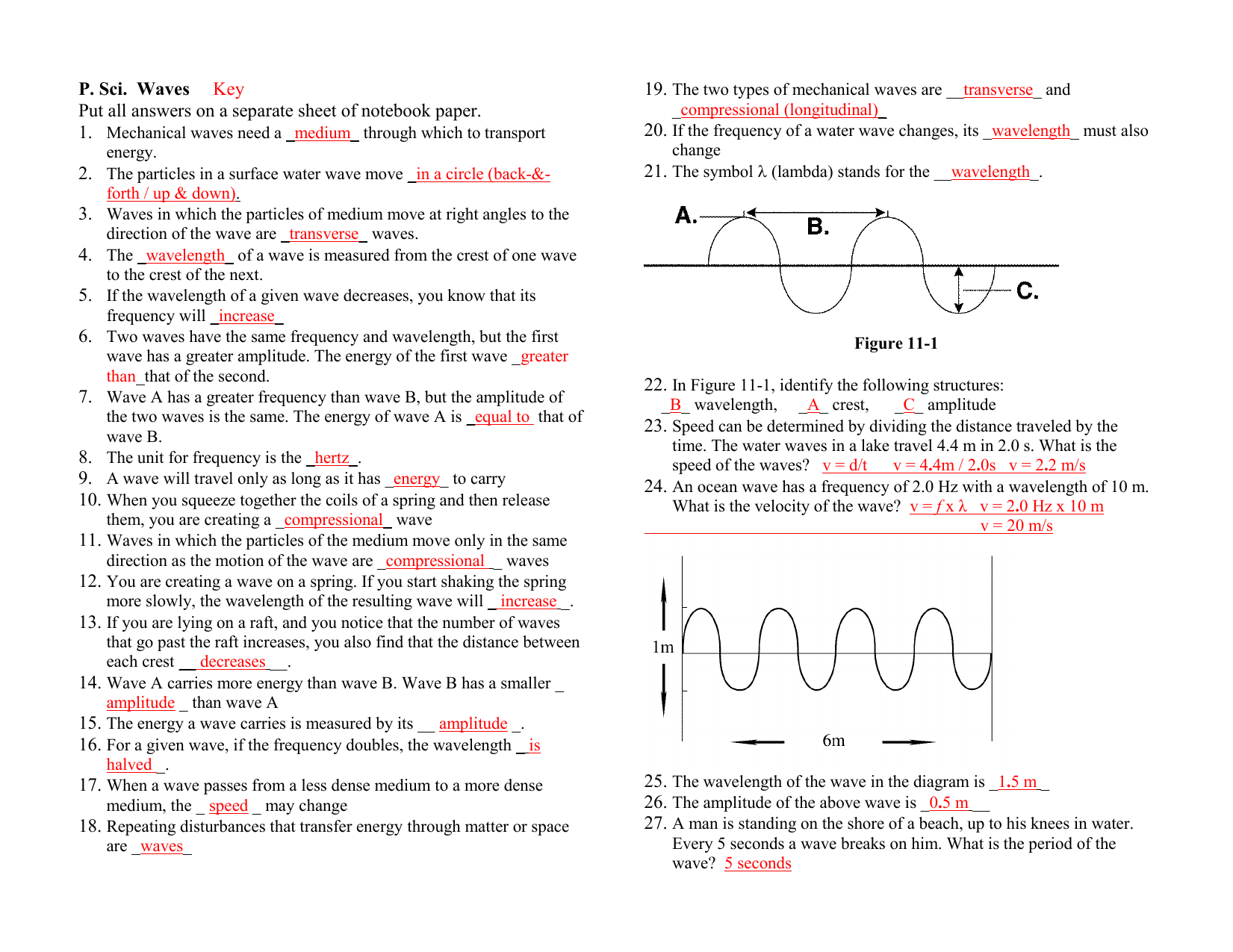
The opening section should evaluate whether students understand physical terminology without relying heavily on mathematics. Questions here should ask learners to label diagrams of transverse waves—specifically pointing out crests, troughs, amplitude, and wavelength. For longitudinal waves, students should correctly identify and label compressions and rarefactions.
True-or-false or multiple-choice questions in this segment can address misconceptions, such as clarifying that a wave transports energy rather than matter across long distances.
Part 2: Conceptual Calculations (Frequency and Period)
The second tier transitions learners into arithmetic by testing reciprocal relationships. Example tasks include:
- Calculating the period of a pendulum or wave given a frequency of $50\text{ Hz}$.
- Determining the frequency of a wave that completes $120$ cycles in $60$ seconds.
These intermediate steps reinforce unit conversions and dimensional analysis before tackling multi-variable wave speed equations.
Part 3: Application of the Universal Wave Equation
The core of the worksheet features applied word problems utilizing $v = f \times \lambda$. To maximize educational value, problems should vary the unknown variable. Students should practice solving for wave speed in one scenario, frequency in the next, and wavelength in the final problem.
Furthermore, problems should introduce different mediums (e.g., water, air, steel) to demonstrate how wave speed changes depending on the density and elasticity of the material, while frequency typically remains constant when crossing boundaries.
Common Student Misconceptions and Troubleshooting
Even with clear formulas, students frequently encounter predictable hurdles when working through wave problems. Recognizing these pitfalls helps instructors refine their explanations and worksheets.
- Confusing Amplitude with Wavelength: Students often measure amplitude from peak to trough (total height) rather than from the resting equilibrium position to the crest. Worksheets should feature explicit vertical dimension lines on diagrams to clarify this distinction.
- Unit Inconsistencies: A frequent error occurs when wave speeds are given in meters per second, but wavelengths are provided in centimeters or kilometers. Students must convert all variables into standard SI base units before performing calculations.
- Misinterpreting Frequency Units: Hertz ($Hz$) must be recognized as equivalent to inverse seconds ($s^{-1}$). When students see cycles per minute, they must convert the value to cycles per second before applying the wave equation.
Frequently Asked Questions
What is the difference between transverse and longitudinal waves?
Transverse waves cause particles in the medium to oscillate perpendicularly to the direction of wave travel, whereas longitudinal waves cause parallel oscillations characterized by compressions and rarefactions.
How do you calculate wave speed if only frequency and wavelength are known?
You multiply the frequency ($f$) by the wavelength ($\lambda$) using the universal wave equation ($v = f \times \lambda$). Ensure units are in Hertz and meters to yield meters per second.
Does changing the frequency of a wave change its speed in the same medium?
No. In a uniform medium, wave speed remains constant. If frequency increases, wavelength must proportionally decrease to maintain a constant wave speed.
Why is amplitude not part of the standard wave speed equation?
Amplitude measures the maximum displacement or energy of a wave, whereas wave speed is determined by the physical properties (such as elasticity and density) of the medium through which the wave travels.
How do I convert frequency into period for worksheet problems?
Take the reciprocal of the frequency ($T = \frac{1}{f}$). For example, a frequency of $10\text{ Hz}$ results in a period of $0.1$ seconds.
Next Actions for Educators and Learners
To put these insights into practice, download or draft a structured worksheet that follows the multi-tiered framework outlined above: start with visual identification, move to period-frequency conversions, and conclude with multi-variable universal wave equation problems. Always require students to explicitly list known values, unknown variables, and units in their work to build rigorous problem-solving habits.
Image Gallery