Union Pacific Railroad: The Largest U.S. Freight Operator Guide
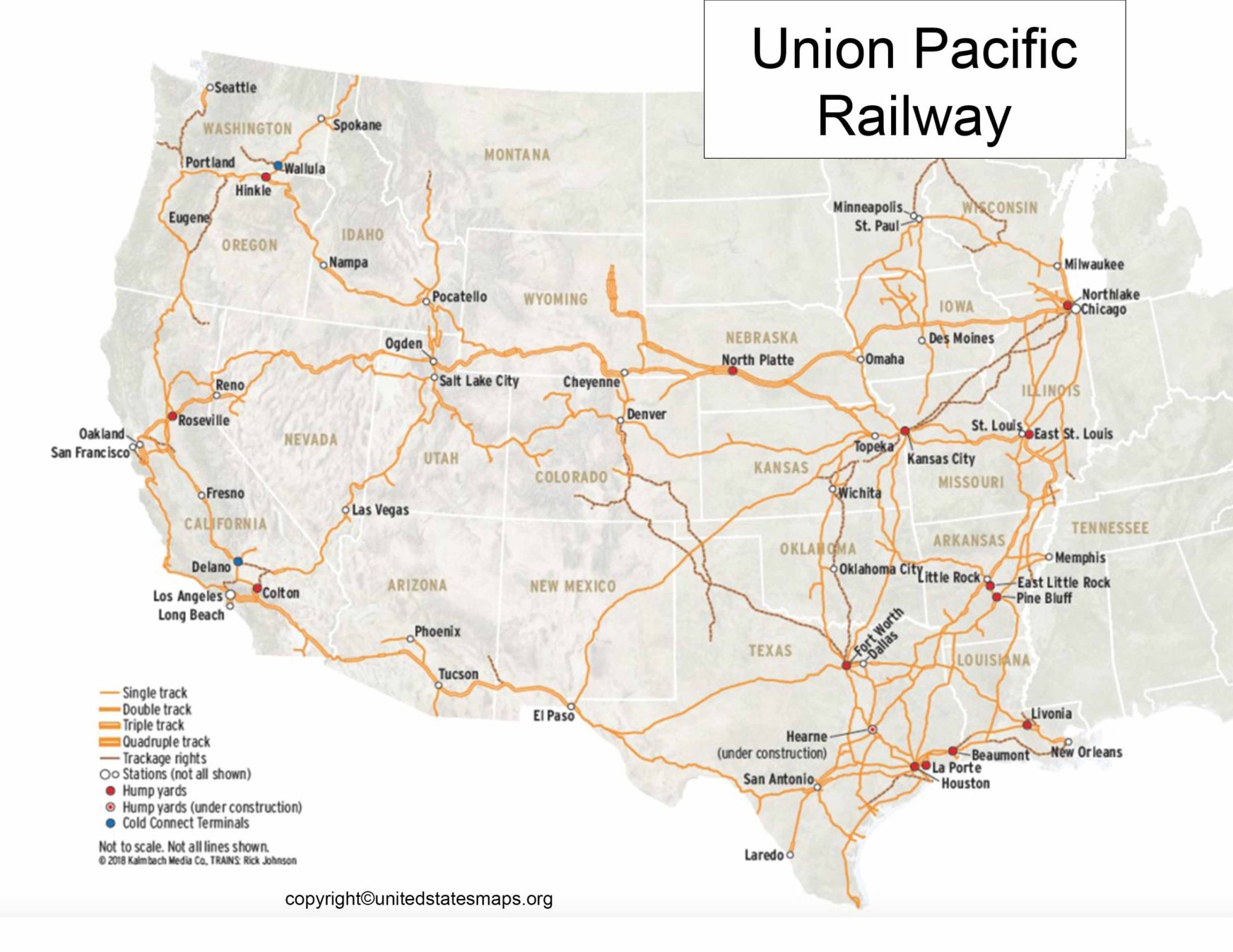
Union Pacific Railroad operates the largest Class I freight rail network in the United States alongside BNSF Railway. Spanning approximately 32,200 route miles across 23 states west of the Mississippi River, Union Pacific connects majo...
Union Pacific Railroad operates the largest Class I freight rail network in the United States alongside BNSF Railway. Spanning approximately 32,200 route miles across 23 states west of the Mississippi River, Union Pacific connects major West Coast and Gulf Coast sea ports with Midwestern industrial hubs, Canadian rail lines, and six primary border crossings into Mexico.
Contents
Network Footprint and Strategic Rail Gateways
Union Pacific Railroad (reporting mark UP) anchors the logistics backbone of the western two-thirds of the United States. Its network forms a complex web designed to transport industrial, agricultural, intermodal, and energy commodities efficiently over long distances. Understanding the geographical scope of this footprint is essential for logistics directors, supply chain strategists, and industrial developers planning modal shifts from highway to rail.
- West Coast Ports (Los Angeles, Long Beach, Oakland)
- Gulf Coast Ports (Houston, Corpus Christi)
- Union Pacific Core Network (32,200 Route Miles / 23 States)
- Mexico Border Gateways (Laredo, El Paso, Eagle Pass, etc.)
- Eastern Rail Interchanges (Chicago, St. Louis, Memphis, etc.)
Coverage Across 23 Western States
Union Pacific operates rail infrastructure across a territory extending from the Pacific Ocean to the Mississippi River, reaching north to the Canadian border and south to the Gulf of Mexico. This territory includes major economic centers in California, Texas, Illinois, Washington, Oregon, Texas, and Nebraska—where its corporate headquarters resides in Omaha.
By operating extensive mainline tracks—such as the historic Overland Route and the Sunset Route—Union Pacific allows high-density freight trains to bypass highway congestion. This extensive network acts as an engine for domestic commerce, providing uninterrupted long-haul movements across long transcontinental corridors.
Pacific and Gulf Coast Port Integration
A vital structural advantage of the Union Pacific system is its direct rail access to key maritime ports. On the West Coast, Union Pacific serves:
- The Port of Los Angeles and Port of Long Beach (the San Pedro Bay port complex, which handles the largest share of containerized imports from Asia into North America).
- The Port of Oakland, serving Northern California agricultural and industrial exports.
- Pacific Northwest gateways, including Seattle, Tacoma, and Kalama, which handle grain, timber, and containerized cargo.
Along the Gulf Coast, Union Pacific serves key port facilities in Houston, Beaumont, Corpus Christi, and New Orleans. These tracks directly link chemical manufacturing plants, oil refineries, and plastic resin producers with domestic markets and deepwater export terminals.
Cross-Border Infrastructure with Mexico
Trade under North American supply chain frameworks relies heavily on cross-border rail connections. Union Pacific reaches all six major rail gateways linking the United States and Mexico:
- Laredo, Texas: The busiest freight border crossing in North America.
- Eagle Pass, Texas: A high-volume corridor for automotive and agricultural traffic.
- El Paso, Texas: A critical junction for West Coast-bound industrial goods and maquiladora shipments.
- Nogales, Arizona: Primary gateway for produce and manufacturing along the Sonoran corridor.
- Calexico (Brawley/Imperial Valley), California: Facilitating trade with Baja California manufacturing nodes.
- Brownsville, Texas: Connecting Eastern Mexico industrial facilities with Gulf Coast shipping routes.
Through operational coordination with Mexican rail operators, including Ferromex (in which Union Pacific holds a 26% minority financial interest) and Canadian Pacific Kansas City (CPKC), Union Pacific facilitates international customs clearance and seamless cross-border freight interchange.
Key Inland Interchange Hubs
To transport freight beyond its western footprint, Union Pacific exchanges railcars with Eastern Class I operators—primarily CSX Transportation and Norfolk Southern Railway—as well as Canadian networks. The primary interchange hubs connecting eastern and western rail grids include:
- Chicago, Illinois: The largest rail freight gateway in North America, processing thousands of intermodal and manifest cars daily.
- St. Louis, Missouri: A major central crossing for bulk commodities and general merchandise.
- Memphis, Tennessee: A critical gateway connecting the Mid-South, Gulf Coast, and Southeastern consumer markets.
- New Orleans, Louisiana: A key exchange point for east-west southern rail corridors and ocean shipping.
Core Freight Commodity Segments and Fleet Equipment
Union Pacific moves a diverse range of raw materials, intermediate components, and finished goods. The railroad categorizes its traffic into four primary commercial business groups: Bulk, Industrial, Automotive, and Intermodal.
- Union Pacific Business Groups
- Bulk (Grain, Coal, Soda)
- Industrial (Chemicals, Steel)
- Automotive (Vehicles, Parts)
- Intermodal (Containers, Trailers)
1. Intermodal Freight
Intermodal freight represents the movement of shipping containers and trailers using a combination of rail, ocean vessel, and motor carrier. Union Pacific operates numerous dedicated intermodal ramps where ocean containers (20-foot and 40-foot ISO units) and domestic containers (53-foot units) are transferred between truck chassis and specialized double-stack railcars (well cars).
Intermodal transport offers shippers substantial cost savings compared to long-haul over-the-road trucking while providing reliable door-to-door transit schedules across transcontinental lanes.
2. Bulk Commodities
Bulk shipping involves raw materials transported unpackaged in unit trains—entire trains dedicated to a single product operating point-to-point. Key bulk freight served by Union Pacific includes:
- Agricultural Products: Wheat, corn, soybeans, bio-fuels, dried distillers grains (DDGS), and fertilizer moved in heavy-capacity covered hoppers.
- Grain & Food Products: Milled grain, canned food, malt, and beverage products moving in temperature-controlled boxcars or covered hoppers.
- Soda Ash & Minerals: Union Pacific transports green river soda ash from Wyoming—the world's largest natural deposit—to export ports and domestic glass manufacturers.
- Coal: Transported in open-top gondolas and hopper cars primarily from the Powder River Basin in Wyoming to electrical utility facilities.
3. Industrial Products
The industrial segment serves the manufacturing, construction, energy, and chemical production sectors. Freight equipment and commodities include:
- Chemicals and Plastics: Transported using specialized tank cars for liquid chemicals, acids, and compressed gases, along with covered hoppers for plastic pellets.
- Forest Products: Lumber, plywood, wood pulp, and paper products carried on flatcars, centerbeam cars, and specialized boxcars.
- Construction Materials: Cement, aggregates, sand, and asphalt moved in open or covered hoppers to support regional construction projects.
- Metals and Steel: Coiled sheet steel, rebar, pipe, and scrap metal transported using heavy-duty gondolas and flatcars.
4. Automotive Shipments
Union Pacific is the primary automotive rail carrier west of the Mississippi, transporting origin-to-destination shipments for automotive manufacturers. Freight includes assembled passenger cars, light trucks, heavy commercial vehicles, and auto replacement parts.
The railroad utilizes specialized multi-level auto-rack cars (bi-level and tri-level enclosed railcars) that shield vehicles from weather and road debris during transit between assembly plants, port terminals, and regional vehicle distribution centers.
Comparative Analysis of Major U.S. Class I Railroad Operators
To evaluate Union Pacific's positioning within the North American freight system, logistics planners analyze Class I freight railroads based on route network, geographic focus, and structural connectivity.
| Railroad Enterprise | Operating Region | Route Mileage (Approx.) | Key Coastal Access & Gateways | Primary Freight Specializations |
|---|---|---|---|---|
| Union Pacific Railroad (UP) | Western U.S. (23 States) | ~32,200 miles | West Coast ports, Gulf Coast, 6 Mexico border portals, Chicago, Memphis | Intermodal, Industrial Chemicals, Grain, Automotive, Soda Ash |
| BNSF Railway | Western U.S. (28 States) | ~32,500 miles | West Coast ports, Gulf Coast, Pacific Northwest, Chicago, Kansas City | Intermodal, Consumer Goods, Grain, Energy & Powder River Coal |
| CSX Transportation | Eastern U.S. (23 States) | ~20,000 miles | Atlantic Coast, Gulf Coast, Great Lakes, Chicago, New Orleans | Chemicals, Intermodal, Metals, Utility Coal, Forest Products |
| Norfolk Southern Railway (NS) | Eastern U.S. (22 States) | ~19,300 miles | Atlantic Seaboard, Gulf Coast, Chicago, St. Louis, Memphis | Intermodal, Automotive, Metals, Industrial Minerals, Agriculture |
| Canadian Pacific Kansas City (CPKC) | Canada, U.S. Midwest/South, Mexico | ~20,000 miles | Canadian Coasts, U.S. Gulf Coast, Laredo border gateway, Mexico Ports | Cross-border Automotive, Grain, Energy, Liquids, Intermodal |
Operational Infrastructure and Precision Scheduled Railing
Executing rail transportation at high volumes requires advanced operational models, network discipline, and specialized physical infrastructure.
Precision Scheduled Railing (PSR) Operating Model
Like most Class I carriers, Union Pacific utilizes an operational philosophy based on Precision Scheduled Railing (PSR). Traditional rail operations focused on accumulating enough loaded railcars to fill long, unscheduled trains. In contrast, PSR emphasizes:
- Fixed Train Schedules: Running trains on consistent, published departure times regardless of total tonnage on a given day.
- Car-Point Scheduling: Tracking individual railcar movements against specific transit windows to minimize dwell time in classification yards.
- Asset Utilization: Reducing locomotive fleet size and freight car inventories through faster equipment turnarounds.
- Direct Routing: Bypassing intermediate classification yards via point-to-point block swaps and unit train dispatching.
PSR operational metrics monitored by shippers and federal oversight authorities like the Federal Railroad Administration include average train speed, dwell time at terminals, train length, and on-time car arrival performance.
Rail Infrastructure & Yard Classification
Union Pacific operates major terminal infrastructure facilities designed to sort, store, and dispatch freight trains:
- Classification Yards (Hump Yards & Flat Yards): Facilities like the Bailey Yard in North Platte, Nebraska—the world's largest rail classification yard—use gravity-fed "humps" and computer-controlled switches to group incoming cars by destination.
- Intermodal Terminals: Dedicated ramps equipped with overhead gantry cranes and side-loaders to shift containers rapidly between railcars and drayage trucks.
- Transload Centers: Facilities that convert non-rail-served bulk and break-bulk products from trucks into railcars, extending the reach of the rail network.
- Inbound Train
- Hump Sorting Yard
- Destination Tracks
- Outbound Departure
Advanced Technology and Automation
Safety and efficiency across Union Pacific’s network rely on digital technologies:
- Positive Train Control (PTC): An enforcement system required by federal law that automatically stops or slows a train if a human operator fails to respond to signal alerts, preventing train-to-train collisions and over-speed derailments.
- Automated Track Inspection (ATI): Autonomous geometry cars and lasers measuring rail alignment, track gauge, and ballast condition in real time.
- Locomotive Telematics & Predictive Maintenance: Sensors monitoring engine diagnostics, fuel consumption, and wheel profile wear to prevent mechanical failures before trains depart terminals.
- API and EDI Integration: Enterprise platforms (such as the ShipUP portal) that provide supply chain visibility, automated car ordering, bill-of-lading submission, and real-time GPS tracking.
How Shippers Connect and Utilize Union Pacific Rail Freight
Integrating rail into a company’s distribution strategy depends on physical track access, shipment volume, and cargo volume characteristics.
- Freight Shipment?
- Direct Track Connection (Manifest / Unit Train)
- No Track Connection
- Transload Service (Truck + Rail Line)
- Intermodal Shipping (Container (COFC))
Direct Rail Siding (Manifest and Unit Train Service)
Industrial facilities, processing plants, and major warehouses with direct track connections (rail sidings) load railcars on-site. Union Pacific local switching crews pull loaded cars directly from private trackage and incorporate them into local trains, which transfer the cars to main classification yards.
- Manifest Shipping: Suitable for businesses shipping one to several carloads of diverse products simultaneously.
- Unit Train Shipping: Ideal for high-volume shippers moving massive unified loads (e.g., 100+ cars of coal, grain, or ethanol) from a single origin to a single destination on fixed loops.
Transloading Services for Off-Rail Facilities
Facilities that lack direct rail spurs can still leverage rail rates through transloading. Trucking fleets pick up freight at the manufacturing site and transport it to a nearby rail transload terminal (such as those managed by Union Pacific Distribution Services).
Here, bulk materials (liquids, powders, granules) or dimensional cargo (lumber, steel pipe) are transferred directly into railcars for long-haul transport. Once near the final destination, the process reverses for final truck delivery.
Intermodal Door-to-Door Solutions
For non-rail-served shippers moving containerized manufactured goods, intermodal provides an accessible entry point. Logistics providers supply standard 53-foot domestic intermodal containers directly to a factory loading dock via local drayage trucks.
Once loaded, the truck transports the container to a regional Union Pacific intermodal ramp. The container is loaded onto a well car for long-distance rail transport, then offloaded onto another drayage truck for final delivery at the receiving warehouse.
Environmental Efficiency and Regulatory Oversight
Freight rail occupies a critical place in modern supply chain sustainability strategies and national infrastructure policy.
- Freight Rail Efficiency
- 1 Ton of Freight moved ~450+ Miles on 1 Gallon of Fuel
- Reduces Greenhouse Gas Emissions by up to 75% vs. Trucking
Fuel Efficiency and Sustainability Impact
According to data compiled by the Bureau of Transportation Statistics, moving freight by rail is approximately three to four times more fuel-efficient than over-the-road trucking.
- On average, Union Pacific can move one ton of freight more than 450 miles on a single gallon of diesel fuel.
- Transitioning long-haul freight from highways to rail reduces greenhouse gas (GHG) emissions by up to 75%.
- A single intermodal train can remove several hundred long-haul semi-trucks from congested interstate highways, reducing pavement wear and traffic congestion.
To meet corporate sustainability mandates, Union Pacific continues testing alternative fuel options, including high-percentage biodiesel blends, renewable diesel, and zero-emission battery-electric switching locomotives in urban classification yards.
Regulatory Oversight Framework
As a Class I freight operator, Union Pacific operates under comprehensive federal regulation:
- Surface Transportation Board (STB): An independent federal agency overseeing rail carrier rates, service complaints, line abandonments, rail line mergers, and the common carrier obligation—the statutory requirement mandating that railroads provide transportation service upon reasonable request.
- Federal Railroad Administration (FRA): An agency within the U.S. Department of Transportation that establishes and enforces rail safety rules covering track maintenance, locomotive inspection standards, operating practices, signal security, and train crew hour limits.
Frequently Asked Questions
What makes Union Pacific one of the largest U.S. freight operators?
Union Pacific ranks among the largest U.S. freight railroads based on network reach (~32,200 route miles across 23 states), operating revenue, and annual freight volume. It shares leadership of the Western U.S. freight rail market with BNSF Railway, serving critical Pacific and Gulf Coast ports, major Mexican border gateways, and vital trade corridors.
What is the difference between manifest, intermodal, and unit train freight?
- Manifest Freight: Individual railcars containing varied commodities from multiple shippers combined into a single train that is sorted at intermediate rail yards along its route.
- Intermodal Freight: Cargo packed inside ocean containers or 53-foot domestic containers transferred seamlessly between ocean vessels, motor trucks, and specialized double-stack railcars.
- Unit Trains: Dedicated, single-commodity trains (such as coal, grain, or crude oil) moving directly from one origin to one destination without being uncoupled or sorted along the way.
How does Union Pacific connect with supply chains in Mexico?
Union Pacific operates rail links at six international border crossings: Laredo, Eagle Pass, El Paso, Brownsville (Texas), Nogales (Arizona), and Calexico (California). It interchanges rail traffic with Mexican rail networks like Ferromex and CPKC, using automated customs processing to streamline cross-border shipping.
Can a business use Union Pacific freight rail without direct track access?
Yes. Businesses without direct rail track access can use intermodal containers for door-to-door shipping using drayage trucks at both ends. Alternatively, shippers can use transloading services, trucking goods to a local transload facility where products are transferred into railcars for long-haul transport.
How does Precision Scheduled Railing (PSR) affect freight shipping schedules?
Precision Scheduled Railing (PSR) organizes rail operations around fixed, point-to-point train schedules rather than waiting for trains to reach maximum length before departing. For shippers, PSR aims to deliver more predictable departure and arrival windows, shorter transit times, reduced terminal car delay, and improved equipment utilization.
Practical Recommendation for Supply Chain Managers
To evaluate or integrate Union Pacific freight services into your corporate logistics operations, take these strategic steps:
- Conduct a Network Freight Audit: Analyze your organization's shipping lanes for long-haul movements exceeding 500 miles. Identify recurring volume lanes moving between the Western U.S., Mexico, and the Midwest that are candidates for modal conversion from truck to rail.
- Determine Rail Access Type:
- If your production or distribution facility has an existing rail spur, request a track inspection and switching service evaluation through Union Pacific’s business development team.
- If your facility lacks direct rail lines, evaluate regional intermodal ramp locations or contact authorized transload operators near your supply chain origins and destinations.
- Compare Total Landed Shipping Costs: Request freight quotes comparing direct truckload rates against rail carload or intermodal rates. Account for inventory holding costs, transit times, equipment loading parameters, and carbon offset reporting.
- Leverage Digital Tracking Portals: When onboarding rail freight, establish electronic data interchange (EDI) connections or access online management applications (such as ShipUP) to track railcar locations, manage demurrage risks, and automate car ordering.
Image Gallery