Life Insurance Agent Earnings and Opportunities: Complete Career and Income Guide
Life insurance agents in the United States earn a median annual income between $65,000 and $85,000, but total compensation varies widely based on employment structure, policy volume, and persistency. Entry-level agents typically earn $...
Life insurance agents in the United States earn a median annual income between $65,000 and $85,000, but total compensation varies widely based on employment structure, policy volume, and persistency. Entry-level agents typically earn $35,000 to $50,000 in their first year, while top-tier independent producers and agency owners routinely generate over $250,000 annually through commissions, renewals, and production bonuses.
Contents
Disclaimer: This article is provided for informational and educational purposes only and does not constitute financial, legal, or career advisory services. Earnings in insurance sales depend on individual effort, market conditions, state licensing, and contractual agreements with carriers or agencies.
How Life Insurance Agents Get Paid: Commission and Compensation Models
Understanding life insurance agent earnings requires dissecting the specific financial mechanics of policy sales. Unlike salaried corporate roles, life insurance agent compensation is heavily weighted toward variable incentive structures driven by target premium—the annual base premium paid on a policy excluding policy fees or rider costs.
Total Agent Income = (First-Year Commission + Production Bonuses) - Chargebacks + Residual Renewals
First-Year Commissions (FYC)
The primary source of revenue for a new agent is the First-Year Commission (FYC). When a client purchases a policy, the agent receives a percentage of the contract's annualized first-year premium.
- Term Life Insurance: FYC rates generally range from 40% to 90% of the first-year target premium.
- Whole Life Insurance: FYC rates range from 55% to 110%, depending on whether the agent operates within a captive environment or an independent Field Marketing Organization (FMO).
- Universal Life & Indexed Universal Life (IUL): FYC rates typically span 60% to 100% of target premium, though excess premiums beyond the target pay out at significantly lower rates (often 2% to 5%).
Renewal Commissions and Residual Income
Residual income represents the long-term wealth engine of a life insurance career. Beginning in policy year two and often continuing through year ten (or for the lifetime of the policy), agents earn a smaller percentage of every premium payment made by the client.
- Standard Renewal Rates: Typically range from 2% to 10% per year.
- Vesting Schedule: Contract terms dictate when an agent "vests" in their renewals. Vested agents retain their right to receive renewal commissions even if they leave an agency or carrier. Fully vested contracts are standard for independent brokers, whereas captive contracts may require 3 to 10 years of service before renewals become permanent.
Production Bonuses and Carrier Overrides
Carriers and agencies incentivize volume through tiered bonus structures:
- Persistency Bonuses: Paid to agents whose written policies remain active (in force) at high rates—typically 85% to 90% persistency over a 13-month rolling window.
- Production Tier Bonuses: Quarterly or annual cash payouts awarded for reaching specific premium benchmarks (e.g., $100,000 in net annualized premium).
- Agency Overrides: Managing agents and agency owners earn an "override"—the spread between their contract commission rate and the lower rate assigned to the junior agents they recruit and train.
The Mechanics of Advances vs. Chargebacks
Most carriers offer commission advances, paying the agent 75% to 100% of the anticipated first-year commission shortly after the policy goes in force, rather than making monthly payments as the client pays premiums.
However, if a policyholder cancels (lapses) their policy within the first 12 months, the carrier issues a chargeback. The agent must repay the unearned portion of the advanced commission. Unmanaged chargebacks represent a primary financial risk for new agents who fail to maintain client persistency.
Captive vs. Independent Life Insurance Agents: Compensation Comparison
A fundamental choice facing anyone entering the industry is deciding between a captive agency model and an independent broker model. This structural decision directly dictates earning ceilings, overhead costs, and business ownership.
| Metric / Feature | Captive Agent Model | Independent Agent / IMO Model |
|---|---|---|
| Typical FYC Contract Level | 30% – 70% of target premium | 80% – 120%+ of target premium |
| Lead Generation Costs | Often provided or subsidized by agency | 100% self-funded ($500–$2,500+/mo) |
| Administrative & Office Overhead | Provided by carrier/agency | Self-funded (software, CRM, office space) |
| Contract Vesting (Renewals) | Conditional (often 3–10 years required) | Immediately vested or 1-year vesting |
| Product Access | Exclusive to single carrier products | Multiple carriers (20+ product lines) |
| Average 1st-Year Earnings | $35,000 – $55,000 | $25,000 – $85,000+ (high variance) |
| Primary Financial Risk | Low overhead; lower commission upside | High overhead; direct risk of lead waste |
The Captive Agent Model
Captive agents contract exclusively with a single insurance company (such as Northwestern Mutual, State Farm, or New York Life). In exchange for lower commission percentages, captive agents receive structured sales training, local office support, administrative personnel, brand recognition, and often direct lead distribution or client lists.
This environment reduces upfront financial operational risk, making it an attractive path for career changers and entry-level sales professionals seeking structured guidance.
The Independent Agent Model
Independent agents contract with Insurance Marketing Organizations (IMOs), Field Marketing Organizations (FMOs), or National Marketing Organizations (NMOs) to sell products from dozens of insurance carriers. Independent contracts offer substantially higher commission schedules—sometimes exceeding 100% of target premium due to agency volume bonuses.
However, independent agents operate as complete business owners. They must pay for their own Marketing/Lead Generation, Customer Relationship Management (CRM) tools, errors and omissions insurance, legal advice, and office space.
Realistic Earnings Expectations: From Entry-Level to Top Producers
Public compensation averages can be misleading because life insurance sales features high turnover during the initial 12 to 24 months. According to historical industry benchmarks from LIMRA, early-stage turnover in life insurance sales sits between 80% and 90% within the first three years.
- Year 1: $35k - $60k (Learning / High Turnover)
- Years 2-4: $65k - $110k (Established Client Base)
- Year 5+: $120k - $250k+ (Compounding Renewals)
Entry-Level Realities (Year 1)
During the first 12 months, an agent's earnings depend almost entirely on activity metrics: cold calls, warm networking, presentation count, and closing percentage.
- Median First-Year Net Earnings: $35,000 to $60,000.
- Key Expense Deductions: Licensing fees, pre-licensing education, examination fees, lead purchases, marketing materials, and software subscriptions reduce gross income significantly for independent agents.
Mid-Career Established Agents (Years 2 to 5)
Agents who survive the initial ramp period experience a transition in revenue dynamics. As client bases expand, incoming renewal commissions create a steady financial floor, reducing reliance on raw prospecting.
- Median Mid-Career Income: $75,000 to $130,000.
- Driver of Success: Cross-selling complementary products (such as fixed annuities, disability insurance, and long-term care riders) to existing policyholders.
Top Producers and Agency Builders (Top 5%)
High-performing agents and agency principals achieve top-tier earnings through two distinct pathways:
- High-End Personal Production: Specializing in executive benefit design, key-person insurance, premium financing, and high-net-worth estate planning.
- Agency Scaling: Building an organization of 20 to 100+ producing agents, earning overriding commissions across all team production.
The premier international association for financial services professionals, the Million Dollar Round Table (MDRT), sets strict annual production requirements for qualification. Reaching standard MDRT status places an agent in the top tier of global producers, while Court of the Table and Top of the Table qualifiers earn mid-six-figure to seven-figure annual incomes.
Major Industry Trends and Opportunities for Growth
The life insurance distribution landscape is shifting rapidly due to changing demographics, modern technology, and evolving consumer buying habits. Agents who adapt to these trends unlock higher productivity and higher commission yields.
- Modern Insurance Growth Drivers
- Retirement & IUL Accumulation
- Remote Closing & Digital CRM
- Scaling Agencies & Overrides
1. Indexed Universal Life (IUL) and Retirement Planning
Consumer interest in tax-advantaged cash-value growth has driven significant market share toward Indexed Universal Life (IUL) policies and fixed index annuities. Agents who position life insurance as a supplemental retirement vehicle rather than merely a final expense or income protection tool command larger premium sizes. A single structured IUL policy can yield $5,000 to $15,000+ in agent commission.
2. Digital Lead Generation and Remote Sales (Telesales)
Historically, life insurance required face-to-face kitchen table presentations. Modern agents leverage digital sales funnels, CRM technology, and screen-share consultations to sell policies across multiple state jurisdictions from a home office.
This shift dramatically reduces transit time and travel costs, allowing high-volume agents to conduct 20 to 30 policy presentations per week compared to 5 to 8 in-person appointments.
3. Agency Building and Capitalizing on Overrides
Building a agency network remains one of the most lucrative opportunities in financial services. By recruiting agents, providing sales training systems, and contracting with an IMO, agency builders capture overrides. For example, if an agency owner holds a 110% contract and hires a junior agent at a 70% contract, the agency owner earns a 40% override on every policy written by that junior agent.
How to Become a Licensed Life Insurance Agent: Step-by-Step Requirements and Costs
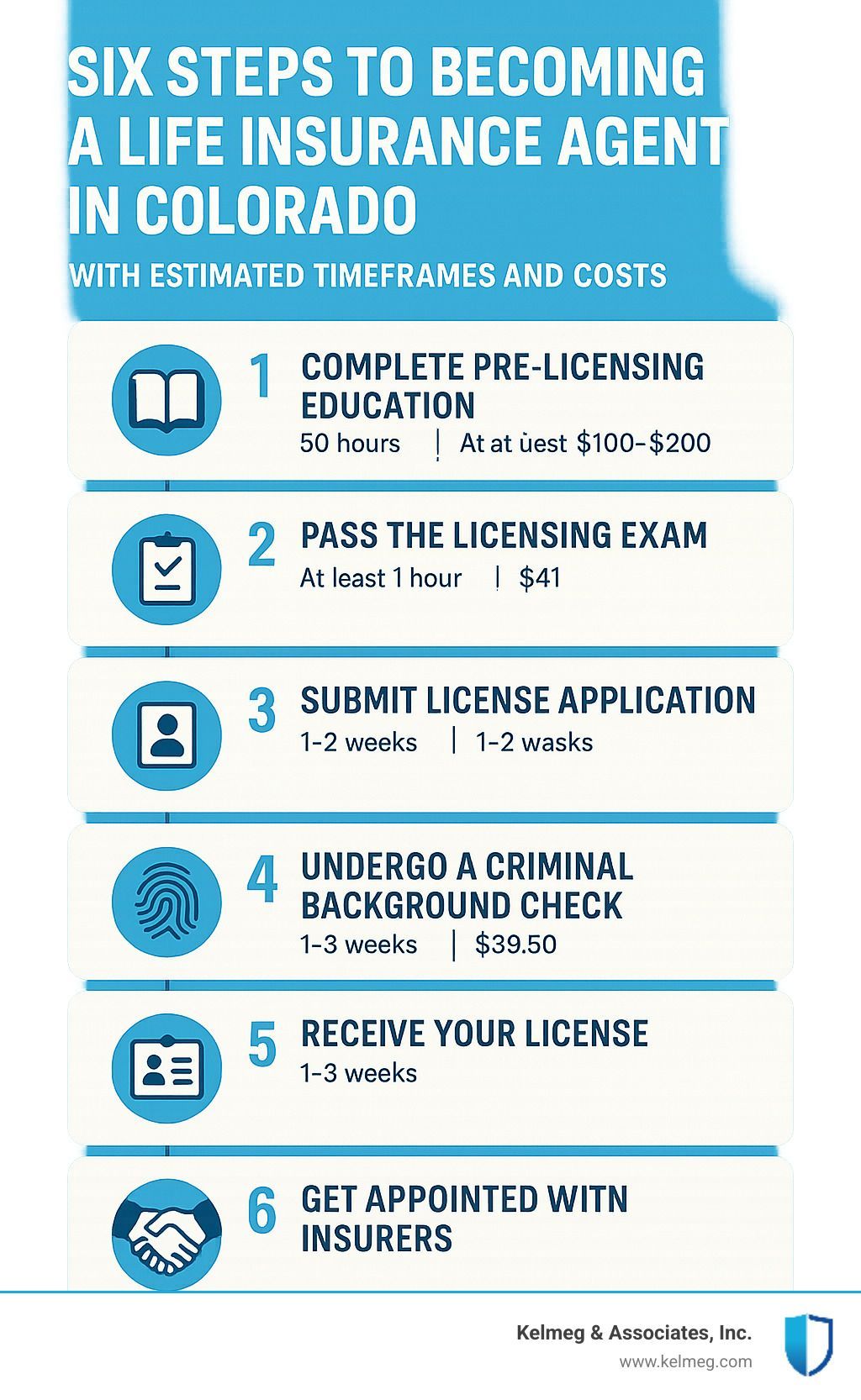
Licensing regulations for life insurance agents are established at the state level in accordance with guidelines from the National Association of Insurance Commissioners (NAIC). Below is the practical timeline and financial capital required to initiate a career.
- Pre-Licensing Course ($100 - $300)
- State Exam & Fingerprints ($80 - $150)
- State License Application ($50 - $200)
- Carrier Appointments & E&O ($500 - $1,000/yr)
Step 1: Complete Pre-Licensing Education
Most states require applicants to complete a state-approved pre-licensing education course covering insurance concepts, contract law, policy provisions, and state-specific regulations.
- Format: Online self-paced or classroom instruction.
- Duration: Typically 20 to 40 study hours.
- Cost: $100 to $300 depending on the provider.
Step 2: Pass the State Licensing Exam
After completing pre-licensing requirements, candidates must schedule and pass the state Life Insurance examination administered by testing centers such as Prometric or Pearson VUE.
- Passing Score: Typically 70% or higher.
- Exam Fee: $50 to $100 per attempt.
Step 3: Complete Background Checks and State Licensing Application
Insurance agents are trusted with confidential financial information and client funds. States require fingerprinting and a formal criminal background check prior to granting a license.
- Fingerprinting & Background Fee: $40 to $70.
- State Application Fee: $50 to $200 (varies by state).
Step 4: Secure Errors & Omissions (E&O) Insurance and Carrier Appointments
Before writing business, licensed agents must secure Errors and Omissions liability insurance to protect against professional liability claims. Once insured, the agent submits background credentials to insurance carriers to obtain formal appointments—the legal authorization from a carrier to sell their specific products.
- E&O Insurance Cost: $500 to $1,000 per year (often payable monthly at $40 to $80/month).
Frequently Asked Questions
How long does it take for a new life insurance agent to start earning money?
A newly licensed agent can close their first policy within 1 to 2 weeks after receiving carrier appointments. Because carriers typically advance commissions within 24 to 48 hours of policy issuance, initial commission checks can arrive within 30 days of beginning active sales effort.
What is a chargeback in life insurance sales, and how do agents avoid it?
A chargeback occurs when a policyholder cancels or surrenders their policy during the early months (typically months 1 through 12). When this happens, the insurance carrier reclaims the unearned portion of the advanced commission from the agent's future earnings. Agents mitigate chargebacks by conducting thorough financial needs analyses, ensuring policy premiums fit the client's budget, and maintaining regular communication with clients during the first year.
Is life insurance sales a 100% commission job?
Most life insurance agent roles are 100% commission-based, operating under 1099 independent contractor status or 100% commission W-2 employee status. However, some captive agencies offer a temporary base salary, a training draw, or a subsidy during the first 6 to 24 months to help new agents transition into full commission structures.
What is the Million Dollar Round Table (MDRT), and how do agents qualify?
The Million Dollar Round Table (MDRT) is an independent global association of life insurance and financial services professionals. Qualification is based on achieving a high volume of paid commission or premium income within a single calendar year. Members gain access to advanced professional education, peer networking, and global industry recognition.
Do life insurance agents need a college degree?
No, a college degree is not legally required to become a licensed life insurance agent in the United States. State licensing depends on completing pre-licensing education, passing the state licensing exam, and clearing a criminal background check. However, degrees in finance, business management, or communications can be advantageous for agents working in advanced estate planning and executive benefit markets.
Recommended Next Steps for Prospective Agents
To evaluate whether a career in life insurance sales aligns with your financial targets and risk tolerance:
- Assess Your Capital Reserves: If pursuing an independent agency contract, secure 3 to 6 months of living expenses plus $2,000 to $5,000 in startup capital for licensing, E&O insurance, software, and marketing/leads.
- Evaluate Contracting Models: Interview both captive agencies (focusing on structured training and office infrastructure) and independent FMOs/IMOs (focusing on high commission contracts, ownership of renewals, and lead generation systems).
- Review State Licensing Requirements: Check the official website of your state's Department of Insurance to verify specific pre-licensing education hours, examination fees, and background check procedures.
- Inspect Contractual Terms: Prior to signing an agency agreement, review contract clauses governing renewal vesting schedules, commission advance terms, and non-solicitation restrictions.
Image Gallery