How Ecommerce Fraud Detection Works: Technical Architecture and Process
E-commerce fraud detection works by evaluating transactional data, user behavioral cues, device fingerprints, and contextual history in real time. Automated fraud prevention engines use machine learning models and customizable risk rul...
E-commerce fraud detection works by evaluating transactional data, user behavioral cues, device fingerprints, and contextual history in real time. Automated fraud prevention engines use machine learning models and customizable risk rules to score incoming payments, instantly approving legitimate purchases, blocking high-risk transactions, or routing suspicious orders to human analysts for manual review.
Contents
The E-Commerce Fraud Threat Landscape
Online merchants face continuous financial and operational risks from fraudulent transactions. Unlike traditional physical retail, where a payment card is physically presented, online store transactions rely on Card-Not-Present (CNP) payment processing. This fundamental distance between the buyer and the payment processing infrastructure creates exploitation vectors for bad actors.
Understanding how fraud detection works requires recognizing the specific attack vectors merchants defend against:
- Payment Fraud / Stolen Credentials: Fraudsters purchase lists of compromised credit card numbers, CVVs, and personal identifying information (PII) from dark web markets to make unauthorized purchases.
- Account Takeover (ATO): Attackers gain control of valid customer accounts using credential stuffing, phishing, or brute-force scripts. Once inside, they use stored payment methods or loyalty points to complete fraudulent orders.
- Friendly Fraud (First-Party Fraud): A legitimate account holder makes an online purchase but subsequently claims they never received the item or did not authorize the transaction, filing a chargeback with their issuing bank to secure a refund while retaining the merchandise.
- Promotion and Refund Abuse: Malicious users exploit merchant promotional systems, multi-accounting tactics, or policy loopholes to repeatedly gain discounts, referral rewards, or illegitimate cash refunds.
- Triangulation Fraud: Cybercriminals create fake online storefronts listing real items at steep discounts. When an unsuspecting buyer orders from the fake shop, the fraudster collects the customer's cash and uses a stolen payment card to buy the product from a legitimate merchant, routing shipping directly to the buyer.
When fraud succeeds, merchants bear far more than the lost inventory cost. They face financial chargeback fees from payment gateways, increased interchange fees, administrative overhead, and potential processing penalties or gateway termination if chargeback ratios exceed strict card brand thresholds (typically 0.9% to 1.5% of total volume).
Core Components of Modern Fraud Detection Infrastructure
To evaluate transactions in the fractions of a second between a customer clicking "Place Order" and payment authorization, modern fraud detection systems integrate several technical layers.
- Checkout Initiated
- Data Ingestion Layer
- Device Fingerprint
- IP & Geolocation
- Behavioral Signals
- Payment Token & BIN
- Analytical Processing Engine
- Static & Dynamic Rules
- Machine Learning Scoring
- Network Graph Analytics
- Decisioning Engine
- Approve (Pass)
- Challenge (3DS2)
- Review (Manual Queue)
- Decline (Block)
1. Data Ingestion and Telemetry Signals
The fraud detection engine gathers signals across four distinct categories before and during checkout execution:
- Device Fingerprinting: JavaScript snippets embedded on the checkout page collect client-side configuration parameters, including browser version, screen resolution, rendering traits, installed fonts, battery status, WebGL signatures, time zone, and language settings. This combination creates a unique hash that identifies a specific device, even if the user clears cookies or switches browser sessions.
- IP and Network Telemetry: The engine evaluates the origin IP address, cross-referencing it against database tables maintained by regional Internet registries to determine if the user relies on commercial data centers, known VPNs, Tor exit nodes, residential proxies, or bulletproof hosting providers.
- Behavioral Biometrics: Systems track micro-interactions across the web session, such as mouse movement trajectories, typing cadences, touch-screen gesture pressure, and clipboard paste actions. High-velocity automated scripts or botnets display rigid, non-human behavioral curves, whereas humans exhibit organic navigation variance.
- Payment and Identity Metadata: The payment processing stack retrieves Bank Identification Number (BIN) data, which reveals card brand, funding type (credit, debit, prepaid), and card issuing bank location. This information is instantly compared against the customer's provided billing and shipping address inputs.
2. Rule Engines vs. Machine Learning Models
Fraud detection systems merge deterministic rule engines with probabilistic machine learning engines to maximize detection accuracy.
- Rule Engines: Static or dynamic logical statements constructed by risk teams (e.g., IF Order Value > $500 AND Shipping Country != Billing Country AND IP = Proxy THEN Action = Challenge). Rule engines are highly predictable and instantly updated, but they struggle to adapt to sophisticated, multi-variable attack patterns without generating high numbers of false positives.
- Machine Learning (ML) Inference: Supervised machine learning algorithms (such as XGBoost, Random Forests, and Neural Networks) are trained on millions of historical labeled transactions containing past chargebacks and verified legitimate orders. These models calculate complex multi-dimensional feature interactions to output a aggregate risk score between 0 and 1,000 in real time. Unsupervised models (such as isolation forests) work alongside supervised engines to flag novel statistical anomalies without prior training data.
3. Velocity and Entity Linking Engines
Single transactions often look benign when analyzed in isolation. Velocity engines track key transactional counters across flexible sliding time windows (e.g., 5 minutes, 1 hour, 24 hours). If a single payment card is attempted across five distinct email addresses within ten minutes, or if twenty transactions originate from the same subnet within an hour, velocity counters trigger immediate blocks.
Entity linking uses graph database architectures to identify shared attributes—such as common device fingerprints, shipping addresses, phone numbers, or IP subnets—connecting seemingly unrelated accounts into coordinated fraud ring clusters.
Step-by-Step Execution Lifecycle of Fraud Detection
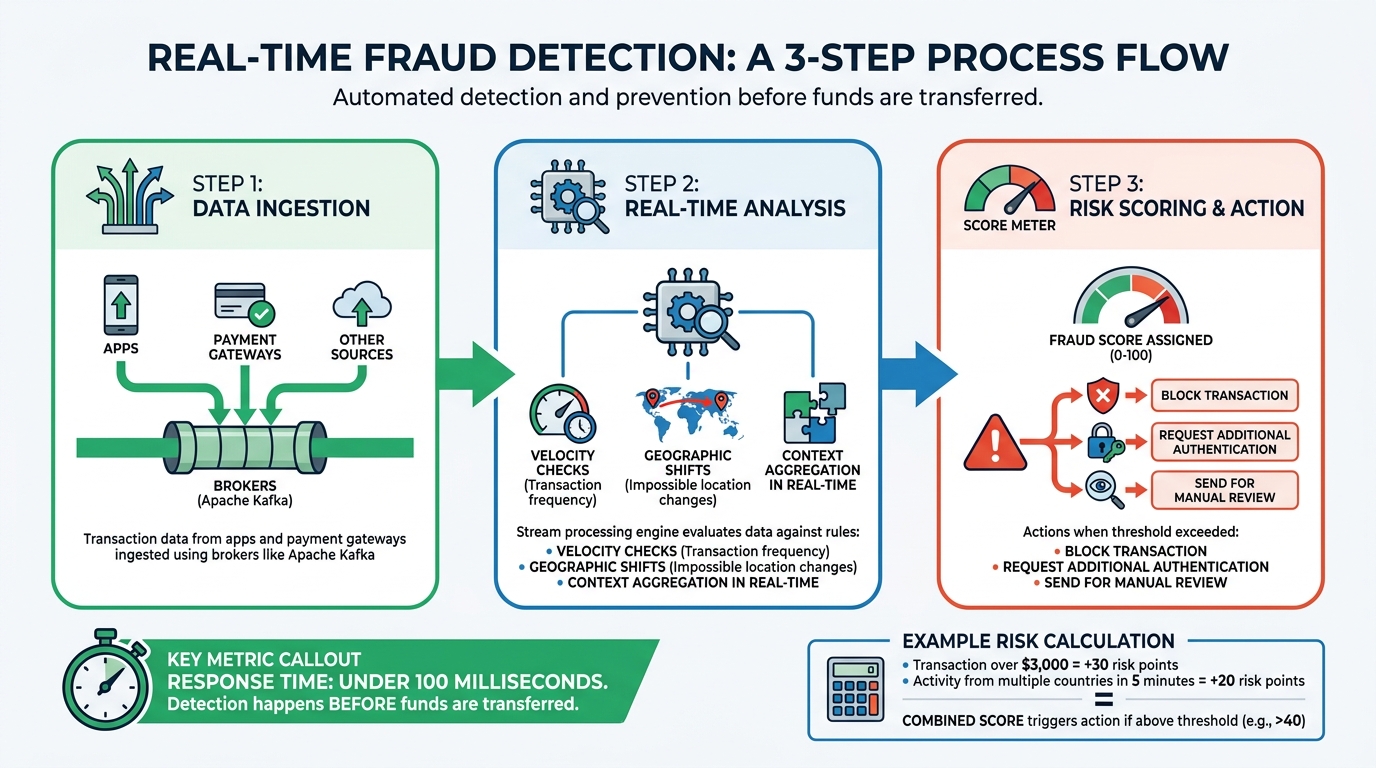
When a customer submits an order on an e-commerce platform, the payment gateway and fraud detection layer execute a rapid sequence of validation operations before money changes hands.
Step 1: Pre-Authorization Signal Collection
As the customer fills out their checkout fields, background scripts capture browser environment vectors and telemetry data. The payload is encrypted and forwarded via API call to the fraud engine alongside item details, basket value, and merchant identifiers.
Step 2: Verification Protocol Checks
The merchant platform or payment gateway issues requests to external payment verification services:
- Address Verification Service (AVS): Compares the numerical digits of the billing street address and postal code against the information on file with the card issuer, returning standardized response codes (e.g., Full Match, Partial Match, No Match).
- Card Verification Value (CVV/CVC): Checks the three-digit or four-digit code entered against the card network database.
- BIN Routing & Velocity Check: Queries internal memory caches to determine if the card, IP, or email account has exceeded rate limits.
Step 3: Feature Extraction and Machine Learning Scoring
The fraud engine converts raw inputs into hundreds of mathematical features, such as distance between IP location and billing address, transaction value relative to historical user average, and time spent on page before checkout. These features feed into the machine learning inference engine, generating an aggregate risk score.
Step 4: Decision Execution
The business decisioning engine compares the transaction's overall risk score against pre-configured risk tolerances:
- Low Risk (Approve): The order bypasses additional friction and routes immediately to payment authorization and order fulfillment.
- Medium Risk (Challenge via 3D Secure): The system invokes 3D Secure 2.0 (3DS2) protocol. This prompts the buyer to complete multi-factor authentication (MFA), such as entering a one-time passcode (OTP) delivered via push notification or SMS from their issuing bank.
- High Risk (Manual Review Queue): The order funds are reserved or pre-authorized, but fulfillment is paused. The order routes to an internal team of risk analysts who evaluate background details, call the customer, or review public records.
- Critical Risk (Decline / Block): The payment request is dropped or declined instantly, stopping authorization attempts before transaction processing fees accumulate.
Step 5: Post-Transaction Monitoring and Feedback Loops
Fraud detection is an iterative, closed-loop process. If an order passes all fraud checks but later results in a bank chargeback notification, the transaction details are tagged as fraudulent. This labeled record feeds directly back into model retraining pipelines, teaching the machine learning architecture to identify similar attack patterns in future order streams.
Technical Comparison of Detection Methodologies
The following table compares the operational characteristics, underlying mechanisms, strengths, and inherent limitations of key e-commerce fraud detection technologies:
| Detection Technology | Primary Mechanism | Primary Benefit | Operational Limitation |
|---|---|---|---|
| Deterministic Rule Engines | Boolean logic statements (IF/THEN conditionals) set by human risk analysts. | Fully transparent, easy to audit, and offers immediate execution control. | Fails to scale; creates complex rule bloat and high false decline rates over time. |
| Supervised Machine Learning | Statistical classifiers trained on historical chargeback data sets. | Scales effortlessly; detects complex non-linear pattern interactions automatically. | Requires large volumes of labeled historical transaction data to remain accurate. |
| Device Fingerprinting | JavaScript and browser API calls capturing hardware and OS parameters. | Uncovers bot activity, headless browsers, and recurring device identities. | Advanced attackers bypass detection using antidetect browsers and proxy routing. |
| Behavioral Biometrics | Client-side tracking of typing speed, cursor telemetry, and device angle metrics. | Distinguishes automated scripts from human interactions transparently. | Requires JavaScript support and may yield variable results across specialized hardware. |
| 3D Secure 2.0 (3DS2) | Protocol transmitting merchant data directly to card issuers via EMVCo specs. | Shifts chargeback liability from merchant to card issuer for verified transactions. | Introduces step-up user friction, which can decrease checkout conversion rates. |
Navigating False Declines and Latency Realities
Evaluating fraud engines requires balancing transaction security against customer experience metrics. Tightening risk thresholds eliminates chargebacks, but it risks creating false positives (also known as false declines)—rejecting legitimate purchases made by valid customers.
The True Cost of False Declines
False declines carry severe long-term financial consequences for e-commerce brands:
- Immediate Lost Revenue: The business forfeits the gross merchandise value of the current shopping cart.
- Customer Lifetime Value (LTV) Erosion: Industry research shows that a significant percentage of legitimate consumers will not return to a merchant store after experiencing an unexpected payment rejection.
- Acquisition Cost Waste: Marketing dollars spent driving high-intent shoppers to the checkout yield zero return when the payment engine erroneously blocks valid transactions.
Effective fraud engines optimize for Precision (ratio of true fraud blocks to total blocks) and Recall (ratio of detected fraud to total actual fraud), keeping false positive ratios low without exposing the enterprise to excessive loss.
Operational Latency Demands
Modern online shoppers expect frictionless checkout experiences. E-commerce platforms typically limit processing window budgets for fraud scoring APIs to under 300 milliseconds. If a fraud detection infrastructure exceeds this execution window, page response times lag, leading to cart abandonment. To operate within these constraints, fraud engines rely on high-throughput, low-latency microservices, edge data caching, and asynchronous model processing.
Best Practices for Implementing E-Commerce Fraud Prevention
E-commerce businesses structuring their risk mitigation frameworks should pursue an integrated strategy combining technology, governance, and process design:
- Implement 3D Secure 2.0 Strategically: Use dynamic 3DS2 routing instead of applying step-up authentication to all checkout attempts. Reserve interactive authentication challenges exclusively for orders flagged as elevated risk by the underlying machine learning model, allowing low-risk customers a seamless, frictionless path.
- Combine Signals via Unified APIs: Avoid relying on a single verification vector. Combine payment verification protocols (AVS, CVV) with modern device intelligence and behavioral profiling to build holistic risk assessments.
- Establish Continuous Retraining Pipelines: Update machine learning weights continuously using clean, updated chargeback data to account for seasonal purchasing spikes, shifting consumer patterns, and emerging fraud tactics.
- Monitor Velocity Metrics Continuously: Configure automated monitoring thresholds to flag sharp surges in authorization attempt failures, card testing patterns, or localized geographic delivery anomalies.
- Audit Rules Quarterly: Regularly sunset outdated, redundant static rules that generate false positives without catching modern fraud patterns.
Frequently Asked Questions
What is the difference between static rules and machine learning in fraud detection?
Static rules apply rigid, hard-coded conditions (such as blocking all orders over a specific dollar limit) created directly by human risk analysts. Machine learning models analyze hundreds of variable relationships dynamically, learning complex risk patterns from historical data to assign nuanced probabilities to each order automatically.
How does device fingerprinting detect returning fraudsters?
Device fingerprinting queries background software, hardware, and screen characteristics to generate a distinct alphanumeric hash representing a client device. Even if an attacker clears browser cookies, changes user account credentials, or uses private browsing windows, the underlying device fingerprint remains consistent, allowing systems to connect the session to past malicious actions.
What role does 3D Secure 2.0 play in modern fraud mitigation?
3D Secure 2.0 (3DS2) provides an authentication framework created by major card networks that allows merchants to share contextual transaction data directly with issuing banks. If the issuing bank verifies the customer's identity—either background data matching or through an interactive verification code—liability for potential fraudulent chargebacks shifts from the merchant to the card issuer.
Why do legitimate orders sometimes get declined for fraud?
Legitimate orders are declined when a customer's purchasing pattern accidentally matches risk indicators designed to stop bad actors. Common causes include placing purchases while connected to commercial VPNs, shipping items to addresses far from the billing location, making unusually large purchases outside normal spending behavior, or mistyping address details that fail Address Verification Service (AVS) checks.
What is the difference between chargeback guarantees and self-managed fraud tools?
Chargeback guarantee providers score transactions and assume full financial liability for any fraudulent orders they mistakenly approve, charging a percentage fee per transaction for this risk transfer. Self-managed fraud detection platforms provide risk-scoring infrastructure, data tools, and policy control to the merchant, leaving the ultimate decision logic and chargeback liabilities under the merchant's operational control.
Implementation Checklist and Practical Next Steps
To deploy an optimized e-commerce fraud prevention strategy, organizations should follow a structured evaluation methodology:
- Audit Current Chargeback and False Decline Metrics: Calculate your current chargeback rate (chargeback volume divided by total volume) and false decline ratio to establish a performance baseline.
- Map Transaction Flow Vulnerabilities: Identify where fraud enters your sales funnel—whether through new account creation, card testing scripts at guest checkout, or promotion mechanics.
- Evaluate Vendor Architecture: Select a modern fraud detection engine that provides low API latency (<300ms), native integration with your primary e-commerce platform and payment gateways, flexible policy customization, and explainable machine learning outputs.
- Implement Dynamic Challenge Workflows: Integrate flexible 3DS2 challenge flows so that step-up authentication friction targets only high-risk payment attempts.
- Establish Periodic Performance Reviews: Review manual queue resolution accuracy, monitor vendor model drift, and prune legacy manual rules on a quarterly basis.
Image Gallery