The Phases of the Calvin Cycle: How Plants Convert Light Energy into Sugar
The Calvin cycle is a series of biochemical redox reactions that take place in the stroma of chloroplasts, converting carbon dioxide and water into organic compounds like glucose. It utilizes the chemical energy (ATP and NADPH) generat...
The Calvin cycle is a series of biochemical redox reactions that take place in the stroma of chloroplasts, converting carbon dioxide and water into organic compounds like glucose. It utilizes the chemical energy (ATP and NADPH) generated during the light-dependent reactions to "fix" inorganic carbon into a stable, energy-rich sugar molecule.
Contents
Photosynthesis is often simplified as a single step, but it is actually divided into two distinct yet interdependent stages. The first stage, the light-dependent reactions, captures solar energy to create temporary energy carriers. The second stage, known as the Calvin cycle (or the light-independent reactions), is the "synthesis" part of photosynthesis. As of 2026, our understanding of these pathways has become even more critical as scientists work to engineer crops that can better withstand fluctuating carbon levels in the atmosphere. To understand how a plant builds itself from thin air, one must look closely at the three specific phases of the Calvin cycle: carbon fixation, reduction, and regeneration.
The Prerequisites: Energy from the Light Reactions
Before the Calvin cycle can begin, the plant must first successfully complete the light-dependent reactions. These occur within the thylakoid membranes of the chloroplast. During this phase, chlorophyll absorbs photons, triggering an electron transport chain that results in the production of two vital molecules: Adenosine Triphosphate (ATP) and Nicotinamide Adenine Dinucleotide Phosphate (NADPH).
ATP serves as the primary energy currency, providing the "fuel" needed to drive endergonic (energy-absorbing) reactions. NADPH provides the high-energy electrons necessary for reducing carbon dioxide into sugar. While the Calvin cycle is often called the "dark reaction," this is a slight misnomer. It does not require darkness; rather, it does not directly require light. However, it is highly dependent on the products of the light reactions. Without a constant supply of ATP and NADPH, the Calvin cycle grinds to a halt, which is why plants generally perform this process during daylight hours.
Phase 1: Carbon Fixation
The first phase of the Calvin cycle is known as carbon fixation. This is the process of taking inorganic carbon (CO₂) from the atmosphere and "fixing" it into an organic molecule. This phase is dominated by one of the most important enzymes on Earth: Ribulose-1,5-bisphosphate carboxylase/oxygenase, commonly known as RuBisCO.
In the stroma, a five-carbon sugar named Ribulose-1,5-bisphosphate (RuBP) serves as the starting point. RuBisCO catalyzes a reaction between RuBP and a molecule of CO₂. This fusion creates an extremely unstable six-carbon intermediate. Because of its instability, this six-carbon molecule immediately splits into two molecules of a three-carbon compound called 3-phosphoglycerate (3-PGA).
For every three molecules of CO₂ that enter the cycle, three molecules of RuBP are used, resulting in six molecules of 3-PGA. This specific step is the bridge between the inorganic world and the biological world. RuBisCO is famously slow and occasionally makes mistakes—sometimes grabbing oxygen instead of carbon dioxide in a wasteful process called photorespiration—but its role in carbon fixation is the foundation of almost all food chains.
Phase 2: Reduction
Once the carbon is fixed into the 3-PGA format, it must be energized and reduced to create an actual sugar. This occurs in the second phase, known as reduction. This stage is where the energy harvested from sunlight is officially "deposited" into the carbon molecules.
The reduction phase involves two primary chemical steps:
- Phosphorylation: Each molecule of 3-PGA receives a phosphate group from ATP (the ATP produced in the light reactions). This converts 3-PGA into 1,3-bisphosphoglycerate.
- Reduction: NADPH then donates two electrons to each 1,3-bisphosphoglycerate molecule. This process also causes the molecule to lose a phosphate group, transforming it into a three-carbon sugar called Glyceraldehyde-3-phosphate (G3P).
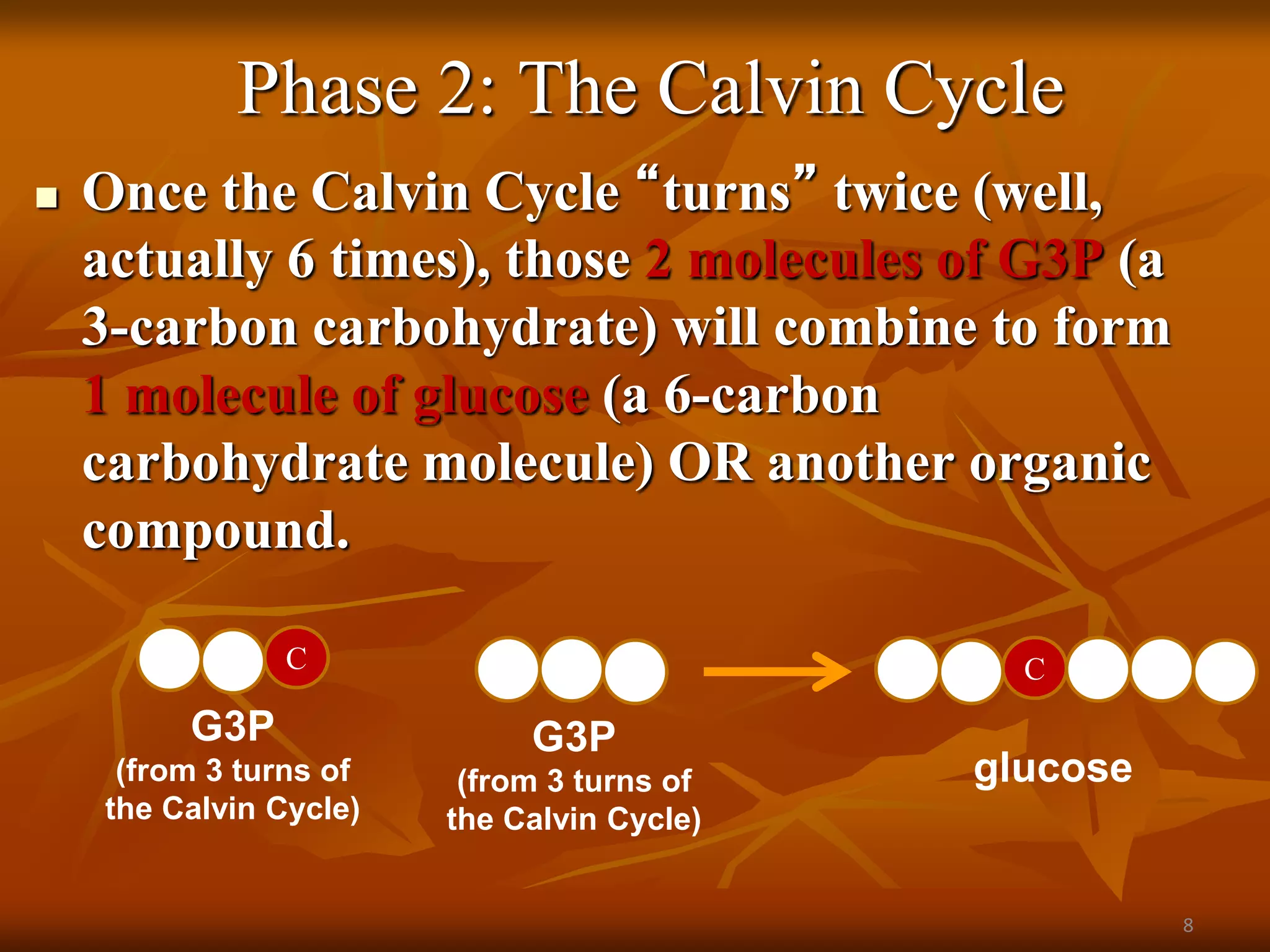
G3P is a high-energy molecule and is the true "product" of the Calvin cycle. While we often say plants make glucose, they actually make G3P first. For every three CO₂ molecules that enter the cycle, six G3P molecules are produced. However, only one of these G3P molecules exits the cycle to be used by the plant to make glucose, starch, or cellulose. The other five G3P molecules must remain in the cycle to ensure the process can continue.
Phase 3: Regeneration of RuBP
The final phase of the Calvin cycle is the regeneration of RuBP. Without this step, the plant would quickly run out of the five-carbon "acceptor" molecules needed to fix more CO₂, and the entire system would fail.
Regenerating RuBP is a complex "molecular dance." The five G3P molecules that did not exit the cycle (totaling 15 carbons) are rearranged through a series of reactions into three molecules of RuBP (also totaling 15 carbons). This rearrangement is not spontaneous; it requires further energy in the form of three additional ATP molecules.
Once the RuBP is regenerated, the cycle is ready to receive more carbon dioxide. This cyclical nature is what makes photosynthesis so efficient at continuous production. It allows the plant to sustain itself using a recycled pool of carbon-acceptor molecules, requiring only a constant influx of CO₂, water, and sunlight-derived energy.
Summarizing the Calvin Cycle Stoichiometry
To understand the scale of this process, it is helpful to look at the "math" required to produce a single sugar precursor. Because glucose is a six-carbon sugar ($C_6H_{12}O_6$), the cycle must technically turn six times (fixing six CO₂ molecules) to produce the equivalent of one glucose molecule.
| Feature | Phase 1: Fixation | Phase 2: Reduction | Phase 3: Regeneration |
|---|---|---|---|
| Primary Enzyme | RuBisCO | N/A (Multiple enzymes) | RuBP kinase |
| Input (per 3 CO₂) | 3 RuBP + 3 CO₂ | 6 ATP + 6 NADPH | 3 ATP |
| Primary Intermediate | 3-PGA | 1,3-bisphosphoglycerate | G3P (recycled) |
| Output | 6 molecules of 3-PGA | 6 G3P (1 exits, 5 stay) | 3 RuBP (regenerated) |
| Energy Consumption | None | High (ATP & NADPH) | Moderate (ATP) |
The Output: From G3P to Glucose and Beyond
The G3P that exits the Calvin cycle is the building block for all other organic molecules in the plant. While G3P can be converted into glucose ($C_6H_{12}O_6$) via gluconeogenesis, it is also used to create:
- Sucrose: The transport sugar moved through the phloem to power roots and developing fruits.
- Starch: The long-term energy storage molecule found in seeds and tubers (like potatoes).
- Cellulose: The structural component of cell walls, providing the rigidity that allows plants to grow tall.
- Lipids and Amino Acids: By adding nitrogen, sulfur, and other minerals, the plant uses the carbon skeleton of G3P to build proteins and fats.
Evolutionary Adaptations: C4 and CAM Pathways
While the standard Calvin cycle (C3 photosynthesis) is effective, it is not always efficient in hot or dry environments due to photorespiration. In 2026, research into C4 and CAM plant pathways is vital for agricultural security in warming climates.
- C4 Plants: Plants like corn and sugarcane physically separate the initial carbon fixation from the Calvin cycle. They fix CO₂ into a four-carbon compound in mesophyll cells and then pump it into bundle-sheath cells where the Calvin cycle occurs. This ensures RuBisCO is always surrounded by high concentrations of CO₂, minimizing oxygen interference.
- CAM Plants: Succulents and pineapples fix carbon only at night when it is cooler, storing it as an acid. During the day, they close their stomata to conserve water and release the stored CO₂ into the Calvin cycle.
Frequently Asked Questions
Does the Calvin cycle happen at night?
The Calvin cycle does not require light directly, but it relies on the ATP and NADPH produced during the day. In most plants, the cycle slows down significantly or stops at night because the supply of these energy carriers is depleted. Only CAM plants have specialized adaptations to fix carbon at night.
Why is RuBisCO considered inefficient?
RuBisCO is considered inefficient because it can bind with oxygen instead of carbon dioxide. When it binds with oxygen, it initiates photorespiration, which consumes energy and releases CO₂ without producing sugar. This "mistake" happens more frequently at higher temperatures, which is why heat stress reduces crop yields.
How many molecules of ATP are used to make one glucose?
To produce one molecule of glucose, the Calvin cycle must fix six molecules of CO₂. This requires 18 molecules of ATP and 12 molecules of NADPH. This high energy cost explains why plants require so much sunlight to thrive and grow.
Where exactly does the Calvin cycle take place?
The Calvin cycle takes place in the stroma, which is the fluid-filled space surrounding the thylakoid stacks (grana) inside the chloroplast. This location allows it easy access to the ATP and NADPH generated at the thylakoid membrane.
What happens if a plant doesn't get enough CO₂?
If CO₂ levels are too low, the Calvin cycle cannot proceed through the fixation phase. RuBisCO may begin to fix oxygen instead, leading to photorespiration. This is why many greenhouses supplement their air with additional CO₂ to stimulate faster growth and higher yields.
Practical Recommendation for 2026
For those studying plant physiology or managing agricultural systems in 2026, it is essential to monitor environmental factors that influence Calvin cycle efficiency. Maintaining optimal hydration and providing shade during extreme heat can reduce the rates of photorespiration by keeping stomata open and reducing the oxygen-to-carbon ratio within the leaf. For students, focusing on the relationship between the "energy-harvesting" light reactions and the "sugar-building" Calvin cycle is key to mastering the topic of bioenergetics.
Image Gallery