Essential Forms for Work Incident Reporting and Workers' Compensation Claims
To initiate a workers' compensation claim in 2026, you must complete three primary documents: an internal Employer Incident Report, a state-mandated Employee’s Claim Form (such as a DWC-1 or C-3), and a Medical Release Authorization. T...
To initiate a workers' compensation claim in 2026, you must complete three primary documents: an internal Employer Incident Report, a state-mandated Employee’s Claim Form (such as a DWC-1 or C-3), and a Medical Release Authorization. These forms collectively document the injury, establish a legal timeline, and permit the review of relevant health records.
Contents
Navigating the administrative requirements of a workplace injury can be daunting, particularly while recovering from physical or psychological trauma. However, the accuracy and timeliness of the forms you submit are the most critical factors in determining whether your claim is accepted or denied. Workers’ compensation is a "no-fault" system, but it is also a highly procedural one. Failure to use the specific forms required by your state or federal jurisdiction can result in delayed medical treatments and a temporary cessation of wage-replacement benefits.
The Distinction Between Incident Reporting and Claim Filing
Before gathering paperwork, it is vital to distinguish between a "work incident report" and a "workers' compensation claim form." While they are related, they serve different legal and administrative purposes.
Internal Incident Reports
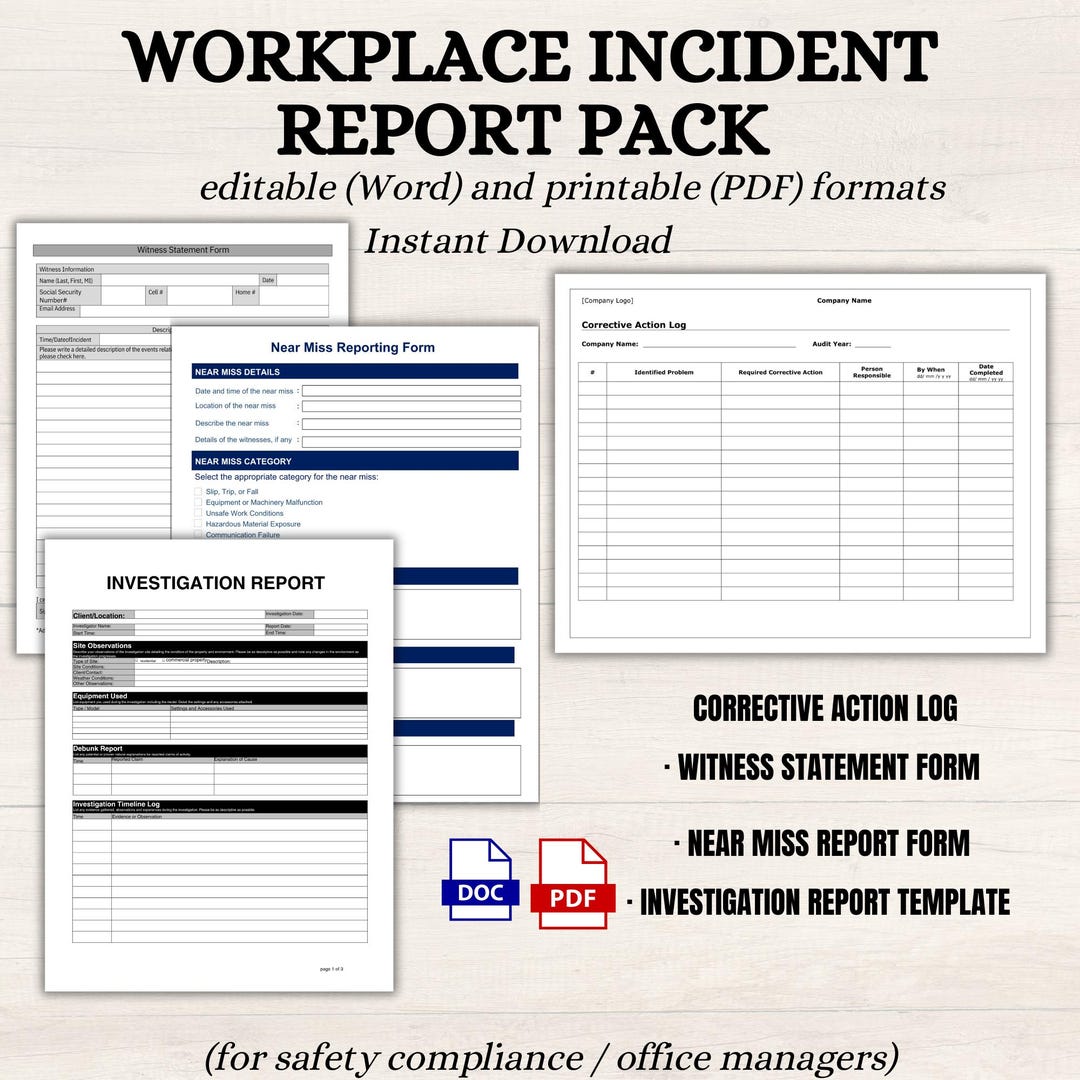
An incident report is typically an internal company document. Its primary purpose is to notify the employer’s safety or HR department that an event occurred—even if no injury was immediately apparent. In 2026, most mid-to-large-sized enterprises utilize digital safety management systems where supervisors input the time, location, witnesses, and nature of the event. This document is essential for the employer’s compliance with Occupational Safety and Health Administration (OSHA) standards but does not, by itself, initiate a request for financial benefits.
Formal Workers' Compensation Claim Forms
A claim form is a legal document filed with the state’s workers’ compensation board or commission. This form is what officially triggers the insurance carrier’s obligation to investigate the case, pay for medical bills, and provide disability payments. If you only fill out an internal incident report but never file the state-specific claim form, you may find yourself barred from benefits once the statutory "statute of limitations" expires.
Essential Forms for Every Workplace Injury
While specific form numbers vary by jurisdiction, the following categories of documentation are universally required across the United States.
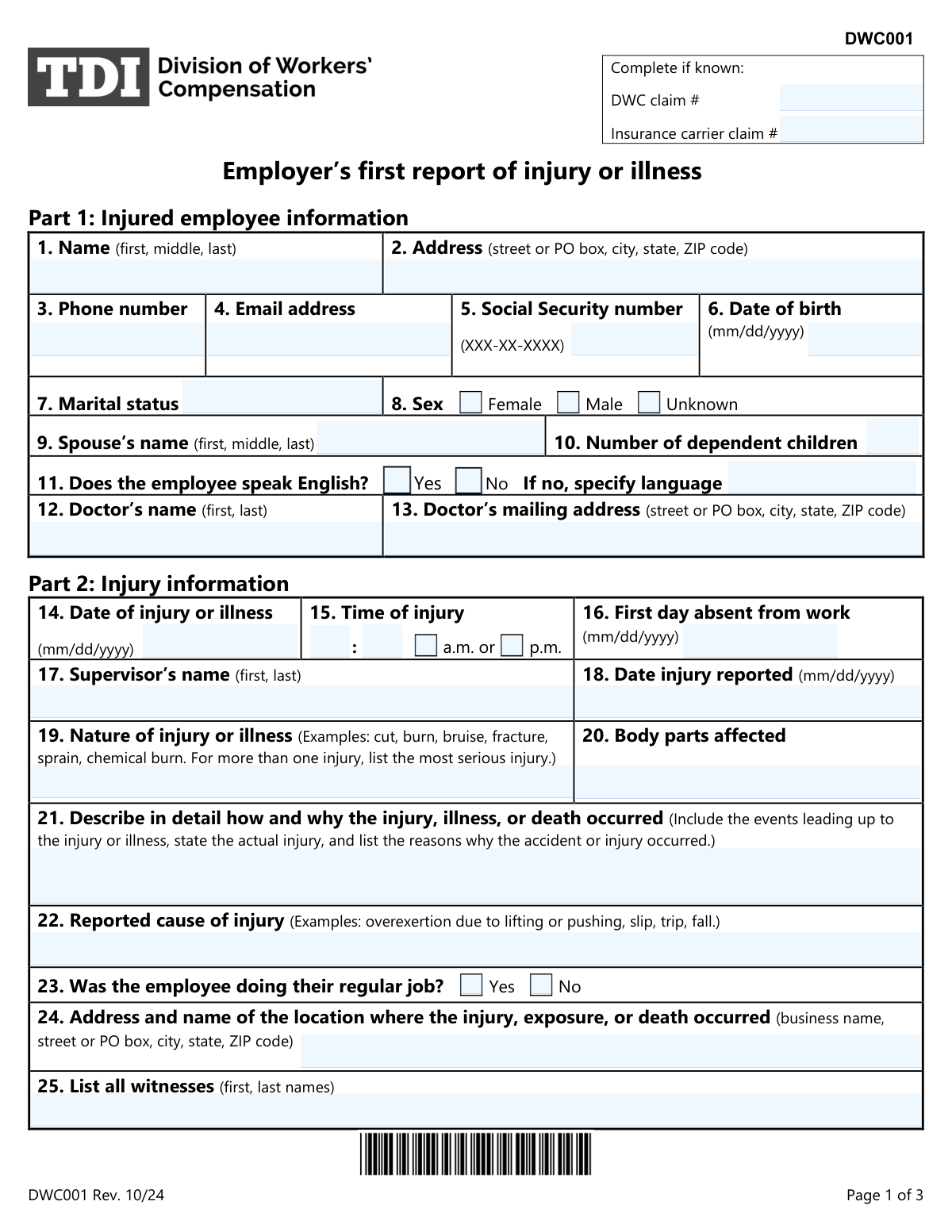
1. The Employee’s First Report of Injury (The Claim Form)
This is the most critical document. In California, this is the DWC-1; in New York, it is the C-3; and for federal employees, it is the CA-1 (for traumatic injuries) or CA-2 (for occupational diseases).
This form requires:
- Personal Information: Full legal name, social security number, and contact details.
- Incident Specifics: The exact date, time, and physical address where the injury occurred.
- Injury Description: A detailed account of how the injury happened and which specific body parts were affected.
- Witness Information: Names of any coworkers or third parties who saw the event.
2. OSHA 301: Injury and Illness Incident Report
Under federal law, employers must maintain records of serious work-related injuries. The OSHA Form 301 is one of the first forms completed when a "recordable" injury occurs. While the employee may not always see this form, the information provided in the initial incident report is used to populate it. It includes more technical data regarding the equipment involved and the specific task the employee was performing at the moment of impact.
3. Medical Release and HIPAA Waiver
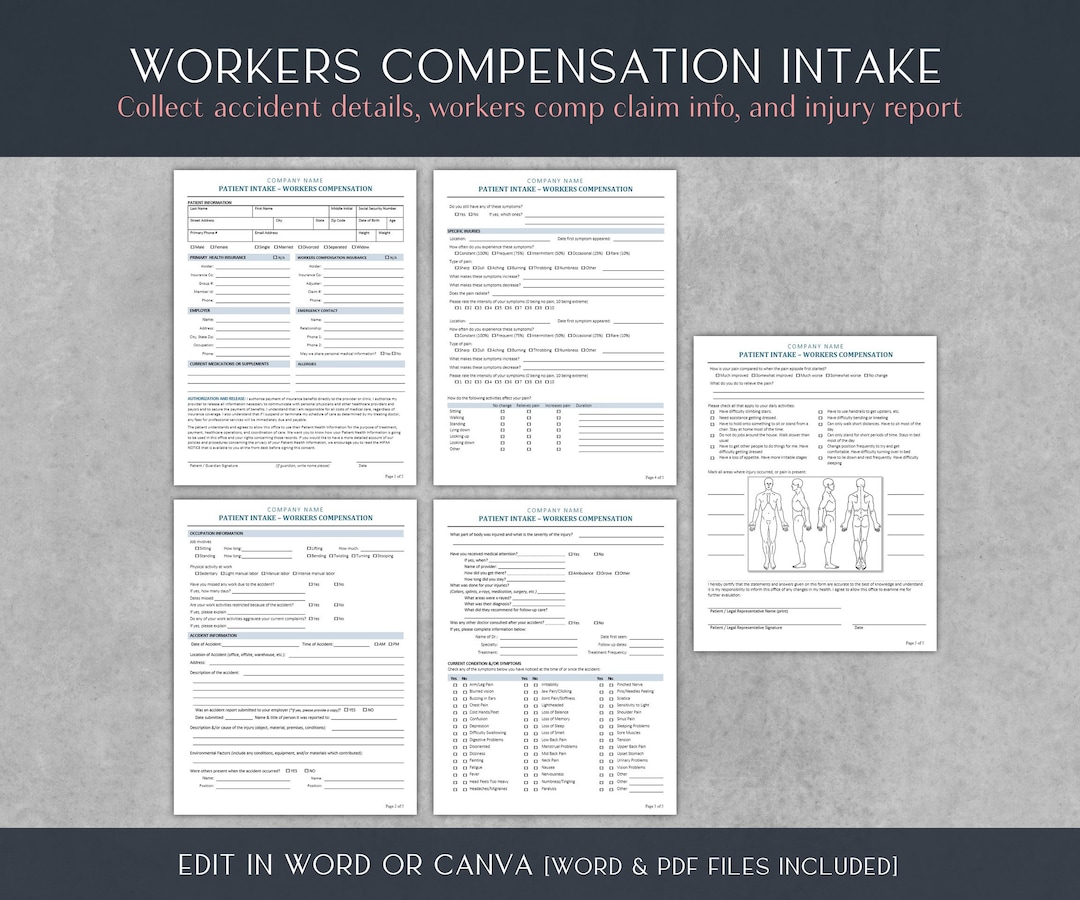
To process a claim, the insurance adjuster must verify the extent of the injury. You will be asked to sign a Form for Authorization to Disclose Health Information. It is important to review these carefully. In 2026, legal standards generally limit these releases to records related only to the body parts injured at work. Signing an overbroad waiver may allow the insurer to dig into unrelated medical history, which can be used to argue that your current condition is "pre-existing."
4. The Attending Physician’s Report (Doctor's First Report)
When you first seek medical attention, the treating physician must complete a specific form—often called a Doctor’s First Report of Occupational Injury or Illness. This form provides the clinical diagnosis, the doctor's opinion on whether the injury is work-related (causation), and "work status" instructions (e.g., whether you can return to full duty, light duty, or must remain off work entirely).
Comparative Overview of Common Workers' Compensation Forms
The following table outlines the most frequent forms encountered during the reporting process. Note that state-specific names may vary.
| Form Category | Common Name/Number | Purpose | Primary Responsibility |
|---|---|---|---|
| Notice of Injury | Form DWC-1 / C-3 | Officially notifies the state and insurer of a claim. | Employee |
| Employer’s Report | Form 301 / FROI | Reports the injury to the state board and insurer. | Employer |
| Medical Evidence | PR-2 / Form C-4 | Provides clinical proof of disability and treatment needs. | Treating Physician |
| Federal Traumatic | Form CA-1 | Specific to federal employees for sudden accidents. | Employee (Federal) |
| Wage Verification | Wage Statement | Calculates the Average Weekly Wage (AWW) for benefits. | Employer / Payroll |
Jurisdiction-Specific Requirements
The "correct" form depends entirely on where you work or where the injury occurred. This is known as jurisdiction.
State-Funded and Private Insurance States
In most states (e.g., Florida, Texas, Illinois), you use forms provided by the state’s Department of Labor or Workers’ Compensation Commission. These are usually available for download on official ".gov" websites. By 2026, nearly all states require these to be submitted via an electronic portal to accelerate the "three-day rule"—the period within which an employer must forward your claim to the insurance carrier.
Federal Employees (FECA)
If you work for the USPS, the TSA, or any federal agency, you do not use state forms. You must use the forms provided by the Office of Workers' Compensation Programs (OWCP) under the Federal Employees' Compensation Act (FECA).
- CA-1: Use this if you tripped, fell, or had a sudden accident today.
- CA-2: Use this if your injury developed over time (e.g., carpal tunnel syndrome or lung disease from chemical exposure).
Longshore and Harbor Workers
If your injury occurred on navigable waters or in maritime loading areas, you may need to file an LS-201 (Notice of Injury or Death) and an LS-203 (Employee's Claim for Compensation) under the Longshore and Harbor Workers' Compensation Act.
Step-by-Step Guide to Completing the Paperwork
- Immediate Verbal Notice: Notify your supervisor immediately. In many jurisdictions, failure to provide notice within 30 days can permanently forfeit your right to benefits.
- Request the Claim Form: Your employer is legally required to provide you with the state’s official claim form within a specific timeframe (usually 24 hours) after you report an injury.
- Detailed Documentation: When filling out the "description of injury," be specific but factual. Instead of writing "hurt my back," write "felt a sharp pop in my lower back while lifting a 50-pound crate of machine parts."
- Submit and Date Stamp: If submitting a paper form, keep a copy for yourself. If submitting electronically in 2026, save the confirmation receipt or "Transaction ID" provided by the state portal.
- Follow Up with Payroll: Ensure your employer completes the Employer's Report of Occupational Injury. The insurance company cannot begin paying disability benefits until they have verified your prior year's earnings to calculate your benefit rate.
Common Obstacles and Troubleshooting
Even with the correct forms, the process can hit snags. One common issue in 2026 is the "Medical-Only" vs. "Indemnity" designation. If your injury only requires a few doctor visits and no time off work, it is a medical-only claim. However, if you miss more than the state-mandated "waiting period" (usually 3 to 7 days), the claim becomes an indemnity claim, requiring additional wage-verification forms.
Another frequent problem is the unclear causation statement. If the doctor’s form does not explicitly state that the injury was "more likely than not" caused by work activities, the insurance carrier will likely issue a "Notice of Controversy" or a "Denial of Claim." In such cases, you may need to request an Independent Medical Examination (IME) or a Qualified Medical Evaluator (QME) report, which involves its own set of specialized forms.
If an employer refuses to provide the necessary forms, you should contact your state’s Workers’ Compensation Board directly. Most boards have an "Ombudsman" or "Information and Assistance" office specifically designed to help unrepresented workers secure the correct paperwork and file independently.
Frequently Asked Questions
What happens if I realize I forgot to list a body part on the initial form?
You should file an "Amended Claim Form" as soon as possible. In 2026, insurance companies are very strict about "expanding the scope" of a claim. If you reported a shoulder injury but later realized your neck was also hurt, failing to update the form quickly can lead to a denial of treatment for the neck.
Do I need a lawyer to help me fill out these forms?
For simple injuries with clear causation, most workers can handle the initial forms themselves. However, if the injury is severe, requires surgery, or if the employer is disputing that the accident happened at work, consulting a legal professional who specializes in workers' compensation is advisable to ensure all procedural deadlines are met.
Is there a fee for filing workers' compensation forms?
No. There is no filing fee for an employee to submit a workers' compensation claim form to the state or their employer. The system is designed to be accessible to all workers regardless of financial status.
How long should I keep copies of these documents?
You should maintain a complete file of all reporting forms, medical reports, and correspondence from the insurance carrier for at least five years after your case is closed. This is crucial in case the injury recurs or you need to reopen the claim for additional medical treatment later.
Can I be fired for asking for these forms?
No. It is illegal for an employer to retaliate against an employee for filing a workers' compensation claim or requesting the forms to do so. Retaliation can lead to separate legal actions and significant penalties for the employer.
Final Recommendation
Your priority should be to secure and submit the official state claim form immediately after an injury. While internal incident reports are helpful for company safety, the state-mandated form is the only document that protects your legal right to medical care and lost wage replacement. Always keep a timestamped copy of every document you sign, and verify that your treating physician has submitted their "First Report" to the insurance carrier to prevent delays in your benefit payments.
Disclaimer: This information is for educational purposes and does not constitute legal advice. Workers' compensation laws vary significantly by jurisdiction and are subject to statutory changes. Consult with a qualified professional for specific legal guidance.
Image Gallery