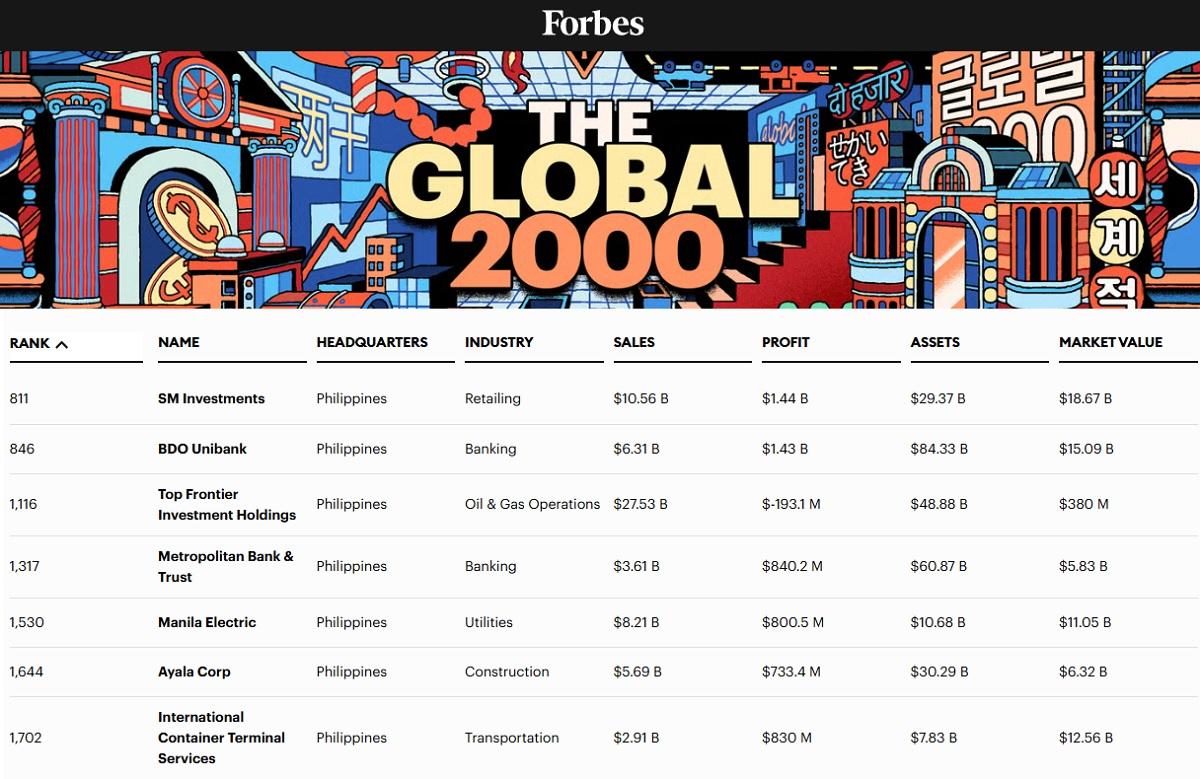
Why the Top 50 Forbes List Beats Other Rankings for Ambitious Investors
For the ambitious investor, the Forbes Top 50 lists—ranging from the World’s Billionaires to the Midas List or the Forbes 500—serve as essential benchmarks that outperform standard market indices or generic industry rankings. These lis...
For the ambitious investor, the Forbes Top 50 lists—ranging from the World’s Billionaires to the Midas List or the Forbes 500—serve as essential benchmarks that outperform standard market indices or generic industry rankings. These lists provide a high-fidelity window into capital allocation trends, identifying the individuals and entities controlling the levers of global economic growth before those patterns manifest in broader market data.
Contents
The Mechanism of Value in Forbes Rankings
The primary reason Forbes lists command higher utility for investors than typical industry surveys lies in their rigorous verification process. Unlike many "top" lists that rely on self-reported data, user nominations, or paid advertising tiers, Forbes maintains a dedicated team of journalists and analysts who verify net worth, asset holdings, and revenue streams. For an investor, this creates a reliable dataset that strips away the marketing fluff often found in trade journals.
When a name appears on a Forbes Top 50 list, it has been subjected to a "look-through" approach. Editors analyze public filings, private equity interests, real estate holdings, and debt structures. For the investor, this means the ranking is not merely a popularity contest; it is a map of high-performance capital. By studying these individuals, an investor can track how "smart money" is moving, observing shifts in sector preference, risk tolerance, and geographic focus.
Comparative Reliability: Why Other Rankings Fail
Most industry rankings fall into two categories: curated marketing pieces or surface-level sentiment indices. A ranking based on "influencer status" or "customer satisfaction" offers little predictive value for capital deployment. In contrast, Forbes lists are grounded in financial reality.
| Feature | Forbes Top 50 Lists | Standard Industry Rankings |
|---|---|---|
| Verification Method | Audited financial disclosures | Self-reported or survey-based |
| Primary Metric | Net worth or revenue data | Popularity or qualitative score |
| Update Frequency | Consistent annual/recurring | Irregular or project-based |
| Predictive Utility | High (capital flow analysis) | Low (historical vanity) |
| Bias Mitigation | Independent journalistic oversight | Often influenced by ad spend |
As an investor, you must distinguish between "reputation" and "capitalization." Other rankings often confuse the two, promoting brands or figures that are well-liked but lacking in liquid asset control or scalable business models. Forbes provides the latter, which is the only metric that influences market outcomes.
Analyzing Capital Concentration
Ambitious investors use the Forbes Top 50 to perform top-down analysis. When you observe a concentration of billionaires moving into a specific sector—such as green hydrogen or artificial intelligence infrastructure—it acts as a lagging indicator of a larger trend that you may be able to capitalize on through related, smaller-cap vehicles.
The lists are effectively a proxy for institutional-grade intelligence. Because Forbes tracks how these figures diversify their portfolios, an investor can identify the "anchor" companies that provide stable foundations for these portfolios versus the "venture" bets they take. By mirroring the asset allocation strategies of the top 50, investors can construct portfolios that balance capital preservation with aggressive growth.
Prerequisites for Utilizing Forbes Data
Before using these lists for investment research, ensure you are utilizing the most recent publication period. As of 2026, the global economic landscape requires a nuanced reading of these lists. Do not simply look at the names; look at the methodology notes provided in the supplemental materials of the list.
- Determine the Scope: Are you looking at the global lists, or regional subsets like the Forbes Asia 50? Regional lists are often more actionable for localized market entry.
- Verify the Date: Ensure you are working with the 2026 data set to account for current fiscal year impacts.
- Cross-Reference: Use SEC filings (or equivalent international regulatory bodies) to verify the current status of the public entities mentioned in the list. The list tells you who is winning; the regulatory filings tell you how they are doing it.
Common Mistakes to Avoid
The most common error investors make when reviewing these lists is treating them as a "stock pick" guide. Forbes lists are not investment advice; they are status reports. If you blindly buy shares in a company owned by someone on the Forbes 50, you are ignoring the fact that their position might be a long-term hedge rather than a growth play.
Another mistake is failing to account for debt. A high net worth on a Forbes list often includes massive debt-financed assets. If the macro-interest rate environment shifts, those individuals may be forced to liquidate, potentially putting downward pressure on the equities they control. Always assess the debt-to-equity ratio of the underlying assets mentioned in the accompanying Forbes analysis.
Expert Guidance for Portfolio Integration
To integrate these rankings into a professional strategy, treat them as a "thematic filter." Instead of focusing on individual names, extract the industry and regional trends. If 15 out of the top 50 are heavily invested in private-market logistics, investigate how that translates into public-market real estate investment trusts (REITs) or supply chain software developers.
This high-level analysis allows you to act as a contrarian or a follower, depending on your risk appetite. If a sector is over-represented in the top 50, it may be reaching a point of market saturation. Conversely, if you spot a nascent trend that only one or two of the top 50 are currently exploring, that may be your signal to perform deeper due diligence on the sector.
Frequently Asked Questions
Are Forbes Top 50 lists updated in real-time? While the Forbes website tracks net worth changes in near real-time, the formal, comprehensive Top 50 lists are typically annual publications. Use the real-time data for market sentiment and the formal lists for structural, long-term strategic planning.
How does Forbes verify private company valuations? Forbes analysts apply sector-specific price-to-earnings ratios and revenue multiples derived from comparable public companies. They verify these figures through interviews with industry experts and reviews of private transaction records.
Can these lists help with finding investment partners? Yes. For those in private equity or venture capital, identifying which firms or families are the most active in certain sectors is a core use case. The lists often highlight the family offices or private holding companies that act as the primary engines for these individuals.
Should I follow the movements of the Top 50 blindly? No. These figures have different time horizons and risk profiles than the average investor. A billionaire’s decision to hold a position for ten years may not align with your need for quarterly or annual returns. Use the list as an intelligence report, not an instruction manual.
Where can I find the methodology for each specific list? Each Forbes list contains a "Methodology" tab or section at the bottom of the landing page. It is critical to read this, as the criteria for a "Billionaires" list differ significantly from an "Innovative Leaders" or "Top Venture Capitalist" list.
Recommendation
For the ambitious investor, the next step is to curate a "watch list" based on the 2026 Forbes Top 50 rankings that align with your specific industry focus. Instead of viewing the data as a static ranking, import the primary entities into a tracking tool and correlate their public disclosures with the market movements of their competitors. By shifting your perspective from "Who is on the list?" to "What is their capital doing?", you transform a journalism product into a proprietary intelligence stream.
Image Gallery