The History of the United States Air Force Academy: From Foundation to the Space Age
The United States Air Force Academy (USAFA) is the youngest of the five federal service academies, established in 1954 to train officers for the then-fledgling U.S. Air Force. Located in Colorado Springs, Colorado, it combines rigorous...
The United States Air Force Academy (USAFA) is the youngest of the five federal service academies, established in 1954 to train officers for the then-fledgling U.S. Air Force. Located in Colorado Springs, Colorado, it combines rigorous academic instruction, intensive military training, and competitive athletics to develop "leaders of character" for the nation’s air and space forces.
Contents
The Quest for an Independent Air Academy
The concept of a dedicated academy for air officers dates back long before the Air Force became an independent service. Following World War I, airpower advocates like Brigadier General William "Billy" Mitchell recognized that the specialized nature of aerial warfare required a unique educational foundation. At the time, officers were primarily sourced from the United States Military Academy (West Point) or the United States Naval Academy (Annapolis), neither of which focused on the emerging doctrine of strategic bombardment or aeronautical engineering.
Throughout the 1920s and 1930s, Mitchell and other visionaries argued that just as the Army and Navy had their own specialized institutions, the "Air Service" required a professional school to cultivate a distinct airman culture. However, the Great Depression and inter-service rivalries stalled these efforts. It was not until the massive expansion of the Army Air Forces during World War II—and the subsequent realization that air superiority was the decisive factor in modern conflict—that the momentum became unstoppable.
In 1947, the National Security Act formally established the United States Air Force as a separate branch of the military. This created an immediate administrative crisis: the new branch had no direct pipeline for commissioned officers. For several years, the Air Force continued to pull 25% of the graduating classes from West Point and Annapolis, but this was viewed as a temporary "stop-gap" measure.
The Air Force Academy Act of 1954
In 1949, Secretary of the Air Force W. Stuart Symington appointed a commission, headed by Dr. Robert L. Stearns and General Dwight D. Eisenhower, to study the feasibility of a dedicated academy. The Stearns-Eisenhower Board concluded that the requirements of the Air Force could not be met by existing institutions.
The legal birth of the academy occurred on April 1, 1954, when President Dwight D. Eisenhower signed Public Law 325, the Air Force Academy Act. This legislation authorized the expenditure of $126 million for the construction of a permanent campus. Secretary of the Air Force Harold Talbott then appointed a site selection commission to travel more than 21,000 miles and evaluate 580 potential locations across 45 states.
Choosing Colorado Springs
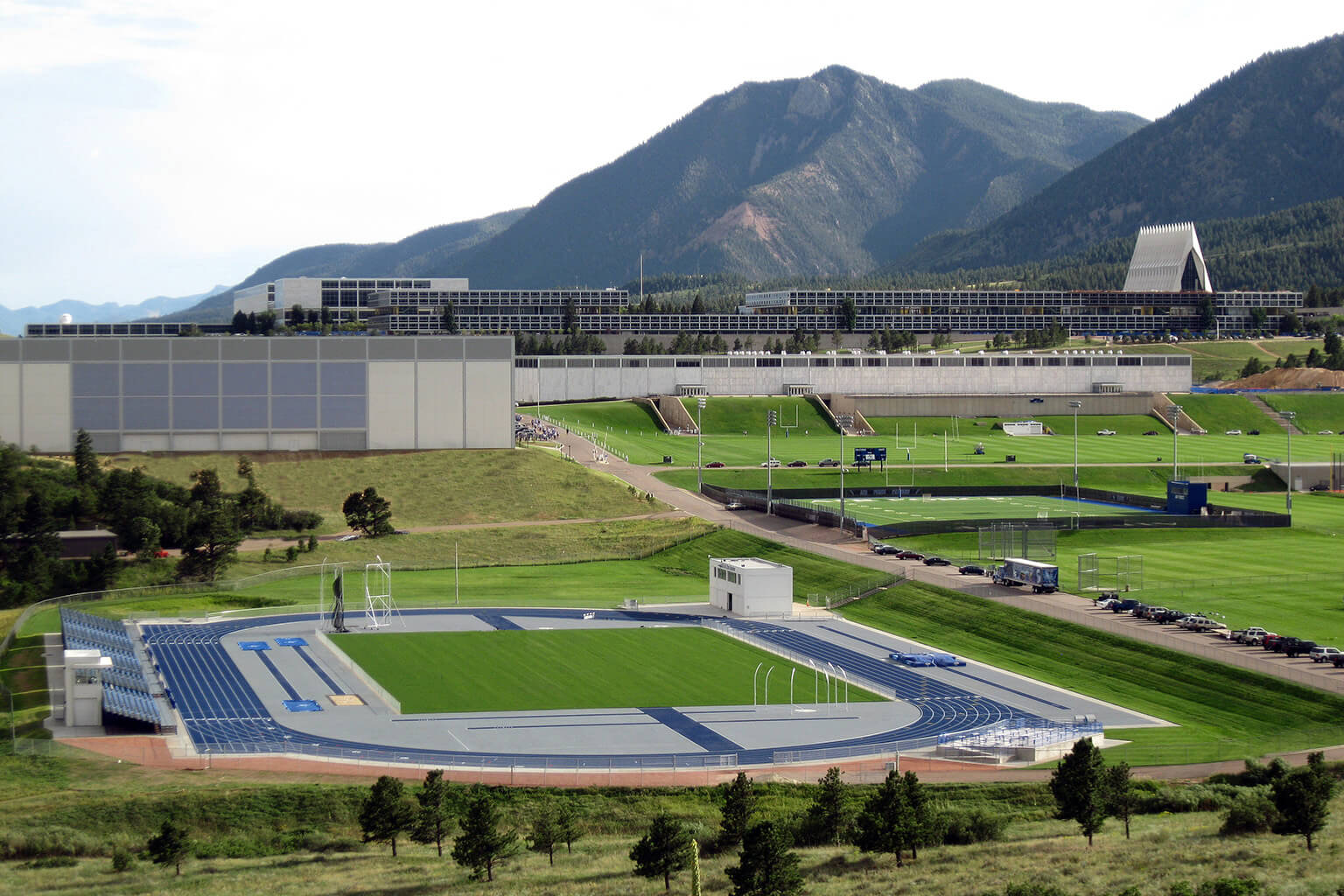
The selection process was highly competitive, with the finalists being Alton, Illinois; Lake Geneva, Wisconsin; and Colorado Springs, Colorado. Ultimately, Colorado Springs was selected for its favorable climate, central geographic location, and the strong support of the local community. The state of Colorado contributed $1 million toward the purchase of the land—a massive tract of roughly 18,500 acres at the base of the Rampart Range.
While the permanent campus was being designed and built, the Academy opened its doors at a temporary location: Lowry Air Force Base in Denver. On July 11, 1955, the first class of 306 cadets (the Class of 1959) was sworn in. Lieutenant General Hubert R. Harmon, a key figure in the academy's planning, was recalled from retirement to serve as the first Superintendent.
Architectural Revolution and Controversy
The design of the Academy’s permanent home was a departure from traditional military architecture. While West Point featured gray stone Gothic towers and Annapolis featured Beaux-Arts granite, the Air Force sought a look that reflected the future. The architectural firm Skidmore, Owings & Merrill (SOM), led by lead designer Walter Netsch, proposed a bold "International Style" campus using glass, steel, and aluminum.
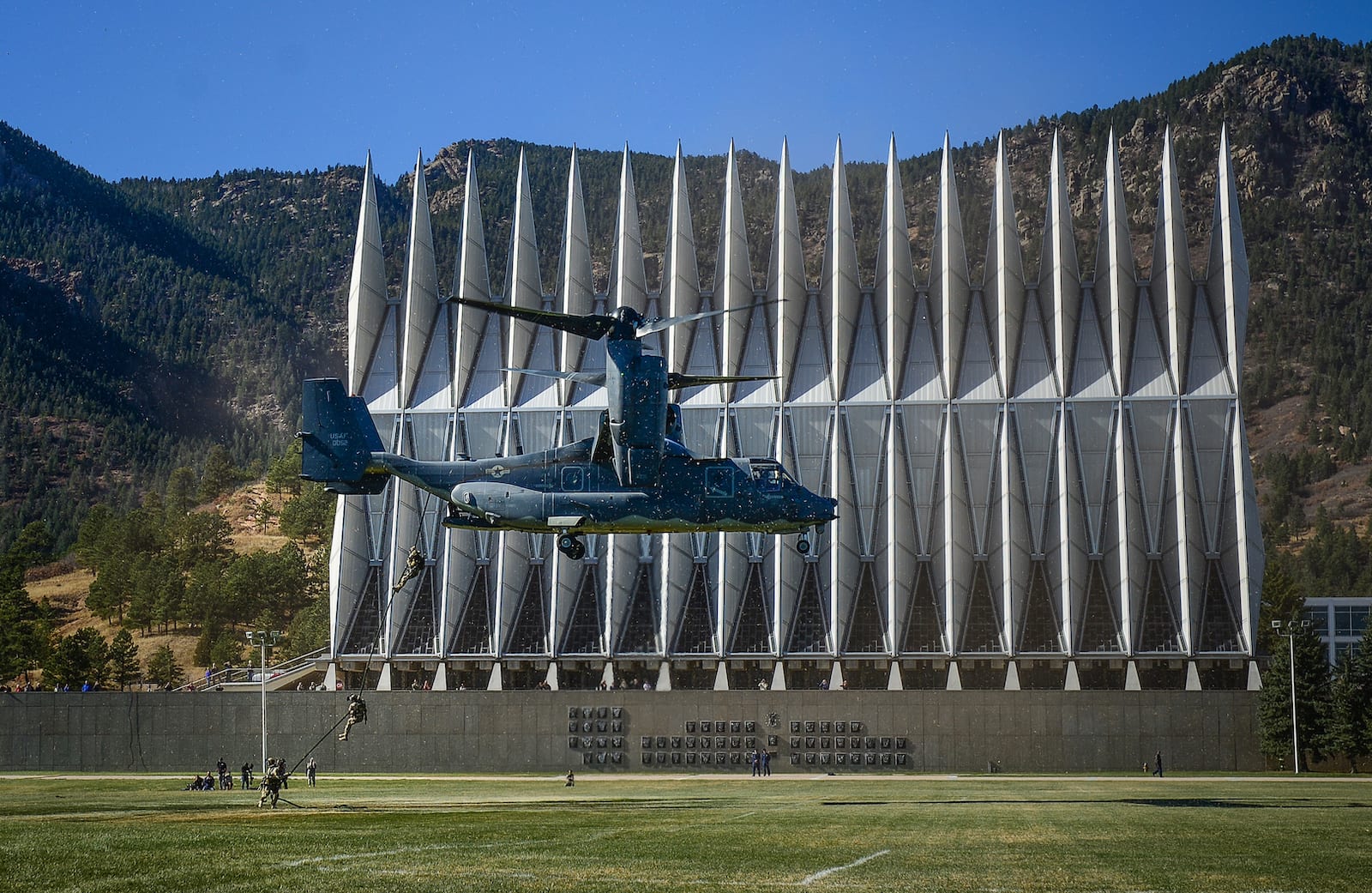
The most iconic and controversial structure was the Cadet Chapel. Its 17-spire design, reaching 150 feet into the sky, was initially ridiculed by some members of Congress as looking like an "accordion" or "blasphemous." However, the design eventually won widespread acclaim and is now a National Historic Landmark. By 2026, the Chapel has undergone a multi-year, $200 million restoration project to address structural leaks and preserve its modernist legacy for future generations.
The Cadet Wing moved from Lowry AFB to the permanent site in August 1958. The first graduating class took their oaths on June 3, 1959, marking the transition of the institution from an experiment to a cornerstone of American defense.
The Evolution of the Cadet Wing
The history of the Academy is not merely a story of buildings, but of the social and cultural shifts within the military.
The Integration of Women
One of the most significant changes occurred in 1975, when President Gerald Ford signed legislation allowing women to attend the federal service academies. In June 1976, 157 women entered the USAFA Class of 1980. This transition was met with resistance from some traditionalists, but the "First Class of Women" proved their resilience. Of the original 157 women, 97 graduated in 1980. Today, women make up approximately 25-30% of the Cadet Wing and hold top leadership positions, including the role of Superintendent.
The Honor Code
Central to the history of the Academy is the Cadet Honor Code: "We will not lie, steal, or cheat, nor tolerate among us anyone who does." Formalized in 1955, the code was designed to be cadet-run, meaning that cadets themselves are responsible for maintaining the ethical standards of their peers. While the code has faced challenges and periodic scandals throughout the decades, it remains the foundational element of the "leader of character" philosophy.
Milestones in USAFA History
The following table summarizes the pivotal moments that defined the Academy’s trajectory from its inception to its current status in 2026.
| Year | Event | Significance |
|---|---|---|
| 1947 | National Security Act | Established the U.S. Air Force as an independent service branch. |
| 1954 | Air Force Academy Act | Officially authorized the creation of the Academy. |
| 1955 | First Class Inprocessed | 306 cadets began training at temporary quarters at Lowry AFB. |
| 1958 | Move to Colorado Springs | The Cadet Wing occupied the permanent campus at the foot of the Rockies. |
| 1964 | Enrollment Expansion | President Lyndon B. Johnson authorized expansion to 4,417 cadets. |
| 1976 | Admission of Women | The first gender-integrated class entered the Academy. |
| 2004 | 50th Anniversary | Celebration of a half-century of officer production and academic excellence. |
| 2020 | U.S. Space Force Integration | The Academy began commissioning officers directly into the Space Force. |
| 2026 | Modernization Milestones | Completion of major campus infrastructure and Chapel restoration projects. |
The Space Force Era and Modern Mission
The landscape of the Academy changed significantly with the establishment of the United States Space Force (USSF) in December 2019. As the primary undergraduate institution for the Department of the Air Force, USAFA immediately adapted its curriculum to support the new branch.
By 2026, the Academy has fully integrated Space Force requirements into its core curriculum. Cadets can now choose to commission as Guardians directly upon graduation. The institution has expanded its research into satellite engineering, cyber warfare, and orbital mechanics, ensuring that graduates are prepared for a multi-domain battlefield. This shift mirrors the Academy’s original founding: a recognition that new domains of warfare require specialized, elite training.
Academic and Military Curriculum
The Academy's curriculum is notoriously demanding. Every cadet must complete a core curriculum that includes robust coursework in the basic sciences, engineering, social sciences, and humanities, regardless of their major. This "whole-person" approach is designed to produce officers who are not just technically proficient, but also capable of critical thinking and ethical decision-making in complex geopolitical environments.
Cadets are also required to participate in "Summer Programs," which include:
- Combat Survival Training (CST): Teaching the fundamentals of survival, evasion, resistance, and escape (SERE).
- Jump (Parachuting): Many cadets earn their basic jump wings through the Academy’s free-fall program.
- Airmanship: Programs in soaring (gliders) and powered flight provide early exposure to aviation.
FAQ: Common Questions About the USAFA History
When was the Air Force Academy established? The Academy was officially established on April 1, 1954, after decades of lobbying by airpower advocates. The first class entered training in 1955, and the move to the permanent Colorado Springs campus occurred in 1958.
Who was the first woman to graduate from the Air Force Academy? The first group of women graduated in the Class of 1980. Rather than a single "first" woman, 97 women graduated together in that class, having entered in June 1976 after a change in federal law allowed their admission.
Why is the architecture of the Academy so modern compared to West Point? The Air Force leadership in the 1950s wanted the campus to represent the "future" of the military. They deliberately avoided the "collegiate gothic" style of older academies in favor of the International Style, characterized by aluminum, glass, and steel, symbolizing the aerospace age.
How does the Academy support the U.S. Space Force? Since 2020, the Academy has served as the primary commissioning source for the Space Force. Approximately 10% of each graduating class (roughly 80-100 cadets) currently commissions as second lieutenants (Guardians) in the Space Force, with specialized training available in space operations and engineering.
What is the "Doolie" year? "Doolie" is the nickname for fourth-class cadets (freshmen). The term is derived from the Greek word doulos, meaning "slave" or "servant." It refers to the rigorous first year of training where cadets must follow strict "knowledge" requirements and military customs to earn their place in the Cadet Wing.
Strategic Guidance for Prospective Applicants
For those looking to become part of the ongoing history of the United States Air Force Academy, the process remains one of the most competitive in the nation. Admission requires more than just academic excellence; it demands a demonstration of leadership, physical fitness, and a commitment to service.
As of 2026, prospective candidates should focus on:
- Congressional Nominations: Start the application process early in your junior year of high school to secure a nomination from a Senator or Representative.
- STEM Proficiency: Given the Academy’s shift toward space and cyber operations, a strong foundation in calculus and physics is highly prioritized.
- Physical Readiness: The Candidate Fitness Assessment (CFA) is a critical gate. Preparation should involve consistent aerobic and strength training.
- Leadership Verification: The admissions board looks for "proven leadership"—this means holding significant roles in sports, student government, or community organizations, rather than just being a member.
The Air Force Academy remains a living monument to the evolution of American airpower. From its first class of 306 men in 1955 to the multi-domain Guardians of 2026, its history is a testament to the nation's drive to reach "Higher, Faster, and Farther."
Image Gallery