Mitsubishi Outlander Trunk Space Overview: Capacity, Dimensions, and Practical Usability
The Mitsubishi Outlander offers up to 79.7 cubic feet of maximum cargo space with all rear seats folded flat in current-generation models. Behind the second row, it provides up to 33.5 cubic feet, while folding out the standard third-r...
The Mitsubishi Outlander offers up to 79.7 cubic feet of maximum cargo space with all rear seats folded flat in current-generation models. Behind the second row, it provides up to 33.5 cubic feet, while folding out the standard third-row seats leaves 11.7 cubic feet of dedicated boot space for daily items.
Contents
Mitsubishi Outlander Cargo Dimensions and Volume Overview
Understanding cargo capacity requires looking past simple total volume numbers. The Mitsubishi Outlander occupies a unique niche in the compact crossover segment: it is one of the few vehicles in its class to standardise three-row seating across most trim levels. Consequently, cargo measurements vary significantly depending on how many passenger rows are upright.
The current-generation Outlander (introduced for the 2022 model year and continuing through 2026) features a redesigned chassis developed under the Renault-Nissan-Mitsubishi Alliance. This platform provides a wider track, longer wheelbase, and flatter folding mechanisms than previous iterations.
| Configuration | Cargo Volume |
|---|---|
| MAXIMUM CARGO VOLUME (1st Row Active) | Up to 79.7 cu. ft. |
| MID-CONFIGURATION (2nd Row Active) | Up to 33.5 cu. ft. |
| FULL SEATING (3rd Row Active) | Up to 11.7 cu. ft. |
Official Volume Metrics (SAE vs. Total Usable Volume)
When researching cargo specifications, vehicle manufacturers typically report measurements based on standards established by the Society of Automotive Engineers (SAE J1100).
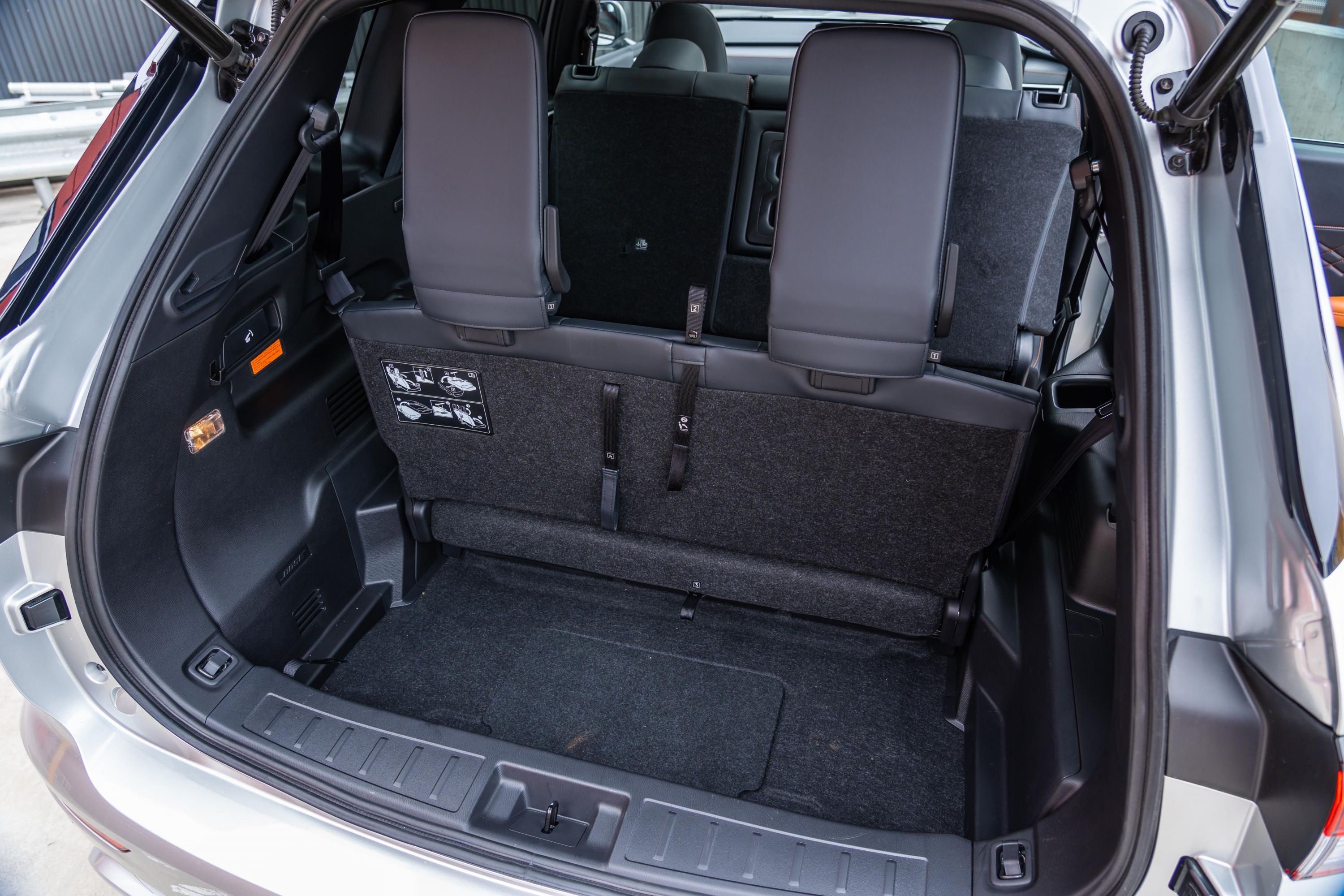
- Behind the 3rd Row (All Seats Up): 11.7 cubic feet (331 liters). This area is tailored for grocery bags, compact backpacks, or small carry-on suitcases stood vertically.
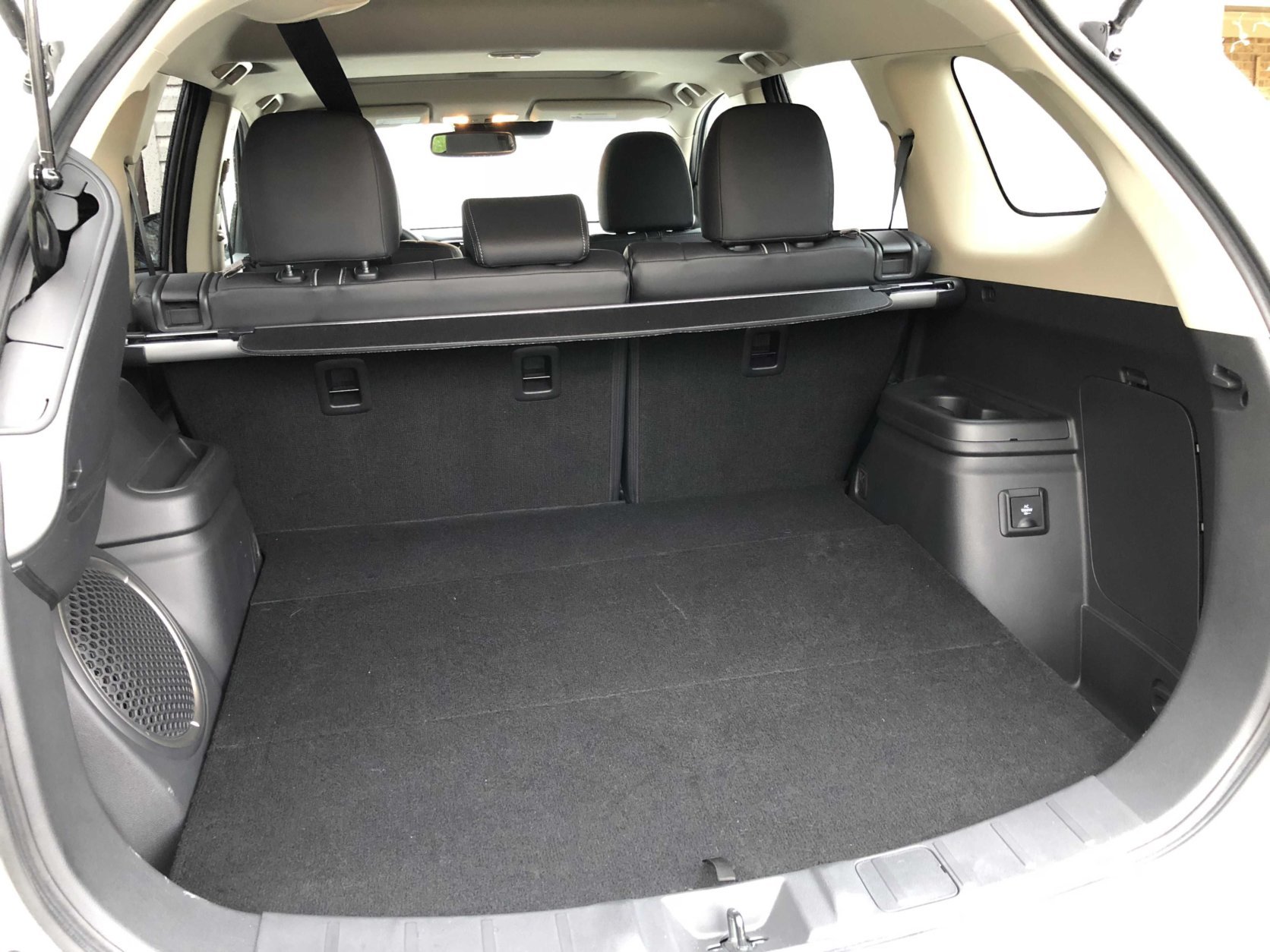
- Behind the 2nd Row (3rd Row Folded Flat): 33.5 cubic feet (948 liters) in standard trims, or 30.6 cubic feet in models equipped with the panoramic sunroof. This represents the primary cargo configuration for most drivers.
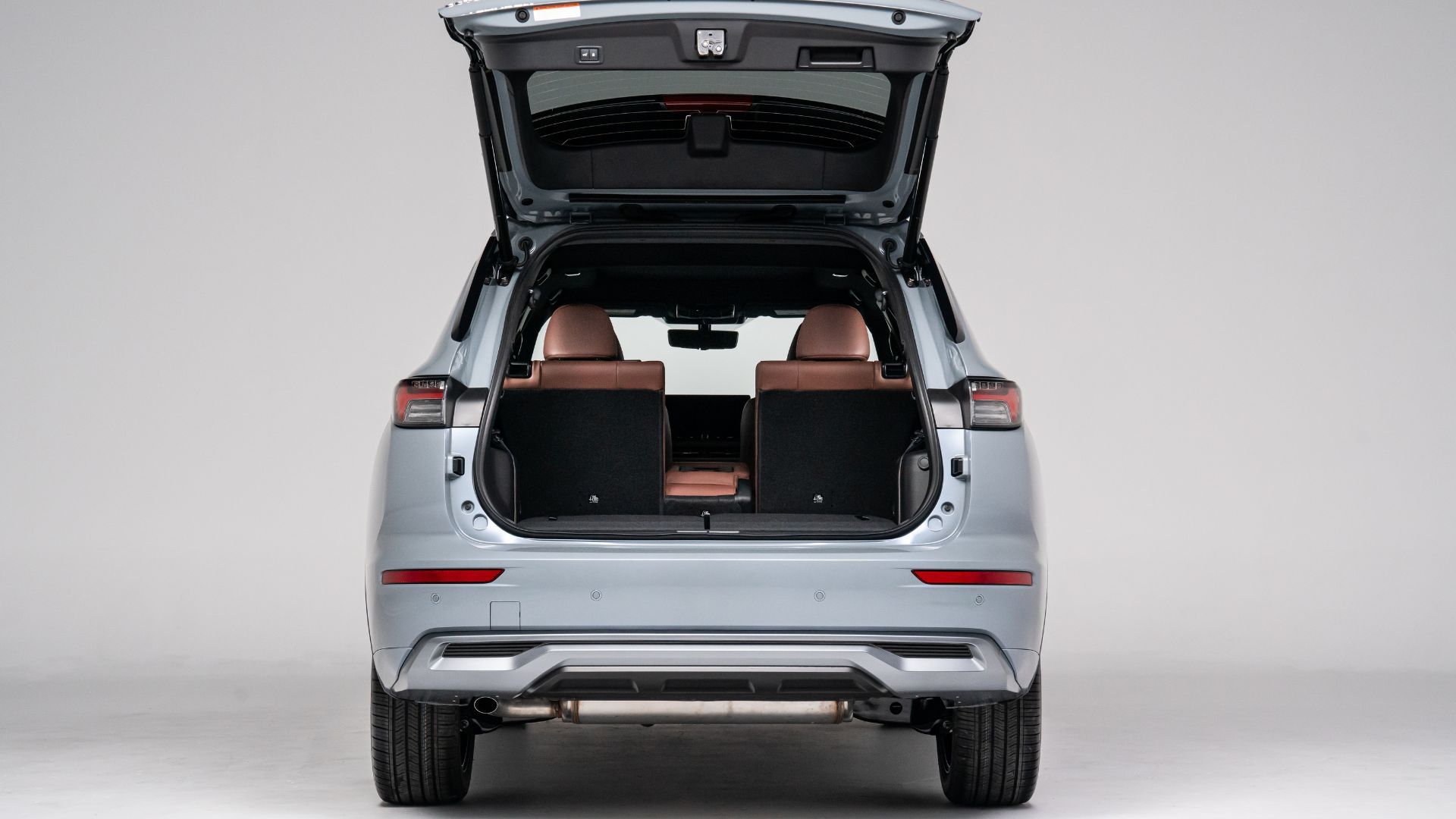
- Behind the 1st Row (2nd & 3rd Rows Folded Flat): Up to 79.7 cubic feet (2,256 liters) of maximum total enclosed space (SAE measured cargo index approximately 64.3 cubic feet depending on seat position and sunroof fitment).
Detailed Cargo Specifications by Model Year and Powertrain
Cargo packaging differs noticeably between vehicle generations and powertrain choices. Below is a breakdown comparing current-generation gasoline models, Plug-in Hybrid Electric Vehicle (PHEV) variants, and previous-generation architectures.
| Model & Generation | Volume Behind 3rd Row | Volume Behind 2nd Row | Max Cargo Volume (1st Row) | Liftgate Opening Width | Floor Length (2nd Row Folded) |
|---|---|---|---|---|---|
| Current Gen Gas (2022–2026) | 11.7 cu. ft. | 30.6 – 33.5 cu. ft. | 64.3 – 79.7 cu. ft. | ~42.9 inches | ~66.4 inches |
| Current Gen PHEV (2023–2026) | 11.7 cu. ft. | 30.8 – 33.2 cu. ft. | 64.7 – 78.5 cu. ft. | ~42.9 inches | ~66.4 inches |
| Previous Gen Gas (2016–2020) | 10.3 cu. ft. | 34.2 cu. ft. | 63.3 cu. ft. | ~39.5 inches | ~63.0 inches |
| Previous Gen PHEV (2018–2022) | N/A (2-row standard) | 30.4 cu. ft. | 66.6 cu. ft. | ~39.5 inches | ~63.0 inches |
Gas vs. PHEV Cargo Packaging
Historically, hybrid and plug-in hybrid vehicles sacrificed substantial interior utility to accommodate high-voltage battery packs and electric motors. In the previous generation (pre-2022), the Outlander PHEV was sold strictly as a two-row vehicle because the drive battery occupied the space normally used to store the folded third-row seat.
In current models, Mitsubishi re-engineered the battery pack location beneath the main cabin floor. As a result:
- 3-Row Availability: The current Outlander PHEV retains three-row seating capabilities identical to the gasoline model.
- Flat Floor Integration: Battery components do not raise the primary rear floor height.
- Under-Floor Storage: The PHEV version forfeits a portion of under-floor hidden storage space to accommodate charging cables and power electronics, but primary trunk area dimensions remain virtually identical between gas and PHEV trims.
Physical Dimensions and Loading Geometry
Raw volume numbers in cubic feet measure enclosed space, but structural shape dictates whether large items fit through the door opening.
- Max Width: ~51.2"
- Cargo Opening Width: ~42.9"
- Opening Height: ~32.1"
- Rear Load Floor Length (2nd Row Down): ~66.4"
- Liftover Height: ~29.8"
Key Measurement Breakdown
- Cargo Floor Length (Behind 3rd Row): ~14.2 inches (360 mm) from the bottom of the seatback to the inner tailgate latch.
- Cargo Floor Length (Behind 2nd Row): ~38.4 inches (975 mm) with second-row seats slid to their rearmost position.
- Maximum Floor Length (Behind 1st Row): ~66.4 inches (1,686 mm) measured to the rear of the front center console.
- Minimum Trunk Width (Between Wheel Arches): ~37.4 inches (950 mm).
- Maximum Interior Width: ~51.2 inches (1,300 mm) at the rear side recess areas.
- Liftgate Aperture Height: ~32.1 inches (815 mm).
- Liftover Height: ~29.8 inches (757 mm) from ground level to the cargo sill, reducing heavy lifting effort compared to high-riding ladder-frame SUVs.
Seating Flexibility and Folding Configurations
The Mitsubishi Outlander's utility relies heavily on its modular seating design. Managing seats effectively maximizes trunk space for specific passenger and cargo loads.
The 50/50 Split Third Row
The third row is designed primarily for occasional use or children. When folding the third-row seats down:
- Remove or tilt forward the integrated headrests.
- Pull the releases located on the rear of each seatback.
- The seatbacks drop forward into a recessed well, creating a level cargo surface level with the rear sill.
When the third row is raised, the seatbacks tilt slightly, but cargo depth behind them drops to just under 15 inches.
The 40/20/40 Split-Folding Second Row
The second-row seat offers enhanced flexibility compared to typical 60/40 bench designs:
- Independent Center Pass-Through (20%): The center section can fold independently, allowing long items such as skis, 2x4 lumber, or rolled rugs to stretch into the main cabin while carrying two adult passengers on the outer second-row seats.
- Fore/Aft Slide Adjustment: The second-row seats slide forward and backward by roughly 8 inches. Sliding them forward increases cargo volume behind the second row while preserving child-seat room.
- Recline Functions: Multi-position reclining seatbacks let owners prioritize upper cargo room or rear passenger comfort.
Practical Stacking and Real-World Usability
Knowing how common gear fits helps translate cubic measurements into practical application.
| Configuration | Details / Gear Capacity |
|---|---|
| Gear Examples | [Full Luggage Set] [Double Stroller] [Camp Gear] |
| 3rd Row Down | 3-4 Large Suitcases + Carry-ons |
| 3rd Row Up | 2 Carry-on Bags or Grocery Packs |
| All Rows Down | Furniture, Bicycles, Full Camping Kit |
Real-World Gear Fitment Scenarios
- Full Passenger Load (7 Passengers, 3rd Row Up): Fits 2 to 3 standard carry-on suitcases stood vertically, or 4 to 6 fully packed paper grocery bags. For family road trips with seven occupants, a roof cargo carrier or hitch-mounted cargo tray is generally required for luggage.
- Standard Family Mode (5 Passengers, 3rd Row Down): Fits a full-size double stroller alongside two large rolling suitcases and multiple soft duffel bags. Alternatively, four golf bags lay across the widest point of the floor without folding the second row.
- Utility & Hauling Mode (2 Passengers, All Rear Rows Down): Accommodates standard flat-pack furniture boxes up to 65 inches in length. A standard adult mountain bike can be loaded horizontally with the front wheel removed.
Storage Features, Accessories, and Power Ports
To help organize gear, Mitsubishi incorporates functional hardware and tiedowns into the rear cargo compartment.
Tiedowns and Hooks
- Four Metal Anchor Points: Located at the corners of the cargo floor, designed to secure cargo nets, elastic cords, or heavy strap tie-downs.
- Bag Hooks: Molded plastic hooks rated for light shopping bags (up to 8 lbs each) are built into the side trunk panels.
Hidden Under-Floor Compartments
Underneath the rearmost section of the trunk floor rests a concealed storage tray. On gas models, this tray holds:
- The removable rear cargo cover when not in use.
- Emergency equipment, tire inflation kits, and small tools.
- Personal valuables hidden out of sight from windows.
On PHEV variants, this space is partially occupied by the 120-volt EV charging cable set and vehicle power management hardware, though a narrow recess remains for small items.
Electrical Outlets and Lighting
Depending on the trim level (such as SEL, SEL Touring, or PHEV trims), the rear cargo bay includes power access:
- 12V DC Socket: Standard across most trims for running portable 12-volt air pumps or cooler boxes.
- 1,500-Watt 120V AC Outlets (PHEV Trims): Located on the side wall of the trunk area. This dual-outlet system draws directly from the main lithium-ion traction battery, capable of powering camp stoves, microwave ovens, power tools, or tailgating equipment during outdoor trips or grid outages.
Cargo Space Comparison: Outlander vs. Competitors
The Mitsubishi Outlander bridges the gap between traditional 2-row compact crossovers and larger mid-size 3-row SUVs. The table below shows how its boot space compares against direct segment rivals.
| Vehicle Model | Seating Rows | Space Behind 3rd Row | Space Behind 2nd Row | Max Cargo Space |
|---|---|---|---|---|
| Mitsubishi Outlander | 3 Rows | 11.7 cu. ft. | 33.5 cu. ft. | 79.7 cu. ft. |
| Nissan Rogue | 2 Rows | N/A | 31.6 – 36.5 cu. ft. | 74.1 cu. ft. |
| Toyota RAV4 | 2 Rows | N/A | 37.5 cu. ft. | 69.8 cu. ft. |
| Honda CR-V | 2 Rows | N/A | 39.3 cu. ft. | 76.5 cu. ft. |
| Kia Sorento | 3 Rows | 12.6 cu. ft. | 38.5 – 45.0 cu. ft. | 75.5 cu. ft. |
| Volkswagen Tiguan | 2 or 3 Rows | 12.0 cu. ft. | 33.0 cu. ft. | 65.3 cu. ft. |
Comparative Analysis
- Versus Compact 2-Row SUVs (RAV4, CR-V): Two-row competitors offer slightly more volume directly behind the second row because they do not need to package a folded third-row seat mechanism beneath the floor. However, the Outlander offers significantly more maximum overall volume (79.7 cu. ft.) when all rear seats are folded flat.
- Versus 3-Row Mid-Size/Mid-Compact SUVs (Sorento, Tiguan): The Kia Sorento offers slightly more cargo volume behind its second row due to a longer body, but the Outlander matches or beats overall usable ceiling height and total cargo width when loading bulky items.
Practical Recommendations for Outlander Buyers
- Evaluate Passenger vs. Cargo Frequency: If you frequently haul seven passengers, plan to invest in roof crossbars and a roof cargo box. The 11.7 cubic feet available behind the third row fills quickly with basic supplies.
- Measure Long Items Before Transport: While maximum diagonal length exceeds 70 inches, flat length along the floor stops at 66.4 inches. Measure furniture or lumber before loading to ensure the hands-free power liftgate can close fully.
- Choose Trims Based on Utility Needs: If off-grid camping or utility power is a priority, the PHEV's 1,500W AC outlet system adds functional value directly inside the cargo compartment.
- Protect the Load Floor: Because the third-row seatbacks form part of the primary cargo floor when stowed, installing a fold-away or modular all-weather cargo liner protects seat fabric and leather from dirt, liquid spills, and scuffs.
Frequently Asked Questions
Can a full-size mattress fit in the back of a Mitsubishi Outlander?
A standard Twin mattress (38 inches wide by 75 inches long) can fit diagonally or laid flat if pushed forward against the front seatbacks with the tailgate fully closed. A Full or Queen mattress is too wide to fit through the rear hatch opening (maximum interior width is 51.2 inches).
Does the Mitsubishi Outlander PHEV have less trunk space than the gas model?
In models from 2023 through 2026, primary cargo volume behind the second and third rows is virtually identical to the gas model. The drive battery is mounted under the main vehicle floor. The primary difference is reduced under-floor storage space, which houses charging cables in the PHEV.
Is the trunk floor completely flat when seats are folded down?
Yes. When the third row is folded into its floor recess and the 40/20/40 second row is dropped forward, the Outlander provides a flat continuous floor from the rear bumper sill to the front seatbacks.
What is the maximum weight capacity for the Outlander's cargo floor?
Payload capacity varies by trim, engine, and drivetrain (AWD vs. FWD), but total combined payload (passengers + cargo) generally ranges between 1,150 lbs and 1,350 lbs. Avoid placing concentrated single-point loads exceeding 300 lbs directly on the folded third-row seatbacks.
Will a double stroller fit behind the third row when seats are up?
No. Standard full-size double strollers require folding down at least one side of the 50/50 third-row seats. Behind an upright third row, only compact umbrella strollers or slim travel strollers will fit.
How does the hands-free power liftgate work on the Outlander?
On equipped trims, kicking your foot beneath the center of the rear bumper with the smart key keyfob in your pocket automatically opens the tailgate. Cargo height can be customized using the height-memory button located on the interior liftgate trim.
EDITORIAL CATEGORY METADATA:
Image Gallery