Understanding Marilyn Ezzy v. Workers’ Compensation Appeals Board: The Reasonable Expectancy Test
The landmark case of Marilyn Ezzy v. Workers’ Compensation Appeals Board (1983) established the legal standard for determining when injuries sustained during voluntary off-duty social or athletic activities are compensable under Califo...
The landmark case of Marilyn Ezzy v. Workers’ Compensation Appeals Board (1983) established the legal standard for determining when injuries sustained during voluntary off-duty social or athletic activities are compensable under California workers' compensation law. It created the "reasonable expectancy" test, which evaluates whether an employee subjectively believed participation was required and whether that belief was objectively reasonable.
Contents
In the realm of California workers' compensation law, few cases carry as much weight regarding the "course of employment" as Marilyn Ezzy v. Workers' Comp. Appeals Bd. (1983) 146 Cal.App.3d 252. For decades, this case has served as the primary benchmark for judges, attorneys, and claims adjusters when navigating the complex intersection of mandatory work duties and optional social engagements. As of 2026, the principles established in this ruling continue to govern how courts interpret Labor Code Section 3600(a)(9), ensuring that employers cannot exert subtle pressure on employees to participate in "voluntary" activities without assuming the risk of liability for injuries.
The Historical Context of the Ezzy Decision
To understand the impact of the Ezzy decision, one must look at the legislative environment of the late 1970s. Prior to 1978, the legal landscape was somewhat ambiguous regarding recreational injuries. In response to rising costs and a perceived expansion of employer liability, the California Legislature enacted what is now Labor Code Section 3600(a)(9).
The statute specifically states that an injury is not compensable if it arises out of voluntary participation in any off-duty recreational, social, or athletic activity, unless those activities are a reasonable expectancy of, or are expressly or impliedly required by, the employment.
The Ezzy case was the first major appellate test of this legislative language. It sought to define the threshold of what constitutes "reasonable expectancy" in an era where corporate culture was increasingly blending professional performance with social interaction.
Case Facts: The Softball Game Injury
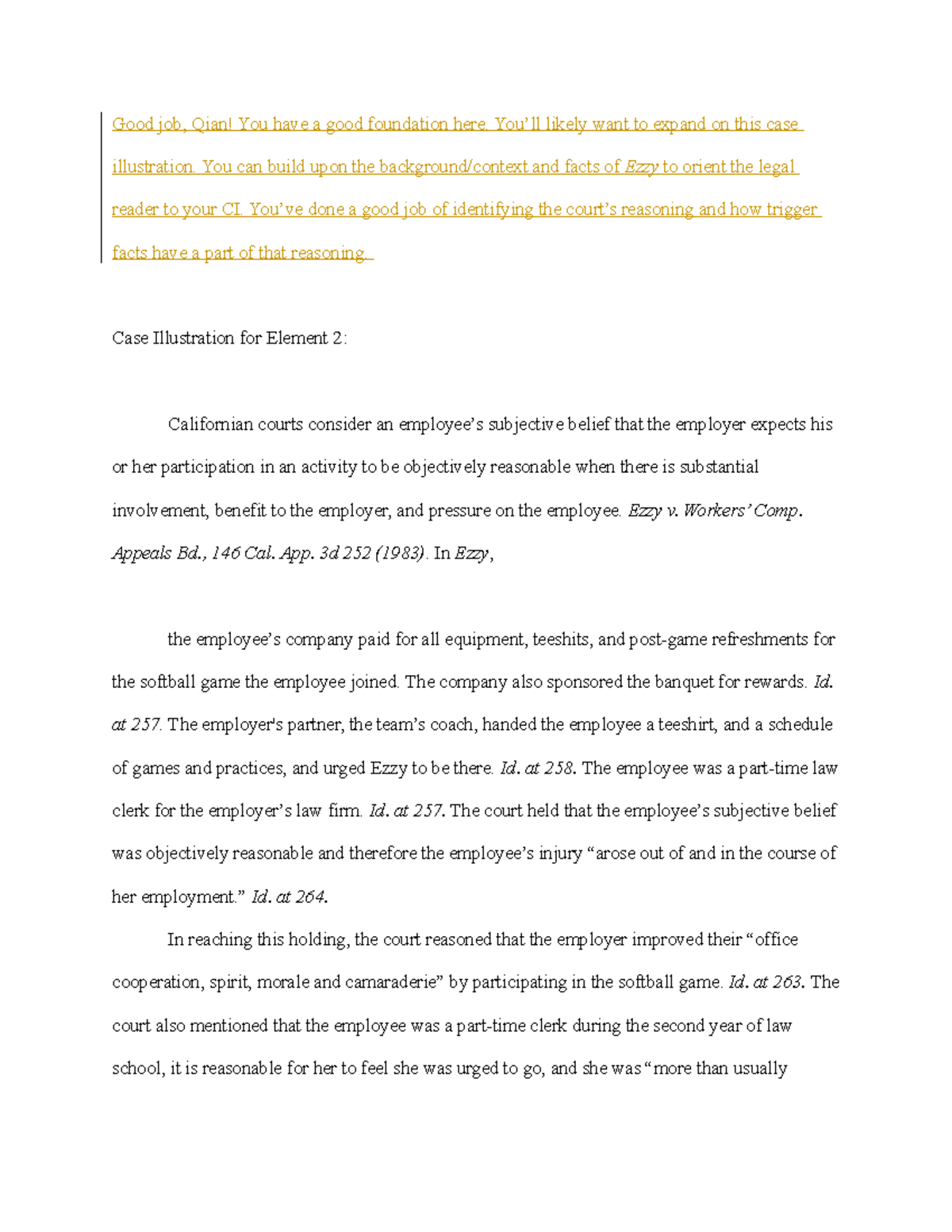
Marilyn Ezzy was a second-year law student working as a part-time law clerk for the law firm of Gassett, Perry & Frank. During her summer clerkship, she was "urged" by one of the firm's partners to play on the firm’s co-ed softball team. The team was part of a league where points were awarded based on the number of female players on the field, making her participation particularly valuable to the firm’s competitive standing in the league.
Ezzy was not a regular athlete and had expressed hesitation about playing. However, after a partner handed her a jersey and emphasized the need for female players to avoid a forfeit, she felt a professional obligation to participate. During a game, while attempting to catch a fly ball, she collided with another player and sustained a significant injury to the little finger of her right hand.
The Workers’ Compensation Appeals Board (WCAB) initially denied her claim, siding with the employer's argument that the activity was voluntary and off-duty. Ezzy appealed the decision, leading to the California Court of Appeal's definitive ruling that reshaped the interpretation of the Labor Code.
The Two-Pronged "Reasonable Expectancy" Test
The Court of Appeal in Ezzy rejected a narrow interpretation of "voluntary." Instead, it introduced a two-pronged test to determine if an activity falls under the "reasonable expectancy" exception of the Labor Code. This test remains the gold standard in 2026 for assessing compensability in similar disputes.
1. The Subjective Prong
The first step of the test focuses on the employee’s internal state of mind. The court asks: Did the employee honestly believe that their participation in the activity was expected by the employer?
In Ezzy’s case, this was easily established. She testified that as a young clerk hoping for a future associate position, she felt she could not refuse a partner's request. She viewed the "request" not as a social invitation, but as a professional directive. For the subjective prong to be met, the employee does not need to show they were "forced," only that they perceived a requirement to attend or participate.
2. The Objective Prong
The second step is a "reasonableness" check. The court asks: Was the employee’s subjective belief objectively reasonable under the circumstances?
This prevents employees from claiming compensability for every minor social gathering based on unfounded paranoia. To satisfy this prong, there must be "indices of pressure." In the Ezzy case, the court found her belief was objectively reasonable because:
- The person "urging" her was a partner in the firm (a position of significant power).
- The firm provided the equipment (jerseys).
- The firm paid for the league entry fees and post-game refreshments.
- The participation of women was essential to the team’s ability to compete under league rules.
Factors Influencing Compensability in Social Events
The Ezzy decision forced the legal community to look beyond the "voluntary" label and examine the power dynamics and benefits involved in employment-related recreation. The following table outlines the key factors that courts and adjusters evaluate when applying the Ezzy standard in 2026.
| Factor | High Likelihood of Compensability | Low Likelihood of Compensability |
|---|---|---|
| Source of Invitation | Direct supervisor or high-level executive. | A peer or co-worker with no authority. |
| Benefit to Employer | Client networking, team building, or required branding. | Purely for employee morale/socialization. |
| Employer Involvement | Employer provides uniforms, funding, or handles scheduling. | Employees organize the event independently off-site. |
| Implicit Pressure | Attendance is tracked or used in performance reviews. | No record of attendance is kept; no penalties for absence. |
| Time and Location | During work hours or on the employer's premises. | After hours at a public park or private residence. |
| Nature of Request | Expressed as a "need" or "requirement" for the team/firm. | Expressed as a "casual invite" with no strings attached. |
The "Benefit to the Employer" Doctrine
A critical element of the Ezzy ruling is the analysis of the benefit the employer derives from the activity. The court noted that while the softball game was recreational, the law firm benefited from the "camaraderie" and the public relations aspect of having a team.
However, the court cautioned that a generic benefit like "improved employee health" or "better morale" is generally insufficient on its own to make an injury compensable. There must be a more tangible link between the activity and the employment relationship. In Ezzy, that link was the direct pressure from a partner and the specific need for the employee’s participation to satisfy league requirements.
Modern Application: Remote Work and "Fun" Culture
In 2026, the Ezzy standard is more relevant than ever due to the evolution of the workplace. With the rise of remote and hybrid work models, many companies have turned to "mandatory fun" retreats and off-site team-building exercises to maintain culture.
If an employee is injured during a virtual reality team-building session or a "voluntary" weekend hiking retreat, the Ezzy test is applied. If the CEO sends an email saying, "It would be great to see everyone there," and that CEO also signs the employee’s paycheck, the Ezzy precedent suggests that a junior employee’s belief that they must attend is both subjective and objectively reasonable.
Common Misconceptions and Legal Pitfalls
One of the most frequent mistakes made by employers is the belief that a signed "waiver" or a statement in an employee handbook saying "participation is voluntary" provides absolute immunity. Under California law, you cannot contract away workers' compensation rights if the underlying facts satisfy the Ezzy test.
Another pitfall is the "silent pressure" tactic. Managers may not explicitly demand attendance but may reward those who do attend with better assignments or more face-time. Courts in 2026 continue to look at the "totality of the circumstances." If an employer creates an environment where social participation is a de facto requirement for career advancement, the Ezzy standard will likely trigger compensability for any injuries sustained.
Practical Guidance for Employers and Employees
For Employers
To minimize liability under the Ezzy standard, employers should:
- Clarify Communications: Use explicit language in invitations stating that participation is strictly voluntary and will have no impact—positive or negative—on performance evaluations or career advancement.
- Avoid Top-Down Pressure: Invitations should ideally come from social committees or peers rather than direct supervisors or partners.
- Limit Funding: While paying for an event doesn't automatically make it compensable, it is a factor. Consider keeping social events truly separate from business operations.
- Document Non-Attendance: If a significant portion of the staff regularly skips the event without consequence, this serves as strong evidence that participation is not a "reasonable expectancy."
For Employees
If you are injured during a company-sponsored event, you should:
- Document the Invitation: Save emails, Slack messages, or notes from meetings where the event was discussed.
- Identify the Benefit: Note if the event involved clients, company branding (uniforms), or specific "work talk" that was encouraged.
- Report Promptly: Like any industrial injury, report the incident immediately to your supervisor or HR department to ensure the timeline of events is preserved.
Frequently Asked Questions
Does the Ezzy case apply if I was injured at a company holiday party?
Yes. The "reasonable expectancy" test applies to all social and recreational activities. If the party involved client networking or if an employee felt their attendance was required to show "team spirit" for their year-end review, an injury sustained there—such as a slip and fall—could be compensable under the Ezzy precedent.
What if I was injured while practicing for the event on my own time?
Generally, injuries sustained during private practice are less likely to be compensable unless the employer specifically directed the practice. However, if the employer provided the facility or equipment for the practice, the argument for compensability becomes stronger under the "objective reasonableness" prong.
Can an employer fire me for filing a claim based on an Ezzy-style injury?
No. California Labor Code Section 132a prohibits discrimination or retaliation against any worker for filing a workers' compensation claim. Even if the employer disputes the "reasonable expectancy" of the activity, they cannot legally terminate you for seeking benefits.
Does the "reasonable expectancy" test apply to professional athletes?
Professional athletes operate under different contractual and statutory frameworks. The Ezzy standard is specifically designed for "off-duty" activities that are not part of the employee's core job description. For a professional ballplayer, playing the game is "on-duty" work, not a recreational social activity.
If my employer pays for my gym membership, is my injury at the gym covered?
Usually, no. Merely providing a benefit or a subsidy for fitness does not constitute a "reasonable expectancy" that you must use that specific gym or exercise at a specific time. Unless the employer requires you to maintain a certain fitness level for your job (like a firefighter) and directs you to use that facility, the activity remains voluntary.
Recommendation for Next Actions
If you are involved in a dispute regarding an injury sustained during a social or athletic event, your first step should be to gather all evidence of the "invitation" or "urging" that led to your participation. For legal professionals and claims adjusters, a thorough interview focusing on the "indices of pressure" is essential. Because these cases are highly fact-specific, consulting with a specialist in California workers' compensation law is recommended to determine how the Ezzy two-pronged test applies to the unique circumstances of the incident.
Image Gallery