How to Choose a Sex Swing Hook: A Technical Safety and Installation Guide
Choosing a sex swing hook requires prioritizing dynamic load capacity, material integrity, and ceiling structure compatibility. For maximum safety, select high-grade 304 or 316 stainless steel mounts rated for at least 500 lbs (227 kg)...
Choosing a sex swing hook requires prioritizing dynamic load capacity, material integrity, and ceiling structure compatibility. For maximum safety, select high-grade 304 or 316 stainless steel mounts rated for at least 500 lbs (227 kg) of dynamic force. The hardware must be specifically designed for overhead suspension, such as heavy-duty eye bolts or industrial-grade swivel mounts, and must be anchored directly into structural support beams.
Contents
Understanding the Physics of Overhead Suspension
When selecting hardware for a sex swing, the most common mistake is accounting only for static weight. Static weight is the mass of the users standing still. However, a sex swing is a dynamic environment. Movement, bouncing, and swinging create centrifugal forces and sudden impacts that can triple or quadruple the load placed on the mounting point.
In 2026, engineering standards for home suspension have become more standardized, yet the fundamental physics remain the same. A 200-pound individual using a swing can easily exert over 400 pounds of force during vigorous activity. Therefore, a hook rated for 250 pounds is insufficient and potentially dangerous. Professionals recommend hardware with a Minimum Breaking Strength (MBS) that provides a safety factor of at least 4:1. If you expect the combined weight of participants to be 400 pounds, your hardware and the structural beam it is attached to should technically be capable of supporting 1,600 pounds to account for movement and wear over time.
Material Selection: Why Stainless Steel Reigns Supreme
The material of the hook determines its resistance to "metal fatigue" and environmental degradation. While zinc-plated steel is common in general hardware stores, it is often prone to surface wear that can lead to structural failure under high-friction conditions.
304 vs. 316 Stainless Steel
For interior residential use, 304-grade stainless steel is the industry standard. It offers an excellent balance of tensile strength and durability. However, if the installation is in a high-humidity environment (such as a basement or near a home spa), 316-grade stainless steel is preferable due to its superior corrosion resistance. Corrosion is not just an aesthetic issue; it can create microscopic fractures in the metal, leading to sudden "brittle failure" without warning.
Avoiding Cast Iron and Low-Grade Alloys
Avoid hooks made of cast iron or "mystery metals" often found in decorative hardware. Cast metals are brittle. Under the stress of a sex swing, a cast hook will not bend to show signs of failure—it will simply snap. Forged steel or machined stainless steel are the only acceptable options for load-bearing suspension.
Analyzing Your Ceiling Structure
Before purchasing a hook, you must identify the material you are drilling into. A high-quality hook is only as strong as the substrate holding it.
Wood Joists and Beams
In most residential homes, the ceiling consists of drywall attached to wood joists. You must use a high-quality stud finder to locate the exact center of a 2x6, 2x8, or 2x10 wood joist. Anchoring a hook into the edge of a joist significantly reduces its weight capacity and risks the wood splitting. For wood installations, a heavy-duty eye bolt with a deep, coarse thread is required. The bolt should penetrate at least 2.5 to 3 inches into the solid wood, not including the thickness of the drywall.
Concrete Ceilings
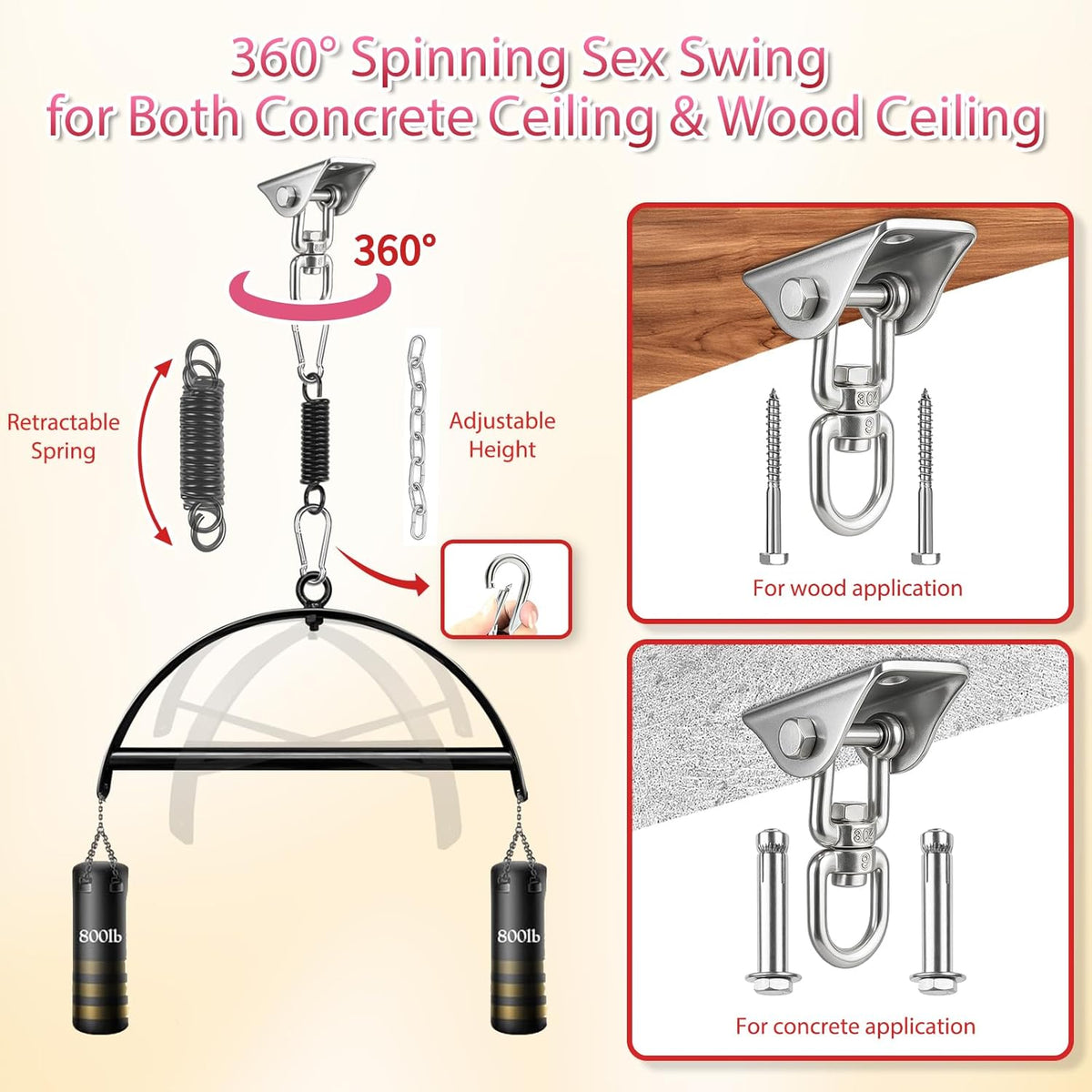
If you are installing into a solid concrete slab (common in modern lofts and high-rise apartments), you cannot use standard wood screws. Instead, you must use expansion anchors or wedge anchors. These are designed to expand against the walls of a pre-drilled hole in the concrete, creating a friction-based bond that can support thousands of pounds.
Steel I-Beams
In industrial-style spaces, you may encounter steel I-beams. In these cases, drilling is often discouraged. Instead, use a beam clamp rated for overhead lifting. These clamps grip the flange of the I-beam and provide a secure eye-loop for the swing without compromising the structural integrity of the metal beam.
Types of Mounting Hardware
Not all hooks are shaped the same, and the design you choose impacts the range of motion and the lifespan of your swing’s straps.
The Traditional Eye Bolt
A closed-loop eye bolt is the most secure option because the attachment point cannot "slip out." However, a stationary eye bolt causes friction against the carabiner of the swing. Over time, this metal-on-metal friction can grind down the hook or the carabiner. If using a standard eye bolt, it is essential to inspect the hardware regularly for signs of metal shavings or thinning.
Swivel Mounts and X-Mounts
Modern suspension technology has popularized the "X-mount" or "Swivel Plate." These devices feature a flat plate that is bolted into the ceiling at two or four points. Multi-point mounting is inherently safer than single-point mounting because it distributes the load across a larger surface area of the joist.
Furthermore, many of these mounts include a 360-degree swivel. A swivel prevents the swing straps from twisting and binding, which reduces lateral (side-to-side) torque on the screw. Lateral torque is a leading cause of screws backing out of wood over time.
| Hook/Mount Type | Load Distribution | Best Substrate | Pros | Cons |
|---|---|---|---|---|
| Heavy-Duty Eye Bolt | Single Point | Wood Joist | Inexpensive, discreet | Higher friction, risk of unscrewing |
| X-Mount (Fixed) | Dual Point | Wood or Concrete | High stability, weight spread | No rotation, requires two bolts |
| Swivel Plate Mount | Dual/Quad Point | Concrete/Solid Wood | Eliminates rope twist, 360° motion | More visible, higher cost |
| Expansion Anchor | Single Point | Solid Concrete | Immense hold strength | Permanent, requires masonry tools |
Installation Steps and Safety Verifications
Once you have chosen the appropriate hardware, the installation process must be precise. Failure to follow these steps can result in structural damage or injury.
- Locate the Center: Use a stud finder to find the joist. Use a small finishing nail to "probe" and find the exact edges of the wood so you can mark the absolute center.
- Pre-Drill the Pilot Hole: Never force a large lag screw or eye bolt into wood without a pilot hole. A pilot hole should be slightly smaller than the shank of the screw. This prevents the wood from splitting while allowing the threads to bite deeply into the grain.
- Check for Verticality: Ensure the bolt is being driven perfectly vertical. An angled bolt creates uneven stress and is more likely to fail under dynamic loads.
- The Initial Load Test: Once installed, do not immediately use the swing. Perform a static test by hanging from the mount with your full weight while someone else observes the ceiling for any signs of cracking or "pulling" of the drywall.
- The Dynamic Test: Gradually introduce movement. Listen for "creaking." While some wood noise is normal as the house settles, a "cracking" sound indicates the joist is being overstressed or the screw is failing to hold.
Common Mistakes to Avoid
Drywall Anchors and Toggle Bolts
Never, under any circumstances, use drywall anchors, toggle bolts, or molly bolts for a sex swing. Drywall is made of gypsum and paper; it has zero structural load-bearing capacity for human suspension. Any hardware not anchored into wood, concrete, or steel will fail immediately upon use.
Using "Open" Hooks
While an open "S-hook" or a "J-hook" may seem convenient for easy removal, they are dangerous for dynamic movement. A swing that bounces can momentarily lift the carabiner off the hook, allowing it to unseat and fall as the weight comes back down. Always use a closed-loop system with a locking carabiner.
Ignoring Hardware Fatigue
Hardware is not a "set it and forget it" installation. Metal fatigue occurs over time. Every few months, unscrew the mount slightly (or inspect the baseplate) to ensure there is no "play" in the hole. If the hole has widened, the mount must be moved to a new location on the joist.
FAQ
How do I install a sex swing hook if I am a renter?
In a rental, the most common solution is a portable sex swing frame. These are free-standing steel structures that require no drilling. If you must install a hook, the most discreet option is a heavy-duty eye bolt. When you move out, the bolt can be removed, and the small hole can be filled with standard spackle and painted over, making it virtually invisible.
Does the hook need to be "discreet"?
Many users worry about the visibility of a large ceiling mount. To maintain discretion, many choose to install the hook inside a closet (if a structural joist is available) or use a mount that can be covered by a decorative canopy or a hanging plant hook when not in use. Some swivel mounts in 2026 are designed to look like modern lighting fixtures or minimalist architectural hardware.
How much weight should the hook hold?
While a person may weigh 180 lbs, the hook should be rated for a minimum of 500 lbs. This higher rating accounts for the "force multipliers" of swinging and bouncing. If two people will be using the swing simultaneously, seek hardware rated for 800 lbs to 1,000 lbs.
What should I do if my ceiling creaks?
Minor creaking is common in wood-frame houses, but loud, sharp cracking sounds are a red flag. This often means the joist is "rolling" (twisting) or the screw is pulling out. If this occurs, stop use immediately. You may need to install a "blocking" piece of wood between two joists to stabilize the mounting point.
Are "sex swing kits" better than hardware store parts?
Not necessarily. Many kits sold online are simply rebranded industrial hardware. Often, buying high-grade lifting eye bolts from a reputable industrial supplier or hardware store is safer, as those parts must meet rigorous OSHA or ISO certification standards, whereas "novelty" kits may not have the same quality control.
Practical Recommendation
For the highest level of safety and functionality in 2026, purchase a stainless steel 360-degree swivel ceiling mount designed for yoga silks or heavy boxing bags. These mounts are engineered for dynamic, multi-directional movement and high weight capacities. Ensure you use a stud finder to anchor the mount into the center of a structural beam, and always use locking carabiners to connect your swing to the mount. Regularly inspect the hardware for signs of wear or loosening to ensure long-term safety.
Image Gallery