How Professional Mold Remediation Works: The Technical Process Explained
Professional mold remediation works by isolating contaminated areas under negative air pressure, physically eliminating active fungal growth, removing unsalvageable porous materials, and restoring indoor air quality to normal backgroun...
Professional mold remediation works by isolating contaminated areas under negative air pressure, physically eliminating active fungal growth, removing unsalvageable porous materials, and restoring indoor air quality to normal background levels. Guided by strict industry standards like ANSI/IICRC S520, technicians combine moisture engineering, HEPA air filtration, physical abatement, and post-remediation verification to ensure mold does not return.
Contents
Understanding Indoor Mold Mechanics and Industry Standards
Mold spores exist naturally in both outdoor and indoor environments. However, indoor mold growth becomes a structural and health hazard when spores settle on damp building materials and find suitable conditions to germinate. Fungi require three core elements to thrive: elevated moisture levels (relative humidity above 60% or direct water intrusion), an organic carbon substrate (such as cellulose in drywall, wood, or cardboard), and stagnant air.
When moisture problems remain unaddressed, fungal colonies proliferate rapidly—often within 24 to 48 hours of water exposure. Active colonies release microscopic spores, volatile organic compounds (VOCs), and potential mycotoxins into the air, triggering respiratory irritation, allergic reactions, and structural degradation of wooden framing and paper-faced drywall.
To standardise remediation protocols, the restoration industry relies on the ANSI/IICRC S520 Standard for Professional Mold Remediation, published by the Institute of Inspection, Cleaning and Restoration Certification. The standard categorises indoor environments into three distinct conditions:
- Condition 1 (Normal Fungal Ecology): An indoor environment that reflects normal ambient spore counts without active fungal growth or abnormal spore amplification.
- Condition 2 (Settled Spores): An area contaminated with settled mold spores or fungal fragments that have not yet formed active colonies, usually caused by nearby active growth.
- Condition 3 (Actual Mold Growth): An area with active fungal growth, visible colonies, or embedded hyphae contaminating structural materials or contents.
The primary objective of a professional mold remediation campaign is to transition a property from Condition 3 or Condition 2 back to Condition 1 safely, without spreading contamination to unaffected parts of the building.
Phase 1: Inspection, Assessment, and Moisture Mapping
Before any physical removal occurs, technicians conduct a comprehensive assessment to define the scope of contamination and identify the root source of moisture. Remediating visible mold without rectifying the underlying water problem leads directly to secondary fungal growth.
- Inspection & Moisture Mapping (Thermal imaging, hygrometers, sampling)
- Containment & Negative Air (Poly barriers, HEPA air scrubbers)
- Material Removal & Cleaning (HEPA vacuuming, media blasting, biocides)
- Post-Remediation Verification (Independent IEP testing & visual checks)
Moisture Diagnostics and Thermal Imaging
Technicians utilise specialized diagnostic tools to track moisture pathways hidden behind walls, under flooring, and inside ceiling cavities:
- Infrared (Thermal) Cameras: Identify temperature anomalies caused by evaporative cooling, pinpointing hidden water leaks behind drywall or masonry.
- Pin-Type and Pinless Moisture Meters: Measure the absolute moisture content (MC) of wood framing, subflooring, and drywall. Wood materials with an MC above 16–19% present a high risk for fungal propagation.
- Thermo-Hygrometers: Measure ambient indoor temperature and relative humidity (RH) to assess airborne vapor pressure and dew point conditions.
Initial Environmental Sampling
In complex or high-liability scenarios, an independent Indoor Environmental Professional (IEP) or Industrial Hygienist conducts baseline air and surface sampling. Air samples are collected using spore trap cassettes mounted on high-volume sampling pumps, comparing indoor spore counts against ambient outdoor control samples. Surface samples—collected using tape lifts, swabs, or bulk material cuts—identify specific fungal genera, such as Stachybotrys chartarum, Aspergillus, Penicillium, or Cladosporium.
Phase 2: Containment and Air Filtration (Engineering Controls)
The standard for safe mold abatement requires establishing physical containment barriers and negative pressure differentials before disturbing any mold-impacted materials. Disturbing dry fungal colonies releases millions of microscopic spores into the air, creating severe cross-contamination risks if engineering controls are omitted.
Critical Polyethylene Barriers
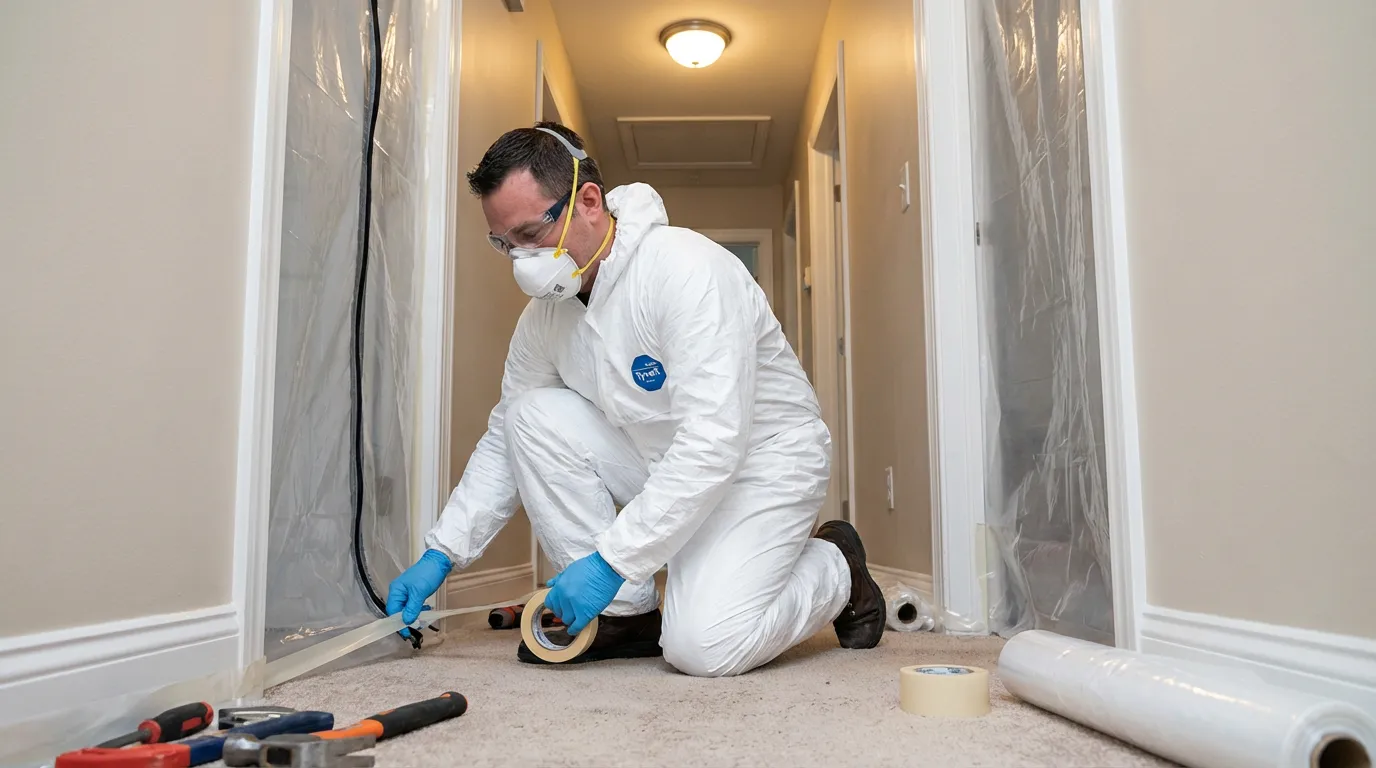
Remediation teams seal off the work zone using flame-retardant, 6-mil thick polyethylene sheeting. Zippered entry doors or double-flap airlocks allow technicians to enter and exit the work area without allowing airborne spores to escape into living areas.
All supply and return air vents within the containment zone are sealed with airtight poly sheeting and tape to isolate the building's central HVAC network. The U.S. Environmental Protection Agency (EPA) advises complete HVAC isolation to prevent ductwork from acting as a distribution channel for fungal spores across unaffected living spaces.
- Containment Zone
- Contaminated Area
- HEPA Air Scrubber
- Exhaust Air via Flex Ducting
- Outdoors or Clean Zone
Negative Pressure Differentials
To ensure air flows exclusively into the containment area rather than out, technicians deploy Air Filtration Devices (AFDs) configured as Air Scrubbers. These units draw air out of the containment space and vent it outside the building through flexible ducting.
- Pressure Metrics: Technicians maintain a continuous negative pressure differential of at least -5 Pascals (-0.02 inches of water column), verified using digital manometers.
- Air Exchange Rates: Equipment is sized to deliver a minimum of 4 to 6 Air Changes per Hour (ACH) within the containment enclosure.
- HEPA Filtration: Air scrubbers utilize True HEPA filters rated to capture 99.97% of airborne particles down to 0.3 microns in size. This ensures exhausted air is free of fungal spores, hyphal fragments, and fine particulate matter.
Phase 3: Extraction, Remediation, and Cleaning Protocols
Once containment is established and negative pressure verified, technicians begin physical remediation. The treatment method depends heavily on the porosity of the affected substrate.
Material Porosity Classification & Treatment Paths:
- Is the contaminated material porous?
- YES: Is it structural wood framing?
- YES: Media blast / Sander grit, HEPA vacuum, and encapsulate.
- NO: Discard material safely in sealed 6-mil bags.
- NO: Clean with HEPA vacuum, damp-wipe with antimicrobial, and dry completely.
- YES: Is it structural wood framing?
Porosity Classification and Material Protocols
Porous Materials (Drywall, Carpet, Fiberglass Insulation, Ceiling Tiles): Porous items allow mold hyphae (root structures) to penetrate deep beneath the surface. Because chemical biocides cannot reliably penetrate deep porous matrixes, damaged porous materials classified under Condition 3 must be cut out, bagged in 6-mil poly bags within containment, misted to minimize airborne dusting, and discarded.
Semi-Porous Materials (Structural Framing, Concrete, Plywood Subflooring): Structural elements that cannot be removed undergo physical surface abatement. Technicians utilize controlled mechanical agitation, such as:
- HEPA-Filtered Sanding and Wire Brushing: Removing surface hyphae directly from dimensional lumber.
- Dry Ice Blasting (CO2 Media Blasting): Sublimating carbon dioxide pellets under compressed air pressure to instantly freeze and detach mold colonies from wood framing without generating secondary solid waste.
- Soda Blasting: Using sodium bicarbonate particles for delicate architectural timber or historic wood restoration.
Non-Porous Materials (Glass, Tile, Sealed Metals, Hard Plastics): Non-porous surfaces are restored entirely through surface cleaning. Technicians follow a two-step cleaning methodology: HEPA vacuuming the surface, followed by detailed damp-wiping using an EPA-registered hospital-grade disinfectant or biocide.
Chemical Application and Encapsulation
While physical removal remains the foundation of mold abatement, targeted chemical treatments prevent micro-residual regrowth:
- Antimicrobials and Fungicides: Applied to semi-porous surfaces to neutralize remaining microscopic fungal spores. The Centers for Disease Control and Prevention (CDC) notes that while chemical application reduces viable spore counts, it does not substitute for the physical removal of dead fungal biomass, which remains allergenic.
- Polymer Encapsulants: After cleaning and drying structural wood members, technicians apply breathable acrylic sealants or antimicrobial coatings. These sealants lock down microscopic residual fibers and contain moisture-resistant barriers that inhibit future mold germination.
Phase 4: Post-Remediation Verification (PRV)
The remediation process is complete only after rigorous verification proves the space has returned to Condition 1 status. To maintain objectivity, post-remediation verification (PRV) should be performed by an independent third-party Industrial Hygienist or IEP who has no financial ties to the remediation contractor.
The PRV Inspection Criteria
- Visual Inspection: The IEP inspects containment zones under high-intensity white light and ultraviolet illumination. The area must be completely free of dust, debris, water staining, and visible fungal growth.
- Odor Assessment: The containment space must be completely devoid of musty, damp, or earthy odors (microbial volatile organic compounds).
- Moisture Clearance: All structural components within the containment zone must meet target dry standards (typically below 12% wood moisture equivalent).
- Air Clearance Testing: Spore trap samples are collected inside the containment zone while AFDs are temporarily turned off. The sample results are analyzed by an accredited laboratory under microscopic analysis.
Laboratory Clearance Passing Criteria
To grant final clearance, the laboratory analytical report must demonstrate:
- Total indoor airborne spore counts inside containment are statistically lower than or comparable to control outdoor air samples.
- High-risk indicator species—such as Stachybotrys, Chaetomium, and Aspergillus/Penicillium—are absent or present in negligible background quantities.
Once the PRV report passes, containment poly is carefully dismantled, HEPA air scrubbers are deactivated, and structural restoration or drywall reconstruction can proceed.
Technical Summary of Material Protocols
| Material Type | Examples | Primary Remediation Method | Salvageability | Key Technical Equipment / Media Used |
|---|---|---|---|---|
| Porous | Drywall, insulation, carpet, acoustic ceiling tiles | Physical removal, bagging, disposal | Unsalvageable (if Condition 3) | 6-mil poly disposal bags, HEPA vacuums, dust suppressants |
| Semi-Porous | Structural framing, subflooring, joists, concrete | Physical abrasion, dry ice blasting, sanding | Salvageable | CO2 dry ice blasters, wire brushes, antimicrobial sealants |
| Non-Porous | Metal framing, tile, glass, solid plastic | HEPA vacuuming and antimicrobial damp-wiping | Fully Salvageable | EPA-registered disinfectants, microfiber cloths, HEPA vacuums |
| Air Quality | Ambient air inside containment and adjacent rooms | Negative pressure containment, HEPA air scrubbing | Restored during process | Air filtration devices (AFDs), negative air machines, digital manometers |
Equipment Specifications and Operational Metrics
Professional mold remediation relies on industrial-grade equipment designed to meet strict performance metrics enforced by safety organizations like OSHA:
- HEPA Filtration Efficiency: 99.97% capture rate at 0.3-micron particle sizes. Standard shop vacuums or residential vacuum cleaners lack true HEPA seals and will bypass microscopic mold spores, blowing them into the ambient room air.
- Negative Air Pressure Differential: Maintained continuously at -5 Pascals (-0.02 inches of water column) relative to surrounding uncontained areas.
- Air Changes per Hour (ACH): Minimum of 4 to 6 continuous air volume turnovers per hour inside the containment zone during active work.
- Dehumidification Capacity: Commercial LGR (Low Grain Refrigerant) dehumidifiers are deployed to drive ambient relative humidity below 45% during the drying phase, removing dozens of pints of moisture per day.
Common Mistakes and Prevention of Recurrence
The Bleach Myth vs. Root-Cause Remediation
A common mistake in non-professional mold cleanup is applying standard household chlorine bleach (sodium hypochlorite) to porous substrates like wood or drywall. Bleach consists primarily of water (typically 90-95%) and a small percentage of chlorine. When applied to porous surfaces, the chlorine chemical stays on the surface while the water soaks into the material, inadvertently feeding the deep-rooted hyphae beneath the surface. True remediation requires physical removal or dedicated non-water-based antimicrobial fungicides.
Moisture Management Protocols
Preventing future mold recurrence requires keeping building interiors dry. Key operational metrics for long-term prevention include:
- Maintaining indoor relative humidity consistently between 30% and 50%.
- Ensuring proper roof drainage, downspout extensions (directing water at least 5 feet from foundations), and appropriate exterior grading.
- Installing continuous vapor barriers (minimum 10-mil poly) across dirt crawlspaces.
- Ensuring bathroom exhaust fans and kitchen vents exhaust directly outdoors, rather than into attic spaces.
Frequently Asked Questions
Can I stay in my home during mold remediation?
If mold growth is localized to a small area (under 10 square feet) and contained properly, occupants can often remain in uncontained portions of the home. However, for extensive remediation projects involving main HVAC systems, large structural framing, or high concentrations of toxigenic species like Stachybotrys, temporary relocation is recommended to protect occupants from exposure to residual particulates and noise from commercial air scrubbers.
How long does a typical professional mold remediation process take?
A standard residential mold remediation project generally takes between 1 and 5 days. Assessment and containment setup take 1 day, physical removal and cleaning take 1 to 3 days, and post-remediation clearance testing plus laboratory processing typically add 1 to 2 days before final reconstruction can begin.
How much does professional mold remediation cost?
Remediation costs depend on the extent of contamination, access constraints, and required structural removal. Minor localized projects may cost between $500 and $1,500, while extensive whole-home structural abatement involving crawlspaces, attics, or HVAC systems ranges from $3,000 to over $10,000. Independent IEP testing and structural rebuilds are typically billed separately.
What is the difference between mold removal and mold remediation?
"Mold removal" is a misnomer, as mold spores naturally exist everywhere in airborne environments. Complete elimination of all indoor mold spores is scientifically impossible. "Mold remediation" focuses on removing active mold colonies, clearing contaminated structural materials, and restoring airborne spore levels to safe, normal indoor ecology (Condition 1).
Actionable Next Steps
If you suspect abnormal mold growth or water intrusion in your building, follow these standard steps:
- Identify and Stop the Moisture Source: Repair active plumbing leaks, roof breaches, or groundwater intrusion immediately. Remediation cannot succeed while water remains active.
- Commission an Independent Inspection: Hire a certified, independent Indoor Environmental Professional (IEP) to perform baseline testing and develop an unbiased Scope of Work.
- Hire a Certified Remediation Firm: Select a remediation contractor certified by the IICRC (holding AMRT—Applied Microbial Remediation Technician credentials) that adheres strictly to ANSI/IICRC S520 standards.
- Verify Containment and Negative Air: Ensure the contractor sets up proper 6-mil poly containment barriers, seals HVAC vents, and operates HEPA air scrubbers under negative pressure before work starts.
- Require Independent Clearance Testing: Require third-party post-remediation verification (PRV) testing to confirm the containment area has passed lab analysis before dismantling containment or commencing reconstruction.
Image Gallery