Understanding Payday Loans Near You with No Credit Check: How They Work, Costs, and Alternatives
Searching for a "payday loan near me no credit check" usually leads to short-term, high-cost loans that skip traditional FICO credit reviews. Instead, lenders verify your regular income and active checking account. While convenient for...
Searching for a "payday loan near me no credit check" usually leads to short-term, high-cost loans that skip traditional FICO credit reviews. Instead, lenders verify your regular income and active checking account. While convenient for urgent cash needs, these loans carry high fees and steep annual interest rates that require careful evaluation before borrowing.
Contents
What Does "No Credit Check" Really Mean for Payday Loans?
When a lender advertises "no credit check," it specifically means they do not perform a hard credit inquiry through the three major national credit bureaus: Experian, Equifax, or TransUnion. Traditional loans—such as personal installment loans, auto loans, or credit cards—rely heavily on your FICO credit score to assess risk. A low score or limited credit history can result in immediate denial.
Payday lenders operate under a different risk model. Rather than evaluating past credit management, they focus on immediate cash flow. However, "no credit check" does not mean "no verification." Payday lenders usually verify your financial profile through alternative channels:
- Specialized Subprime Consumer Reporting Agencies: Lenders frequently pull data from specialty bureaus like Clarity Services (an Experian company), Teletrack, or FactorTrust. These databases track short-term loan histories, active payday debts, bank account closures, and bounced checks.
- Bank Account Authentication: Online and storefront lenders often use third-party data aggregators like Plaid to inspect real-time transaction history, verify direct deposits, and ensure your account has no history of excessive overdrafts.
- Income Proof: Lenders review recent pay stubs, electronic deposit records, or benefit distribution statements to ensure you earn enough to cover the loan amount plus fees upon your next payday.
Because the lender bypasses standard credit underwriting, they offset their default risk by charging high financing fees, making these financial products among the most expensive forms of legal credit available.
Storefront "Near Me" Lenders vs. Online Payday Lenders
Borrowers seeking immediate relief often choose between visiting a local storefront location or applying through an online lending platform. Understanding how these channels differ helps set expectations regarding funding speed, privacy, and regulatory oversight.
- Storefront Payday Loan (Physical Branch)
- In-Person Identity & Income Verification
- Paper Check or Immediate Cash Payout
- Local State-Specific License Required
- Online Payday Lender (Digital Platform)
- Electronic Account Verification (e.g., Plaid)
- Direct Deposit (Same-Day or Next Business Day ACH)
- May Operate Under Tribal, Out-of-State, or State Licenses
Physical Storefront Locations
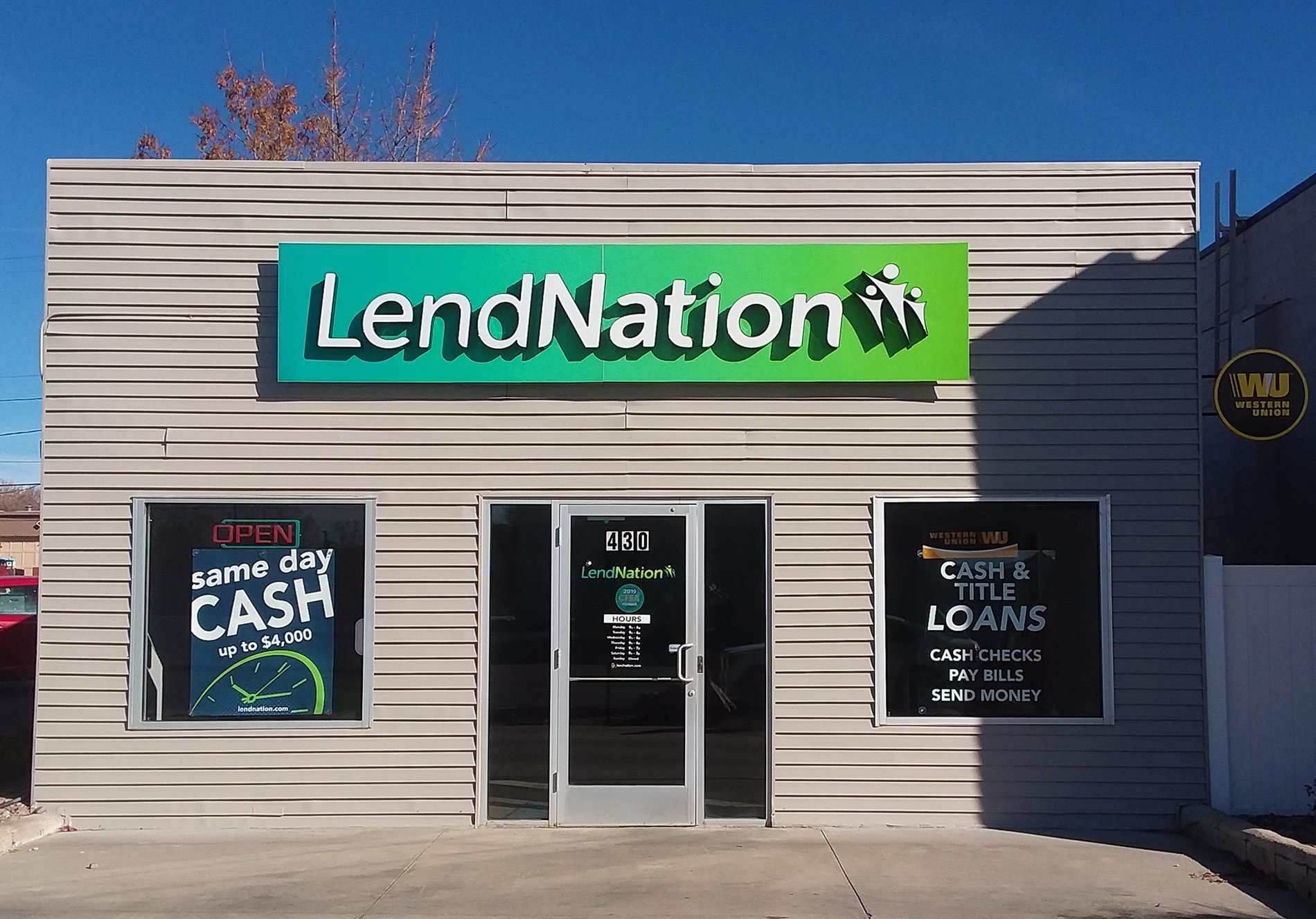
Visiting a physical loan shop provides immediate face-to-face interaction and instant access to funds. If approved, you can often leave the store with cash or a pre-loaded debit card within 15 to 30 minutes.
To complete an in-person application, storefront lenders typically require:
- A valid government-issued photo ID (driver's license, state ID, or passport).
- Your most recent pay stubs or proof of regular government benefits.
- A blank, physical paper check from your active checking account (which the lender holds as collateral).
- Proof of residency, such as a utility bill or lease agreement.
Online Payday Lenders and Brokers
Online lenders allow you to apply from home via a smartphone or computer. While convenient, online borrowing involves critical distinctions:
- Direct Lenders vs. Lead Generators: Many online search results for "no credit check loans" lead to lead generation networks rather than direct lenders. Lead generators collect your sensitive financial data and sell it to third-party lenders, which can result in multiple marketing emails, texts, and phone calls.
- Funding Timelines: Online loans rarely deliver cash instantly unless the lender supports real-time push-to-card debit transfers. Most online transfers use standard Automated Clearing House (ACH) networks, meaning funds typically arrive the next business day.
- Licensing and Compliance: Physical stores must comply strictly with the state laws of the physical location where they operate. Online lenders may attempt to operate from states with looser regulations or under sovereign tribal entities, potentially bypassing local state interest rate caps.
Eligibility and Verification Requirements
While payday lenders do not enforce strict credit score minimums, applicants must satisfy baseline operational criteria to qualify for approval.
Primary Application Requirements
To secure a short-term payday loan, you generally must meet the following baseline standards:
- Age and Legal Status: You must be at least 18 years old (19 in certain states like Alabama and Nebraska) and a legal resident or citizen of the country.
- Verifiable Source of Income: Lenders require steady net income. Acceptable sources include regular W-2 wages, 1099 contractor earnings, Social Security Income (SSI), Social Security Disability Insurance (SSDI), pensions, or court-ordered child support/alimony.
- Active Checking Account: Almost all payday lenders require an active personal checking account in good standing. Savings accounts and prepaid debit cards are rarely accepted because lenders rely on electronic ACH debits to collect repayment automatically on your due date.
- Contact Information: You must provide an active phone number and a valid email address for loan documentation and identity confirmation.
The Real Cost: Interest Rates, Fees, and APR Calculations
The primary hazard of payday borrowing is the cost structure. Instead of quoting a standard annual interest rate upfront, lenders charge a flat fee per amount borrowed—typically ranging from $15 to $30 for every $100 borrowed. While a $15 fee on a $100 loan may sound reasonable for a short-term emergency, converting that fee into an Annual Percentage Rate (APR) reveals the true cost.
How to Calculate Payday Loan APR
The Annual Percentage Rate represents the annualized cost of credit, accounting for both interest and mandatory fees over a 365-day period. The basic formula is:
$$\text{APR} = \left( \frac{\text{Total Finance Charges}}{\text{Principal Amount Borrowed}} \right) \times \left( \frac{365}{\text{Loan Term in Days}} \right) \times 100$$
Example Calculation:
Suppose you borrow $500 for a standard 14-day term, and the lender charges $15 per $100, totaling $75 in fees.
- Divide Fee by Principal: $$75 / $500 = 0.15$
- Multiply by Days in a Year: $0.15 \times 365 = 54.75$
- Divide by Loan Term: $54.75 / 14 = 3.9107$
- Convert to Percentage: $3.9107 \times 100 = \mathbf{391.07% \text{ APR}}$
At an APR near 400%, borrowing costs accumulate rapidly. If you cannot pay the full $575 balance on day 14, the lender may offer to "roll over" or renew the loan for another two-week term by charging an additional $75 fee. Over several months, borrowers can easily pay more in fees than the initial principal borrowed.
Legal Landscape and Consumer Protections
Payday lending rules vary by jurisdiction, creating distinct borrower protections depending on where you reside.
State-Level Regulations and Interest Rate Caps
In the United States, states govern short-term consumer lending laws. Legal approaches fall into three primary categories:
- Strict Cap States: Over 18 states and the District of Columbia enforce strict interest rate caps (typically 36% APR or lower) on small consumer loans or ban payday lending entirely. In these states, traditional high-cost payday loans are illegal.
- Fee-Capped States: Many states permit payday loans but enforce caps on fee structures (e.g., maximum $15 per $100) and restrict maximum loan amounts (typically $300 to $1,000).
- Uncapped / Deregulated States: Certain states permit high fee caps or allow lenders to structure products as open-end credit lines, leading to effective APRs exceeding 500% to 600%.
Federal Protections: The Military Lending Act (MLA)
Active-duty military service members and their covered dependents receive explicit federal protection under the Military Lending Act (MLA). Federal law caps the Military Annual Percentage Rate (MAPR) at 36% for most forms of consumer credit, including payday loans, vehicle title loans, and tax refund anticipation loans. Lenders are legally prohibited from offering standard high-cost payday loans to active military personnel.
Regulatory Oversight
The Consumer Financial Protection Bureau (CFPB) enforces federal consumer financial laws. CFPB rules prohibit payday lenders from making repeated, unsuccessful electronic debit attempts against a borrower's bank account after two consecutive failed attempts due to insufficient funds. This rule helps protect borrowers from accumulating cascading bank overdraft fees.
Disclaimer: This article is provided for general informational purposes only and does not constitute legal or financial advice. Loan terms, fee structures, and regulatory protections depend on your state of residence and individual lender terms.
Comparing Payday Loans to Alternative Financing Options
Before choosing a high-cost payday loan, review how it compares to safer, lower-cost alternative credit solutions:
| Feature / Metric | Storefront Payday Loan | Credit Union PAL (PAL I) | Earned Wage Access (EWA) App | Personal Installment Loan |
|---|---|---|---|---|
| Typical Borrowing Limit | $100 – $500 | $200 – $1,000 | $50 – $500 | $1,000 – $50,000 |
| Maximum Interest / APR | 300% – 500%+ APR | Capped at 28% APR | 0% APR (Optional tips/fees apply) | 6% – 36% APR |
| Credit Check Required? | No traditional FICO check | Soft inquiry / Credit union review | No credit check | Yes (Hard FICO inquiry) |
| Repayment Term | 14 to 30 Days | 1 to 6 Months | Next scheduled payday | 12 to 60 Months |
| Application Fee Limit | None (Built into fee structure) | Capped at $20 maximum | Free standard transfer (Instant fee optional) | $0 (Origination fees vary) |
| Default Risk Level | Extreme (Debt trap potential) | Low | Very Low | Moderate |
Safer Alternatives to High-Interest Payday Loans
If you face an immediate expense, several lower-cost alternatives can help you access funds without entering a payday debt cycle.
- Emergency Cash Needs
- Credit Union Member?
- Apply for PAL I or II (Capped at 28% APR)
- W-2 / Hourly Employee?
- Earned Wage Access App (EarnIn, Brigit, etc.)
- Need Broader Debt Relief?
- Non-Profit Credit Counseling (NFCC Debt Management Plan)
- Credit Union Member?
1. Payday Alternative Loans (PALs) from Credit Unions
Federal credit unions regulated by the National Credit Union Administration (NCUA) offer official Payday Alternative Loans (PALs). These loans provide affordable short-term credit designed specifically to help members avoid payday lenders:
- PAL I: Borrow amounts between $200 and $1,000 with repayment terms ranging from 1 to 6 months. Interest rates are legally capped at 28% APR, and application fees cannot exceed $20.
- PAL II: Borrow amounts up to $2,000 available immediately upon joining the credit union, with repayment terms extending up to 12 months and interest capped at 28% APR.
2. Earned Wage Access (EWA) / Payroll Advance Apps
Financial technology apps allow employees to access money they have already earned before their scheduled pay date. Popular platforms include EarnIn, Brigit, Chime MyPay, and Dave:
- How They Work: The app connects directly to your bank account and time-card data to track your hours worked. You can withdraw a portion of your accrued wages early.
- Costs: These services typically do not charge interest. Instead, they operate on voluntary "tips," small monthly subscription models ($1 to $10/month), or optional instant transfer fees ($1.99 to $4.99).
- Benefit: Because you are accessing money you have already earned, you avoid creating new debt obligations.
3. Non-Profit Credit Counseling Services
If you face recurring cash shortages, non-profit credit counseling agencies accredited by the National Foundation for Credit Counseling (NFCC) offer free or low-cost guidance. Certified credit counselors can:
- Help build a functional household budget.
- Negotiate directly with creditors to lower interest rates on existing credit cards.
- Enroll you in a Debt Management Plan (DMP) to consolidate multiple debt payments into one affordable monthly payment.
4. Local Community Action Agencies and Emergency Grants
Many local governments and non-profit organizations offer emergency financial assistance grants that do not require repayment. Resources accessible by calling 2-1-1 (in the US and Canada) include:
- Utility relief programs (such as LIHEAP) to prevent electric or gas shutoffs.
- Local rental assistance programs funded by housing charities.
- Community food banks and emergency prescription assistance vouchers.
Common Pitfalls and How to Protect Yourself
If you decide to proceed with a short-term payday loan, taking proactive steps can reduce the risk of fraudulent schemes and financial harm.
Watch Out for Unlicensed Lenders and Scams
Online loan scams often target individuals with bad credit. Red flags include:
- Upfront Fee Demands: Legitimate lenders never ask you to pay advance fees, purchase gift cards, or send wire transfers before disbursing funds. Origination fees are deducted directly from the loan proceeds.
- Guaranteed Approval Without Verification: Reputable lenders must verify your identity and income source. Avoid any lender offering instant money without requesting pay stubs or bank details.
- Unlicensed Operation: Check your state attorney general's office or state banking regulator website to confirm the lender holds a valid license to operate in your jurisdiction.
Protecting Your Checking Account from Continuous ACH Withdrawals
When you sign a payday loan agreement, you typically authorize the lender to pull payments automatically via ACH debit transfers. If your account lacks sufficient funds on repayment day, the lender's debit attempt will bounce, triggering non-sufficient funds (NSF) fees from your bank and returned-check fees from the lender.
If you cannot afford the repayment and want to prevent repeated overdraft charges:
- Revoke ACH Authorization: Under federal law (Regulation E), you have the legal right to revoke automatic authorization. Send a written revocation notice to the lender at least three business days before the scheduled payment.
- Issue a Stop Payment Order with Your Bank: Inform your bank in writing or by phone that you have revoked authorization for the lender. Request a formal "Stop Payment Order" against all future debit attempts from that specific lending entity. Banks may charge a small stop-payment fee, but it prevents recurring overdraft charges.
Frequently Asked Questions
Will applying for a payday loan lower my credit score?
No, applying for a traditional "no credit check" payday loan will not affect your credit score because the lender does not perform a hard credit pull through Experian, Equifax, or TransUnion. Furthermore, payday lenders rarely report on-time payments to national credit bureaus, so successful repayment will not help build your credit score.
What happens if I fail to repay a payday loan?
If you default on a payday loan, the lender will first attempt to collect the debt through internal collection departments, triggering repeated overdraft or NSF charges on your bank account. If unpaid, the lender may sell the debt to a third-party collection agency, which can place a negative collection account on your credit reports. In severe cases, the lender or collection agency may sue you in civil court to obtain a wage garnishment order.
Can I get a payday loan without a bank account?
It is very difficult to secure a payday loan without a checking account. Most lenders rely on electronic bank deposits and automatic withdrawals. However, a small number of physical storefront lenders accept pre-paid debit cards or allow you to cash a check in person, though these options typically carry higher operational fees.
How many payday loans can I take out at one time?
State law dictates the maximum number of concurrent payday loans you can hold. Many states restrict borrowers to one active loan at a time or enforce database tracking systems (such as Veritec systems) to prevent individuals from taking out multiple payday loans across different storefront lenders simultaneously.
Are online payday loans legal in all US states?
No. High-cost payday loans are illegal or severely restricted in more than 18 states and Washington D.C., where strict state usury laws cap interest rates at 36% APR or lower. Online lenders operating in these states without appropriate licenses face severe regulatory penalties, and unenforceable loan contracts may be voided under local consumer protection laws.
Next Steps: Making an Informed Financial Decision
When facing an unexpected emergency expense, a "payday loan near me no credit check" should be treated as a last resort due to its high cost and risk of creating a debt cycle. Take these steps before signing a loan agreement:
- Explore Lower-Cost Alternatives First: Contact a local federal credit union to inquire about a Payday Alternative Loan (PAL), or download an Earned Wage Access app if your employer offers one.
- Verify State Licensing: If you proceed with a local storefront or online lender, check your state regulator's database to verify the lender is licensed in your state.
- Read the Fine Print: Look past the flat fee per $100 and locate the Truth in Lending Act (TILA) disclosure block, which explicitly outlines the full dollar fee, loan term, and calculated Annual Percentage Rate (APR).
- Create an Explicit Repayment Strategy: Ensure your checking account will have sufficient funds on your upcoming payday to clear the entire principal and fee balance without needing to roll over the debt.
Image Gallery