How to Perform a Katy Perry "Teenage Dream" Cover: Voice, Chords, and Arrangement Guide
Performing a cover of Katy Perry’s "Teenage Dream" requires balancing powerful vocal delivery, precise rhythmic driving, and a unique harmonic atmosphere. To deliver a compelling performance, you must master the song's non-resolving ch...
Performing a cover of Katy Perry’s "Teenage Dream" requires balancing powerful vocal delivery, precise rhythmic driving, and a unique harmonic atmosphere. To deliver a compelling performance, you must master the song's non-resolving chord progression, transpose the key to match your vocal range, execute clean chest-to-mix vocal transitions, and choose an arrangement style that suits your ensemble.
Contents
Understanding the Musical Structure and Harmonic Secret of "Teenage Dream"
Written by Katy Perry alongside Lukasz Gottwald, Max Martin, Bonnie McKee, and Benjamin Levin, "Teenage Dream" is recognized in pop music theory for its hypnotic, floating quality. This distinct emotional atmosphere is driven by a continuous harmonic trick: the song's primary chord progression intentionally avoids resolving to its tonic (home) chord during the verses and choruses.
The original recording is set in the key of F-sharp Major (G-flat Major) at a tempo of 120 Beats Per Minute (BPM) in standard 4/4 time.
The Harmonic Progression
Throughout the verse, pre-chorus, and chorus, the song cycles repeatedly through a four-chord loop:
- IVmaj7 (Bmaj7)
- V (C#)
- iiim7 (A#m7)
- vi (D#m)
Because the progression continuously rotates between the subdominant (Bmaj7), dominant (C#), mediant (A#m7), and submediant (D#m) without ever landing directly on the home key tonic of F# Major, the listener experiences an unresolved sense of weightlessness and longing.
When planning your cover performance, maintaining this harmonic tension is essential. If you resolve early to the tonic chord, you lose the signature euphoria that defines the track.
Vocal Technique: Mastering Katy Perry’s Delivery and Pitch Control
Katy Perry’s original studio vocal on "Teenage Dream" combines bright pop diction, explosive mix-voice belt energy, dynamic breath control, and subtle vocal flips. Performing the song well demands clear physical prep and vocal placement.
- Verse 1: Light Chest/Head Mix
- Pre-Chorus: Ascending Breath Push
- Chorus: Full-Grit Mix Belt (Eb5/D#5)
- Bridge: Soft Head Voice & Deciphered Air
1. Navigating Vocal Range and Tessitura
The vocal line in the original key spans from approximately F#3 to D#5 (Eb5).
- The Verses: Require a conversational, forward-placed tone. Focus on clean, crisp consonants without pushing excessive air through your vocal folds.
- The Pre-Chorus: Builds momentum through ascending melodic lines. Maintain steady diaphragmatic support so your voice naturally lifts into your upper register without straining.
- The Chorus: Demands a resonant, high chest-mix belt. The peak notes on phrases like "Let's go all the way tonight" require wide oral resonance, stable posture, and focused air compression to hit the high Eb5 cleanly.
2. Vocal Flips and Articulation
A signature element of Perry’s style on this track is the quick transition—or vocal flip—between full voice and head voice on phrase endings (e.g., the subtle shift on words like "skin" or "begin").
- Practice isolating these phrase endings by isolating the vowel sounds (e.g., changing "skin" to an open "ih" sound).
- Avoid over-exaggerating the vocal flip; it should sound like a natural expression of emotion rather than a forced technical maneuver.
3. Breath Management for Sustained Energy
Because the chorus features long, continuous melodic lines with minimal rest intervals, efficient breathing is critical.
- Identify explicit "catch-breath" locations before entering each chorus line.
- Engage your lower abdominals to sustain pitch stability on held vowels during phrases such as "run away and never look back."
Selecting the Right Key and Arrangement Style
Unless you possess a high soprano or strong tenor range, performing "Teenage Dream" in its native F-sharp Major can cause vocal fatigue. Transposing the track allows you to preserve the song's energy while optimizing it for your natural tessitura.
Common Transpositions for Cover Performances
- Key of G Major: Excellent for acoustic guitarists. Move the progression to Cmaj7 – D – Bm7 – Em. Using a capo on the 4th fret while playing open C shapes keeps the tonal clarity high.
- Key of E Major: Preferred for lower female vocalists or mid-range male singers. The progression becomes Amaj7 – B – G#m7 – C#m.
- Key of C Major: Ideal for Baritones or Altos seeking a relaxed, warm vocal tone. The progression becomes Fmaj7 – G – Em7 – Am.
Comparing Arrangement Styles
Depending on your instrumentation and event context, "Teenage Dream" can be adapted into several distinct performance styles:
| Arrangement Style | Recommended Key | Key Instruments | Rhythmic Drive | Dynamic Profile |
|---|---|---|---|---|
| Faithful Pop Cover | F# Major or G Major | Electric Guitar, Synth Pads, Bass, Electronic Drums | Driving 4-on-the-floor kick beat at 120 BPM | High energy; sharp drop in Verse 2, massive final chorus |
| Acoustic Singer-Songwriter | G Major (Capo 4) or D Major | Steel-string Acoustic Guitar, Cajón or Foot Percussion | Constant muted palm-strumming with accented backbeats | Crescendo build from quiet fingerpicking to open strumming |
| Piano Ballad / Downtempo | C Major or E Major | Grand Piano, Ambient Reverb, Cellos/Strings | Half-time, free-rubato tempo (~75–80 BPM) | Intimate, vulnerable, focusing on lyrical nostalgia |
| Indie Rock / Synthwave | E Major or A Major | Analog Synths, Overdriven Guitars, Drum Machine | Upbeat driving bassline with heavy 8th-note pulse | Wall-of-sound choruses with vintage electronic textures |
Step-by-Step Instrument Breakdown
Whether performing solo or with a full band, each instrument plays a strategic role in maintaining the track’s momentum.
Guitar: Voicings and Rhythm
The iconic guitar sound in "Teenage Dream" relies on clean, single-coil electric tone combined with palm-muted rhythmic strumming.
- Rhythmic Pattern: Keep a steady 16th-note or 8th-note strumming pattern using gentle palm muting over the bridge pickup. Emphasize beats 2 and 4 to lock in with the snare drum.
- Chord Extensions: Always play the major 7th variation on the first chord of the loop (e.g., Bmaj7 in F# or Cmaj7 in G). Leaving the 7th interval audible maintains the floating, romantic texture of the original rhythm tracks.
Example Strumming Accent Pattern (8th-note distribution): 1 and 2 and 3 and 4 and [M] [M] [A] [M] [M] [M] [A] [M] (M = Muted strum, A = Accented open strum)
Piano and Keyboards
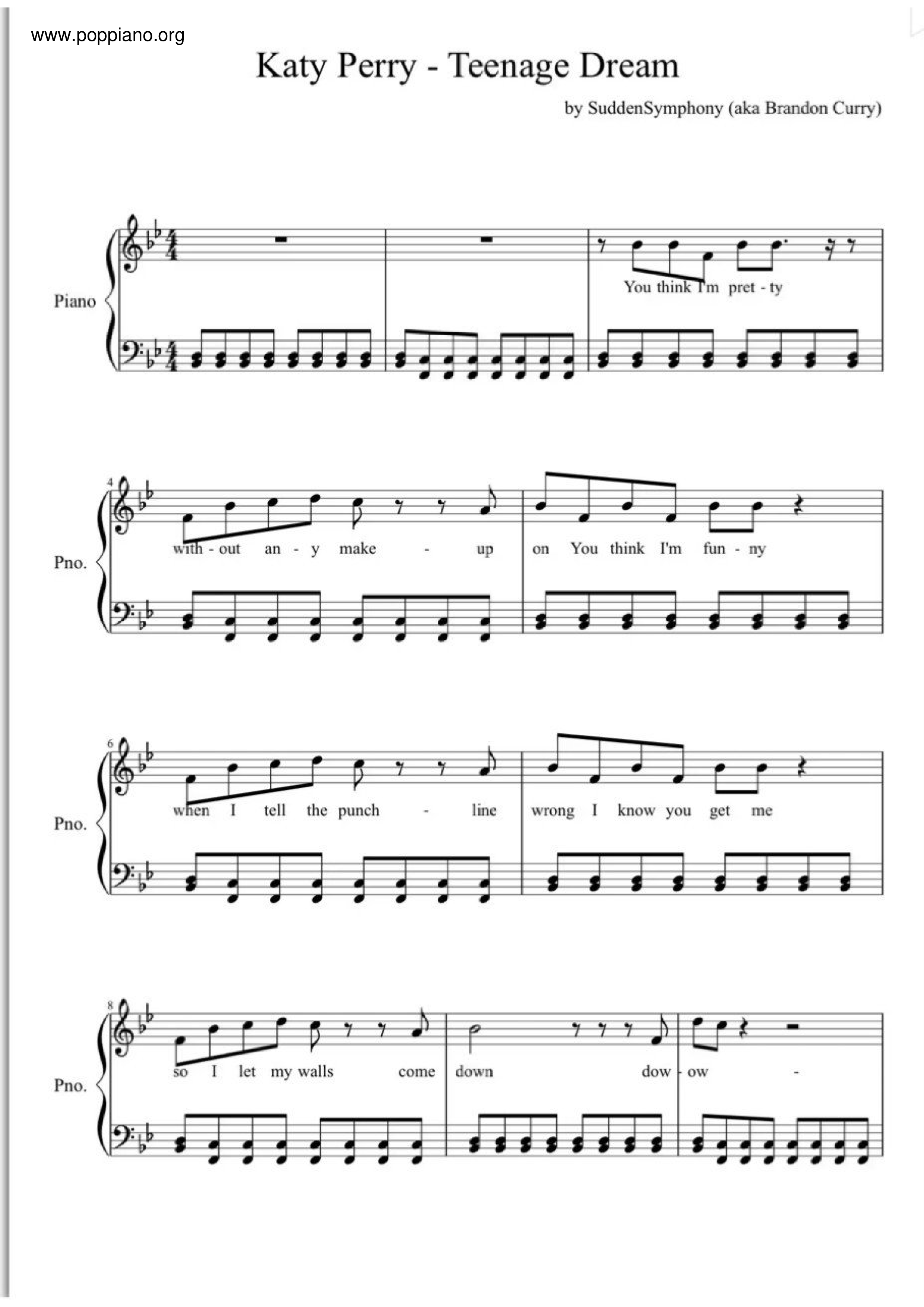
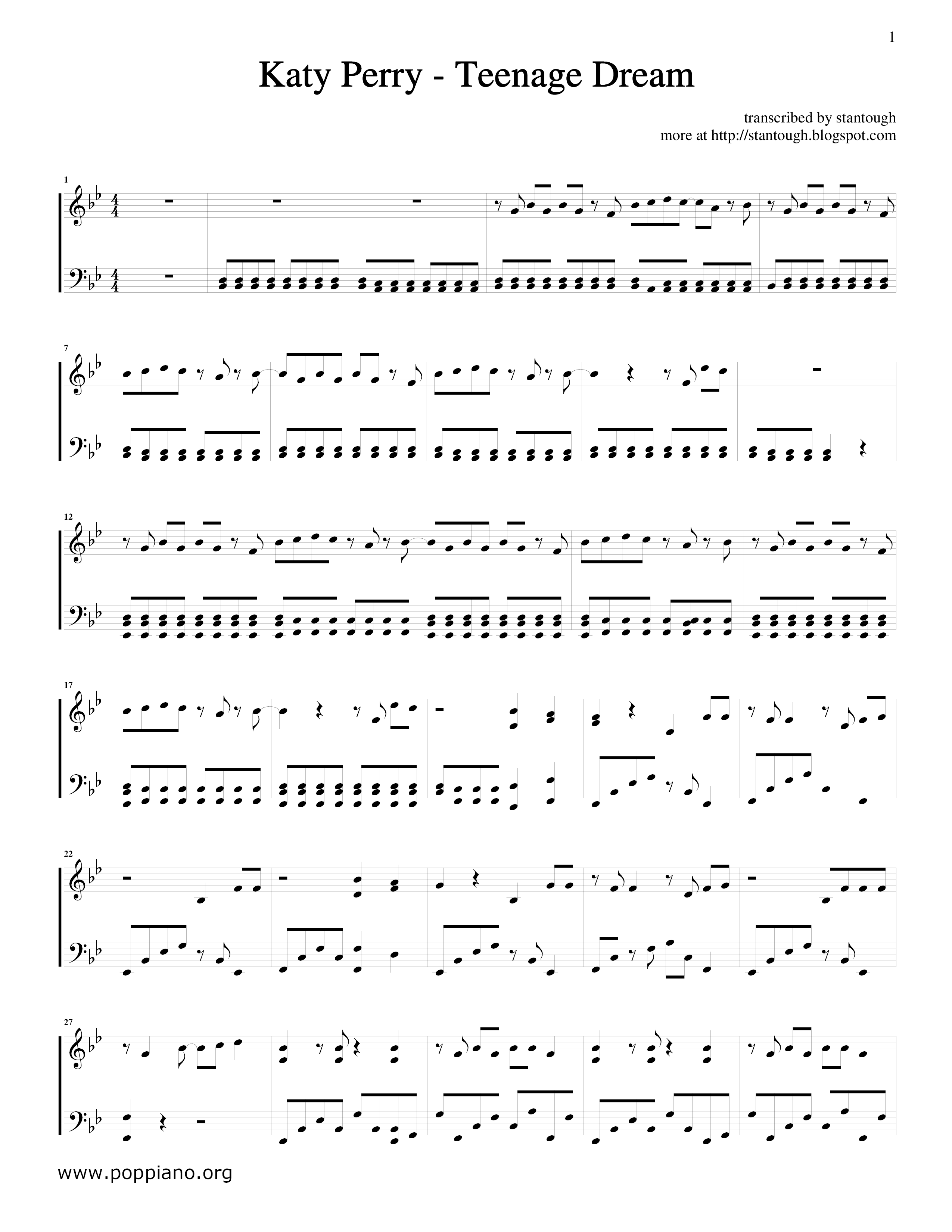
- Left-Hand Movement: Octave bass notes on root movements (B - C# - A# - D#). Avoid heavy low-end chords to keep the arrangement transparent.
- Right-Hand Voicings: Play mid-register open triads with extensions. Incorporate subtle synth-pad layers in the background to emulate the wide stereo image of the studio master produced by Dr. Luke and Max Martin.
Bass and Percussion
- Bassline: Focus on root-five note choices. In the chorus, use driving octave jumps on the 8th notes to propel the song forward.
- Drums: The standard pop arrangement relies heavily on a 4-on-the-floor kick drum pattern during the chorus. For acoustic or unplugged versions, replicate this drive using a cajón bass strike or a heel-down kick pedal.
Live Performance vs. Studio Recording Considerations
Executing a live performance of "Teenage Dream" demands a different focus than capturing a studio recording or releasing a digital video cover.
"Teenage Dream" Cover Execution Workflow:
- Live Performance
- Stage presence
- Key adaptation
- Direct audience engagement
- Studio Recording
- Doubled vocals
- Vocal pitch tuning
- Sync licensing (MLC/Distro)
Live Stage Execution
- Vocal Stamina: Do not push 100% of your chest voice strength in the first verse. Save your peak vocal output for Chorus 2, the Bridge crescendo, and the Final Chorus.
- Stage Presence: "Teenage Dream" is an emotionally expressive, nostalgic pop anthem. Maintain open body language, make direct eye contact with the audience, and reflect the song's themes of youth and excitement.
- Monitors: Ensure your vocal fold feedback in your in-ear or floor monitors has adequate mid-range frequency response so you do not push flat while reaching for high belts.
Recording and Releasing a Cover Version
If recording a studio cover to upload to streaming services or video platforms, observe key technical and legal steps:
- Vocal Production: Layer your chorus vocals. Recording a center lead vocal flanked by two hard-panned vocal doubles (left and right) instantly yields that classic, larger-than-life pop sound.
- Time and Pitch Correction: Use subtle transparent pitch correction (such as Celemony Melodyne or Antares Auto-Tune) to smooth micro-pitch variations while retaining human dynamic nuance.
- Mechanical Licensing: To distribute an audio recording of a cover song to platforms like Spotify or Apple Music, secure a mechanical cover license through your digital distributor or organizations like the Mechanical Licensing Collective (The MLC).
- Sync Licensing: If publishing a video cover on YouTube, standard mechanical licenses do not cover visual synchronization. Video platforms rely on system tools (like YouTube's Content ID) to identify the composition and route ad revenue to original publishers (such as Capitol Records and Sony/ATV Music Publishing).
Common Pitfalls to Avoid
When performing "Teenage Dream," avoid these typical mistakes:
- Resolving to the I Chord Early: Inserting a root tonic chord (like F# or G Major) at the end of the four-chord loop destroys the song's tension. Stick strictly to the IV - V - iii - vi loop.
- Over-singing the Verses: Straining too early in the verses leaves little room for dynamic contrast when the high-energy chorus hits.
- Ignoring the Tempo: Dragging the tempo below 116 BPM in a pop arrangement can make the repetitive chord loop feel tedious. Keep the tempo tight at 120 BPM.
- Neglecting Vocal Warm-Ups: Hitting repeated Eb5 notes in chest-mix without warming up upper resonance channels risks vocal fatigue or hoarseness.
Frequently Asked Questions
What is the original key and tempo of Katy Perry’s "Teenage Dream"?
"Teenage Dream" is originally in the key of F-sharp Major (G-flat Major) and has a tempo of 120 Beats Per Minute (BPM) in a standard 4/4 time signature.
What are the chords for an acoustic guitar cover of "Teenage Dream"?
For an easy acoustic guitar version, place a capo on the 4th fret and play the chords in the key of G Major: Cmaj7 – D – Bm7 – Em. This matches the pitch of the original recording while using common open-finger voicings.
How do I sing the high notes in the chorus without straining?
To hit the high chorus notes (up to Eb5) safely, utilize a balanced mix voice (blending chest resonance with head voice placement). Keep your chin level, maintain active diaphragm breathing, and avoid pushing excess chest voice air upward.
Do I need a license to upload a cover of "Teenage Dream" to YouTube?
Uploading a video cover to YouTube generally falls under YouTube's Content ID agreement with music publishers. While you typically do not need to purchase a sync license manually for standard YouTube uploads, the copyright owners may claim ownership of the audio to monetize or place ads on your video.
Can male singers perform "Teenage Dream" effectively?
Yes. Male vocalists usually transpose the song down to the key of C Major or D Major to sing in a comfortable tenor or baritone range, or perform it in the original key by shifting the octave down or using a controlled falsetto on the chorus lines.
Recommended Next Steps
To build a flawless cover of "Teenage Dream," follow this structured rehearsal schedule:
- Establish Your Key: Test the song in F# Major, G Major, and E Major using a piano or guitar. Select the key where your voice hits the chorus peaks with emotional power without straining.
- Isolate the Chord Loop: Practice the IVmaj7 – V – iiim7 – vi progression slowly with a metronome set to 120 BPM until the transitions are seamless.
- Map Your Vocal Dynamics: Record a rough draft of your vocal performance. Focus on keeping Verse 1 intimate, building the Pre-Chorus, and opening up your mix voice fully for Chorus 1 and Chorus 2.
- Finalize Your Arrangement: Polish your arrangement—whether an acoustic performance, full pop band setup, or ambient piano rendition—and review copyright/licensing rules before public release.
Image Gallery