Understanding the Role of AWS Cloud Security Services
AWS cloud security services provide a multi-layered defense mechanism designed to protect data, identities, and infrastructure within the cloud environment. By leveraging automation, encryption, and continuous monitoring, these service...
AWS cloud security services provide a multi-layered defense mechanism designed to protect data, identities, and infrastructure within the cloud environment. By leveraging automation, encryption, and continuous monitoring, these services enable organizations to meet stringent compliance requirements while maintaining high availability and operational resilience under the AWS Shared Responsibility Model in 2026.
Contents
As organizations continue their transition toward cloud-native architectures, the complexity of managing security across distributed environments has grown. Amazon Web Services (AWS) addresses this by offering a suite of specialized tools that manage everything from identity and access to threat detection and data encryption. Understanding these services is no longer just the domain of security engineers; it is a foundational requirement for any enterprise operating in the modern digital economy.
The Foundation: The AWS Shared Responsibility Model
To understand the role of AWS cloud security services, one must first grasp the Shared Responsibility Model. This framework clarifies the division of labor between AWS and the customer. AWS is responsible for the "Security of the Cloud"—the global infrastructure, including hardware, software, networking, and facilities that run AWS services. The customer is responsible for "Security in the Cloud."
In 2026, this model has evolved alongside the rise of serverless computing and managed AI services. While customers still control their data, the configuration of security services like AWS Identity and Access Management (IAM) and Amazon GuardDuty remains their primary duty. Failing to configure these tools correctly is the leading cause of cloud data breaches. The security services provided by AWS act as the toolkit customers use to fulfill their side of this responsibility.
Identity and Access Management (IAM): The Modern Perimeter
In a cloud environment, the traditional network perimeter has been replaced by identity. AWS Identity and Access Management (IAM) is the central service that controls who can access which resources and under what conditions.
IAM allows administrators to create and manage AWS users and groups, using permissions to allow or deny access to AWS resources. By 2026, the industry has shifted heavily toward AWS IAM Identity Center, which facilitates workforce identities and single sign-on (SSO) capabilities across multiple AWS accounts and third-party applications.
The Principle of Least Privilege
The primary role of IAM is to enforce the Principle of Least Privilege (PoLP). This ensures that a user or service has only the minimum permissions necessary to perform its task. AWS provides tools like the IAM Access Analyzer, which uses formal reasoning to identify unintended public or cross-account access. Utilizing these automated analyzers is critical for preventing "permission creep," where users accumulate excessive access over time.
Infrastructure Protection and Edge Security
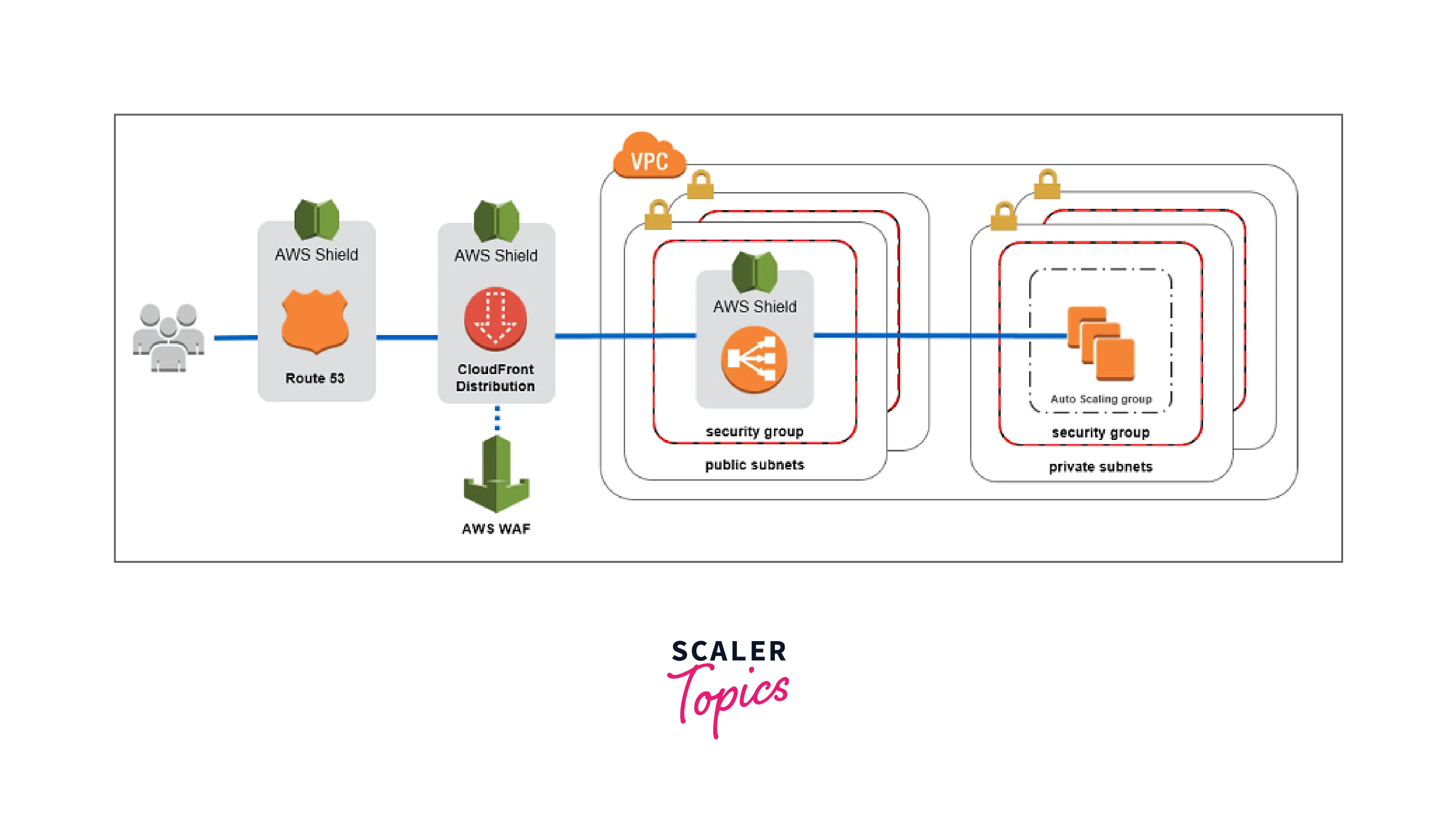
Protecting the underlying network and servers is the next layer of defense. This involves several services that shield applications from external threats, such as Distributed Denial of Service (DDoS) attacks and malicious web traffic.
AWS WAF and AWS Shield
AWS WAF (Web Application Firewall) protects web applications from common web exploits that could affect availability, compromise security, or consume excessive resources. It allows you to create custom rules that block common attack patterns, such as SQL injection or cross-site scripting (XSS).
Complementing this is AWS Shield, a managed DDoS protection service. All AWS customers benefit from the standard protection of AWS Shield at no additional charge, which defends against the most common network and transport layer attacks. For higher levels of protection, AWS Shield Advanced provides additional detection and mitigation against large-scale and sophisticated DDoS attacks, integrated with the AWS Shield Response Team (SRT).
Amazon VPC and Security Groups
At the network level, Amazon Virtual Private Cloud (VPC) allows you to provision a logically isolated section of the AWS Cloud. Within the VPC, Security Groups act as virtual firewalls for your instances to control inbound and outbound traffic. Unlike traditional firewalls, security groups are stateful; if you send a request from your instance, the response traffic for that request is allowed to flow in regardless of inbound security group rules.
Data Protection and Encryption Services
Data is an organization's most valuable asset. AWS provides several services to ensure data remains confidential and integral, both at rest and in transit.
AWS Key Management Service (KMS)
AWS KMS is the backbone of data encryption across the AWS ecosystem. It allows you to create and manage cryptographic keys and control their use across a wide range of AWS services and applications. In 2026, KMS remains highly integrated, allowing for seamless encryption of S3 buckets, EBS volumes, and RDS databases. It uses Hardware Security Modules (HSMs) validated under FIPS 140-2 to protect the secrecy of your keys.
Amazon Macie
For organizations dealing with massive datasets, identifying sensitive information is a challenge. Amazon Macie is a fully managed data security and data privacy service that uses machine learning and pattern matching to discover and protect sensitive data in AWS. Macie automatically scans S3 buckets for personally identifiable information (PII) or intellectual property, providing alerts if this data is found in unencrypted or publicly accessible locations.
Threat Detection and Continuous Monitoring
Security is not a static state but a continuous process. AWS provides automated services that constantly monitor the environment for anomalies and potential threats.
Amazon GuardDuty
Amazon GuardDuty is a threat detection service that continuously monitors for malicious activity and unauthorized behavior. It uses machine learning, anomaly detection, and integrated threat intelligence to identify threats such as crypto-mining, communication with known malicious IP addresses, or unusual API calls. Because it is a managed service, GuardDuty does not require you to deploy or maintain security software or infrastructure.
AWS Security Hub
As organizations enable multiple security services, managing the resulting alerts can lead to "alert fatigue." AWS Security Hub solves this by providing a comprehensive view of your security state. It aggregates, organizes, and prioritizes security alerts (findings) from multiple AWS services, such as GuardDuty, Inspector, and Macie, as well as from AWS Partner solutions.
In 2026, Security Hub is the primary dashboard for security operations centers (SOCs), offering automated compliance checks against industry standards like CIS AWS Foundations and PCI DSS. Detailed documentation on these integrations can be found at the AWS Security Hub User Guide.
Governance, Risk, and Compliance (GRC)
For many industries, cloud security is also a matter of regulatory compliance. AWS offers services to automate the auditing and reporting process.
- AWS Config: This service provides a detailed inventory of your AWS resources and their configurations. It allows you to automate the evaluation of recorded configurations against desired settings. If a resource deviates from the "known good" state, AWS Config can trigger automated remediation via AWS Lambda.
- AWS CloudTrail: This is the "black box" recorder for your AWS account. It records every API call made in your environment, providing a history of events that is essential for security analysis, resource change tracking, and compliance auditing.
- AWS Audit Manager: This tool helps you continuously audit your AWS usage to simplify how you manage risk and compliance with regulations and industry standards. It automates the evidence-collection process, making it significantly easier to prepare for audits.
Comparison of Key AWS Security Services
| Service Name | Primary Function | Primary Benefit | 2026 Strategic Use Case |
|---|---|---|---|
| AWS IAM | Identity Management | Secure access control | Zero Trust architecture implementation |
| AWS KMS | Key Management | Centralized encryption control | Regulatory compliance and data privacy |
| Amazon GuardDuty | Threat Detection | Automated anomaly sensing | Identifying compromised credentials/nodes |
| AWS WAF | Web Security | Application-layer protection | Blocking botnets and automated attacks |
| AWS Security Hub | Security Orchestration | Centralized visibility | Single-pane-of-glass for SOC teams |
| AWS Config | Compliance Monitoring | Resource tracking | Continuous configuration auditing |
| Amazon Macie | Data Privacy | PII discovery | GDPR/CCPA automated data discovery |
Common Security Misconfigurations to Avoid
Despite the robustness of AWS security services, human error remains a significant risk factor. Organizations often struggle with:
- Overly Permissive S3 Buckets: Leaving S3 buckets public is a classic error. Using S3 Block Public Access at the account level is the recommended mitigation.
- Root Account Usage: Using the AWS "root" user for daily tasks is a critical security risk. The root account should be protected by MFA and used only for a very limited set of account and billing management tasks.
- Lack of Logging: Failing to enable AWS CloudTrail in all regions prevents forensic analysis after a security incident.
- Hardcoded Credentials: Storing AWS access keys in source code. Organizations should use AWS Secrets Manager or IAM Roles for EC2/Lambda to manage credentials securely.
Frequently Asked Questions
Does AWS provide protection against DDoS attacks?
Yes. Every AWS customer is automatically protected by AWS Shield Standard at no extra cost. This service provides always-on detection and automatic inline mitigations that minimize application downtime and latency. For more advanced protection, organizations can subscribe to AWS Shield Advanced, which offers higher levels of protection against sophisticated attacks and 24/7 access to the AWS Shield Response Team.
How does AWS KMS differ from CloudHSM?
AWS KMS is a multi-tenant, managed service that is highly integrated with other AWS services. It is generally the right choice for most encryption needs. AWS CloudHSM provides dedicated hardware security modules within your VPC, giving you exclusive control over the hardware. CloudHSM is typically used by organizations with specific regulatory requirements that mandate single-tenant hardware or the use of specific cryptographic APIs not supported by KMS.
Can AWS security services help with GDPR compliance?
AWS security services such as Amazon Macie (for PII discovery), AWS KMS (for encryption), and AWS CloudTrail (for auditing) are essential tools for building a GDPR-compliant environment. However, compliance is a shared responsibility; while AWS provides the tools, the customer must implement the appropriate policies and procedures to meet legal requirements.
What is the difference between a Security Group and a Network ACL?
A Security Group operates at the instance level and is "stateful," meaning it remembers the state of connections. A Network ACL (NACL) operates at the subnet level and is "stateless," requiring both inbound and outbound rules to be explicitly defined. Generally, security groups are your first line of defense for controlling traffic to specific resources, while NACLs provide an additional layer of network-wide security.
How do I monitor my AWS environment for suspicious login attempts?
The most effective way is to use Amazon GuardDuty in combination with AWS CloudTrail. GuardDuty analyzes CloudTrail management events to identify unusual login patterns, such as logins from unexpected locations or successful logins after multiple failed attempts. You can also configure Amazon CloudWatch Alarms to notify you of specific API patterns.
Final Recommendations for AWS Security
To effectively utilize AWS cloud security services in 2026, organizations should prioritize a "Security by Design" approach. Start by enabling AWS Security Hub and Amazon GuardDuty across all regions and accounts to gain immediate visibility into your security posture. Implement a strong identity foundation using IAM Identity Center and enforce Multi-Factor Authentication (MFA) for every user.
Finally, automate your defenses. Use AWS Config to automatically revert unauthorized changes and leverage AWS Secrets Manager to rotate credentials frequently. Security in the cloud is not about building a single wall, but about creating a resilient, automated ecosystem that can adapt to threats in real-time. For more detailed architectural guidance, refer to the AWS Well-Architected Framework - Security Pillar.
Image Gallery